Cookies

Friday, January 06, 2012

Marilyn by Request: Marilyn Maye at the Metropolitan Room


If you have never seen Marilyn Maye, really, what are you waiting for? She's an amazing jazz singer, a brilliant interpreter, and funny to boot. She's a delight to spend an evening with. She's a classic. Timeless. The real thing.

In her most recent show, at the Metropolitan Room, Maye combined her  thematic medleys and standards with requests from the audience. The result was a pot pourri of different forms of bliss. Consider this partial set list: Celebrate Good Times, Hey Old Friend, Too Good to Be True, Start of Something Big, I Love You Today, Too Late Now, I Don't Want to Know, Pennies From Heaven, It Might as Well Be Spring, If I Were a Bell, Bye Bye Country Boy, Take Five, and the Best of Time Is Now. Her wonderful, youthful (she's in her 80s!), throaty voice, her sense of emotional complexity and joy, and her seductive personality made each and every song a winner. Her backup band, led by Billy Stritch (who sang with her on a handful of numbers) provided smart, elegant accompaniment with the wonderful Tom Hubbard on bass and Ray Marchica on drums..

I wish there were a way to truly describe the experience of seeing Maye, but what can be stranger than trying to explain how someone sings, how they express emotion, how they make magic happen? It's kind of impossible.

But I can describe the audience's reactions: Hugh grins. Cheers. Bravas. Ecstasy.

Really, truly, you have to see Marilyn Maye.


(For Maye's schedule of upcoming dates, click here. For the Metropolitan Room's calendar, click here.)


(press ticket, audience left)

Thursday, January 05, 2012

How the World Began


Heidi Schreck and Adam LeFevre
Photo: Carol Rosegg

After her life in New York falls apart, Susan Pierce (Heidi Schreck) ends up in Plainview, KS, teaching science to high schoolers whose town was recently decimated by a tornado. Susan has a tendency to say whatever pops into her head, no matter how inappropriate. She makes jokes to her student Micah Staab (Justin Kruger) about a herd of cows that were killed in the tornado. But the Christian Micah is more put off that she said, in class, "The leap from non-life to life is the greatest gap in scientific theories of the Earth's early history, unless, of course, you believe in all that other gobbledy gook." (At least that's what he claims she said. We do not see the scene.) In fact, he is highly offended and wants Susan to apologize. After Susan refuses to do so, Micah's unofficial guardian, Gene Dinkel (Adam Lefevre)--a Christian who believes in evolution and sees natural selection as "God's hand" at work--also tries to get her to apologize.

This is the basic story of How the World Began, Catherine Trieschmann's new play, currently being presented by the excellent Women's Project at Playwright's Horizon. It goes on to examine belief versus nonbelief, relationships, grief and loss, and standing by one's principles. Parts of it are fascinating; the characters are three-dimensional and occasionally surprising in convincing ways.  Rather than being a pseudo-screenplay like many contemporary plays, How the World Began unfolds in the sort of long, thoughtful scenes that theatre does best of all the art forms.

There's so much I liked about this play that I'm sad about my reservations, but here they are:

[possible spoilers below]

The most important one is that the character of Susan is whiny and dishonest. Since she represents my point of view, I wanted very much to like her, but she won't take responsibility for what she said--in fact, she denies having said it--and then won't take responsibility for what it means. She even claims that she didn't mean religion when she said "all that other gobbledy gook," although clearly she did. I didn't want Susan to be perfect or Joan of Arc. I understood that she feared for her job. But her dishonesty cast a pall over her actions and beliefs. (I suppose it's possible that she genuinely forgot what she said, but that seems highly unlikely.)

Another problem I had was with the structure of the play. Micah's true motivation is not revealed til toward the end of the play. However, the delay felt too much like a plot device. There was no character-driven reason for him not to have explained his thinking earlier.

Susan's interactions with Gene--which I actually found more interesting that her interactions with Micah--are never resolved. She says something horrible to him, and we never see him again.


Some of the humor struck me as easy laughs for the knowing, evolution-savvy theatregoer. (Though on a whole I found Trieschmann to be respectful of the two Christian characters--perhaps more respectful than she was of Susan.) And some moments were heavy-handed. For example, right at the beginning Susan is freaked out by the smell of manure (oh, she's not in New York anymore!).  Even the name of the town--Plainview--is a little too on the nose.

And I wish all playwrights would stop having scenes where the characters are waiting for someone we know will never come because we know how many people are in the cast (exception: Beckett). It just comes across as fake.

[no more spoilers]

The show is well-directed (by Daniella Topol) and largely well-acted. I had some trouble with Schreck as Susan, but I came to think that my problem was actually with the character. Adam Lefevre gives great depth and warmth to Gene, and Justin Kruger wears Micah's emotions on his sleeve.

I recommend How the World Began to people interested in the topic. But I can't help but think that there's a better play in there.

(press ticket; 4th row center)

Friday, December 30, 2011

Wendy's Top Ten of 2011


2011 continued my personal trend of seeing many more Off-Off-Broadway shows and considerably fewer Broadway Shows, with Off-Broadway holding steady. In fact, of over 70 shows, only eight were on Broadway. And this year, it's not just the insanely high price of tickets keeping me away--it's also the lackluster offerings. Perhaps my life will be forever diminished because I never saw Bonnie and Clyde or Mountaintop or the latest Anything Goes, but I'm willing to risk that, particularly because Off-Off- and Off-Broadway boast such high-quality offerings.

Here, then, in alphabetical order, is my top ten list, with links to the reviews:

Chris Wight, Lori E. Parquet, and Liz Douglas in Dog Act
(Photo: Isaiah Tanenbaum)
    Daniel Morgan Shelley and David King in
    The Man Who Ate Michael Rockefeller
    (Photo: Lia Chang)

Thursday, December 22, 2011

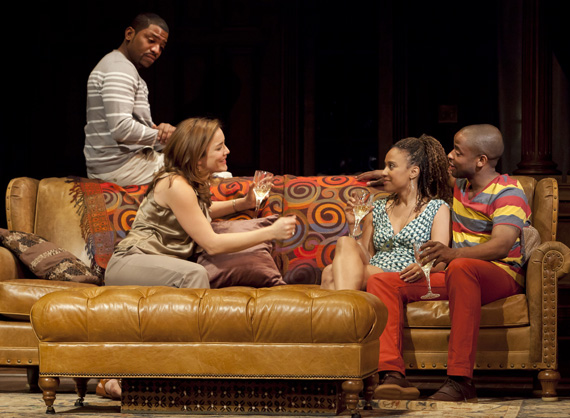
Stick Fly

Photo: Richard Termine

Stick Fly, which is currently running at the Cort Theater on Broadway after bouncing around the country, has been described as an old-fashioned, domestic melodrama, and in some respects, that description fits the show just fine: The multigenerational members of a highly intellectual, accomplished, affluent family meet at their Cape Cod summer home for a weekend of rest, relaxation, and bonding over food, drink, and board games. Yet questions arise almost immediately, and the audience knows that they'll all be solved by the final curtain: How do the elder brother and the fiancée of the younger brother know one another? Where is the family matriarch, who was expected to show up with her husband, but hasn't? What does the aging maid--who is terminally ill, but so tied to this family that she has sent her teenage daughter to cover for her--want her daughter to talk to the family patriarch about? Why is said patriarch being so evasive, and so snippy? The audience--most of whom, unless they are watching the show from the rock they've been raised under, can see what's coming from miles away--nevertheless thrills to the ways in which such revelations occur. This is, in short, the stuff of classic domestic drama: heavy-handed and over-the-top sometimes, sure, but lots of dishy, dirty fun nonetheless.

Were it just a melodrama, Stick Fly would have been enough for me: the show was engaging, the characters were likeable for their flaws, and the story-line certainly held my attention, even though I, having not been raised under said rock, figured out the trajectory pretty quickly. But there's so much to this play that it defies traditional labels, and thus to simply call it a domestic melodrama is not fair, or accurate, in the end.

So here's the jist of Stick Fly, in a nutshell (ok, fine, larger than a nutshell; perhaps smaller, though, than a breadbox):
For all its accomplishments, brilliance, and wealth, the members of the LeVay family can't brush the chips from their shoulders. No one quite knows who they are in this play, and no one feels totally comfortable in their own skins, their own settings, their own homes. Joe LeVay, the patriarch (Ruben Santiago-Hudson), is a successful neurosurgeon who can't stop driving his two grown sons to succeed (but on his terms--not theirs), and can't shake the feeling that he is less of a man because he married into so much of his money. Harold "Flip" LeVay, the elder son (Mekhi Phifer), is a skirt-chasing plastic surgeon who's just a little too smooth with the many women he beds but can't, for the life of him, commit to. Kent "Spoon" LeVay (Dulé Hill), the far more sensitive little brother, is seriously overeducated, but for all his advanced degrees, can't settle on a career he feels comfortable with, let alone one that will please his exacting dad. The fact that both brothers have invited women to join them for a weekend that features a mysteriously absent matriarch and the gloomy presence of Cheryl (Condola Rashad), the daughter of the family's long-time maid, only complicates an already fraught family dynamic. You can escape the city for the fresh air of the Cape, sure, but you sure as hell can't escape your family when you go on vacation with them.

The two women, like their men, don't feel like they belong anywhere, and especially not at the LeVay summer home. Spoon's fianc
ée, Taylor (Tracie Thoms), seems, at least on the surface, to be a more comfortable fit for the LeVay family: an extraordinarily intelligent, almost ludicrously well-educated black woman, she is the daughter of a famous (deceased) professor of sociology. Yet her dad, who left her mother when she was young, never fully acknowledged her, and certainly didn't help her financially, which has left her positively trigger-happy with anger, defensiveness, and self-described exhaustion at feelings of alienation, abandonment, and of never "having a space that's all mine." Flip's newest girlfriend, Kimber (Rosie Benton), seems, again at least on the surface, comparatively more comfortable with herself, with material wealth, and with the privileges she's enjoyed and taken for granted through her life. But it doesn't escape her for a moment that, as a white woman who has fallen in love with a black man, she represents an awful lot of cultural baggage, and that she is not necessarily as welcome in the LeVay home as she is stiffly, and usually but not always pleasantly, tolerated.

The fact that the LeVay family is black adds a dimension right away, sure. Seriously, how many plays out there are about affluent, educated, cohesive black families? And then, how many of them are written (by Lydia R. Diamond), directed (by Kenny Leon), and produced (by Alicia Keyes) by black professionals, and how many of those run on the Great White Way to audiences that are, at least the day I saw Stick Fly, easily 65- to 70% black? Broadway, which remains stubbornly segregated at best, and lily white at worst, despite enormous, if maddeningly recent, strides, needs lots and lots more shows like this (and lots and lots more audiences like the one I watched the show with yesterday), but really, that's not Stick Fly's problem--it's ours. Thus: this is really not so much a show about race per se as it is about assumptions about race, and then, not so much assumptions about race as assumptions about class and gender.

The gender angle is not quite as pronounced as the class angle; while this is much a show by and about women, it wears its gender politics gracefully and intelligently. It should be noted that some of the best performances take place in some of the best scenes, which tend to be segregated along gender lines. A scene where the three women in the cast gather in the kitchen late at night for a drunken bitch-session is just wonderful, as is a revelatory scene between Hill and Phifer. Hill has been criticized for being a bit stiff in his role, but this particular scene is so effective and layered that it more than compensates for some of the clunkier, more expository stuff Hill has to work with earlier in the show. The cast, in general, is strong to excellent, but these scenes will stay with me the longest.

And while the class angle is hit the hardest throughout the show, there are quiet moments that speak loudest because they are so well-acted. A scene near the end of the show during which Rashad slowly, deliberately, self-consciously takes a seat at the kitchen table--which she has been manically setting, clearing, and cleaning for most of the show--is particularly profound.

So...race, gender, and class can't really, truly be separated in any realistic way, can they? And what do we mean by these terms? And in talking and talking and talking about them, as these characters do, what is helping, and what is hurting, and what is digging us all merely more deeply into our own, angry, hurt, defensive "post-racial" little corners? Diamond's characters--like many educated, affluent people I know--practically contort themselves to avoid offending one another along race, gender, or class lines. But the way they all, in avoiding certain assumptions, so easily and unconsciously step right into others is where the play gathers steam and force, and its most biting commentary; Diamond's refusal to let any of her characters off the hook, while at the same time refusing to punish them for being, in the end, human beings, makes Stick Fly downright powerful.

Stick Fly defies melodramatic trappings right up to the end: it concludes not by tying up all the loose ends and resolving all the family baggage by the time Sunday rolls around. Because, face it, I'll bet money that that's never going to happen in your family--it certainly won't happen anytime soon in mine. But the ending is hopeful, caused me to shed a couple of genuine, if totally unexpected tears, and left me with real affection for these flawed characters, all of whom deserve to find themselves and to find happiness, and thus to come to terms with whatever skin-tone, class status, and sex designation they've been handed in the process.

Saturday, December 17, 2011

Follies


Is it too much to say that Stephen Sondheim is our Shakespeare? I don't think so. His range of topics is epic; he's endlessly surprising; his work is deep and textured enough for dozens of interpretations; he's raised his art form to previously unimagined levels; directors sometimes go overboard conceptually when doing his shows; and performing his work is extremely challenging and even more rewarding. And comparing Richard Burton's Hamlet to Kevin Kline's to Laurence Olivier's is fascinating, so is comparing Dorothy Collins' Sally to Judith Ivy's to Victoria Clark's to Bernadette Peter's.

Don Correia, Susan Watson, Jayne Houdyshell, Mary Beth Peil.
Photo: Joan Marcus.
Of all of Sondheim's shows, Follies may offer the most opportunities for dissection and comparisons and disagreements. Last week I was in a Pain Quotidien and heard a young woman reciting lines from "In Buddy's Eyes" and then debating their meaning with her companions. (I agreed with her that Sally never did really love Buddy.) There are a lot of popular musicals, but there are few that people debate in this way. And most of them are by Sondheim.

Different productions of Follies add to the debates by using different versions of James Goldman's ever-problematic book. Seeing a variety of productions can be an education in the significance of a single line or two: it matters whether or not Sally has a suicide attempt in her past.

The version of Follies currently on Broadway is, unfortunately, the least impressive one I've seen (others: Papermill, Roundabout, Signature in Virginia, St. Bart's, Encores!).

Here's why:
  • The ballroom dancers Vincent and Vanessa have been cut from the show. When Old Vincent grasps Vanessa's waist as a pale imitation of the glorious lift that Young Vincent is carrying out behind him, when Old Vincent and Vanessa are a sweet old couple while Young Vincent and Vanessa are strapping and gorgeous and graceful and sexy, the whole of Follies is summed up in a glorious, heartbreaking microcosm.
  • The use of the ghosts is heavy-handed and not choreographed for maximum effect. For example, this Follies loses the wonderful coup de theatre during "Mirror, Mirror," when the young versions of the women appear en masse. Instead, they sort of trickle in. 
  • Also, the older women dance a little too well and the young women not spectacularly enough for the contrast to be as hard-hitting as it can be. (Also, why was there no young Stella on the other night? Perhaps the usual actress was out sick, but no understudy? Please.)
  • "Mirror, Mirror" lacks the poignancy it should have. Part of this is because Terri White is a disappointment. She loses her laughs with awkward timing, and she’s too smug in her singing.
  • The young versions of the characters are a too aware of the old versions. They are memories, ethereal. They shouldn't pull focus, except at very specific times.
  • In "Too Many Mornings," the switch from Old-Ben-Old-Sally to Old-Ben-Young-Sally is clunky. In one of the versions I saw (I believe it was Papermill), as Ben sings he seems to be reaching out to Sally but he is actually reaching out to Young Sally in back of her. It was a striking moment, as Ben's lies and self-delusions were made palpable.
  • Jan Maxwell voluntarily limits Phyllis's range. Yes, Phyllis is enraged, but she is also yearning, wistful, confused, and even the tiniest bit hopeful.
  • Ron Raines involuntarily limits Ben's range--he just doesn't have the chops to catch the full depth of Ben's anguish and regrets. 
  • Bernadette Peters is in over her head. I know people love her. I love her. I have articles I saved about her from 1969. But there is more to Sally than crying. And crying. And crying. And whipping her head around occasionally. And crying.
  • The transition into the Follies segment is unexciting.
  • Since the interpretations of three of the four leads are shallow, and since the use of the ghosts is a little clunky, Follies loses its inexorable build.
Are there good things in this Follies? Yes.
  • It's Follies. The music is gorgeous. The overture/entrance music is pure heaven. (If someone put a gun to my head and said that I had to pick my one favorite Sondheim melody--an impossibility, really--it might be "All Things Bright and Beautiful.")
  • During that opening music, two chorus-girl ghosts come out together, dancing to a tune only they can hear. The contrast between their period kicks and twirls and the show’s present-day look touches the sort of emotion the show is mostly lacking.
  • Natasca Katz’s lighting and Gregg Barnes’ costumes combine perfectly to delineate the scenes from the past with a washed-out, ghostly look.
  • Mary Beth Peil is a wonderful Solange, sexy, funny, self-aware. And you can understand every word of "Ah, Paree." (When Solange mentioned that she is 69, I thought, “It must be weird for Peil to have to say that she’s 69 when she’s so much younger.” My bad. Peil is 71—and rocking!)
  • Jayne Houdyshell makes “Broadway Baby” her own. The entire world has sung it before her, yet she makes it her own! It’s a simple, heartfelt interpretation. She’s lonely with just that bed and that chair. But she’ll survive it. She’s a Broadway Baby!
  • Danny Burstein is a convincing Buddy. Of the four leads, Buddy is the most “regular guy” and he would just like a “regular guy’s” life. Burstein gets that poignancy, and he does well by “Buddy’s Blues.”
  • Jonathan Tunick’s orchestrations are exquisite, as always, though the orchestra should have been even larger, as always.
General thoughts on the book:
  • The book has a leaning toward cheap jokes, such as Sally naming her kids Tom and Tim.
  • It drives me crazy that Sally is the character who forgets the name of the place where they went dancing 30 years earlier—she’s the one who would remember!
  • The exposition is amazingly clunky. “It’s 1971 and though the years have changed me, yes, I am Dmitri Weisman.” (Paraphrased.) That’s just one example.
  • I find it odd that Carlotta talks about how strangers tell her their life stories “not just the bad stuff” and soon after Buddy talks about how he remembers the whole past, “not just the bad stuff.” (Again, paraphrases.) Since Goldman uses this concept twice, I’ve got to think he believes that most people focus on the “bad stuff.” Interesting.
I am glad that Follies is on Broadway. I am glad that people are going to it and enjoying it. But, damn, I wish it were a better production.

(Row L, audience right, tdf ticket.)

Barbara Cook at Feinstein's


Reviewing Barbara Cook is as easy as one, two, three.
1. Barbara Cook is an incomparable interpreter of the American Songbook.
2. Barbara Cook lives her songs as freshly and honestly the hundreth time she sings them as the first.
3. Barbara Cook is a charming raconteur.

Okay, I guess maybe one, two, three isn't enough. Maybe ten?
4. Barbara Cook is a master at wielding a mike so that it doesn't block her face and the sound is always just right.
5. Barbara Cook is also a master at working a room, embracing people in the furthest nooks and crannies.
6. Barbara Cook is a generous, giving brilliant master classes and nurturing the next generation--and the next and the next.
7. Barbara Cook is open to all sorts of music, from discovering a song on Cathouse: The Series to admiring Lady Gaga's intelligence and voice.
8. Barbara Cook is a master class in aging gracefully.
9. Barbara Cook is funny.
10. Barbara Cook is cool.

Mind you, I know that Cook is not everyone's cup of tea. In fact, I'm not a huge fan of her CDs. But there's something amazing about seeing her in person in a small room: you realize that you are in the presence of greatness--human, confident, self-deprecating greatness.

Cook is currently appearing at Feinstein's with Michael Feinstein (she'll be back solo in April). The night I saw her, Feinstein wasn't there. The first half of the show was similar to the last show she did at Feinstein’s, but with new patter (including a lovely tale of winning the Kennedy Center Honors) and one or two new songs. Highlights included a sensitive "I Got Lost in His Arms," a yearning "I've Grown Accustomed to His Face," and a light and lovely "This Can't Be Love."

And then she announced that she had a surprise for us, and a wonderful surprise indeed: Euan Morton was there to sing a few songs--some solo, some with her. She extolled his rare and amazing natural voice, and Morton is indeed impressively talented. His version of "What'll I Do" (one of my all-time favorite songs) was one of the best I've ever heard. He also sang "Danny Boy" and Leonard Cohen's "Hallelujah" (wonderful!). His mike handling was some of the best I've seen among under-50 singers; I wonder if Cook gave him some pointers.

Then Cook sang some more solos. The highlight was Molinary and Butler's "Here's to Life," which could be Cook's theme song. She lives that song when she sings it and even when she doesn't.

The show ended with Cook and Morton singing "White Christmas" and then with the whole room joining them. I spend much of December muttering angrily about having Christmas Carols shoved down my throat, but this was pure joy.
If you have never seen Cook, try to do so. She’s really something. 

(Press ticket, very nice seats.)

Friday, December 16, 2011

SNOW WHITE


Gracie White as Snow White, Ashley Handel, and Laura Careless as the Evil Queen

Photo: Steven Schreiber

With two big-budget Snow White films coming out in 2012, the porcelain-faced ingénue seems poised to become the queen of the fairytale princess set. Yet, it seems unfathomable that either of Hollywood’s versions could surpass the sweetness and magic of watching Company XIV’s current revival of their 2009 production of Snow White. The spare set (designed by Zane Pihlstrom) insinuates the familiar setting: a forest (a gilded tree where the branches suspend from wires never fully attaching to the trunk) and a castle (marked by twin crystal chandeliers). But this telling of the story offers no singing dwarves. Instead, Snow White (Gracie White) lives in a world where she’s part circus performer and the Evil Queen (Laura Careless) morphs into a dancer, equally able in ballet, Russian Folk, or ballroom.

Conceived, directed and choreographed by the company founder Austin McCormick, a 2006 Juilliard graduate, with new text by Jeff Takacs (who moonlights as the MC/Narrator and Huntsman), the show combines a collection of genres, including Cirque du Soleil like acts, with dance, video, and a song catalog containing everything from Ella Fitzgerald to Vivaldi to The Rolling Stones. Yet, the myriad of styles never overwhelms; each segment eases into another. Our heroine, Snow White, more naïf here than fool, impresses with her athleticism and the ease that she rests in the circle of her protective tree even as she gullibly accepts the Evil Queen’s disguises despite multiple assignation attempts. As in the Grimm telling of the tale, Snow White’s stepmother anoints the girl as the provocateur of her distress after the magic mirror declares the child rather than herself as “fairest in the land.” The Evil Queen asks a huntsman to kill the beautiful princess and, like the familiar story, he cannot. A terrified Snow White runs through the woods—as snowflakes fall, long white ribbons release from the ceiling and Sam Hilbelink, a performer from Circus Juventas (the show features several members, including Snow White and the Prince) wrestles, twists and spins in its lengths as he embodies the storm. Snow White joins him briefly as she’s caught up in the tempest, finally sliding down the cloth’s widths onto the ground.

Here, the narrative deviates from the one we all know, and Snow White becomes a forest nymph, sitting cross-legged in a suspended circle that serves as an extension of the tree. The Evil Queen discovers the Huntsman’s double-crossing and sets off to do her own dirty work. Three times she tempts Snow White with items that could potentially kill her; each sequence feels like a ride on Disneyland’s “It’s A Small World,” with nationality specific inspired-production numbers, including one where the Evil Queen and her henchmen visit as part of a Parisian Clothier cart, clad like can-can dancers in a Baz Luhrmann film.

The costumes (Olivera Gajic), while visually stimulating with their emphasis on red, black, and white, lean toward the dominatrix side and mix black leather bustiers with high heels—for both the women and the men. In a rare dissolution of the fourth wall, costume racks sit in view of the audience, just behind the seating—and one can occasionally see actors seeking their next outfit. This adds an unexpected intimacy to the production and when Snow White skips guilelessly across the facility to reach her perch at the end of intermission, you don’t miss the signaling of a second act with the rise of a lush velvet curtain at all.

Snow White’s main flaw still resides in the character herself. Rather than learning from her lessons, Snow White repeatedly trusts the strange visitors in her woods, requiring saving from various forest friends (shown through inventive lighting and projection by Gina Scherr and Corey Tatarczuk) and finally the Prince (Joseph McEachern). Still, White manages to infuse wariness in her expression as Slavic Folk Dancers tempt her with their frolicking movements and glowingly red apples (Wait, hasn’t she been here before?) before succumbing to their charms—at least, here, she shows a slow recognition to the dangers that walk in the world. Careless plays the Evil Queen as a deliciously vain, self-indulgent bully who pushes and mocks those that serve her, while still showing vulnerability as the Queen sobs brokenly on the floor when Snow White’s beauty triumphs her own.

While, most of the circus tricks thrill, occasionally, the awkwardness of setting up a balancing act interrupts the beauty of the moment. For instance, when the Prince spies a poisoned Snow White, inert in her tree, he precariously climbs into her circle with more exertion than the dreamlike seamlessness expected. This dissipates as soon as he settles in, kisses her gently and they both ease from the perch—once more returning you to this magical version of Snow White.

The show runs from December 2 to January at the 303 Bond Street Theatre (303 Bond St.) in Carroll Gardens, Brooklyn. (General seating, press tickets)

Monday, December 12, 2011

Boom! (CD Review)


What happens when jazz and musical theatre singers and siblings Ann Hampton Callaway (Swing) and Liz Callaway (Baby) decide to explore the music of the sixties and early seventies? You get their entertaining new live CD Boom! 

If you are a fan of the music of that fascinating decade, the song list will probably delight you, as it delighted me: "(There's) Always Something There to Remind Me," "A Case of You," "Joy to the World," "Blowin' in the Wind,""These Boots Are Made for Walking," and many more.

As people who follow the Callaways' work already know, Liz's soprano and Ann's huskier voice work together beautifully, offering both blend and contrast, and their connection and love for one another adds an extra layer to their wonderful duets. The sisters nail "Got to Get You Into My Life" and "Happy Together," and their version of "The Way We Were" is haunting and evocative. The Stevie Wonder medley is a great finale, and their sweet, loving, simple rendition of "You've Got a Friend" is a perfect encore.

Liz's solos work well. Her mini-medley of "I Know a Place" and "Downtown" is particularly successful; she captures the wistful joy and sweetness of the originals while adding her own lovely sound. On the other hand, I can't decide what I think/feel about Ann's solos. Ann can do balls-to-the-wall like no one's business; her version of "Blues in the Night" from Swing! is nothing short of thrilling. But some songs don't profit from that level of intensity, and I think Ann oversells/oversings "You've Lost That Lovin' Feelin'," "Blowin' in the Wind," and "A Case of You." I've listened to the CD many times, and sometimes these solos strike me as, well, kinda silly. However, other times, damned if they're not flat-out impressive. I'd be fascinated to know how these interpretations strike the songs' writers, Barry Mann, Phil Spector and Cynthia Weil ("You've Lost That Lovin' Feelin'), Bob Dylan ("Blowin' in the Wind"), and Joni Mitchell ("A Case of You").

On a whole, Boom! is a charming trip back in time with excellent hosts.

Thanks as always to PS Classics for separating the patter tracks from the song tracks. Good songs can be enjoyed a million times; even the best patter is ephemeral.

(press copy)

Monday, December 05, 2011

Once

Once in a while, you get to have an experience in the theatre that is thoroughly satisfying. Every now and then, the experience is completely original. Occasionally, a movie is transplanted to the stage and works.

Once, now playing at the New York Theatre Workshop, is that infrequent experience.

It isn’t a revolutionary script. It isn’t much of a story at all. It is not merely a some-enchanted-evening, nor the magical onceness of serendipity that sustains the evening. Once is about wants, the pure human desires and regrets and promises unfulfilled that plague and paralyze each of us. That is why the music haunts instead of whines. The subtext is Shakespearean, the text is fragile.

Steve Karzee, as the Guy, doesn’t act. He inhabits the aching. He broods without petulance. He is so effortlessly believable and vulnerable that he kills softly, strumming our pain and other cliches without cliche. And the words, that could easily have descended into complaint rock, bleed and break as truly as the heartiest among us.

Cristin Milioti, the Girl who breathes life into a stranger and whose honesty arrests then paroles the Guy’s heart, is amazing in a role that could have been 2 hours of nails on a chalkboard. She has the mystique to make you fall in love with your kidnapper—and her lushious voice cradles every break in your spirit.

The large cast, integral though only loosely integrated, are multi-talented, playing multiple instruments and roles and creating vital environment to a piece that is largely environmental. The Director, John Tiffany, is smart enough to showcase them for nearly a half-hour before curtain as they take the stage singing a series of bar songs on the stage that has been converted into a bar—functioning and serving alcoholic beverages before the show and at intermission. They set a perfect tone of fun and exuberance that makes the subtle strip into the full exposure of the opening number all the more gripping.

Fitting that the empty bar, the symbol of drowning in wants on the rocks, frames the open stage where the action can move through time and space unencumbered. This cinematic flow befits a film turned stage production, but more importantly it befits this production. Once hits every note beautifully.

There is talk of Once moving to Broadway, but it is so perfectly realized at NYTW that you should catch it there before the towering bar loses its majesty in a more majestic house. Something this good only comes along once and a while. I already have my ticket to see it again. Once was not enough.

Ch'inglish


The first word that came to my mind after seeing David Henry Hwang's Ch'inglish, currently running at the Longacre, was "solid." I meant it, I thought to myself, in only the most satisfying, positive way: the play, its players, the direction, lighting, scenery, sound design and costumes balanced one another beautifully; the show was entertaining and engaging; I had a good time. In one word, then: "solid."

But then the inner dialogue began, and with it, doubts about my choice of words, and thus my initial reaction. Because really, if you think about it, "solid," at least the way it's often used in mainstream American parlance, is not necessarily the kindest or most effusive descriptor one might have come up with. "Solid?" my inner doubts began to nag at me. "SOLID? Not 'excellent'? Not 'brilliant'? Not 'sublime'? Merely 'solid'--as in 'good,' or 'reliable' but nothing more than that?"

By the time I got home from the theater, I was almost angry at myself for allowing the word "solid" to have even entered my mind.
Admittedly, I don't always obsess over a single word the way I did after leaving the Longacre theater last week, but then again, Ch'inglish is a show that's all about language. And how language contributes not only to understanding--cross-cultural and otherwise--but also how it adds to the absolute mess that is culture, let alone cross-culture, in the first place. If you think about it--and I have, a lot, since seeing the show--language not only influences gender, class, and racial politics, but it also allows us to cultivate both the masks we wear for others and the characters we convince ourselves that we are. Less obvious, perhaps, is the fact that language can actually hinder communication as often as it can aid it.

As a playwright, Hwang is no stranger to themes relating to culture, persona, and the fluidity of identity--he wrestled with them all in M. Butterfly, the show that put him on the map in 1988, and in Face Value, which I saw in previews in 1993, and which, alas, never managed to open. Ch'inglish revisits all of these themes, but places them in a broader, transglobal perspective.

I read some review, somewhere, that likened Ch'inglish to a wacky sitcom, and in some ways, it is--but only on the very surface: A naive American businessman named Daniel Cavanaugh (Gary Wilmes) decides to expand his Ohio-based sign-making company, and thus attempts to make inroads by branching out into the "small" city of Guiyang (4 million), China. He hires an interpreter, Peter Timms (Stephen Pucci), and begins to negotiate with the minister of culture, Cai Guoliang (Larry Lei Zhang). Initially raising fierce opposition to Cavanaugh's very presence is the assistant culture minister, Xi Yan (Jennifer Lim, in hands-down one of the most extraordinary, fascinating performances I've seen in, like, forever), who, soon enough, grows closer to Cavanaugh than anyone else involved in the negotiations. Nothing is quite what it seems; wackiness ensues. Hence the sitcom comparisons.

Yet the show wrestles with so many tangled, confusing, fascinating themes that it's likely to burrow its way into your psyche in ways that a vast majority of wacky sitcoms can't. It's funny, yes, but it also questions language and cultural constructs, and shines new light on the ways in which these things help and hinder communication and understanding--of both ourselves and others.

Alas, Ch'inglish has no big stars or pyrotechnics, and thus is not likely to last as long as it deserves to. When I saw it, the refreshingly multicultural house was not-so-refreshingly half-empty. So see it soon, if you can--it deserves your attention, and demands that you doubt the ways you think about it long after you've exited the theater.

Sunday, December 04, 2011

The Cherry Orchard


Anton Chekhov considered The Cherry Orchard to be a comedy. Its first director, Stanislavski, believed it was a tragedy. Since its first production over a hundred years ago, directors have been striving to find the perfect balance for this great-granddaddy of dramedies. While director Andrei Belgrader writes that he is "firmly in Chekhov's corner," he fails to mine the deeper levels of humor in his worthy but uninspiring production at the Classic Stage Company. The obviously comic moments are there--the pratfalls, the insults, the nodding off midsentence. But the deeper comedy, the rueful sense of human limitations, is lost, arguably because the production tries too hard.

Take the scene in which Varya (the wonderful Juliet Rylance) believes--as does the audience--that Lopakhin (John Turturro) is about to propose to her. This scene is a master class in subtext. Romance and marriage are never referred to; instead, the characters discuss their plans for the immediate future and, yes, the weather. Without context, their dialogue has no weight at all; with context, it is heartbreaking, and, potentially, heartbreakingly funny. The last thing it needs is Lopakhin getting down on one knee again and again, drowning the delicate humor with blatant signifying. Belgrader also has the characters directly address the audience, with one actually sitting in the first row and offering the woman next to her a bite of a pickle. While this decision adds a little immediacy and a couple of (cheap) laughs, it ruins the sense of time and place.

Overall, however, this production does well by The Cherry Orchard. The themes of class differences, societal changes, passivity in the face of disaster, luck versus hard work, and the price of loving the wrong person are all well-delineated, and parts are quite moving.

Josh Hamilton strikes the perfect tone as the perennial student; Daniel Davis is sweet and touching as the befuddled brother; Alvin Epstein is perfect as the ancient servant; and Roberta Maxwell nails the strange role of the assistant-slash-magician. I did not buy Dianne Wiest as a Russian at the turn of the 20th century; her voice, look, and carriage all signify late 20th, early 21st century. In addition, her relatively small eyes don't read well without the benefit of closeups (I am a huge fan of hers in film). Elisabeth Waterston does well as the younger daughter; Katherine Waterston seems to me miscast. (When I saw that two of Sam Waterston's daughters were in the cast, my first thought was that the Gummers must have been busy.)

The scenic design by Santo Loquasto is beautiful. The costumes by Marco Piemontese are quite nice, but I wish that the CSC had the budget to allow the characters more outfits.

All in all, this is a solid production of the Cherry Orchard, with its strengths outweighing its weaknesses.

(Press ticket, first row center)

Wednesday, November 30, 2011

Godspell

Godspell contains one of my favorite scores. Growing up enamored as much by Amy Grant and Sandi Patty as Betty Buckley and Jennifer Holliday, Godspell was one of those college discoveries that overwhelmed me and created a connection that still grips me. The production at Loyola University in New Orleans, set in a small room with folding chairs, was clear and powerful and funny and thrilling.

The current Broadway revival fails to capture the nostalgia of two decades ago, but I certainly can’t fault it that—a second affair can’t live up to the thrill of the first time, especially when the emotional memory is stronger than the actual memory.

My biggest challenge with the current production is that it isn’t clear. Had I not known what it was about, I would still be scratching my head. To be fair, the show itself is muddled. Further, the production is almost done in by atrocious sound that, on the night I attended, rendered some actors unintelligible—singing songs for which I know every single word. It is unfortunate because there is a lot of talent on the stage at Circle in the Square.

It is hard to pick a stand out. All the women are solid pop tarts although, with the exception of Uzo Aduba, they sound indistinguishable with the same gospel riffs and upper range wails. Hunter Parrish, as Jesus, lacks the focus and sincerity that made his debut in Spring Awakening so powerful. I can only imagine that he was directed toward the particular spasticity that seems to have taken over his arms and the over-happy, jerky delivery of his lines. Perhaps, it is because he is surrounded by a cast that is very comfortable with the improvisational farce of the script and the mix of simplicity, soaring, and sass of the songs that he doesn’t fare as well in comparison. Perhaps, he needs a little more time in the role to inhabit it comfortably. Perhaps, Jesus is just tough to nail. Parrish’s voice is fine but limited, and the noticeable strain on that particular Sunday night actually gave him a raspy depth that was appealing in the lower register.

The production comes across as a college mounting, a very fine college performance, which isn’t inappropriate. While I caught myself occasionally wondering what might have been in more experienced hands, I had to remind myself that the spirit of this show is rooted in the joyous fumblings of youth and inexperience. Also, it is almost impossible to evaluate the performances and the greater production when you can only hear and understand about sixty percent of the show.

To be fair, my companion that night had seen the show the previous week from the other side of the theater and understood everything and enjoyed the show so much that he couldn’t wait to see it again. Part of the problem is that the band was often too loud, but that was occasional. The mics and sound were the main culprits. Actually, three in the cast reprised a first act number during Intermission with only piano accompaniment, no microphones. It was splendid, and not because the voices were one bit better than that of the actress who performed it during the show—the audible glimpses of her voice were spectacular.

I am not sure this production builds a case for sitting through it, but I would love to hear the cast recording. The show itself delivers on the God but falls short on the spell.

Monday, November 28, 2011

Bonnie and Clyde: The Musical

No surprise to find a show in its third full production in fine form during a preview. Three out of four of the lead performances are spectacular. The featured actors, young and old, are strong. The ensemble solid. The staging is efficient. While the score is more swollen than swell and the book is mostly functional, in the hands of these talented actors, both provide more than enough flint to catch fire.

Jeremy Jordan, as Clyde Barrow, is tremendous. He has more killer charm than killer instinct, but from a musical standpoint, he kills it. Everything about him is effortless, especially his lyric and lovely voice. His country cool isn’t layered so much as cellular. Even when he is saddled with a score where every song sounds alike, he meets the monotonous task with passion. When cuffed (sometimes literally) with clichés, especially in the moment the whole show and his whole life are justified for the sake of his inner child—rather anti-climactically since his inner child is an asshole too—Jordan rises above the stagemine and soars above the material.

Laura Osnes, as Bonnie Parker, gets a far less showy role which makes it all the more gripping when she grabs you by the throat in the second act and wrenches your gut with the big show ballad. The fact that the song is beautiful but stupid is all the more impressive.

The revelation of the show is Melissa van der Schyff, as the Bible-thumping Blanche Barrow. She is natural, vulnerable, passionate, and comedic without a hint of caricature. I grew up with a woman who could have been Ms. van der Schyff in this role. That’s what was so exciting, she convinced me she was a real person—an incredibly talented real person.

Clayborne Elder will, hopefully, use the days until opening to find some shade of honesty. He’s got the loping gait, the sloped shoulders beaten down by the shame of poverty, and he’s nailed the accent. The downfall is that he seems to think that the mastery of drawl and diphthong requires a descent into duncery. One can be a follower without being a complete moron, and one’s reasoning can be clouded by family loyalty without boarding the short bus.

The supporting cast is fine. Joe Hart and Louis Hobson don’t really stand out. Hobson, who was so appealing in Next to Normal, may need to settle into this role. The performance is disjointed and he isn’t gifted much from the page. Neither does he bring much to filling in the blanks. Michael Lanning stands out as a preacher who wails a nice gospel tune and a pedantic pander called “Made in America,” easily the worst song in the show with the most tone deaf sentiment—you may be starving, poor, out of work, have no options but keep a smile on your face, gosh darn it, because you were made in America.

The score is classic Frank Wildhorn—too many songs with too little payoff, that don’t move the story along. He is clearly a graduate from the Andrew Lloyd Webber school of songwriting. The music swells to a bloat, leaving the show herniated and unstable. He uses the same four-note regression so many times, he reprised songs before he’d ended them. The melodic déjà vu was just as well, Don Black’s lyrics were recycled from an after-school special, a really dumb school.

The book by Ivan Menchell tries to be serious but descends into formula; and when the author’s note spends five paragraphs on how yours is the only true take on the subject matter ever written, you better deliver. He seems to have gotten caught up in the hype and offers more glorification than insight.

Bonnie and Clyde isn’t the killer it should have been, more of a miss-demeanor; but Jordan, Osnes, and van der Schyff should be classified America’s Most Wanted.

It Is Done


The great thing about site-specific theater is that even when the play's awful, you're at least somewhere new. Thankfully, Alex Goldberg's It Is Done isn't awful -- just mediocre -- and it's in the basement of The Mean Fiddler, a cheery, old-fashioned bar, so you can pass the time with a few drinks. Passing the time is also the theme of Goldberg's ninety-minute play, in which Matt Kalman plays a horny bartender whose godforsaken watering hole is visited by two strangers, Ruby (Catia Ojeda) and Jonas (Ean Sheehy), and their two dark secrets.... It Is Done has no shortage of quips (e.g., if rotary phones are classic, so's syphilis), but writing like that's bottom-shelf theater. If we begin as flies on the wall, eavesdropping on a fresh first date, by the end we're closer to the sort of flies that buzz around a long-dead corpse.

[Read full review here]

Wednesday, November 23, 2011

An Evening With Patti LuPone and Mandy Patinkin

Patti LuPone and Mandy Patinkin are deserved legends. Spending an evening with them singing two dozen or so songs, you know, during some incredibly magical moments, exactly why. When Ms. LuPone sings “Don’t Cry for Me Argentina,” she needs neither trappings nor context. She devastates with raw vulnerability and abundant vocal guts. She delivered a dizzying performance of “Not Getting Married Today.” Actually, she delivered it twice on opening night, just to get every word out perfectly.

She is never more charming and enjoyable than when she assumes the role of underdog. It was as lovely as it was rare to see. Likewise, Mandy Patinkin’s best moment came after a few flubs and false starts during “Everybody Says Don’t.” When Ms. LuPone distracted him with an impromptu waltz, he stopped performing and just sang the song—beautifully.

Much of the rest of the evening is labored and moves far too slowly. Nobody comes to a Mandy and Patti show and expects subtlety or boredom, but they have included scenes from musicals associated with some of the songs. That is a mistake. Their acting is stilted and the scenes contrived and the flimsy thread that connects the whole affair is cute at best. They spoke as themselves once each during the evening. They are so personal and human and connected to the audience, you long for more banter. More of them. It is what you walk in expecting. So, it becomes not so much an evening with them as an evening watching them half-act what one can only imagine are dream roles. That their dreams include so much Rodgers and Hammerstein made me want to pinch myself. I couldn’t wake up fast enough.

You really need to be a fan, perhaps not die hard but a fan nevertheless, to fully appreciate the evening. Patinkin hasn’t so much lost his voice as his lilt. He seems to be recasting himself as a baritone, but his voice in that register is wobbly and overworked. His vibrato is like a cement mixer, and his phrasing is all jerks and lurches. I know voices settle as they age, but his upper range is clear and beautiful and breathtaking. The lower range sounds like he settled and then settled. Ms. LuPone has either become a caricature of herself or is atrophied by habit. That she over articulates when she speaks and sings without burden of a consonant is an expectation as much as an enigma; but the mouth is more cocked, the phrases spit as often as sung, and so many notes got trapped in her nose, I suspect at least one was of the ransom variety.

But these are stars, still bigger than life. They deserve a show that is as big as they are, as monumental. Watching tigers wimper and only occasionally growl feels like voyeurs at the zoo, waiting for the caged animals to yawn or lick themselves. One expects that the stage is LuPone’s and Patinkin’s natural habitat. They do attack from time to time—a charming chair dance, an uncharacteristic “A Quiet Thing” and “Like It Was” from Ms. LuPone, exciting reprises of past performances of “The-God-Why-Don’t-You-Love-Me Blues” and “Oh What a Circus” from Mr. Patinkin, and two delightful duets for an encore. Even a theatre cub would starve on the amount of red meat they served up, quality though it was.

I have no doubt that an evening with LuPone and Patinkin could be thrilling. I have spent evenings with them that were thrilling. Unfortunately, not this time, not entirely.

Tuesday, November 22, 2011

Wild Animals You Should Know


[spoilers below]

I'm not exactly sure what Thomas Higgins is trying to say in his intriguing play Wild Animals You Should Know (currently at the Lucille Lortel Theatre). He's clearly interested in relationships, definitions of manhood, and the lies we tell ourselves, but his beliefs and conclusions on these topics are obscure.

The plot: Jacob and Matthew are teenage friends. Jacob loves, or at least has a major crush on, Matthew. Matthew accepts Jacob's adoration because it makes sense to Matthew that people love and want him.

When Matthew finds himself attracted to his scoutmaster Rodney, he ruins Rodney's life, mainly because he has the power to do so. So, is Matthew a narcissist? Pathologically self-hating? A garden-variety psychopath? Sociopath? Was he "born bad"? Did his parents do something terribly wrong? Who is he anyway? What is this play about?

I suspect that Wild Animals You Should Know would not hold up well to repeat viewings or careful reading. However, despite its faults, it is consistently thought-provoking and never dull. The solid direction by Trip Cullman helps, as does the top-notch acting, particularly by Patrick Breen as Matthew's ineffectual father (his pratfall is a thing of beauty), Gideon Glick as Jacob (he brings depth to a role that needs it), Daniel Stewart Sherman as an adult who seems to know the "man rules," and John Behlmann as the scoutmaster whose life is destroyed by Matthew. Higgins--and the audience--is lucky to have them all.

(subscriber ticket, first row center)

Standing on Ceremony: The Gay Marriage Plays


Once upon a time, it was considered risky for performers to play homosexual characters because people might think that they were homosexual. Once upon a time, homosexual characters were pathetic, tortured, and suicidal. Once upon a time, overtly lesbian- and gay-focused theatre barely existed. Once upon a time, lesbians and gay men didn't think much about marriage, because they were too busy fighting for the right to be who they were without risking their jobs, their homes, and, yes, their lives.

Harris, Leavel, Consuelos, Bierko,
Draper, and Thomas
(photo: Joan Marcus)

In altogether too many places, "once upon a time" is still today. In others, however, "once upon a time" is receding into the past. Standing on Ceremony, The Gay Marriage Plays, reflects--and contributes to--this progress.

A collection of sometimes funny, sometimes heartbreaking one acts, Standing on Ceremony includes pieces by Mo Gaffney, Jordan Harrison, Moisés Kaufman, Neil LaBute, Wendy MacLeod, Jose Rivera, Paul Rudnick, and Doug Wright. The plays range in tone from the hysterics of a wacko homophobe, written by Rudnick and perfectly portrayed by the amazing Harriet Harris, to a touching eulogy for a partner of 46 years, poignantly written by Kaufman and sensitively depicted by Richard Thomas. The one acts also present a groom-to-be who insists that his wedding vows reflect current laws exactly, a long-time lesbian couple dealing with last-minute pre-wedding jitters, a handful of people arguing about gay marriage on Facebook, and a couple whose wedding bliss is tragically short-lived.

The excellent cast, which also includes the charming Craig Bierko, the gorgeous Mark Consuelos, and the wonderful Beth Leavel, performs at music stands, paying more or less attention to their scripts in the manner of Love, Loss, and What I Wore

I hope Standing on Ceremony enjoys the same success as Love, Loss . . ., running indefinitely with changing casts. It's not a masterpiece, but it's frequently first-rate, and its very existence is a treat.

(press ticket, second row center)

Saturday, November 19, 2011

Standing on Ceremony: The Gay Marriage Plays

The power of this collection of same-sex marriage shorts isn't the words. You won't hear anything you haven't heard before if you've been listening to anyone with anything to say on the subject.

What is transformative is the master class being provided by Harriet Harris. Without the trappings of costume or set or the freedom to storm the stage, she does the hardest and simplest and best that any actor can--she tells the story, honors the words and fills the space between the page and the audience with heart, humor, and humanity. Ms. Harris is the perfect muse for Paul Rudnick's exaggerated reality and goes from zero to hilarious in a glance. If it is true, as many actors will tell you, that comedy is harder than drama, don't point to Harriet Harris as your evidence. Her performance is effortless, which is not to say that she isn't working hard. She is any playwright's or dairy farmer's dream, she milks every moment for what it's worth but offers you nothing but the cream.

Her performance alone is reason to see this reading of 9 playlets. Fortunately, Harriet Harris doesn't stand on ceremony alone. Beth Leavel is one of the most consistent delights working in the theatre today, and she is no less terrific here. Richard Thomas, occasionally slathering the effete on top rather than baking it into the performance, is ultimately heartbreaking and wonderful, brilliantly navigating the traps of an obituary monologue by Moises Kaufman. Mr. Kaufman contributed the most thoughtful and strongest piece of the day with a fairly compelling argument against marriage as the ultimate acknowledgement of commitment, suggesting the life and the love speak louder than any single word.

Mark Consuelos and Craig Bierko are both strong and steady with uneven material. Polly Draper appears to have believed she was, in fact, hired to perform in a reading. Perhaps if her co-stars had gotten the same memo and not delivered fully-formed performances, her brilliance might have come through more consistently; but her online lesbian in Doug Wright's "On Facebook" is a scream, every line. While clumsy in Mo Gaffney's "Traditional Marriage," I have to give her credit for jabbing me in both eyes as she tore through my heart.

Standing on Ceremony won't change your life and won't change your mind about gay marriage. Many of the pieces are overly sweet with a side of trite. Paul Rudnick makes you not care about the content or the concept in either of his two pieces because the form and style are so strong and so him. Neil LaBute's "Strange Fruit" is just too trying--trying too hard to shock, trying too hard to force emotions without taking the time to earn them, and trying my patience for borrowing a bit too much from Torch Song Trilogy. Jordan Harrison, Wendy MacLeod, and Jose Rivera contribute fine but expected points of view.

Unless you are simply in need of an hour and a half of "atta gay," the plays aren't the thing; but with this cast, neither the subject nor the matter are the point. The reason to stand on ceremony, to stand up and celebrate are the players not the plays. All six of these actors have been brilliant before and will be brilliant again, just maybe not on the same stage at the same time. If Standing on Ceremony gets you to consider only one commitment, make it not missing these performers.

Monday, November 14, 2011

King Lear


Why would King Lear do something as foolish as give up his kingdom? What if he were secretly aware of showing early signs of dementia?  Sam Waterston seems at first to take this approach in the current production of King Lear at the Public Theatre, and it's an interesting interpretation. Unfortunately, he soon trades it in for yelling. And yelling. And yelling. And when he finally does drop his yelling--to whisper, "Howl. Howl."--it comes across as a gimmick rather than a moment of heartbreak. His Lear is one-dimensional.

But, of course, Lear is not just about Lear. It's also about his three daughters--the two glib connivers and the loyal but tongue-tied youngest. And it's about Gloucester, who is no better than Lear at knowing which child to trust. And it is about the stalwart Kent and the wily Fool--and about Edmund and Edgar, whose life stories were determined when one was born on the right side of the sheets and one on the wrong.

The cast has that trademark Public Theatre variety of races, acting backgrounds, and types. Some of the performers nail their roles. Kelli O'Hara works against her sweetness and is satisfyingly rotten as Reagan; the reliable Enid Graham is even rottener as Goneril; Michael McKean, famous for his comedy roles, makes a credible Gloucester; Seth Gilliam is a charmingly evil villain; Bill Irwin provides a textured and touching Fool; and John Douglas Thompson does well as Kent (but would do even better as Lear!). On the other hand, Kristen Connolly as Cordelia and Frank Wood as Cornwall lack the skills to perform Shakespeare effectively.

The direction, by James Macdonald, does not unite the components of this production into a coherent whole. But, and this is a big but for a three-and-a-half hour performance, the show is never dull.

Sunday, November 13, 2011

Violet


There are few things as purely joyful as watching an excellent version of a superb show. The New York University Tisch Drama Stageworks production of Violet fits that description perfectly, and I left the theatre happy, excited, and totally satisfied.

 
Violet (based on ''The Ugliest Pilgrim,'' a short story by Doris Betts) is a road story; the title character, an isolated young woman, travels hundreds of miles by bus to have a horrible scar on her cheek cured by a TV preacher. As is common to odysseys, her journey is both physical and internal. She leaves the stability and security of home, meets people different from any she has known, experiences unexpected adventures, and eventually finds/develops a new self.

It is hard to understand why this show isn't more renowned--although Ben Brantley's lukewarm review in the New York Times of the 1997 Playwrights Horizons production probably didn't help. Written by Jeanine Tesori (music) and Brian Crawley (book and lyrics), Violet  is touching and funny and true, and the score, which encompasses gospel, bluegrass, blues, and country, is exceptional. For example, "On My Way," sung by the bus passengers as they set off to meet their futures, is thrilling; "Let It Sing," a soldier's salute to self-expression, soars; and Violet's confrontation with her father, "Look at Me" and "That's What I Could Do," breaks your heart.

Michael McElroy, who sang "Let It Sing" in the original Violet, directs here, and his work is sure and clean, as is Jason Burrow's music direction. The seven-person band is quite good, though I wished at some points that they weren't quite so amplified (ditto some of the singing).

As Violet, Molly Jobe is amazingly good. It's a marathon role; not only is Violet onstage throughout the show, but she goes through a roller coaster of emotions. It would be easy to overplay her, but Jobe is a subtle and smart actress--and she sings the roll beautifully. Also outstanding are Dimitri Joseph Moise and Dustin Smith as the two soldiers that befriend Violet, Travis Slavin as the TV preacher, and Emily Ide as an old woman who sits next to Violet on the bus. But, really, the entire cast is wonderful; the rest are Michael Ruocco, Elizabeth Evans, Gerianne Perkins, Maria Norris, Meryl Williams, Vinnie Urdea, Corey Camperchioli, Carl Michael Wilson, Jelani Alladin, Sydney Blaxill, Molly Jean Blodgett, Taylor Daniels, Tara Halpern, Keziah John-Paul, Charlie Kolarich, and Gabriella Perez.

While this is a university production, the only way it feels different from a top-notch professional production is the youth of the performers. I look forward to following their careers.


($14 full-price ticket, first row center)