Cookies

Sunday, March 09, 2014

Win a Copy of Nothing Like a Dame!

To win a copy of the very enjoyable Nothing Like a Dame (review here), just match up the quote and the dame and send your answers to retsac@gmail.com. A winner will be picked at random from all of the correct entries. The deadline is 11:59 pm on Sunday March 16.


Angela Lansbury ___
Audra McDonald ___
Bebe Neuwirth ___
Betty Buckley ___
Carol Channing ___
Chita Rivera ___
Debra Monk ___
Donna McKechnie ___
Donna Murphy ___
Elaine Stritch ___
Idina Menzel ___
Judy Kaye ___
Karen Ziemba ___
Kristin Chenoweth ___
Laura Benanti ___
Leslie Uggams ___
Lillias White ___
Patti LuPone ___
Sutton Foster ___
Tonya Pinkins ___
Victoria Clark ___
 

1. Actually, my introduction to regional theater was Souvenir because Arizona Theater Company wanted to do it after we closed way too quickly on Broadway. With that one I was really licking my wounds. That one I had a personal and emotional investment in and still do. 
2. But at the Tonys people were saying, “Oh, well, you finally lost.” And I was ecstatic: “Hooray! I finally lost!” It happened, it’s no big deal, the world didn’t come to an end, I don’t think my career was in the toilet because I have now not won a Tony.
3. Grizabella is one of my great teachers. It took me so long to find her. I feel like she’s one of my life companions or a soul mate. She’s not me; she’s herself, and I get to lend my soul to her, to bring life to her song. It’s a beautiful, beautiful piece and it keeps evolving for me every time I do it. 
4. I admired Lucille Ball tremendously. She had also come backstage several times to see me, so I knew she had her eye on it. I can never forgive Warner Brothers for not letting me do it because I think it could have been a huge movie. 
5. I liked [Noel Coward] right away and I loved his talent. I heard his records after that. I didn’t know anything about [him]. You don’t think “now I have to investigate this playwright.” 
6. I remember Taye and I read a review and it was really scathing about both of us. Ben Brantley wrote something like, “They should each take a little of whatever the other has. He’s too subdued and she’s too shrill and hyper.”
7. I thought, “Some tall showgirl is going to get that part. They get everything, the tall people!” But I got it and that was the first time in my life that I felt, “I’m gonna make it. My way.” John Kander wrote a whole new aria for me.
8. I was at the opening of God of Carnage and a reporter comes up to me . . . and Marcia Gay Harden, who was up against me when I won the Tony, is right behind me. It’s her opening night. And he says, “So you won Marcia Gay’s Tony?” I looked at him and I said, “No, I won my Tony.”
9. I went back and they had me sing every note that Effie sings. Everything. Michael Bennett puts his arm around me and says, “Ok, when you go to LA, you’ll stand by for Jennifer Holiday. You’ll go on because she’s out a lot.”
10. I would crouch in the wings and watch Patti LuPone stop the show dead cold. It was really joyful. I walked walked by her dressing room once and she was vocalizing or humming. I go, “Hey Patti, would you teach me how to sing.” And she says “Sure doll, you teach me how to dance.” Fabulous. 
11. I would look directly into the audience and I learned to open my heart to that and take it in. Somebody loves me. And all I have to do is take my clothes off.
12. In the musical, I played Alice Beane, second-class passenger. I found the woman that my character was based on. Her name was actually Ethel, not Alice. And I found her family outside of Rochester. I called and learned a lot of things. In the show Edgar, Alice’s husband, dies, but in real life, her husband lived. He was one of the people picked up in the lifeboats.
13. No, it took years to put Sunset in the past. Years. Because it was an assault, it was napalm. Agent Orange.
14. Now I know why I’ve got this new hip! But it’s like war wounds. It’s medals. It’s great. It’s a sign of working hard. It’s a Michael Kidd hip or a Jack Cole thing in the neck. 
15. She’s still my favorite Velma to play opposite. She shares the scenes with you—singing with you as one, dancing with you as one, the way Bob Fosse meant for it to be when he created the roles with Gwen Verdon and Chita Rivera. Bebe and I were a great team.
16. Thank God for Michael Bennett in my life. He really liked my style and he really liked the way his work looked on my body.
17. The cue card guy is walking ahead of me with the cards. He hit a thing of mud, he slipped and he was gone. I can’t find him. The camera’s still going, I have no idea what the hell I’m singing but I got to keep going. You can’t stop the show. So whatever came out of my mouth is what came out of my mouth. . . . I just remembered “Because it’s June!”  
18. The year that she did Funny Girl, she was fabulous! We used to be good friends. We would eat dinner between shows at Sardi’s with Bea Lillie who was doing High Spirits. But we were friends. And we’d say “You’re gonna get the Tony Award.” “No you’re gonna get it.” I got the award.
19. Tony day I was really, really freaked out. We were going to do “Forget About the Boy” and I was so excited to do that. I remember right before the performance, Gregory Hines came by and tapped our desks and wished us luck.
20. We never did the same show twice and that largely had to do with the fact there were things that Toni [Collette] just wouldn’t do. Like conflict. So here we have a poem that doesn’t have any conflict, and every time they try to impose it, Toni says things like, “Well, if she did that to me, I’d just leave,” and she would leave.
21. Yeah, exactly. I remember thinking when I was nominated, “This is going to be so much fun because I know that Julie Andrews is going to win. No pressure.”

Saturday, March 08, 2014

The Architecture of Becoming*

What happens when you assemble five writers (Kara Lee Corthron, Sarah Gancher, Virginia Grise, Dipika Guha, and Lauren Yee) and three directors (Elena Araoz, Lydia Fort, and Lauren Keating) and set them loose on the topic of the history of New York City Center? 

Unfortunately, in the Women's Project's latest production, The Architecture of Becoming*, you get 90 minutes of ideas, concepts, stories, and attitudes that just don't gel. Rather than coming across as a play, or even a thematic series of one acts, The Architecture of Becoming* resembles nothing so closely as a high school sing, full of in jokes and attempted significance, and much more fun and meaningful for the creators and performers than for the audience.

*12/4/14: just discovered, to my embarrassment, that I had the title of this show wrong throughout the review. I wrote Architecture of Being (incorrect) instead of Architecture of Becoming (correct). My apologies to all involved.

Vanessa Kai, Danielle Skraastad
Photo: Carol Rosegg

Take Me Back

The not-quite-accurate publicity synopsis for Emily Schwend's new play Take Me Back goes as follows:
James Kautz
Photo: Russ Rowland
After a four-year stint in federal prison, Bill is back at home, living with his diabetic Mom and looking for a way out of Oklahoma. But today's America doesn't give a guy like Bill many options. How far is he willing to go to change his fortune? With a dose of melancholic nostalgia infused with dark humor, Take Me Back examines the impossibility of the American dream when surrounded by nothing but minimum wage Big Box stores and chain restaurants.
I would have liked to see that play. Instead, Take Me Back is another story about a jerky guy who is so committed to being a jerky guy that he cannot resist the opportunity to be, well, a jerky guy.

Thursday, March 06, 2014

Nothing on Earth (Can Hold Houdini)

Axis Company's Nothing on Earth (Can Hold Houdini), written and directed by artistic director Randy Sharp, has all the ingredients of a fascinating and thought-provoking thriller. Harry Houdini! Arthur Conan Doyle! Seances! Con artists! Yet the show is remarkably uninteresting, with 75 minutes of confusing build-up and 10 minutes of cop-out denouement.

Harry Houdini
Houdini, in addition to being an accomplished magician and the world's foremost escape artist, was devoted to exposing the tricks behind ostensible supernatural abilities. In contrast, Doyle, who was desperate to communicate with his late son, believed in spiritualism, fairies, automatic writing, and ectoplasm. Doyle was even convinced that Houdini himself had supernatural powers, despite Houdini's insistence that his tricks were just that: tricks. Their differences eventually destroyed their friendship. (It helps if you go in knowing this--and more--since the exposition is unfocused and unclear.)

Nothing on Earth begins in total darkness. (No exit signs? Is that even legal?) We see a ghostly figure float by. We hear spirits signaling their presence by pressing buzzers. And then the seance is cut short as Houdini turns on the lights and proceeds to explain how each effect was created: no spirits here.

By the time we get to the climactic seance. led by then-famous medium Mina (Margery) Crandon, we have heard many letters from Houdini to his wife, seen debates between Houdini and Doyle, and gotten a peek behind the scenes at the Crandons, all presented badly, with missing information, unsuccessful overlapping of dialogue, and a generally boring sloppiness.

Wednesday, February 19, 2014

Love and Information

Part sketch comedy, part minimalist drama(s), Caryl Churchill's Love and Information is unlike any show I've seen. Consisting of dozens of playlets, some barely a minute long, Love and Information amasses emotion, insight, and yearning bit by bit, line by line.

Top row: Irene Sofia Lucio, Noah Galvin
Bottom row: Karen Kandel, Adante Power, Zoë Winters,
James Waterston, Lucas Caleb Rooney
Photo: Joan Marcus

Take, for example, this section, called "Grief."
Are you sleeping?

I wake up early but that’s all right in the summer.

Eating?

Oh enough. Dont fuss.

I’ve never had someone die.

I’m sorry, I’ve nothing to say. Nothing seems very interesting.

He must have meant everything to you.

Maybe. We’ll see.

That's it. That's the whole thing, verbatim. In the New York Theatre Workshop production (at the Minetta Lane), which is beautifully directed by James MacDonald, it's performed by a young woman sitting in a chair and an older women on the floor, folding and putting away sweaters. It is a masterpiece of concision--one of many!

Thursday, February 13, 2014

The Correspondent

A door opens and closes, and two people walk into an expensive but messy apartment. The man, Philip (Thomas Jay Ryan), is in his 50s, white, well-off--the owner of the apartment. The woman, Mirabel (Heather Alicia Simms), is African-American, much younger, wearing an old jacket and carrying a backpack. They clearly do not know each other well. It is hard to guess what their relationship might be. And it's even harder to accept what it is.

Thomas Jay Ryan
Photo: Joan Marcus
Mirable is dying, and she has agreed to take a message from Philip to his late wife, Charlotte, killed just a couple of weeks ago in an accident. Philip has unfinished business with Charlotte: he's desperate to know if she forgives him for the awful fight they had just before she died.

Philip pays Mirable. She leaves. And the next night a letter appears in his hallway. A letter from Charlotte, full of things only she could know.

The Correspondent, slyly written by Ken Urban and smartly directed by Stephen Brackett, proceeds to take Philip and the audience on an intriguing and twisted journey, full of unanswerable questions. For the audience, the questions come in two categories. First, what are the characters up to? Who, if anyone, is telling the truth? Second, what is Urban up to? Is he trying to be thought-provoking or to thrill--or both? Do these goals get in each other's way?

I suspect that the answers to these questions will differ from viewer to viewer.

For this viewer, The Correspondent, at the Rattlestick Playwrights Theater, doesn't hold up to much next-day analysis, but that's okay. It's a well-constructed, largely entertaining, and mostly satisfying 90 minutes, and I enjoyed taking the twisted journey.

(third row, press ticket)

Wednesday, February 12, 2014

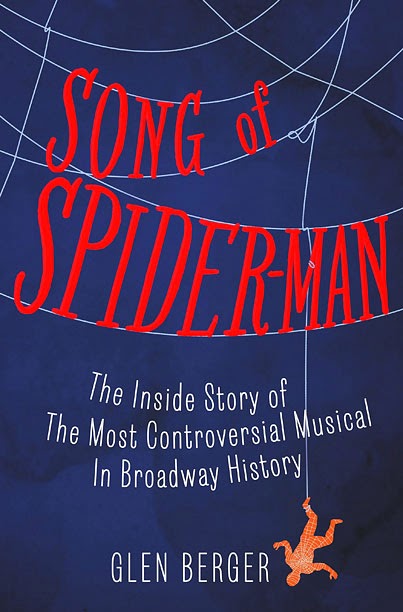
Book review: Song of Spider-Man: The Inside Story of the Most Controversial Musical in Broadway History.


No Broadway show in recent memory elicited a more potent blend of scapegoating and Schadenfreude than Spider-Man: Turn Off the Dark, which was conceived in 2002 by producer Tony Adams, scored by U2's Bono and The Edge, written by Glen Berger and Julie Taymor (and, later, sort of, Roberto Aguirre-Sacasa), directed by Taymor (and, later, sort of, William Philip McKinley), and which opened at the Foxwoods Theater on 14 June 2011. Between its conception and its opening night, the show went through enough trials and tribulations to make Job look like a dude who just hit a brief bad patch.

The efforts it took to get Spider-Man to the stage are the stuff of Broadway legend. It took three years to work out the creative team's contracts, and just as they were finally all being signed in The Edge's New York apartment, Tony Adams suffered a massive stroke and died. No joke. While Edge was looking around for a pen. Seriously. Rather than reading this as an omen and running, screaming, from the project, Adams' producing partner, Alan Garfinkle, took over as lead producer, but he had no Broadway experience, and the production soon ran out of money. Bono's friend, the rock impresario Michael Cohl, also chose not to run screaming from the project; instead, he came in as lead producer in 2009, just in time for the economy to tank. More money for Spider-Man was nevertheless eventually raised, and rehearsals started up again.

Tuesday, February 11, 2014

Not Your Mama’s Fairytales or: In Real Life Everything Sucks


Last week, I went to the TRUF at the Chain Theater in Long Island City to see a series of three, one-act plays which were all postmodern-ish retellings/adaptations of fairy tales.  At the heart of all three plays were major existential themes: what things drive us to self-destruction?  Is death a form of freedom...from endless wants, trauma, duty, or circumstances beyond our control?  While admirable and relevant, the plays varied greatly in terms of their execution and quality.

Little Red - written by Billy Aronson, directed by Paul Urcioli, choreographed by Stacey Abeles

This play was the first out of the gate and definitely the weakest of the bunch.  It attempts to put a more adult twist on the tale of “Little Red Riding Hood.”  The story follows the trajectory of the fairytale, but the familiar characters are fleshed out in less innocent ways.  For example, Red’s mother is overbearing and harbors murderous fantasies toward her own mother.  The Hunter is turned into Red’s incompetent father.  Red and the Wolf’s encounter in the woods is sexually charged, and both Red and her grandmother desire to be eaten by him.  Red, in the end, is forced to live “happily ever after” despite wanting to die.

The thought that kept occurring to me as I watched Little Red was that the budget was used in all the wrong ways.  Sets were changed through these moving projection screens that seemed to eat up the production costs.  Actors had to mime props like the table, food, flowers, and Red’s basket.  Because of this, the production came across as quite amateur and high school-ish, despite the actors’ valiant efforts to lift it.  The dance at the start to Sam the Sham and the Pharoah’s “Little Red Riding Hood” was unnecessary and not very well executed on the small stage.  Rick Cekovsky, who portrayed the Wolf, had on these terrible ears.  They were quite a shame as he was quite handsome and could have sold the performance well sans ears.  Overall, it seemed like Urcioli had good ambitions but didn’t really consider the realities of the space.  And the production suffered because of that.

Forever Neverland - written by Mike Swift, directed by P. Adam Walsh

I fear my reception of this play was colored by my dismay at the first piece.  Finding Neverland takes place in a carriage on the ferris wheel at Michael Jackson’s Neverland Ranch...though it took me reading the synopsis to fully figure that out.  The carriage lifts off with two Lost Boys named Billy and Gene (ba-dump chink), the Prince, and the Prince’s pet chimpanzee.  They are joined at the last minute by a girl named Mary Martin (Clever?  I’m ambivalent...) who is disguised as a boy.  She has cancer and believes that the King of Neverland will heal her.  However, they only treat little boys in Neverland, so when her gender is discovered, she escapes by jumping into the same Ferris wheel carriage.  All sorts of hijinks and death ensue because of the Prince’s sadistic tendencies and the randomly violent chimpanzee.  Towards the end, the only two characters left are Mary and and Billy.  Their conversation reveals that the King has prevented Neverland’s Lost Boys from growing up by sexually assaulting them.  Their only escape is to “fly away” (i.e. leaping to their deaths).

Forever Neverland, again, had good thematic intentions but wasn’t executed well.  The first two thirds or so had some serious pacing issues and had me looking at my watch several times even though it was only thirty minutes long.  I was very confused for much of the play.  It improved, though, as characters left the set.  The ending was poignant, but it was hard work getting there. 

Swift’s writing needs some work, especially at the beginning, because the premise isn’t immediately clear.  You don’t know who the characters are and why you should even care.  Production elements like the fake blood are unnecessary, especially in a small space.  Part of me wonders if it was imagined far more cinematically in the playwright’s mind.  Structurally, it seems like certain plot points would be difficult for any director to bring to life on a stage, especially one as intimate as the TRUF.

The Weight of Wishing - written by Sarah Gallina, directed by Sharone Halevy

This play made the other two worth sitting through.  The Weight of Wishing tells the story of Daisy, who lives life as it were a fairy tale.  Her world comes crashing down around her as the realities of every day life show her that happy endings may, in fact, only exist in stories.  

The Weight of Wishing sparkled in a way that the other two didn’t.  The dialogue was beautiful and the direction was nuanced.  For once, it didn’t feel like the actors (who were good in all three plays) were trying to make up for deficiencies in staging or production.  Michaela Morton (Daisy) and Nick Masson (Mark) had brilliant on stage chemistry as sister and brother.  Halevy, unlike Urcioli and Walsh, seemed to understand the limits of performing in a black box theatre and made it work.  The only thing I didn't love was the cardboard flower shop.  It just didn't look good.

If anything, I think some of the opening conversation between Daisy and Mark could be made clearer.  Her initial “real-life” state could be better established in that conversation, so that her journey becomes all the more poignant.  This play has the most potential of the three presented, and I hope to see it in another incarnation.  

(press ticket, fourth row center)

Monday, February 10, 2014

A Little Night Music

Stephen Sondheim and Hugh Wheeler's A Little Night Music is perfect. Its romance, cynicism, earnestness, silliness, wry humor, brilliant lyrics, and scrumptious music add up to two and a half hours of sheer pleasure. In telling the story of mismatched lovers at a country chateau, Night Music gently unveils the foolishness of life and love and people, while also saluting all three. It is light as air, but moving and insightful. The first time I saw the original production, in the early 1970s, I thought, "Wow, musicals can do this? Musicals can do this?" (Little did I know the treats that Sondheim and his collaborators had in store.)

Rita Rehn, Richard Rowan
Photo: Bella Muccari
The Gallery Players' production of A Little Night Music is not perfect, but it is largely successful and gets the substance of the show right. Tom Rowan directs with great clarity, and the cast, while uneven, makes intelligible virtually every precious word and lyric (no small feat in this occasionally tongue-twisting score). Rob Langeder and Barrie Kreinik as the Count and Countess are excellent, and Rita Rehn makes a charming Desiree. The scenery and costumes are inexpensive but serviceable; the five-person band, while about dozen people short of ideal, is quite good. And the singers are unmiked! Bravi!

Some laughs are missed; there could be more chemistry between the romantic leads; some notes are wobbly at best. But, by and large, this is a respectable and highly enjoyable production, and at $18/ticket, it's a genuine bargain.

It runs through February 16th only, so move quickly!

(press ticket; fifth row center)

Nothing Like a Dame (Book Review)

If you are a fan of musical theatre, you will greatly enjoy Nothing Like a Dame, Eddie Shapiro's collection of long, thoughtful interviews with many of the most brilliant women doing musicals today.

Using a simple question-and-answer structure, Shapiro lets us vicariously hang out with Elaine Stritch, Carol Channing, Chita Rivera, Donna McKechnie, Angela Lansbury, Leslie Uggams, Judy Kaye, Betty Buckley, Patti LuPone, Bebe Neuwirth, Donna Murphy, Lillias White, Karen Ziemba, Debra Monk, Victoria Clark, Audra McDonald, Kristin Chenoweth, Idina Menzel, Sutton Foster, Laura Benanti, and Tonya Pinkins.

The interviews are long enough to give a sense of each woman's personality and attitudes. Each women talks about her career, her hopes and dreams, and her triumphs and disappointments. While more than one interviewee feels hard-done-to by the world of theatre, others wake up grateful each day for all that theatre has given them. Many evince a surprisingly large amount of insecurity and others a breathtaking amount of ego. There is general agreement that awards are overrated (though welcome!), that Stephen Sondheim is a nice genius, and that Jerome Robbins was a nasty genius. Many talk about how hard it was to learn to advocate for themselves, and more than one talks about the difficulties of mixing motherhood and eight shows a week. There is much discussion about reviews, professionalism, missing performances, and the living mass that is the audience. They have a great deal of praise for each other--and for Ethel Merman. And, yes, there is a fair amount of dirt.

The book includes about a million interesting quotes. Here are a few:


Elaine Stritch
I had no idea what I was talking about, singing "The Ladies Who Lunch," but I just grew into it. I grew into that song. And I looked like I knew what I was talking about. I think that meant that I did know what I was talking about, but I just couldn’t explain how it was hitting me. I just could do it.

I don’t like the way you said that. I had a couple of drinks before I went out onstage, but "your first show sober?" I don’t think you’re not sober with a drink or two in you. It’s an unfortunate way of putting that.

Tuesday, February 04, 2014

Newsies

As the lights come up on the first scene, a young man with a bum leg and his stronger, abler friend awaken to greet another gray, dirty summer morning on the Bowery. From the rooftop they've been spending warm, rain-free nights on, they contemplate their dismal future, soon bursting into a song about how wonderful it would be to leave New York City for a cleaner, greener, less complicated place. Once the song ends and they return to their grim reality, they climb down from the roof and force themselves to face another tough day in the urban jungle.

Before I continue, I feel compelled to tell you that I am not describing a musical adaptation of Midnight Cowboy (although why no one has yet attempted a musical adaptation of Midnight Cowboy is beyond me.). Rather, I'm recounting the opening scene from the Broadway production of Newsies, which is sort of like Midnight Cowboy, at least in its vaguely homoerotic treatment of the gritty, male urban underclass. But lest you are thinking of cancelling your plans to bring some kids to see the show next time you're in town, please know that all comparisons end there: Newsies features no disturbing scenes of male hustling, no death by tuberculosis, and not a single weird woman rubbing a plastic rat all over her face in a Times Square automat at 3am. Also, it's not set in New York City in the late 1960s, but in 1899 (an equally grimy, if perhaps not quite as sleazy, time in the city's history). Unlike Midnight Cowboy, Newsies is good, clean fun--a sweet, upbeat story filled with likable, hard-working, earnest young idealists who support each other through thick and thin, join together to fight (usually peacefully) for what's right, and end up making the world a better place as a result of their pluck, ingenuity, and old-fashioned hard work. In short, Newsies is your typical Alger myth, tied up in shiny, cheerful Disney wrapping.

Monday, February 03, 2014

Intimacy


I guess Thomas Bradshaw was aiming for satire when he wrote the dreadful and stupid Intimacy, but satire requires a point of view, intelligence, and more discernment than shown by, say, a bunch of 11-year-olds telling dirty jokes. Scott Elliot's heavy-handed direction helps not at all. 

Intimacy is about sex, and a great deal of sex occurs during its long two hours. The sex involves various organs, positions, and people, including family members, and is performed on stage, on film, and with various prostheses. I guess it's supposed to be funny; it isn't. I guess it's supposed to be shocking; it isn't. I guess it's supposed to mean something; nope.

I like one idea that manages to poke through, that sex can be healing. And I thought the ejaculation mechanism was far superior to the vomiting mechanism in Gods of Carnage. That's it for positives.

Intimacy is puerile, pointless, empty, and stupid. My tickets were free, but I'd sure like the two hours of my life back.

(press ticket; in the theatre, unfortunately)

Row After Row

Jessica Dickey's Row After Row sneaks up on you. The story seems simple: three Civil War re-enactors share a table in a bar following a re-creation of the battle of Gettysburg. Tom and Cal are old friends and experienced re-enactors. Leah is new in town and has joined the re-enactors in a bid to meet people. Cal is horrified both at her having played a soldier and at her having done so in non-period-appropriate clothing. Leah explains, "I didn’t feel like playing the serving wench or a widowed bride or whatever." Cal is derisive and downright rude, calling the new rules that allow women to dress as men, "mamby pamby bullshit." He also explains that it can cost thousands of dollars to get all of the necessary garb and equipment to be an authentic re-enactor. Tom adds, "Most people don’t realize the commitment goes beyond sleeping in a tent and wearing wool in July." Leah and Cal spar, with Tom trying to play peacemaker.

Rosie Benton, Erik Lochtefeld. P.J. Sosko
Photo: Carol Rosegg
Cal is recovering from a brutal breakup and isn't quite the jerk he seems. For all of his belligerence, he listens when Leah speaks.  Leah, who chose to move to Gettysburg by putting her finger "on the map one drunken night about three weeks ago," is mourning her vanished career as a dancer. Tom, a teacher with a son about to be born, and barely scraping by, is deciding whether to go on strike with his union, torn between loyalty to his family and to his coworkers, between principles and fear.

Although the play initially seems to be an entertaining battle of the sexes, with feminist flavoring and even a touch of "meet cute," Dickey has more on her mind. By its end, Row After Row has revealed itself as a serious, thought-provoking, and occasionally chilling examination of bravery, integrity, manhood, and womanhood that is also very funny.

Friday, January 31, 2014

The Bridges of Madison County

It's the moment. The lonely Italian-born Iowan housewife and the dashing photographer dance. And the audience's focus is pulled onto a neighbor, singing.

It's another moment. Their love is growing. And focus is pulled onto a skeletal faux bridge being lowered.

Still another moment. And focus is pulled onto the four store fronts being rolled onstage. Or the kitchen coming in. Or the fake car being put in place. Or the people at the country fair. Etc, etc, etc.

The Bridges of Madison County in its various incarnations is a testament to mush. It's cliched, silly, predictable, corny, and trite. Well-done, it can also be ridiculously affecting, a major tear-jerker. But you have to embrace the mush, focus on the mush, honor the mush, trust the mush.

The often-brilliant Bartlett Sher, director of the musical version of The Bridges of Madison County, does everything he can to distract from the mush. His direction is busy, overthought, and overdone. It takes the slight but sweet story at the center of the show and buries it under motion and scenery and tangents. Composer/lyricist Jason Robert Brown and Marsha Norman are guilty as well; they have stuffed this souffle of a show with so many ingredients that it has no chance of rising. But Sher makes it even worse, never letting the story settle for even a minute or two.

Monday, January 27, 2014

Grounded

Hannah Cabell
Photo: Rob Strong
The Pilot's name doesn't matter because being a pilot is absolutely what she is, over all other forms of identification. She lives to fly "My Tiger/My gal who cradles me lifts me up." She also rains destruction
on the minarets and concrete below me
The structures that break up the sand
I break them back down
Return them to desert
To particles
Sand
At least I think I do
I'm long gone by the time the boom happens
Tiger and I are on to another piece of sky
She doesn't date much: "Most guys don't like what I do/Feel they're less of a guy around me/I take the guy spot and they don't know where they belong." But then she meets Eric:
This one’s eyes light up
This one thinks it's cool
This one kisses me in the parking lot like I'm the rock
star I am

My Daughter Keeps Our Hammer

Katherine Folk-Sullivan (left) and Layla Khoshnoudi (right)
Photo credit: Hunter Canning

With a 65 minute run time, Brian Watkins' My Daughter Keeps Our Hammer is a short and provocative one act play.  It is well worth your time.

The premise is one that the typical New Yorker or urbanite will find foreign.  Two sisters, both college uneducated, living in the middle of a prairie out West.  The elder sister Sarah is burdened with maintaining the family home/land and caring for her ailing mother and a lone sheep named Vicky, while the younger sister Hannah works every day at a roadside diner wrestling with a mild wanderlust and an Isuzu that won't take her anywhere.  Yet its very foreignness is what makes the play all the more poignant when you start to relate to these characters.

The story is told through a series of monologues by the two sisters.  As they state at the beginning, they don't talk much to each other, even as they recall the same events.  Estranged by bitterness, jealousy, and the memories of happier times, Sarah and Hannah's relationship is simultaneously archetypal and personal.  The raw honesty and frequently irreverent humor of their stories highlight the deeper, darker things that often motivate actions.  The strength of this work lies in the characters' step-by-step decisions and tiny explosions of violence, which have the power to transform us from humans with delusions of moral decency to stumbling unrecognizable creatures.  (I once heard a variant of that phrase used with regards to Breaking Bad...it seemed applicable here.)

I'll leave my description at that because I don't want to give too much away.  Production-wise, the choreography of light was quite brilliant (Was that too punny?) - from flashlight to overhead lamp to flame.  The performance by Katherine Folk-Sullivan (Sarah) was top notch.  She especially shone in the moments when Hannah was speaking and you could see the play of emotions across her face.  Layla Khoshnoudi was delightfully funny and insightful as Hannah.

This was my first Off-Off-Broadway play.  I loved the intimacy of the theatre (only two rows of seats), but it was a very wide stage which made views slightly uncomfortable.  Granted, I was sitting at the end of a row.  I kind of wonder if this play might work in the round...but, random musings.   Final verdict: I highly recommend it.  This is a journey worth going on with Sarah and Hannah.

My Daughter Keeps Our Hammer is playing at The Flea Theater (41 White Street) through February 15.

(press ticket, second row, far left)

Friday, January 24, 2014

Russian theater parody


Good people, have you seen this? Because if you haven't, you must. Go. Go now. Watch. It's as good and as brilliant and as effective as this--if not more so.


You're welcome.


Outside Mullingar

A slight, but emotional play by John Patrick Shanley (Doubt--Tony Award/Pulitzer Prize), Outside Mullingar excels at beautifying life's minutiae without delving deeply into its complexities. Like his Academy Award-winning screenplay, Moonstruck, this Manhattan Theatre Club production, which opened last night, depicts quirky characters that fall in love despite themselves.

Although predictable (girl meets boy, boy pushes down girl, decades pass, boy gets girl), the play enchants by the strength of its cast, who often infuses their simple parts with a vulnerability not always apparent in the playwright's words. Especially moving is a tender bedside scene that Brian F. O'Byrne (Anthony Reilly) and his disapproving father, Peter Maloney (Tony Reilly) share in the middle of the night where two men reluctant to talk about feelings heart-achingly appreciate one another--perhaps for the very first time--as the regret that etches their words sits helplessly on their faces. Dearbhla Molloy, as the mother of Rosemary Muldoon (Debra Messing) offers a certain Irish feistiness as she chats about her own demise and admonishes the O'Reilly's on the state of their home: "Your mother would die again if she could see this house."Messing, making her Broadway debut, sounds authentically Irish and holds her own with the stellar cast. You never quite believe, though, with her delicate frame and innate grace, that she could perform the chores required of the farm woman she plays.


Lovely, too, are the endearing details embedded into the set. From the soft patter of the rain on the Reilly's window--a tiny tap tap that intimates something is about to change--to the plain crosses that hang on the kitchen walls, these small things infuse the play with intimacy. Indeed, Shanley knows this world. In fact, so does designer John Lee Beatty and director Doug Hughes, who visited Shanley's ancestral home in Ireland, according to a January 9th essay the playwright wrote in the New York Times. Outside Mullingar touches audiences with this authenticity. Most moving of all is the play's sense of longing and recrimination--for, in the span of 100 minutes, forgiveness is found and the loneliness all humans grapple with ends happily. If only real life could offer the same guarantees

Outside Mullingar


In John Patrick Shanley's Outside Mullingar, Brían F. O'Byrne plays a pathologically shy, quietly quirky farmer named Anthony, whose family farm abuts the one owned by Rosemary's family. Rosemary (Debra Messing) is also quirky, if somewhat more extroverted, and she smokes heavily. There is a long history of tension between the families, and both Rosemary and Anthony have their own misgivings about inheriting their respective farms when their parents die off. Despite all the baggage, will these two solitary misfits find one another--and love--as they enter middle age?

Of course they will, you dumbass. Otherwise, there'd be no play.

Seriously, and with all due respect to the cast and company, that's all I've got on this one. Outside Mullingar is a light, pleasant show that is nonetheless rather thin for its attempts at mining the strained relationships between husbands and wives, parents and children....and Neighbors with Family History. The play is about as deep--if also about as sweet--as one of those snack-packs of chocolate pudding. O'Byrne is typically committed and engaging as a performer. Messing, making her Broadway debut, holds her own, can do a pretty convincing and consistent Irish accent, and is dressed way better than she ever was in "Smash." Peter Maloney and Dearbhla Molloy are solid and convincing as Anthony's dad and Rosemary's mom. The set is nice, and so is the direction. John Patrick Shanley, celebrated playwright that he is, has written a pleasant enough little love story about his ancestral home. The audience I saw it with was appreciative. But for all that, I left the theater feeling that when it comes to Mullingar, there is in fact no there there.

Sunday, January 19, 2014

Loot

One of the risks of writing cutting-edge theatre is that time can wear down sharp edges into blunt instruments. It is the classics that rise above their time and place. Joe Orton's farce Loot is a classic, and even though police corruption, bisexuality, and disrespect for religion are no longer shocking, the play remains fresh and remarkably funny.

Ryan Garbayo and Nick Westrate
Photo: Rahav Segev
The current Red Bull Theater production of this tale of robbery, death, and cheerful sleaziness, complete with ill-gotten gains hidden in a coffin with the corpse in the wardrobe, manages to harvest about 85% of Orton's brilliance. The set (Narelle Sissons) and lighting (Scott Zielinski) provide the perfect ambience, the pacing is good, and much of the acting is excellent. Rebecca Brooksher is an enticing manipulator, Nick Westrate and Ryan Garbayo provide just the right combination of reality and insanity, and Jarlath Conroy's trajectory from mournful to hysterical is perfectly calibrated. The weak link, unfortunately, is Rocco Sisto, who is well-cast physically and a generally reliable performer but who is ultimately defeated by his dialogue. Particularly in the second act, he messed up many lines, and while some sorts of plays can handle such stumbling, farces can't. His mistakes lost laughs and damaged the momentum, and it's really too bad because he was otherwise quite good.

Overall I'd give this production a B. Interestingly enough, my nephew, previously unfamiliar with Orton, gave it an A-. Even at a B, it's well worth seeing, and I continue to be grateful to Red Bull for their always interesting seasons.

(press ticket, second row, right aisle)

Outside Mullingar

Inside John Patrick Shanley's 105-minute Outside Mullingar is a potentially wonderful 85-minute play. As it stands (or stood at the preview I saw), it meanders too much and takes too long to get to the romance promised by the label "romantic comedy." Much of the meandering is charming, but some wanders too far afield or is too repetitious. Outside Mullingar presents too slight a story to justify 1:45, and although I love talky plays, sometimes I wished they would just can it.

The story: boy meets girl, boy knocks girl down, girl gets a crush on boy, boy is rejected by a different girl and becomes withdrawn, girl turns into woman and retains crush for decades, boy-now-man is oblivious. And meanwhile their parents get old and die.

The four-person cast provides three excellent performances (Brian F. O'Byrne, Peter Maloney, and Dearbhla Molloy) and one okay one (Debra Messing).

There are lovely moments in this play, particularly when boy-man and girl-woman finally have a long scene together. I hope Shanley trims down the excess and leaves the sweet core.

(free ticket, 2nd row mezz)

Thursday, January 16, 2014

Criticism and its critics


Hi, all:

I thought I'd tip you off, if you are interested, to a lively, interesting, and occasionally maddening discussion that was sparked a few weeks ago by an essay titled "Critical Generosity" that the scholar Jill Dolan wrote for the premier issue of Public: A Journal of Imagining America. The essay, which is fairly clearly positioned as Dolan's individual take on contemporary theater criticism, was in turn cited in scholar Polly Carl's essay, "A New Year's Diet for the Theater" on the blog HowlRound. This essay is a bit broader and more general than Dolan's in its suggestions, but basically, it, too, suggests that harsh criticism might be fun and easy and good for a belly laugh, but that it's not helping theater.

Carl's essay inspired a response by George Hunka, whose "We Are All Victims Now" was posted on his blog on 7 January. He focuses--perhaps overmuch, perhaps not, depending on your interpretation--on "niceness," which is a term Carl uses, but that Dolan does not, and that is, I think, not the real point of either Dolan's nor Carl's posts.

Dolan responds with as much on Feminist Spectator with "Criticism Redux Redux Redux"; Hunka responds in turn with "Jill Dolan Responds." The back-and-forth results in some twitter discussion by critics including Peter Marks, Jonathan Mandell and Jason Zinoman, as well as Hunka and Dolan, the last of whom ends the discussion with an explanation that she doesn't find twitter an appropriate medium for productive debate. I tend to agree with her, at least in this case, since the debate now strikes me as a lot of people arguing slightly different if interconnected points from a number of angles and ideologies.

At any rate, the debate will culminate (or not) with  HowlRound's weekly howl, "Critical Generosity and the Spectre of Niceness," the title of which seems to cut to the very heart of the shades of discrepancy surrounding the argument. It starts at 2pm est, and I suspect it will be--much like the essays that have prompted it, and I guess much like theater criticism itself--lively, interesting, and (maybe not so) occasionally maddening.

Check it out, why don't you? Unless, of course, this sort of thing makes rolling around naked in ground glass seem more appealing, in which case I'd strongly encourage you to skip it and, instead, take to bed. 

Tuesday, January 07, 2014

Machinal

The brilliant revival of Machinal, Sophie Treadwell's expressionistic 1928 dissection of a woman's life, climbs off the stage and under your skin. This nerve-rattling production is directed by Lyndsey Turner, who has worked closely with a superb team of designers and a strong cast to bring the plight of the Young Woman (she and the other characters are never named) to vivid, multidimensional, heartbreaking, claustrophobic life.

The strength of the production is apparent from its first seconds, as the Young Woman travels on a crowded train, which somehow is convincingly right there, on stage, as noisy and overwhelming as the actual subways that run far below the theatre. The show continues to present an almost miraculous amount of realistic emotion through its expressionistic means.

The story, inspired by the tale of the real-life husband-murderer Ruth Snyder, is simple, and unfortunately still relevant in many women's lives. The Young Woman is expected always to put herself last, and she mostly does, as each of the people and situations in her life fail her, from her mother to her husband to her lover to being a mother herself. Even women who have had many more options--myself included--can feel her plight in our bones, particularly as presented in this superb production. I imagine many men can, too.

In all fairness, I should mention that I found this show painful and unpleasant to sit through, although I admired it from the first. As time has passed, my respect for it has grown, leading to this rave review. Despite the show's unpleasantness, I am grateful to have seen it for the brilliance of the work.

Saturday, January 04, 2014

Theater with Children: A Midsummer Night's Dream

Photo: Gerry Goodstein

When I was a kid, my parents took my sister and me to a lot of theater in our hometown of Pittsburgh, which has a much stronger arts scene than I think most people assume. My folks subscribed (and still do) to Pittsburgh Public Theater, and sometimes took us to summer stock productions under a huge tent at Hartwood Acres. They frequently took us to shows at Carnegie-Mellon University, which had consistently excellent offerings (and has sent about a gazillion starry-eyed graduates to New York over the years). They also took us, for a couple of years, to a great Shakespeare festival. Now sadly defunct, the Three Rivers Shakespeare Festival operated, at least through the late 1980s, out of the lovely little Stephen Foster Memorial Theatre on the University of Pittsburgh campus.

A few days before we'd attend a particular Shakespeare play, my mother would haul the dark gray, heavily inked copy of The Complete Works of William Shakespeare that she had purchased as a college student out from the study and read through it. Then, over dinner or in the car en route to the show, she'd tell us a chatty, child-friendly synopsis of what we were about to see: "Lear was a king, and he had three daughters. Can you guess, just by hearing their names, which one we are supposed to like best?" or, "Wait until you see what an awful man Iago is. Just a terrible guy. Here's what he does to Othello." Her synopses were typically bookended with impassioned reminders that we were not going to be able to understand everything the characters said because they spoke in an older form of English, but that we shouldn't worry about that. Her approach didn't always work (I clearly remember my dad shushing me with growing irritation while I squirmed my way through Richard III, a play I have grown to appreciate but still really don't love), but it helped more often than it didn't. At the very least, whether we connected with the play or not, my sister and I always had some inkling of what the hell was going on at any given time.

Friday, January 03, 2014

Simple Dreams (Book Review)

Simple Dreams is Linda Ronstadt's "musical memoir," and in it, she discusses her forays into light opera (The Pirates of Penzance) and opera (La Boheme). Ronstadt is remarkably modest for someone with her many successes, and she is clear as to her limitations. When she is offered Pirates, she insists on auditioning. When she does Boheme, she writes, "I realized that I should have insisted on auditioning for this production, too, as it was beginning to dawn on me how difficult the singing was going to be." She later quotes Frank Rich's criticism of her performance and agrees with him!

I was an usher at the Public Theatre in the 1970s and still had many friends there when Pirates was done in the early 1980s. By all accounts, Ronstadt was a lovely, unassuming woman. That comes through in Simple Dreams, as does her sheer love of music. It's far from a great book, but its 200 or so pages include enough interesting stories to make it worth the while of anyone interested in Rondstadt or in music in general.

(library book)

Wednesday, January 01, 2014

The (Curious Case of the) Watson Intelligence

Madeleine George's latest play, The (Curious Case of the) Watson Intelligence is by turns breathtaking, annoying, beautiful, overwritten, and gorgeous. A mash-up riff on three Watsons--the Jeopardy-winning computer, Alexander Bell's assistant, and Sherlock Holmes' buddy--The Watson Intelligence wanders hither and yon, taking on romantic relationships, deep friendships, sanity, emotional bravery, and the meaning of being human. In some ways, it's a mess. But, oh, the writing.

David Costabile, John Ellison Conlee
Photo: Joan Marcus
The Watson Intelligence is stuffed full (overfull?) with glorious monologues, each of which could stand alone as a short play. A case in point is Bell's Watson explaining why he feels neither humiliated nor put-upon to always stand in the great man's shadow. This monologue handily tells a story, reveals character, and provides insight into the human condition--all in luxuriously rich language.

Ultimately, the show fails to coalesce, and its sheer wordiness becomes overwhelming. It was also weakened in its recent Playwright Horizon's production by Amanda Quaid's unimpressive performance, which paled beside the strength of her costars, David Costabile and the protean John Ellison Conlee, leaving the triangle unbalanced.

But, never mind. The strengths of The Watson Intelligence far outweigh its weaknesses. And Madeleine George deserves the nurture and support given to her by Playwrights, which makes a habit of presenting the future of dramatic writing. (Playwrights also presents many female playwrights and hires many female directors, without making a big deal out of it. Like women are people, or something weird like that! Bravo!)

I can't wait to see George's next play.

(second row, membership ticket)