Cookies

Wednesday, September 14, 2011

Stars in the Making (I Hope!)


There’s no way I could limit myself to one “star in the making.” New York theatre is just too full of riches. I did however manage to limit myself to seven. 
Lemp and Kautz
Sarah Lemp and James Kautz are, I think, starting to get the attention they deserve, and they might one day actually be well-known. They’re both in The Amoralists Theatre Company, and each has an extraordinarily varied palate. Lemp’s palate runs from icy blue to deep purple, from cold-hearted to too-caring, from not-too-bright to sharply intelligent. Kautz’s range runs more to warm tones, with his emotions always vivid (yet subtle); his happiness becomes our happiness; his heartbreak becomes our heartbreak. And they both do farce really well. (Their shows include Happy in the Poorhouse, The Pied Piper of the Lower East Side, and Hotel/Motel.)

The next five performers aren’t, I think, getting the attention they deserve, and who knows if they ever will. But they are exquisite actors. 

Becky Byers is a sweet-faced redhead with blue eyes. She could easily be cast as Marian the Librarian or Amelia from She Loves Me--which makes her brilliantly controlled lunacy as the storyteller in Dog Act all the more impressive. In bursts of anger, annoyance, and angst, she spewed out her stories with venom, speed, and perfect clarity. She was chilling yet really, really funny. 
Parqu

In Universal Robots, Jason Howard morphed, cell by cell, from robot to feeling, sentient creature. The transition was heartbreaking and breathtaking, a true tour de force. 

Lori Parquet’s silences are exquisite, yet evocative. Her audible acting is brilliant too, particularly as Dog Act’s vagabond vaudevillian, but there is something in her silences, in her listening, that reveals the depth of her talent.

As a member of the Asmat tribe in The Man Who Ate Michael Rockefeller, Daniel Morgan Shelley managed simultaneously to give a subtle, detailed, specific performance and to represent a whole people being changed by outside influences.

The very first time I heard dialogue from one of my plays spoken by an actor, that actor was Nancy Sirianni, which makes me a very lucky playwright. She happened to be the first person to audition; she introduced herself, and she was Nancy. Then she started reading from the play (You Look Just Like Him) and she was Sally, hanging on by a thread, with a history of loss, yet quiet, contained. A thrill ran up my spine. I have since seen her in a number of shows, and she is the real thing, with an astonishing ability to be rather than act.

The Next Big Star: Marla Mindelle


photo: Broadway.com

The criminally underrated musical adaptation of Sister Act (by Alan Menken and Douglas Carter Beane, at the Broadway Theatre) is notable for many reasons, including a breakout performance by newcomer Patina Miller and the always-appreciated presence of Tony winner Victoria Clark. The show's real star turn, however, belongs to Marla Mindelle, as the shy novice nun who, with the help of Deloris Van Cartier (Miller), finds her voice and proceeds to raise it to the rafters. The role of Sister Mary Robert could easily be lost among the shuffle of plot twists and group numbers, but in Mindelle's exceedingly capable hands her journey became the focal point whenever she graced the stage. Mindelle's superb second-act solo, "The Life I Never Led," stopped the show cold when I saw it and left me mentally compiling a list of roles she needs to play (Fanny Brice, anyone?). All in all, don't be surprised when this insanely talented singing actress joins the ranks of Broadway's upper echelon.

ShowShowdown Q&A

Over the next few weeks, the ShowShowdown team will be providing our opinions on a variety of theatre-related questions that often come up. These are questions that interest us, fascinate us, and come up in conversation often. This blog has always been primarily concerned with reviewing live theatre in and around New York City, and that will not change; however, we thought it might be fun if we addressed our opinions about what we're most excited to see in the coming season, or who we find to be the most interesting stage performer around, or who we think would be great replacements for Bernadette and Jan in Follies. Our readers should also feel free to submit any questions or suggestions for this feature; simply click on one of our profiles and send us an e-mail with your proposed question, or post below in the comments section.

Our first Q&A topic will be: "Who do you think is the next big thing or star in the making?" Our contributors will be posting our responses here throughout the week, so be sure to check back regularly and see who we think has a promising career ahead of them on the boards!

Tuesday, September 13, 2011

Sweet and Sad

Laila Robins, J. Smith-Cameron
and Maryann Plunkett

Photo by Joan Marcus

While watching Richard Nelson's Sweet and Sad at the Public Theatre, I found myself thinking of how much I admire Tony Kushner and wondering why I found Kushner's political plays so compelling and Nelson's political play so dull. And here is the conclusion I reached: Nelson's characters care about politics, but Kushner's characters have skin in the game.

Yes, the people in Nelson's drama--an extended family gathering on the tenth anniversary of 9/11--are nicely drawn and beautifully acted. Yes, their little time-honed jabs and ancient assumptions are convincing. Yes, their miscommunications and sorrow are real. But there is no real conflict and no real resolution, and while that doesn't always matter, it matters here. (On the other hand, little happened in Nelson's gorgeous version of James Joyce's The Dead, yet everything happened).

In a note in the program, Artistic Director Oscar Eustis writes of asking Nelson to write a political work, and Sweet and Sad feels like it was indeed written theme-first rather than character- or plot-first. There's almost a sense of, now it's time to have someone express point of view A, now it's time to have someone express point of view B, and so on. Compare this with Kushner's plays, in which political arguments are also arguments for connection, for approval, for love, for life itself, in which politics is a blood sport that matters.

(membership tickets, audience right, a few rows back)

Wednesday, September 07, 2011

She Loves Him: Kate Baldwin Live at Feinstein's


The "him" that Kate Baldwin loves is the amazing Sheldon Harnick, lyricist of such classic shows as She Loves Me, Fiddler on the Roof, and The Apple Tree, and honored guest on this CD. And what's not to love? His range is broad, from romance to satire to history to heartbreak, and his lyrics are smart, funny, and sometimes breathtaking. I'm particularly fond of this section of "He Tossed a Coin" (not on this CD) from the Rothschilds:
Old coins, rare coins, treasures of an ancient kingdom
Numismatic wonders from days of old
Curios of silver, rarities of gold
You've got to like a guy who can use "numismatic" in a lyric, yet write something as simple and perfect as this ("Sunrise, Sunset" from Fiddler):
Is this the little girl I carried? Is this the little boy at play?
I don't remember growing older, when did they?

Baldwin sings Harnick's "When Did I Fall in Love?," "A Trip to the Library," "Will He Like Me," a Fiddler medley, "Gorgeous," and more. Her soprano is clear and sweet, and she serves the songs and their stories superbly. But you know what? Harnick steals the CD with his heartfelt, full-throated rendition of "If I Were a Rich Man." And their duets on "To Life," "Dear Sweet Sewing Machine," "In My Own Lifetime," and "Sunrise, Sunset" are a sheer joy. The extraordinary band consists of music director Scott Cady at the piano, Andrew Sterman on an amazing array of woodwinds, and John Beale on bass.

The CD's one weakness is that Baldwin's patter doesn't hold up to repeated listenings. However, the invaluable PS Classics made the smart decision to put the patter interludes on their own tracks, so that they can be skipped when listening or transferring the CD to your iPod.

Do you suppose that in four or five decades, a young person will arrange a tribute evening to Kate Baldwin? I hope so. And I hope that PS Classics is around to record it.


(press copy)

Monday, August 29, 2011

Side Show


One of the best things about seeing a musical Off-Off-Broadway is hearing unmiked voices--when you can hear them. Unfortunately, only some of the cast members in the Sweet&Tart-Art of War production of Side Show (currently playing at the Secret Theatre in Long Island City) are consistently audible. It doesn't help that the band is behind the audience and often conflicts with, rather than works with, the performers. No matter how well a show is directed and how talented the people involved are, if you can't hear, it's all wasted.

Side Show is the fictionalized story of the Hilton sisters, conjoined twins who went from side shows to vaudeville to movies to working in a market as a cashier-bagger team. This is the third Side Show I've seen; the first two were the Broadway and  the Gallery Players versions. I've never liked the recitative, but this time around it struck me how much it damages the show by slowing down all conversations and limiting the performers' ability to act their lines. Someone I know always says, "Don't sing 'Pass the butter,'" and I have to agree. On the other hand, I was also struck by the show's many strengths, including frequently excellent music and lyrics and the compelling nature of the Hilton sisters' situation.

Director Brad Caswell made some excellent and interesting choices, particularly in the scenes where the sisters are still working in the side show. I think he made a mistake casting the twins, however: Nikki Van Cassele would have made a better Daisy and Erin Krom would have made a better Violet. Krom manages to rise above the miscasting with a heartfelt performance, while Cassele seems always to be straining to hold her energy in. Their voices also could have been better matched. I can't say much about Joshua Dixon's performance, as I could only hear about 10% of it, but it seemed like he might have been reasonably good as Terry, the man who gets the sisters into vaudeville. Alex Herrara has an interesting energy as Buddy, the man who teaches the sisters to sing and dance, and he looks right for the period, but he too was difficult to understand. Ken Bolander perhaps overacts as the creepy owner of the side show, but his presence and voice fill the space, for which I was grateful.

Costume designer Gary Lizardo did a good job on what must have been a small budget, but I wish he had given the rest of the side show denizens more character-driven clothing as he did with the Bearded Lady.  I'm not sure how much of Jenn Gartner's lighting design I saw, as it was an early performance and I suspect many cues were mishandled. Venita McLemore's choreography was enjoyable. The exhibit on the Hilton sisters in the lobby, created by Alyssa Van Gorder, did a good job of setting the mood and was fascinating to boot.

(I must mention that I only saw the first act. If I had been able to hear, I would have gladly stayed, but under the circumstances it seemed wiser to go home and buy water and canned food for the hurricane.) 

(press tix; 4th row center--right in front of the band, which was probably part of the problem)

Wednesday, August 24, 2011

FRINGE: Whale Song, or: Learning to Live With Mobyphobia


There are plenty of theater companies out there that produce plays about women who have lost their fathers: grief is a popular topic. But there are few that are willing to risk pursuing such a story from a different angle -- through, say, a whale-sized metaphor -- and it's a genuine pleasure to see Dreamscape Theatre (as they did for The Burning Cities Project) and artistic director Brad Raimondo behind the wheel of Claire Kiechel's Whale Song, or: Learning to Live with Mobyphobia. Maya (Hollis Witherspoon) reacts to the possible suicide of her father, James (Gavin Starr Kendall), by summoning a whale into the Hudson River; unable to confront it, she spends her days teaching her first-grade students all about the etymology of "orca" and the inevitability of death, and her nights sheltered in her apartment, listening to an increasingly surreal reporter (Rosie Sowa) who begins to address her directly.

The script's a bit unpolished, particularly with the inclusion of Shep, the "motherfucking" drummer (Jordan Douglas Smith), though that's to be expected, given that Maya hires him as a literal distraction. Maya's boyfriend, Mark (Ryan Feyk), also needs to be less of a pushover -- similar to the way Maya's sister, Sarah (Siri Hellerman), is the voice of reason; Witherspoon's a solid actress, but she's forced to self-generate much her angst. That said, Kiechel nails the ending, as we learn exactly why Maya hates whales so much -- it involves another death in the family -- and why she's so obsessed with stories and significance. In addition, Raimondo's direction is spot on, from the way Maya's thoughts are manifested in shipping boxes that gradually overflow throughout her apartment to the staging of the news segments, which is done behind Maya, so that it looks as if we are seeing her thoughts, rather than what's actually on TV. Credit's also due to Sam Kusnetz's sound design: given that the theme of the play is about finding meaning where you look for it, it helps to have some genuine whale songs echoing through the La MaMa space.

FRINGE: Paper Cut


At one point, however long ago, you were a kid, and when you were, you probably spent some time playing with toys, making up intricate stories with which the various characters might interact. (If you were never a child, pick up Toy Story and see what you missed out on.) That's very much the sort of theater that Yael Rasooly's interested in making, a semi-solipsistic art that she calls "paper and object theater," a large part of which involves her manipulation of photographs, cut-out paper figures, pop-up books, and various other "flat" puppetry, all while providing the sort of exaggerated voice-over that was all the rage in black-and-white "classic" dramas. The paper-thin plot's beside the point -- Ms. Dolores is a stressed-out, solitary secretary who pines for her boss, even as he obliviously asks her to transcribe love letters to other women -- but it justifies Rasooly's flights of fantasy: creative homages to both over-the-top romances and, as her paranoia invades, Hitchcock. (In terms of inventiveness, it's a bit like a one-woman version of The 39 Steps.) Boiled down to its most simple elements, Paper Cut is a bit one-dimensional, but when she folds together a series of fast-paced accents and title cards to simulate a whirlwind honeymoon, or when she gamely attempt to sing through a bundle of quick-cut love songs (needle skips and all), one can only marvel at her theatrical origami.

Chicago

Ryan Worsing, Charlotte d'Amboise,
and Michael Cusumano
(Photo:
Jeremy Daniel)

With its 6138th performance on August 22, Chicago became the fourth longest running show in Broadway history.  I saw it the previous week at performance number 6132 (estimated). And you know what? It's in great shape.

I have seen Chicago a dozen times or so, thanks mostly to the rush tickets that were available when it was still at the Shubert. I have seen Bebe Neuwirth, Ute Lemper, Deidre Goodwin, Caroline O'Connor, Jasmine Guy, Ruthie Henshall, and Nancy Hess as Velma. I have seen Charlotte d'Amboise, Belle Callaway, Sandy Duncan, Nana Visitor, and Marilu Henner as Roxie. I have seen a slew of Billy Flynns and Mama Mortons and Little Mary Sunshines. (If you want to see the IBDB list of replacements, click here.) And with all of these viewings and all of these performers, the show was never less than entertaining. Frequently, it was superb.

In some ways, there are two versions of Chicago: the star-powered version and the Broadway-stalwart version. Each has its charms, and when you get both (e.g., when Bebe Neuwirth was in it), it's damn close to theatrical nirvana.

The current Chicago is a Broadway-stalwart incarnation. The names Charlotte d'Amboise (Roxie) and Nikka Graff Lanzarone (Velma) may not sell tickets, but the people attached to them are first class performers, able to dance, sing, act, and nail their laugh lines. Lanzarone, not yet 30, is a stalwart-in-training. As Velma, she battles the ghosts of Neuwirth and Lemper et al, and she lacks their individuality and focus. But she's solid, and her unique looks and accomplished dancing do well by the part.

d'Amboise is flat-out wonderful. This was probably the fourth time I've seen her, and she's better than ever. Although it was a one-third-empty matinee, she brought her full performance. You would think it was the first time that Roxie had ever realized that she might be hanged, even though d'Amboise has played the part thousands (!) of times. d'Amboise's acting has actually improved over the years, and she has tightened her version of the "Roxie" number beautifully. Her dancing remains astonishing. In "Me and My Baby" she seems barely to skim the stage, and in "We Both Reached for the Gun" she is so puppet-like that you could easily believe that she has no joints. (That she does this all eight times a week at the age of 47 is truly impressive.)

Carol Woods is a kick-ass Mama Morton (of course!), and Christopher Sieber makes a charming Billy. (His long note on "We Both Reached for the Gun" was so astonishing that my friend suggested that it was supplemented with a recording. I suppose that is possible, perhaps even likely, but it would be disappointing.) The supporting performers--all those staggeringly attractive dancers with their staggeringly perfect bodies--remain energetic and engaged. The (somewhat-diminished) orchestra is also still giving the show their all, and as the audience leaves they become quite playful.

The biggest compliment I can pay Chicago is this: every time I have seen it, my heart has sunk when Roxie sings, "It's good--isn't it?" because I know the show is coming to its end. And every time it ends, I'd gladly sit there and see the whole thing again.

(free tickets; 4th row mezz first act; 1st row extreme side orchestra second act)

Monday, August 22, 2011

Judy Gold takes Avenue Q to Jerusalem for a Holiday


Okay, not really. Having been on a work-schedule imposed hiatus from the theatre, I managed to get to a few things in a cluster. 

The Judy Show: My Life as a Sitcom

Judy Gold is a big old lesbian who wants a sitcom. That isn't disparaging. She reminds you of these obvious facts repeatedly over the course of an hour and a half. These facts are obvious because I'm sighted. The show itself is equally obvious: sing-along theme songs, occasionally rewritten to mirror Judy's life as resume, an obsessive knowledge of the form, fantasies of growing up Brady/Partridge/fill-in-the-blank. Sadly, the only cliche she doesn't use is wrapping the damn thing up in 22 minutes. Judy is a solid joke-teller and has enough ugly faces to stop a wall of clocks, all funny. The show is part biography, part audition. Her biography, as honestly told as it no doubt is, is farily generic outside the Bible Belt. The audition is cute but possibly indicative of why The Judy Show is off Broadway and not on Bravo. I would recommend it only for the die-hard Judy fan or those for whom any 6'3" lesbian will do.

Avenue Q

Avenue Q is one of my favorite Broadway musicals of all time. I won't go into the reasons why beyond the fact that it is well-written, witty, skewering, delightful fun. I hadn't seen it in the smaller New World Stages but wasn't worried about how it would transfer. I was more worried about the cast. Adam Kantor, as Princeton/Rod, doesn't have the aw-shucks charm I've enjoyed previously. He's a fine vocalist, though thin and timid in the upper range. He was completely likeable and charming, better as Princeton than Rod. Veronica Kuehn, as Kate Monster/Lucy/Others, was a delight--fine voiced and the kind of underdog spirit that makes you root for her, but versatile enough to handle Lucy's looseness. The quibble with both actors is that they are simply actors holding puppets whereas previous casts have used the puppets as extensions of themselves, charming mirrors--none more powerfully than originals, John Tartaglia and Stephanie D'Abruzzo. Rob Morrison as Nicky/Trekkie Monster/Bear/Others has a completely different creepy, child-molester vibe than Rick Lyon did, but he is equally effective. The thing that prevented this production from being great was Gary Coleman. In six outings every actor I've seen play Gary, save the original, the brilliant Natalie Venetia-Belcon, has sucked and dragged the show down. How hard is it to find an African-American actress in New York City who can blow the roof off with her voice and say "What you talkin 'bout"? Apparently, they can't get taxis either because, somehow, they're missing the auditions. The show is so strong, though, that it is worth a visit. Even the role of Gary Coleman is so well-written that a talent vaccuum can merely deflate it, not destroy it completely.

Jerusalem

Jerusalem has come and gone and I don't get it. The fuss that is. To be fair, part of the reason I may not have gotten it is because I only understood about 30 percent of what came out of their mouths. Apparently, they can't afford consonants in this trailer park. Mark Rylance was great, give him a Tony, no complaints here; but I appreciated his performance in La Bete more. Oddly enough, I found him more believable in a farce. I've spent some time around trailers (murdering cousins on welfare--you know the sort) and am amazed how similar the trash looks in the UK. Maybe it's my trailered history that makes me unsympathetic to lazy, drug dealing/taking malcontents regardless of their story-telling spell-bindery. Maybe growing up around similar ilks, who live their dreams only in chemically-induced paralysis and live their lives in chemically-induced violence, makes me unmoveable when the drama of art imitating life is so comparatively undramatic. Regardless, I couldn't for the life of me tell you what the difference between scene one and scene two were from a theatrical standpoint--same lukewarm mush, different spoon. It was incredibly disappointing not to love the show. I so wanted to.

Death Takes a Holiday

Death Takes a Holiday should probably be called Maury Yeston Takes a Holiday. He wrote two original melodies and reworked two from other shows (Love Can't Happen from Grand Hotel and Unusual Way from Nine) then repeated them over and over and called it a score. He wrote the lyrics using Boggle, children's edition. Every song was exposition that exposed nothing. A song about the death of a son spent 64 bars describing a rose (okay, maybe only 32). Not that it mattered because this could-have-been-heart-breaking idea of a song was entrusted to Rebecca Luker. She was so wooden and stiff that she would have cried splinters had she bothered to show a single emotion. The director did no one any favors. Doug Hughes ended nearly every song down front, facing forward, arms raised, cheesy smile, button on the last note implied. The rest of the cast was solid enough, although I wouldn't have minded if Max von Essen had shown a second emotion--borrow one from Duchess Lamberti, she's not using any. Jill Paice, as Grazia, and Kevin Earley, as Death, are superb. She gets the unfortunate chore of making love at first sight believable and sustainable and he gets the unfortunate chore of being the cause. I felt fortunate to watch them work. I almost wanted to die. (When they weren't on stage, I really wanted to die.) I wish I could have visited them at a more entertaining vacation spot.

Wednesday, August 10, 2011

HotelMotel

Gershwin Hotel

After watching the Amoralist production of HotelMotel, a pair of one-acts on site at the Gershwin Hotel, I was left with two questions. For Pink Knees on Pale Skin, written and directed by Amoralist Derek Ahonen, the question was: When does theatre tip over into voyeurism and porn? For Animals and Plants, written and directed by Adam Rapp, the question was: Will male playwrights ever get bored of writing about stupid men doing stupid things? 

[spoilers abound] 

Pink Knees is the story of two couples seeking "orgy therapy" to save their marriages. The Wyatts' problem is the husband's infidelity. The Williams' problem is the wife's anorgasmia. The therapist's problem is, "Thereʼs this huge empty part of me that I donʼt know how to fill." The play's problem is that neither the characters nor the situation nor the denouement are convincing.

James Kautz, Sarah Lemp
(photo: Monica Simoes)

I assume that Pink Knees is at least partially satire, but Ahonen doesn't understand sexuality sufficiently to pull it off. For example, the therapist provides the anorgasmic woman with an instant cure, and all the characters are unaware that there are other forms of foreplay than oral sex. The show raises all sorts of issues and then drops them: homosexuality, homophobia, racism, sadomasochism, incest, etc. Many lines are awkward requests for laughs--for example, "I don't teach chimps to have orgies, that's Jane Goodall's job," which is wrong in so many ways that I wouldn't know where to begin.

Perhaps the most surprising fault of the show is that it cops out. For all its bluster, it is ultimately conservative in its values. The promised orgy never occurs, and the happy endings are all monogamous. When one couple does make love, there is an odd combination of purience--in the small hotel-room setting, the audience is practically in bed with them--and modesty, as the therapist circles the bed, making sure the sheet always completely covers them. And it's weird that the only character who is completely nude in the show is the black man--while I'm sure Ahonen et al had no intention of being racist, there is an uncomfortable history of black men being used as beefcake.

This being an Amoralist production, it is not without its strong points. The acting is excellent, and there are funny and even wise lines. I particularly liked this exchange:
Robert (who has been cheating on his wife for a long time):  Iʼll never make the same mistake twice.
Dr. Sarah: You did make the same mistake twice, Robert. You made it hundreds of times over three years.
Robert: I meant… with someone else.
William Apps
(photo: Monica Simoes)

For Animals and Plants, the hotel room of Pink Knees becomes a cheap motel room decorated with taxidermied animals and strewn with empty pizza boxes. Our two main characters are Dantly, who sits quietly on the bed, almost unmoving, almost unblinking, and tries to puzzle out life, and his partner-in-crime-of-ten-years, Burris, who is frenetic, constantly exercising and jumping around, and full of answers. They are in Boone, NC, for a drug deal. We know that things will not go well.

Unfortunately, the way in which things do not go well is undeveloped. The characters are partners and friends, but they're not. Burris has a great vocabularly (some of his definitions are pretty wonderful) until the play needs him not to. And the magic realism moments seem grafted on to add significance to a story that is ultimately a little too familiar and a little too underwritten. When the ending comes, it tries to claim a significance it hasn't earned.

On the other hand, Animals and Plants is frequently entertaining. The conversations about Tiger Lily vs Wendy and the advantages of putting Right Guard on your balls are funny, Dantly has a charming woebegone air, and Burris's hyperactivity amuses. The contrast between the characters works, and Dantly's identification with plants is well supported by his almost total lack of movement.  And William Apps (Dantly) and Matthew Pilleci (Burris) are both wonderful.

For both shows, sitting in such a small audience in such a small performance space was fun, and it certainly afforded a deep (if not always welcome) sense of intimacy. It is not every day that you have to hold your breath in a theatre because the Right Guard that someone is spraying on his balls is coming right at you. But the setting, like both of the plays, ultimately comes across as arbitrary.

I remain a fan of the Amoralists. I still plan to see all of their shows. But HotelMotel is not their shining hour.

(press ticket, in the hotel/motel room with the characters)

Thursday, August 04, 2011

One Night Stand (Movie Review)

Jesse Tyler Ferguson, Cheyenne Jackson
Photo: Kerry Long

If you are at all interested in musical theatre you must see One Night Stand, a documentary about four short musicals that are written, rehearsed, and performed in 24 hours. Both a record of an insane challenge and a microcosm of the creative process, One Night Stand is fascinating, elucidating, suspenseful, and very very funny.

The movie starts with the creative teams being assembled. Composers, lyricists, and book writers who have never worked together (or even met) go from saying hi straight into deadline hell (or deadline heck; while some people take the pressure hard, others seem unruffled). We get to watch each team struggle to come up with a plot and three songs in a matter of hours. Then the shows are handed over to the casts, who also have only hours to learn dialogue and songs and maybe even make sense of what they are doing. The directors help as much as they can, but the goal isn't art--it's survival. All too soon, it's curtain time, and damned if these amazingly talented people haven't come up with four amusing, clever shows!

The writers of these musicals include Brian Crawley, Gina Gionfriddo, Rinne Groff, and Jonathan Marc Sherman. The composers include Robin Goldwasser and Julia Greenberg, Lance Horne, Gabe Kahane, and Benj Pasek and Justin Paul. The directors include Trip Cullman, Sam Gold, Maria Mileaf, and Ted Sperling. And the performers include Roger Bart, Rachel Dratch, Jesse Tyler Ferguson, Mandy Gonzalez, Cheyenne Jackson, Capathia Jenkins, Richard Kind, Michael Longoria, Theresa McCarthy, Nellie McKay, Scarlet Strallen, Marnie Schulenburg, Tracie Thoms, Tamara Tunie, and Alicia Witt.

As for the documentary itself, directors Elisabeth Sperling and Trish Dalton do a nice job of showing us the process and its results, and they allow us to get a sense of the different participants' characters. I wish the movie were longer (how often does one say that?) and that all four musicals were shown in their entirety (DVD extras, maybe? Pretty please?). But all in all, this movie is a gift to anyone who loves musical theatre.

(DVD screener.)

The Pretty Trap

Katharine Houghton, Loren Dunn, Robert Eli
Photo: Ben Hider


On YouTube you can find faux coming attractions that morph famous films into different genres. The Dark Knight becomes a Pixar cartoon and the Shining becomes a romantic comedy. Watching these recuts is entertaining and disorienting and an excellent reminder of the importance of context and point-of-view. Watching Tennessee Williams' short play the Pretty Trap has a similar effect.

The Pretty Trap is an early version of what would turn out to be the Glass Menagerie. Amanda, Tom, and Laura are there; the Gentleman Caller comes to visit; and familiar lines whiz by--but the one-act is just different enough to be, strangely enough, a comedy.

Amanda is somewhat likeable instead of soul-stealing, though she still sells those magazine subscriptions. Laura has no limp and is merely painfully shy, though she still drops out of business school. Tom has a relatively small role to play, though he is still a writer with the nickname "Shakespeare." Most importantly, the Gentleman Caller is not engaged to be married, leaving room for a happy ending. And, yes, there is a glass unicorn.

The Pretty Trap is not a great work of art, but it's a must-see for any Williams fan. And it is entertaining in its own right, particularly as directed by Antony Marsellis and acted by Katherine Houghton, Robert Eli, Loren Dunn, and Nisi Sturgis.

How odd and wonderful that this lightweight one-act could grow into the brilliant Glass Menagerie.

(Press tickets, 3rd row center)

Wednesday, July 27, 2011

The Silver Tassie

Image: Robert Day

Seán O’Casey once described his play The Silver Tassie (1927-28) as “a generous handful of stones, aimed indiscriminately, with the aim of breaking a few windows.” I love this description, which fits the Druid Theatre Company’s gorgeous production of the piece (running through July 31 at the Gerald W. Lynch Theater at John Jay College), not only because it nails the play’s scattershot approach to character, narrative, and plot, but also because it so clearly evokes the Impressionist style in which the play was written. Less a straightforward drama about Irish men serving during World War I, the play is sort of an absurdist-Brechtian-Beckettian-vaudvillian-music hall hodgepodge. Significant scenes take place completely off-stage while characters onstage chat about religion, domesticity, food, and politics; characters appear where they shouldn’t, or suddenly stop doing what one expects of them for no clear reason; characters frequently dance, clown, burst into song, find or lose God at their convenience, and randomly begin to speechify woodenly; characters strike poses (Christ figures galore!) or fixate on props that are thunderingly obvious (like the cup of the title, which is celebrated, revered, sipped from, and inevitably crushed); characters quickly become as abstract and as slippery as the scenes in which they appear.

The problem here is not the production, which is first-rate. It’s the play, which certainly remains compelling throughout, but does not always work. The big picture O'Casey is working with is, after all, nothing new, even if the materials he used in creating it were relatively innovative: war is hell; we all know that. It has the power to crush the strong as well as the weak, to destroy relationships, to make mincemeat of the body and to annihilate the spirit. But the medium remains cool throughout: the reaction is intellectual, but always emotionally distant. At least for me, the play evokes the same reaction as looking at something by Monet: one appreciates the beauty of the thing, and is even occasionally struck breathless by the mastery of the art form, but is likely less moved to empathize, or laugh, or weep, as to distance oneself for further contemplation. This is a brilliant production, and I am happy to have seen it; yet in having seen it, I understand why The Silver Tassie is not nearly as well-known as O'Casey's Juno and the Paycock or The Plough and the Stars.

Saturday, July 23, 2011

Rosencrantz and Guildenstern Are Dead


Jessica Delbridge and Allison Hirschlag
(Photo: Eli Sands)

In Tom Stoppard’s Rosencrantz and Guildenstern Are Dead, Shakespeare meets Beckett and a good time is had by all--except Rosencrantz and Guildenstern. In Stoppard's absurdist tragicomedy, R&G are brought to the kingdom of Denmark at the order of the king and queen, who are concerned by Prince Hamlet's behavior. As they wait to speak to Hamlet, R&G try to suss out what is going on, play games to pass the time, are visited by The Player and his troupe of Tragedians, and ponder life, death, and other imponderables. This being a Stoppard play, there is word play and mathematical theory and tremendously funny set pieces.

Panicked Productions has chosen to present R&G Are Dead with an all-female cast. Explains director Glenn De Kler, "There are tons of talented and funny ladies out there [and] they wouldn’t ordinarily get a chance to sink their teeth into these great roles." The strong cast does indeed sink their teeth in, and their being women brings some interesting texture to the show. Although the characters are still referred to as male, there is a different meaning when a female Rosencrantz cries than when a male Rosencrantz cries. And the female Player's independence, command, and panache feel hard-won while a male Player can take these traits for granted.

More important than the cast's gender is their skills. Allison Hirschlag as Rosencrantz and Jessica Delbridge as Guildenstern are entertaining and touching. Whitney Kimball Long steals the show as The Player, as a good Player always does. The rest of the performers do well with multiple roles, and their acrobatics are great fun. I do wish the cast had been larger.

The show is well-directed by Glenn De Kler and movement director Chie Morita. De Kler and Morita make good use of the small space, using simple clever touches to provide visual variety and a sense of place; the scene at sea is so effective that I found myself swaying with the boat. In addition, virtually every line of dialogue is clear and comprehensible, something that one can no longer take for granted, as shown by the recent Arcadia on Broadway, where great swaths of dialogue went past like so much noise.

Rosencrantz and Guildenstern Are Dead is at the Dorothy Strelsin Theatre only through July 29th. If you are a Stoppard fan in search of a solid, enjoyable production, get thee to 36th St.

(Press tix; first row.)

Monday, July 11, 2011

Death Takes a Holiday


Death Takes a Holiday is a lovely, old-fashioned musical, with an inviting score by Maury Yeston (which sounds somewhat like his Titanic). The frequently charming book by Thomas Meehan and Peter Stone offers few surprises but many pleasures. The female lead, Jill Paice, disappointing in Chess, is sweet, pretty, and likeable here and sings beautifully. Julian Ovenden as Death is everything he needs to be. His joy at discovering sensations is endearing and touching, and he too sings beautifully. (However, it would behoove director Doug Hughes to move Ovenden upstage a bit, as watching him spit on the first row is quite distracting.)

The supporting cast includes the underutilized Linda Balgord, the delightful Alexandra Socha, the ever-reliable Michael Siberry, and the I-have-no-idea-why-people-keep-casting-him Matt Cavenaugh, whose voice is as harsh and nasal as ever. The direction is largely solid, though the blocking makes Death's first song invisible to much of the left-hand-side of the audience. Also, Hughes and Meehan allow some of the relationships and plot points to remain murky. I can't help but wonder what the late and much-missed Peter Stone would have done with the show had he lived; clearly, the man who wrote the brilliant book for 1776 was a master at lucid exposition. The set design by Derek McLane is attractive and enhances the mood from the gauzy white show curtain through the twinkling night ski--though a few more set pieces (missing due to budgetary concerns?) might have better differentiated the grotto from the bedroom.

Kudos to the Roundabout for putting this show in the charming Laura Pels theatre, where every seat is at least reasonably close to the stage and no ticket costs more than $86. (Yes, these days $86 is a ticket price worth commending. Sigh.) Kudos too to designer Scott McKowen for yet another wonderful, evocative poster.

[spoilers below]

Having never before seen any version of Death Takes a Holiday, I enjoyed watching the plot unfold. However, at the end, when Grazia chooses to die to remain with Death, I found it a cruel decision. Her parents have already lost a child; her friends will miss her terribly. But then it occurred to me that this sort of decision was made millions of times by real people in the days before telephones and easy international travel. When Hodel sings "Far From the Home I Love" in Fiddler, she too is leaving her loved ones forever--and she too is willing to die for the man she loves. Yet her decision to leave never struck me as cruel to her family, but just as terribly sad.

Also, do you suppose there is divorce in dead-people land? If not, I sure hope Grazia and Death remain besotted with one another forever. As in, FOREVER.

(Despite my lack of romance here, I cried at the end when Death took Grazia's hand and they died happily ever after.)

(tdf ticket, $30something, first row, last seat on audience left, preview performance)

Wednesday, July 06, 2011

Be Story Free


I admit it. I’m a Steve Burns groupie. With three children under the age of four, “Blue’s Clues” gets plenty of airtime on our television. So curiosity to see Steve sans his sidekick dog led me downtown to the Kirk Wood Bromley play, Be Story Free, performed on June 30th and July 1st as part of Ice Cubes, a one-time companion series to the 18th annual Ice Factory Festival that features new theatrical work.

Unfortunately, Burns’ part as The Device, a mysterious accessory that promises the antidote to well…almost anything, relegates him to movie snippets and voiceovers so fans never see him physically onstage. In a sense the role, like his long-ago days on the children’s program, still has him presenting the audience with a puzzle, encouraging them to find answers—only this time in lieu of following Blue’s paw prints, there’s periodic cell phone calls received by the cast and filmed segments of Steve engaging in random activities, such as playing with a top hat, to dismantle for meaning.

There’s much to admire in Bromley’s writing (who is also the artistic director of Inverse Theater, which co-produces the show) with its Mamet-like lyricism, featuring verbal acrobatics that demand precise articulation by the show’s actors. For roughly two hours, the five-member BSF (Be Story Free) Brigade explains their leader’s theories through a combination of film (by Leah Schrager), speeches, group shares and scripted “Q&A” sessions with the audience. Like true acolytes, they gaze at videos of Dr. Jip Syuzhet with absolute devotedness as he showcases his ability to free participants from “primordial narrative infections.” Imagine the fervidness of a Moony meeting crossed with the awkward audience/actor engagement during a performance of Tina and Tony’s Wedding and you’ll get the idea of this multi-platform theatrical experience: part performance art, part interactive theater, part YouTube video.

Despite the original premise of the show, this voyeuristic view into the cult-like seminars of the fictional Dr. Syuzhet sometimes feels like an overly long “Saturday Night Live” sketch. The play seems relentless at some points, berating the audience with its in-your-face philosophy on embracing life by eliminating story: you wish that the BSFers nonsensical lectures and frequent “shares”—brief bits of storytelling (despite their abhorrence for it)—ended after the sharpness of the first act. Everything past that point seems redundant.

Burns’ soothing voice as the narrator of the filmed clips fits perfectly as he questions the followers on their beliefs, gently mocking them as he asks for their stories or utters such counterfeit profundity as, “your love of truth condemns you to fiction.” Besides Burns, videos also feature dancers moving in Martha Graham-esque motions, sometimes by themselves, sometimes over props such as a table. All of the footage serves as a deliberate distraction, a commercial of sorts between the rants of the devoted, as Burns’ disembodied voice talks about an ultimate and unknown device with unlimited potential. What all of this means isn’t always clear, but it makes for an interesting conversation post-theater.

Often, the cast sits in the front row of the audience, almost part of the crowd, as they wait for their turns onstage. Sometimes this adds to the suffocating effect of attending an assembly geared to such constant persuasion—there’s no escape from the frenetic energy that surrounds you. However, it also allows you to see actors fall out of character occasionally as they yawn, drink a beer, or consult notes. Especially good here is Catherine McNelis, whose elastic face twists in anger as she recounts a tale, cursing a blue streak, then easily transforms later to a rapt, engaged follower.

The Ice Factory Festival, produced by Ohio Theater (under the banner Ohio Interrupted@3LD) runs from June 22 - July 30, 2011 at the 3LD Art & Technology Center. Ice Cubes performances are on Thursdays and Fridays. Upcoming shows includes: The Love Letter You’ve Been Meaning to Write New York (7/7, 7/8), Dead People (7/14, 7/15), Americans n’ Indians (7/21, 7/22), Will Sing (7/28, 7/29).

(Press ticket, front row)

Monday, July 04, 2011

A Streetcar Named Desire

Jessica Hecht
(photo: T. Charles Erickson)

Jessica Hecht has everything an actress could need to be a brilliant Blanche DuBois: talent, sensitivity, compassion, and intelligence. That's why her performance in A Streetcar Named Desire at Williamstown is so puzzling. To say that it is monochromatic doesn't sufficiently describe its lack of luster. This Blanche is sullen, one-note, and frequently unintelligible. This Blanche can barely be bothered to manipulate Stanley or fight for her life.

Not that Sam Rockwell as Stanley is any better. There's nothing theoretically wrong with having a bantam-weight Stanley. I can imagine James Cagney in the role with no problem. But Rockwell's performance is also monochromatic and sullen, and the only way his Stanley could get colored lights going would be by plugging in a Christmas tree. By the time Stanley is trying to stop the large, robust Mitch (nicely played by David Stewart Sherman) from going into the room where Blanche is, any suspension of disbelief is long gone, and it's hard not to laugh at the little guy supposedly restraining the big one.

While it can be difficult to tell from the audience where the director's responsibility ends and the actors' begins, it seems likely that director David Cromer supported, if not requested, these desultory performances. Cromer's aim seems to have been to get in the way of the show as much as possible, from lighting scenes with a single lightbulb, to setting up seats so that each section of the audience is forced to miss something important, to allowing a character to garble an entire joke with a cigarette in his mouth, to carefully casting the four main characters (the fourth, Ana Reeder as Stella, brought little to the table) so that no one has chemistry with anyone else.

I love Streetcar. I have seen six different productions. If this had been my first one, I wouldn't even know that it's a good play.

($35 including fee, not including cost of trip to Williamstown; sat on stage)

Wednesday, June 29, 2011

Zarkana


The magic of Zarkana begins as soon as you enter the gorgeous lobby at Radio City Music Hall. It may take a moment to notice amid the hubbub of the crowd, but there's a white-faced muscular man almost floating above you, singing a mysteriously alluring song. And then there's the Rag Doll woman with her liquid black eyes and impressively creepy rag doll. And . . . well, I don't want to say too much.

Once you're inside and the show begins, your eyes and mind are fed almost to bursting with staggering acrobatic acts, stunning 3D projections (designed by Raymond St-Jean) that seem like full-bodied holograms, and other-worldly costumes (designed by Alan Hranitelj). The stark, dramatic lighting (by Alain Lortie) throws huge shadows on the walls, so that watching the acrobats' shadows is almost as compelling as watching the acrobats.

And, oh, the performers! Carole Demers' jumps and flips on the Russian Bar make Olympic gymnasts seem like wimps. Maria Choodu's juggling is impressive and also beautiful. The trapeze artists utilize four platforms instead of two to allow frighteningly intricate flips and catches. Erika Chen's sand painting is an elegant and welcome respite from the intensity of the acrobatics. Ray Navas Velez and Rudy Navas Velez make you believe that the Wheel of Death is well-named--especially when one of them jumps rope in midair for 10 seconds or so. And Anatoly Zalevskiy uses every one of his perfect muscles in his hand-balancing act, which combines the athleticism of a sport with the beauty of a ballet.

One complaint: there is too much music and it is too loud. Much of it is beautiful, and the singers are excellent, but I would have preferred it to fade into the background during the acts, particularly during the subtlety of the sand painting and hand balancing. There are times the music almost feels assaultive.

Overall, however, Zarkana is glorious.

(press ticket, 31st row, center)

Thursday, June 23, 2011

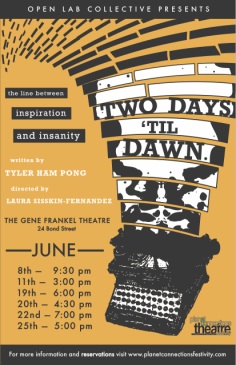
Two Days 'Til Dawn


[spoilers below]

Sol is in trouble. No matter how hard he tries, he cannot write anymore. He can drink. He can make a mess. He can whine. He can speak with great eloquence. He can have a nervous breakdown and chat with  literary figures of the past. But he cannot write. He didn't even win the poetry contest he entered. His wife did.

And here's where Two Days 'Til Dawn, by Tyler Ham Pong, starts to fall apart. Or maybe it would be more accurate to say that it splits into two.

On one hand, we have Sol's fantasy world. Pong shows some originality here, and while the visits from the literary figures are a little mannered and predictable, they are intriguing. The play that takes place in Sol's head has the potential to be an interesting one.

The play that takes place in Sol's life, however, is overloaded and unrealistic. Sol's a novelist, so his wife keeps asking him why he writes poetry at all--but he came in second in the contest, which surely shows some talent. And while his wife is worried that Sol will find out that she won the contest--she entered anonymously--it turns out that he has known all along. But there is no explanation of how he knows, which makes it sound as though there are maybe five poets in the entire world entering contests.

Also, while the prize for the contest is never specified, it sounds like much more money than any poet ever gets for anything. Sol also seems to have made an unusually large amount of money for his fiction. And all this matters, because it turns out that Sol's brother Charlie has been stealing from him due to jealousy, resentment that Sol never told Charlie that Charlie was adopted, and greed. This ostensibly major revelation has little emotional punch because the audience hasn't had the opportunity to get involved with Sol and Charlie as people, and because the combination of the writer's block, the writing competition between the spouses, Sol's nervous breakdown, and Charlie's betrayal is too much for a one-hour play. Oh, and there's maybe a baby who died and maybe a pregnancy now.

The play might have come across better if director Laura Sisskin-Fernández had insisted that her actors consistently enunciate and project, and if she had enticed better performances out of the three supporting cast members. On the other hand, Geoffrey Pomeroy as Sol is nothing short of amazing. He inhabits Sol fully and bravely, and he makes sense of the character's ups and downs and ins and outs, even bringing a bit of charm to his despair.

While there is much wrong with Two Days 'Til Dawn, Pong is a writer to keep an eye on. He aimed high with this show, which is admirable, and there were definite moments of wit, lyricism, and intelligence.

(press ticket, fourth row on the aisle)

Sunday, June 19, 2011

Finding Elizabeth Taylor

Elizabeth Taylor
as Elizabeth Taylor

The one-woman show Finding Elizabeth Taylor started late today because of technical difficulties. At one point, the star and playwright, Elizabeth Taylor, came out and chatted with the audience. She took questions, and she was charming and funny. Unfortunately, she was less interesting during the actual show.

Finding Elizabeth Taylor is a series of scenes about this Elizabeth Taylor's life. Sometimes Taylor plays herself, sometimes other people, and sometimes the world-famous Elizabeth Taylor. The scenes are separated by screens moving across stage, leaving various props and furniture as they go. The screens soon become annoying and give a staccato feel to the show.

Taylor is a good actress and a good writer, but the show doesn't coalesce. The charming person who took questions isn't there, and the show wanders from theme to theme (individuality, dealing with ridicule, weight issues, activism) without adding up to a cohesive whole. I admire Taylor's energy and skills, and I appreciate that she works so hard to show rather than tell. However, some narration might give the show a much-needed spine. As it is, Finding Elizabeth Taylor is too scattershot to be the show that it might be.

(press ticket, fourth row)

The Eyes of Babylon


By coincidence, I saw three plays about soldiers in Iraq this weekend (in order of viewing): Ajax in Iraq (not reviewed), Goliath, and The Eyes of Babylon. The Eyes of Babylon is the only one that was written and acted by a Iraq war veteran. How odd, then, that it turned out to be anticlimactic.

Jeff Key joined the marines in his thirties, eager to defend the constitution, protect defenseless people, and promote peace on earth. Once in Iraq, he had to deal with the fact that he was doing none of those things. In addition, as a gay man he was forced to stay in the closet, which is a galling location for someone whose dream is to fight for freedom for all.

The Eyes of Babylon is structured as a series of vignettes based on Key's journal entries, some of which are considerably more compelling than others. The best is the story of flirting with an Iraqi man in a code that they invent as they speak. Key is also good with the particulars of daily noncombat life as a marine in Iraq, from the sort of food eaten to the interactions with other marines to the graffiti on the walls of the port-o-potty. But the show meanders and runs too long, and Key is not a good enough performer to bring to full life the other people he wants us to meet. By the time Key is sent home for hernia surgery, The Eyes of Babylon has lost its focus.

Key has a lot to say, and his writing is often strong. However, I would have been more affected by The Eyes of Babylon as a series of essays.

(press ticket, third row on the aisle)