Cookies

Memaparkan catatan dengan label Stephen Sondheim. Papar semua catatan

Khamis, Ogos 22, 2024

Sondheim: His Life, His Shows, His Legacy (Book Review)

On one hand, there could never be too many books about Stephen Sondheim. On the other hand, each book should be able to justify its existence through untold stories (are there any?), a new point of view, or access to previously un-interviewed people. 

Sondheim: His Life, His Shows, His Legacy, by Stephen M. Silverman, justifies its existence in a number of ways. It's thorough (though not quite complete, since Here We Are opened too late to be included, except in passing). It is a large and handsome book, with dozens of photos, many of them in color. It includes a bibliography, source notes, and index, and is all in all a classy book. And yet.

It's just not that good a book. 

Silverman is frequently inaccurate. For example, he writes that Mandy Patinkin won a Tony as Best Actor in a Musical for Evita, when he actually won for Best Featured Actor.

Here's another example, about Night Music

A musical duel, set in waltz time, between Fredrik and the Count, "In Praise of Women," takes place before an actual duel with firearms. Said duel leads to young wife Anne running off with Henrik, Fredrik's sexually frustrated seminary student son.

Well, no. The duel takes place after Anne and Henrik run off. In fact, the only reason Fredrik agrees to the duel (Russian roulette, actually) is that he is in shock from losing his wife and son and not thinking straight.

The quote above can also be used as an example of another weakness of the book: an oddness in presenting information. Why specify that "In Praise of Women" is in waltz time when the whole show is in waltz time or variations thereof? Isn't that the more salient point?

And some of Silverman's conclusions are just bizarre. Here is an example:

It was said, just as it later was of Sondheim, that Babbit's "difficult music" required repeated listening before it could be appreciated, even comprehended.* [Asterisk in original]

[The footnote:] *Which might explain the line in Merrily We Roll Along, when the producer tells the crestfallen theatre hopefuls, "It's not a tune you can hum."

Why attach that line to Babbit when it was completely and 100% about Sondheim and his work--and is based on, at least to some extent, Sondheim's experiences getting his foot in Broadway's door?

Here's another example of the klutziness of the writing:

"One of the things I couldn't care less about is posterity," said Stephen Sondheim. "If you can't enjoy life while still alive, what is the point?"

As usual, he gave the statement a quick second thought.

"However, while I'm still alive, I'd like my shows to be done as much as possible.

That's not a second thought! That's more of the first thought!

And, and this is a big and, Silverman tells the famous story about Ethel Merman, Loretta Young, and the swear jar, and makes it not funny. (I guess, in its own way, that's an impressive accomplishment.) Sondheim tells the story here.

Am I picking nits? Yes. But there are an awful lot of nits in this book. Here are some more:

  • Pacific Overtures: [The song being referenced is] "Next," of which it could be said that it is to Tokyo what Company's "Another Hundred People" is to New York City. 

  • Merrily: The theme of the 1934 play and the 1981 musical and, presumably, the 2040 movie is that ambition trumps friendship. 

  • In keeping with the narrative structure of Merrily We Roll Along--which is told in chronological order but backward--this book's account of Sondheim's musical begins in the the future, with what will be [the movie's] 2040 premiere ... 

  • Pacific Overtures: The placid "Pretty Lady" is sung by three foreign sailors positioning themselves to take unfair advantage of an innocent Japanese woman. 

  • Sweeney: [Mrs. Lovett's] business success is short-lived, however, when Mrs. Lovett herself ends up in the oven at the hands of Sweeney, who disposes of her for having kept secret that the insane beggar woman on the street is, in fact, Barker's wife. After this horrible moment, the apprentice, Toby, slits Barker's throat out of an act of love for Mrs. Lovett. 

  • Pacific Overtures: "Chrysanthemum Tea, like A Little Night Music's "A Weekend in the Country," advances the action, but this time with lyrics delivered by a shogun's mother as she slowly poisons her son.


 Completist Sondheim fans may want to own Sondheim: His Life, His Shows, His Legacy. It does cover Sondheim's whole life, and nearly all his work. It does allow a trip down "Memories-of-Sondheim Lane." If only it were better.

Wendy Caster

Selasa, April 23, 2024

A Little Night Music

A lovely production of A Little Night Music is running at Theatre 2020 in Brooklyn Heights thru May 12th. I highly recommend it.

The show has some excellent acting and much wonderful singing. Josh Powell as Frederik Egerman and Maria Tramontozzi as his much younger wife Anne are among the best of people I've seen in those roles, and I've seen a lot of people in those roles. Alex Kopnick's gorgeous projections provide an enjoyable and convincing sense of place. The direction of David Fuller and Judith Jarosz captures both the humor and wistfulness of the piece. 

And it's unmiked! People's voices flow from their actual mouths! 


One of the production's biggest strengths is its use of nontraditional casting. It's great fun to see people triumph in roles that they usually wouldn't even be considered for. 

Projection by Alex Kopnick
Photo: Amy Schachter

Granted, the show suffers some of the problems of very-low-budget shows: a piano rather than an orchestra, no scenery or props, unimpressive costumes. How, this production gets Night Music's essential Night Music-ness. I already have my ticket to see it again. 

Wendy Caster

***

Two little suggestions: (1) At the beginning of the show, project the time and place of the show to orient newcomers (not everyone in the audience has already seen Night Music a dozen times!) (Just most.) (2) While the show gets away without props, relying on much miming of drinking schnapps, etc, you gotta have a rope. Again, remember the newbies.


Rabu, Ogos 16, 2023

Sweeney Todd: The Demon Barber of Fleet Street

If I were forced to name one favorite show, it might well be Sweeney Todd. (Actually, it would be Sweeney-Night Music-Follies, but that's cheating.) Sweeney's size, wit, pathos, beauty, and lushness add up to an evening of riches. It can also be enjoyably frightening.

The current Sweeney, starring Josh Groban and Annaleigh Ashford, leans heavily on the wit and humor (and, unfortunately, shtick), leaving it less emotional and devastating. However, it is beautifully sung and often quite funny, and its (relatively) large orchestra is a gift. 

I have in the past discussed with friends whether Sweeney and Mrs. Lovett ever had sex. Most of my friends said no. I thought they did, although not necessarily good sex. In this production, they are definitely lovers, and they enjoy each other. Whereas most of the Sweeneys I've seen have sung "A LIttle Priest" with humor, they have still been somewhat stiff, definitely damaged. Groban's Sweeney is loose, giggly, and even flirty, and it's nice to see Sweeney having fun for once. While the production's emphasis on humor undercuts its power, having Sweeney like Mrs. Lovett makes her betrayal hit particularly hard.

Josh Groban lacks the gravitas to totally pull off Sweeney, but his voice is gorgeous. Annaleigh Ashford carries her shtick too far into the story, undercutting the show's impact, but she is frequently wonderful.

The direction is messy. Sometimes it is impossible to find what you should be focusing on. And, ironically enough, despite the production's humorous bent, it misses some of the best jokes in the show. Also, the choreography is a total minus for the show and completely unnecessary.

Overall, though, this Sweeney is well worth seeing. While not the best version I've seen, it is solid. And, oh, that music!

Wendy Caster 

Selasa, Mei 16, 2023

Assassins

The Gallery Players production of Assassins is unfortunately not up to its usual standards. I admire the ambition of attempting Assassins, with its non-plot, odd politics, long swaths of spoken scenes, and challenging score. But: Some of the performers didn't sing well enough or act well enough. A few were completely miscast. The band lacked cohesion, and the sound design didn't help it or the performers. The sound effects didn't work: the noises of a bottle-making factory sounded more like someone snoring, and the gunshots were too low and distant to discomfort the audience as they should. Some of the costumes didn't work; in particular, John Wilkes Booth's suit seemed more appropriate for a comedian than a dashing serious actor. The lighting was occasionally murky.

Weirdly enough, however, I would not dissuade you from going. Despite its many flaws, the production was ultimately disturbing in the right way.

Wendy Caster


Selasa, Februari 21, 2023

Sunday in the Park With George

As made clear in James Lapine's must-read Putting It Together (review here), the development of his and Stephen Sondheim's Sunday in the Park With George was hectic, odd, and messy. In many ways, the show is too.

Sunday grew out of Lapine's and Sondheim's imaginative responses to Georges Serault's masterpiece, "A Sunday on the Island of La Grande Jatte," and their ideas on the creation of art (spoiler alert: it isn't easy). While most musicals might be seen as equivalent to novels, Sunday is an anthology. The result is sporadically brilliant, often gorgeous, occasionally boring, and sometimes off-putting. Many people love it; many hate it. I'm somewhere in between: I love parts of the show ("Finishing the Hat," "Sunday," "Move On," etc.) and could definitely live without the rest of it.

Photo by David Fuller

I've previously seen different versions of Sunday on Broadway, with full(-ish) orchestras and star casting. Theatre 2020's current uneven production is my first little Sunday. Having loved little versions of Follies and Night Music, I was intrigued to see how little Sunday would work.

First to be considered is the lack of an orchestra. While musical director Michael O'Dell is truly heroic on the sole piano, the other instruments are missed--that's just a given. On the other hand, the actors are unmiked, and that is a complete pleasure.

The show is performed without a conductor. While many piano-only shows are conducted from the bench, O'Dell is more than fully occupied playing the two or three million notes in the score. Considering that Sondheim is famous for producing difficult songs with odd timing, the cast's singing without being conducted is truly impressive. 

Josh Powell, Rae Hillman  
Photo: John Hoffman

Then there are the physical aspects of the show. The Theatre 2020 production is done on a bare stage with the occasional bench brought on and off and projections/video upstage. Projection/video designer Alex Kopnick's work is imaginative and attractive.

The costumes are less successful. While limitations are acceptable in a small production, sloppiness isn't. Dot's bustle is distractingly misshapen; Jules' clothing fits badly, undercutting a character who would likely be immaculate; some items referred to in the score--a hat, a parasol, etc--are simply missing; some costumes are remarkably unbecoming to their wearers. 

The cast and the direction are uneven. Rae Hillman, who plays Dot/Marie, took over the part after the first performance when the original performer fell ill. While she would profit from more prep time and direction (duh), she gives a solid, confident performance. George/George is, unfortunately, out of his depth here. Rather than being intense and art-centered, with an underlying sexiness and tenderness, this George is  petulant and whiny.

Standouts in the rest of the cast include Caryn Hartglass as the Old Lady/Blair Daniels. She makes "Beautiful" a highlight of the show. (She also gets the two of the best costumes.) Albert Neithropp impresses as Soldier/Alex; he is the George understudy, and I would love to see him in the role. And Raffaela Cicchetti (Louise/Photographer and Museum Assistant) is the rare adult who can totally pull off a kid's role without looking like an adult pulling off a kid's role. 

Director David Fuller pushes for too much theatricality in the acting for a small space and the movement lacks a certain polish. 

Sunday in the Park With George is an ambitious choice for a small theatre, and Fuller and O'Dell ultimately give us a decent, occasionally quite-good production.

Wendy Caster

Jumaat, Mac 11, 2022

Anyone Can Whistle: MasterVoices

The MasterVoices' concert of Anyone Can Whistle was a lovely and poignant reminder that although we have lost Stephen Sondheim, we will always have his work. And, oh!, that work!


Elizabeth Stanley
Photo: Nina Westervelt

Anyone Can Whistle is, to say the least, a problematic musical, bloated here, thin there, sometimes smart but too often cutesy. But the score includes gems: in particular, "There Won't Be Trumpets," "Anyone Can Whistle," and "With So Little to Be Sure Of." And, like all of Sondheim's work, Anyone Can Whistle rewards multiple hearings and viewings. I have known the original cast recording by heart since the late 1970s, yet I was surprised and delighted over and over again by Sondheim's brilliance, humor, and heart.

The cast of the MasterVoices concert was uneven. Elizabeth Stanley was magnetic, brilliant, moving, thrilling, superb, and fabulous. On the other hand, Vanessa Williams was little better than mediocre; frequently, she seemed uncomfortable with the music, and she lacks the presence necessary to give dimension to the Mayoress. She just wasn't interesting. Santino Fontana is always likeable, and he has a lovely voice, but his performance was bland. While Stanley prepared for and gave a full performance, Williams and Fontana seemed less prepared, and they sang songs rather than playing characters.

One of the highlights of the evening was Joanna Gleason's entrance (she narrated the show). Over 2,800 people greeted her as an old friend, roaring and clapping as she beamed with pleasure. And of course she was wonderful as the narrator. 


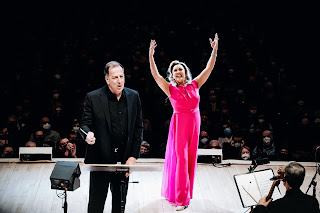
Ted Sperling, Vanessa Williams
Photo: Nina Westervelt

Ted Sperling did a nice job as director and an excellent job as conductor. The orchestra sounded terrific. The MasterVoices chorus was entertaining but underused. Weirdly enough, the sound was erratic. Carnegie Hall is famous for its acoustics, and during intermission my friend told me of sitting in the last row of the highest balcony years ago and hearing every unmiked word. I guess the miking was a problem, because the sound was sometimes murky, and occasionally crackly, with much dialogue completely lost.

Before the concert started, Sperling spoke a few words of introduction. He showed us his vocal score, given to him by Victoria Clark in 1984. It was a mistake to put Victoria Clark in our minds, because it was so easy to imagine how amazing she would have been as the Mayoress. 

But the evening's two stars made it a concert well worth seeing: Stephen Sondheim and Elizabeth Stanley. They made astonishingly beautiful music together.

Wendy Caster

Rabu, Mac 20, 2019

MasterVoices: Night Songs And Love Waltzes

MasterVoices (formerly known as the Collegiate Chorale) has a long history of presenting wonderful evenings of song and theatre, and Night Songs and Love Waltzes fit right in. (There's also every reason to believe that MasterVoices' presentation of Lady in the Dark, starring Victoria Clark, will also be wonderful. For more info, click here.)

Night Songs and Love Waltzes was the work of many people, and they all deserve shout-outs.

Ted Sperling. The artistic director and conductor, Sperling loves his work and shares that love generously. And his taste and conducting are superb. When I see his name, I relax in the knowledge that I'm going to have a good time.


Ted Sperling

MasterVoices Singers. I love big groups of people singing, and MasterVoices' 120 singers sound glorious together. It's a thrill whenever they sing.

The Soloists. Nicole Cabell (soprano), Kate Aldrich (mezzo-soprano), Nicholas Phan (tenor), and Nmon Ford (baritone) acquitted themselves nicely throughout. 

Stephen Sondheim. He's Stephen Sondheim, y'know? And his music for A Little Night Music is some of the most luscious in his brilliant and insanely rich oeuvre. Ted Sperling made an arrangement of those Night Music songs originated by its quintet/chorus--including a song that didn't make it to the finished show--and the result is sheer pleasure.

Ricky Ian Gordon. Gordon's music is often stunning, and his Life is Love, a song cycle to poems of Langston Hughes, is beautiful.

Anderson & RoeGreg Anderson and Elizabeth Joy Roe play piano(s) with proficiency, brilliance, energy, humor, and a touch of insanity. They are fabulous musicians and incredible showpeople.

Anderson (right) & Roe

Brahms, Mendelssohn, Schumann (Clara and Robert), and Schubert. At the risk of revealing my middle-brow-ness, I appreciated rather than loved their pieces. In truth, I was counting the minutes until the work of Sondheim, Gordon, or Anderson & Roe.

The Musicians. When I initially saw cellists Peter Sachon and Mairi Dorman and the horn quartet led by Zohar Schondorf, I thought they made up an odd combination of instruments. Sperling, of course, knows better than I, and the band was terrific and just right.

Alice Tully.  Alice Tully, who died in her early 90s in the early '90s, was originally a singer but ended up focusing on philanthropy once she inherited her family's significant fortune. She pretty much paid for Alice Tully Hall, where Night Songs and Love Waltzes was performed, but she only allowed it to be named after her once she made sure it was up to her standards in acoustics and leg room. The result is a perfect venue in which to hear music, and it is much warmer in mood than its larger siblings in Lincoln Center.

All in all, Night Songs and Love Waltzes soared.

Wendy Caster
(mid-orchestra center)

Isnin, Mei 07, 2018

Follies

How much did I enjoy the APAC production of Follies? I've already purchased my ticket to see it again.

APAC (Astoria Performing Arts Center) has an excellent reputation and many awards, as well it should. Even with limited resources, APAC provides top-notch productions again and again. (See my review of Merrily We Roll Again here.)
How do they do it? I think a big part of the answer has to be Artistic Director Dev Bondarin.

Nailing "The Mirror Number":
Andrea McCullough, Victoria Bundonis,
Tina Stafford, LaDonna Burns,
Marcie Henderson, Denise DeMars,
Rusty Riegelman.
Photo: Michael Dekker

In this production, as the other shows she has directed, Bondarin honors and trusts the work. This Follies has plenty of flaws, as might be expected with an Off-Off-Broadway group choosing such an ambitious project, but that's okay: the important thing is that Bondarin has nailed the show's true Follies-ness. She is a smart director who eagerly serves the work, and this production is full of her smart decisions. The result is more excellent theatre than we the audience have any right to expect for a ticket price of $18! ($12 if you're a student or senior.)

So, yes, this isn't a star-studded production. The production values could be higher. Some performers aren't quite up to the task (though many others are quite good). But this Follies sings, it dances, it feels. It's Follies. If those two words have any meaning to you, make sure to catch this show. Tickets are available here. You'll rarely in your life get such value for your money.

Wendy Caster
(press ticket, 5th row)
Show-Score Score: 90

Cast: Denali Bennett, Victoria Bundonis, LaDonna Burns, Denise DeMars, Tia DeShazor, Susan Cohen DeStefano, Christine Donnelly, Andrea Dotto, Dan Entriken, Jonathan Fluck, Spencer Hansen, James Harter, Marcie Henderson, Greg Horton, Kathleen LaMagna, Andrea McCullough, Sharaé Moultrie, Ben Northrup, Rusty Riegelman, Bruce Sabath, Carolyn Seiff, Cliff Sellers, Lauren Alice Smith, Tina Stafford, Noah M. Virgile, Mandarin Wu.

Production Staff: Director: Dev Bondarin; Musical Director: James Higgins; Choreographer: Sara Brians; Set Design: Ann Beyersdorfer; Costume Design: Jennifer Jacob; Lighting Design: Annie Wiegand; Sound Design: Caroline Eng; Prop Design: Andrew Short; Production Manager: Annie Jacobs; Production Stage Manager: Jessica McIlquham; Assistant Stage Manager: Robert Peatman.

Selasa, November 21, 2017

Follies (National Theatre Broadcast)

You just never know how something is going to hit you. Last night I saw the National Theatre Broadcast of Follies with five friends. Among us, we have easily seen 80 live performances of Follies, including the original, the one in England in the 1980s with Diana Rigg, the concert version with Barbara Cook, Roundabout's, Encores!'s, the one with Bernadette Peters (in D.C. and in New York), Signature's (Arlington, VA), St. Bartholomew's, Paper Mills's, and a couple up in the Berkshires, many of them multiple times. We could probably perform the damn thing.

Photo: Johan Persson

We sat in a row. And the three of us sitting to the right liked it, and the three of us sitting to the left hated it. It was as though a line had been drawn in the middle, and we had completely different experiences on either side of it. (With one exception: we all loathed Tracie Bennett's version of "I'm Still Here.")

You never know.

Jumaat, Jun 16, 2017

Pacific Overtures

I am not a fan of John Doyle's, as evidenced in my review of his production of Passion, so I didn't plan to see his production of Pacific Overtures at CSC. But three things changed my mind: (1) a friend saw the show and said that the singing was excellent; (2) the stage had been reconfigured from the CSC's usual awkward layout with its problematic sight lines; and (3) inexpensive tickets became available through the Theatre Development Fund. So I decided to go, just keeping my expectations low.

And I had a wonderful time.


(By the way, if you're not familiar with Pacific Overtures, you can find out more about it here and here.)

Isnin, Mac 27, 2017

Best Worst Thing That Ever Could Have Happened

Best Worst Thing That Ever Could Have Happened, Lonnie Price's documentary on the making of Merrily We Roll Along, is jammed with treasures, such as footage of auditions, rehearsals, and performances from the original production and then-and-now interviews with members of the original cast. What a disappointment, then, that it's not a particularly good movie.


It might have hit me differently if I knew less about Merrily. But I know a lot about it, and I was annoyed by what the documentary left out. For example, at one point the movie refers to the successful productions after the original disaster. But no one mentions that it was extensively rewritten. I was also annoyed that so many cast members were barely mentioned or not mentioned at all. Surely it's worth a few seconds to acknowledge the presence of Liz Calloway and Giancarlo Esposito? It certainly would have been a better use of the movie’s precious minutes than the cliché shots of spooling film and of Manhattan that Price uses instead.

Rabu, Oktober 26, 2016

Sunday in the Park With George

I wasn't even planning to see this brief production of Sunday in the Park With George, starring Jake Gyllenhaal and benefiting City Center. It's not my favorite Sondheim show, and my life has been a bit topsy-turvy recently, etc, etc. But a truly fabulous friend got us tickets, and, oh boy, am I grateful. I still find the show to be uneven and awkward as a whole, but this Sunday swept my reservations aside and replaced them with tears, laughter, and awe.


Gyllenhaal's voice didn't particularly impress me in Little Shop of Horrors, but he has clearly worked very hard since then to make it the best instrument it could be. He was wonderful. Sunday is odd in that George doesn't have a big number until seven songs in. We do get to see and hear what he wants--Dot to stay still, order, design, composition, tone, form, symmetry, balance, a new way of seeing and showing the world--but he isn't really fully dimensional until "Finishing the Hat." There was a little bit of suspense--how would Gyllenhaal do? Gyllenhaal did good! He gave us a gorgeous, emotional, character-defining version that made the song sound yet again new.

Annaleigh Ashford as Dot gave a full-blooded, human, funny-touching, beautifully sung performance. She was an excellent match for Gyllenhaal, the ideal bright yang to his dark yin. And their "Move On" was glorious, glorious, glorious.

But Gyllenhaal and Ashford were far from the whole story. Any show that has the brilliant Ruthie Ann Miles in a small supporting role and the insanely talented Michael McElroy in the ensemble is clearly presenting an embarrassment of riches. (Here's the rest of the amazing cast: Brooks Ashmanskas, Phillip Boykin, Max Chernin, Carmen Cusack, Gabriel Ebert, Claybourne Elder, Lisa Howard, Zachary Levi, Liz McCartney, Stephanie Jae Park, Solea Pfeiffer, Gabriella Pizzolo, Phylicia Rashad, Jaime Rosenstein and Lauren Worsham. I mean, really!)

Ben Brantley wrote in the Times, "this is one of those shows that seems destined to be forever spoken of with misty-eyed bragging rights by anyone who sees it." Forget bragging rights--someone has to video this production! It was too wonderful to be limited to the relatively few people who were able to see it at City Center.

(4th row balcony; ticket was a gift from amazing friend)

Ahad, Ogos 28, 2016

The Tony Awards: 1970 to 1974

Some friends and I are working our way through past Tony Award shows, and it's been a surprising journey in many ways. This past week, we watched 1970 through 1974. The Tony gestalt has changed a lot over the years. (If you want to watch some shows yourself, here's a place to start; also, the Tony website is starting to put up some telecasts).

Glynis Johns in A Little Night Music

The most striking difference is that the telecast was not treated as an extended advertisement for then-current Broadway musicals. In fact, many nominees were not represented by scenes at all: Company, Follies, A Little Night Music, The Rothschilds, The Me Nobody Knows, Two Gentlement of Verona, Grease, Irene, and Shelter. Yes, some of them had already closed, but many were still running.

In contrast, Applause had numbers on not one, but two Tonys. And the scene from Coco in 1970 included an extensive dialogue scene (with some breathtakingly bad acting by Gale Dixon) and a fashion show and Katharine Hepburn giving her impressive all to singing/massacring "Always Mademoiselle" in a truly unparalleled performance.

Selasa, Disember 22, 2015

On Sondheim: An Opinionated Guide (book review)

In the introduction to Ethan Mordden's On Sondheim: An Opinionated Guide, Mordden writes, "My intention is to bring the reader closer to Sondheim's oeuvre, to explore his unique approach to the creation of musicals while trying to position him in relation to developments in Western art, especially in twentieth-century music and theatre." He goes on to say, "I have endeavored to address all readers simultaneously, from the aficionado through the average theatregoer to the newcomer whose familiarity with the subject is still in process."

Mordden achieves his first goal sporadically and the second less so. Trying to appeal to aficionados, average theatregoers (as though there were such a thing!), and newcomers simultaneously is like trying to teach addition, geometry, and calculus simultaneously: everyone ends up short-changed. Not to mention that the book clocks in at a spare 186 pages, which would be hardly enough for any one audience, let alone all three.

Mordden's book is in three parts: (1) opening essays: "An Introduction to Sondheim's Life and Art" and "Sondheim's Mentors and the Concept Musical"; (2) brief chapters on each of Sondheim's shows in chronological order; and (3) chapters about Sondheim on film, books on Sondheim, and albums/CDs featuring Sondheim's music.

The opening essays are reasonably interesting, if meandering. There is little new here for aficionados, however, and it's difficult to imagine many newcomers or "average theatregoers" enjoying them. Of course, that might be a lack in my imagination rather than Mordden's writing.

Ahad, Mei 10, 2015

Merrily We Roll Along

The Astoria Performing Arts Center (APAC) is presenting an excellent production of Merrily We Roll Along, and you've got two more weekends to catch it. With a top ticket price of $18, it's quite a bargain.

Park, Bonino, Mosbacher, Rhodes-Devey, Horton
As you likely already know, Merrily was written by Stephen Sondheim and George Furth (based on the drama by Kaufman and Hart), is told backward, and was a huge flop when it opened on Broadway in the 1980s. It has since been rewritten in ways that both add to and take away from the original, but the basic story has remained the same: Franklin, Charley, and Mary are three best friends, artistic and ambitious, whose lives fly off into different trajectories that tear the friendship apart.

Sabtu, Januari 17, 2015

Into the Woods

Jim Cox
No, this isn't a review of the movie. I'm talking here about the Fiasco Theater production, which is currently in previews Off Broadway at the Laura Pels Theater. It's terrific: innovative, warm, funny, sad, infectiously goofy, and performed by a charming cast that lacks the studio-scrubbed pipes and carefully groomed good looks of the cast featured in the film. I'm paying the company a complement, by the way, and not implying that they're ugly--though if they were, that'd be cool, too. Into the Woods, after all, purports to be about our favorite fairy tale characters, but it's really about how messy and flawed and directly contradictory human beings are. Botoxed actors who wear their rags perfectly, and boast artful smudges on their faces, are kind of missing the point. 

So are productions (and films) that take the woods literally, at least as I now see it. Don't get me wrong: I saw the original Broadway production many years ago, and the film version about a month ago, and I thought both were fine. But neither one caused Into the Woods to work its way into my blood, brain, and soul the way that, say, past productions of Follies, Company, and Sweeney Todd have. I know plenty of people for whom Woods is top tier Sondheim. But me? I've just never understood what the fuss was about.

Sabtu, Disember 27, 2014

Film Review: Into the Woods

It's not good. It's not bad. It's just nice. And perhaps that's why the long-awaited film adaptation of Stephen Sondheim and James Lapine's Into the Woods, which opened Christmas Day, is largely a disappointment. Directed by Rob Marshall, it is slick, stylized, and without much spark, not unlike Marshall's other two high-profile forays into movie musicals, Chicago (2002) and Nine (2009). The sets and costumes are beautiful. The performances are all professional and proficient, some are even great. The pace is spry. Yet the endeavor stops short of being wholly satisfying. It feels strangely empty in a way that even the less-than-perfect stage productions of this musical I've seen over the years never have.