Cookies

Memaparkan catatan dengan label Tennessee Williams. Papar semua catatan

Isnin, Ogos 14, 2023

Orpheus Descending

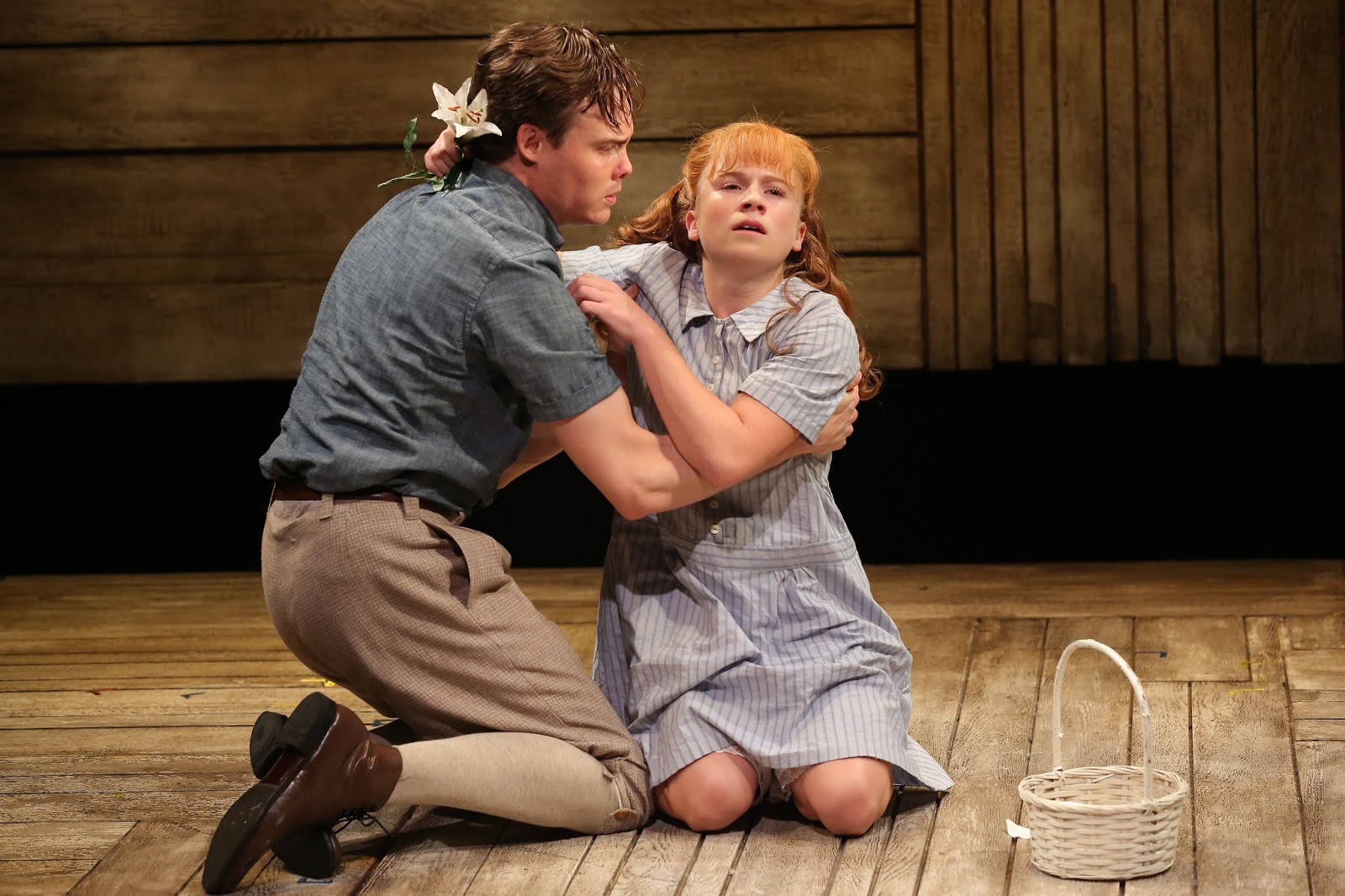
Tennessee Williams’s play Orpheus Descending (recently at the Theatre for a New Audience) was the first of his works to be produced. While it is not one of his masterpieces, it is still rich, sad, funny, fascinating, and compellingly overwrought.

As described on TFANA’s website, the play “tells the story of the passion of two outcasts—Lady Torrance, a storekeeper’s wife and daughter of a murdered Sicilian bootlegger, and Val, a wandering guitar player—and their attempt to escape from a Southern Hell.”


Lady (the excellent Maggie Siff) and Val (Pico Alexander) must negotiate dealings with a wide variety of townspeople: Maggie’s husband, deathly ill but still quite powerful and mean; Carol Cutere, a needy young woman with little chance of ever getting her needs met; Vee Talbott (the wonderful Ana Reeder), who turns her religious visions into paintings; and her husband, the sheriff, who operates in a much more concrete–and dangerous–manner. There are also the town gossips, Maggie’s husband’s nurse, and others. 

Lady and Val exist in a different world than the rest of the town, and they inevitably get involved, despite the dangers of doing so. They talk and actually listen to each other, they understand each other, and they are deeply drawn to each other physically. Most importantly, they find hope in each other.

Erica Schmidt’s direction of the TFANA production left much to be desired in terms of clarify and use of space. The cast was uneven. Maggie Siff had the presence and skill necessary to ground the play in the underpinning of reality that it needs. Pico Alexander lacked the animal magnetism required by his role, which threw off the balance of the play. But all in all, the TFANA production was vibrant and alive.


Wendy Caster


Khamis, Mei 18, 2023

Blanche: The Life and Times of Tennessee Williams's Greatest Creation (book review)

I reviewed Blanche: The Life and Times of Tennessee Williams's Greatest Creation at Talkin' Broadway:

Blanche: The Life and Times of Tennessee Williams's Greatest Creation, by Nancy Schoenberger, is an odd little book. Saying that it runs some 193 pages of actual content is generous, as that includes a number of white pages, a faux obituary of Blanche DuBois, and four pages of sonnets, created by Schoenberger, that purport to be what Blanche's long-dead young husband might have written (!!!). Trimmed of its repetitions, the book could have made a fairly interesting long essay in The New Yorker or The New York Review of Books.

continue reading 


 Wendy Caster

Isnin, September 24, 2018

A Lovely Sunday for Creve Coeur

A Lovely Sunday for Creve Coeur is not one of Tennessee Williams's masterpieces, but it still deserves a better production than the one currently being presented by La Femme Theatre Productions. Director Austin Pendleton seems to think that Creve Coeur is a farce. It is not; it's a slightly hopeful tragedy with some humor. Pendleton does manage to get some laughs, but at the cost of the play's soul.

The situation is familiar: a high-strung Southern woman, Dotty (think Blanche from Streetcar), seeks love with a handsome, charming, well-off man whom she has "dated." Her older roommate, Bodey, wants to match Dotty with her twin brother, who is neither handsome nor charming (think Mitch from Streetcar). Dotty's workmate, Helena, wants Dotty to be her roommate, though she is more focused on Dotty's financial contribution than on Dotty herself.

Jean Lichty
Photo: Joan Marcus

Jean Lichty does a decent job as Dotty, particularly in the later scenes where she is allowed by the writing and the direction to be less frenetic. Kristine Nielsen's two-dimensional Bodey ignores the character's savvy and backbone, much to the detriment of the play. Annette O'Toole plays Helena as though she is a sitcom bad guy. I have to ironically tip my hat to Pendleton: getting bad performances out of Nielsen and O'Toole can't have been easy.

I saw a good production of Creve Coeur in 1990 at the San Diego Rep. While it could not cover the play's faults, it did express its heart and soul. I can't help wonder what the La Femme production might have expressed with a different director.

Wendy Caster
(press ticket; third row)
Show-Score: 65

Khamis, September 10, 2015

Desire

At first glance, The Acting Company's production of Desire would seem to be an evening of works by Tennessee Williams. After all, the six one-acts are ostensibly based on his short stories, and they burst with Williams-isms: the explosive horror of thwarted desire, needy heartbroken women, scared homosexual men, people unable to defy the world's expectations, glass figurines, even cannibalism. But the one acts offer us Williams' sensibility by way of Beth Henley, Elizabeth Egloff, John Guare, Marcus Gardley, David Grimm, and Rebecca Gilman. These playwrights bring much of themselves to the plays, and many of the results are vibrant, vigorous hybrids.

Mickey Theis, Juliet Brett
“The Resemblance Between a Violin
 Case and a Coffin”
Photo: Carol Rosegg
The evening begins with Beth Henley's "The Resemblance Between a Violin Case and a Coffin." Williams' short story is narrated by Tom, a young man uncomfortable with his homosexual urges and crushed by the loss of his older sister Roe--his one friend--to womanhood. Henley moves the focus to Roe, with Tom more of a supporting character, even giving Roe some of Tom's words. She retains, however, the focus on the high price of sexual desire.

When Richard Miles comes into their lives, his beauty and light throws both siblings for a loop. In the play, Tom's discomfort with his attraction to Richard is played somewhat for laughs, while in the short story Tom feels himself to be a monster. Roe's challenges remain the same. Simply put, her attraction to Richard takes away her power as surely as Samson's haircut removed his.