Cookies

Friday, September 28, 2018

Holy Ghosts

Nancy Shedman sits reading in a large-ish, empty, nondescript room. Her husband, Coleman, comes storming in, full of accusations and anger. Little by little the room fills, and Coleman realizes that they are about to have a Pentecostal service, complete with snake-handling. He ends up fighting with many of the people in the room, who are now his wife's friends. He won't leave because he wants his wife to return all the things she "stole" from him when she left him or perhaps even to come back to him. The congregants speak to him with surprising (but not unlimited!) patience, telling him stories from their lives. It's mostly a device to allow the writer, Romulus Linney, to help us understand why people might choose to express their spirituality in extreme ways. The show is about 80% exposition/story-telling, but it works, beautifully. (In terms of structure, it reminded me a bit of the first season of Lost, where we meet the characters one by one.)

Oliver Palmer and Lizzy Jarrett
Photo: James M. Wilson

I worked on the last New York production of Holy Ghosts, 40 years ago (I was show electrician). I was quite impressed with the show, but I thought it had a major flaw. It turns out that play holds up very well--and this production actually fixes the flaw!

A Chorus Line

It takes a lot of ambition to decide to do A Chorus Line at a small Off-Off-Broadway theatre. And it takes a lot of skill to pull it off. Luckily, the Gallery Players in Brooklyn have tons of both, and their production of A Chorus Line is fabulous.

Photo: Steven Pisano Photography

Directed by Tom Rowan, author of the book A Chorus Line FAQ, and choreographed by Eddie Gutierrez, who played Paul in national tours, the production hews faithfully and elegantly to the template set long ago by the brilliant director/choreographer Michael Bennett. The familiar ensemble dance numbers and solos are all there, at a remarkably high level. A Chorus Line requires performers who can dance, sing, and act, and most of the cast at the Gallery Players can do all three, in some cases superbly.

Monday, September 24, 2018

The True

Is it ungrateful of me to wish that Sharr White's play, The True, presented by The New Group, had more to offer? Perhaps. After all, there is already much to like here: solid writing, smooth direction, and an amazing cast. But for all those strengths, I just didn't care.

John Pankow, Edie Falco
Photo: Monique Carboni

In all fairness, I mostly wasn't bored. I mean, look at this cast: Edie Falco. Michael McKean. John Pankow. Peter Scolari. Each and every one of them is a pleasure to watch, always. Falco, unsurprisingly, gives an excellent performance, and you can't keep your eyes off her as she talks, and talks, and talks, and talks. And curses and curses and curses.

Why is Falco's character such a gabber? Dorothea Noonan, known as Polly, is an essential component of the Democratic machine in 1970s Albany, and has been for years. She thinks she knows everything--she certainly does know a lot--and it takes many, many words for her to tell everyone around her how to live their lives, professionally and otherwise.

Noonan is a close friend and adviser to the mayor (McKean), but at the start of the play he has decided that he needs distance from her. This separation does not stop her from fighting for him behind the scenes, and she meets with the various men who will help decide whether he gets another term as mayor. (One theme of the play is how she is treated differently because she's female, but to me everyone was pretty obnoxious and she fit right in.)

Ironically enough, the most emotionally successful moment in the play is silent. (It would be a spoiler to say more.)

Some of the political machinations of The True are interesting. Some of the relationships look like they would be fruitful to explore. But as it stands, there is little reason to care about these characters, and the play ends up being about ploys rather than people.

Wendy Caster
(press ticket, row E)
Show-Score: 80

I Was Most Alive With You

Craig Lucas's new play, I Was Most Alive With You, is impressively ambitious. Performed simultaneously in English and American Sign Language (ASL), with some use of supertitles, it is an extended riff on the biblical story of Job. Ash, a TV writer in his 50s or 60s, and Astrid, his somewhat younger cowriter, decide to use the recent events of Ash's life as the content for their latest project. As they discuss the script, scenes are enacted as they may or may not have occurred in real life. Ash is the Job figure, and much is taken from him.

Marianna Bassham (Astrid), Michael Gaston (Ash),
Russell Harvard (Knox), Tad Cooley (Farhad)
Photo: Joan Marcus

Ash's son, Knox, is Deaf. Although he was brought up to speak and read lips, at the start of the play he will only converse in sign language, even though that leaves his mother, the over-ironically named Pleasant, out of the conversation. Knox is clean and sober (as is Ash). He is in love with Farhad, who is deaf but doesn't sign. (Lucas makes clear that there is a difference between Deaf and deaf, but it goes by quickly. His decision not to define or clarify the distinction makes sense, since this play is written for a Deaf audience as much as--if not more--than a hearing audience, though a bit of explanation might have helped the latter group without hurting the former.) Farhad is a drug user, and although Knox adores him, he will not actually become involved with him until he becomes clean and sober.

Other characters include Ash's mother, Carla, who learned sign language to communicate with Knox, and Mariama, a hearing friend of hers who signs fluently and joins the family on Thanksgiving to translate, mostly for the benefit of Pleasant. The character of Mariama also allows Lucas to add more discussion of religion and loss and belief to the play; unfortunately, she feels much more like a device than a person. But, in truth, only a few of the characters are fleshed out; the others are mouthpieces rather than people.

The Emperor

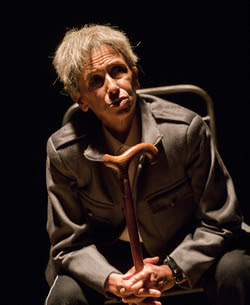
More like a magazine story brought to life than an actual play, The Emperor still has much going for it, the main things being the performances of the protean and ever-fascinating Kathryn Hunter and the music of Ethiopian musician Temesgen Zeleke. Based on interviews with actual servants of the Ethiopian dictator Haile Selassie, The Emperor weaves a vivid tapestry around a Selassie-shaped void. While he is not in the show per se, Selassie's effect, affect, and whims are everywhere and everything, as they were during his four-decade reign.

Photo: Simon Annand 

Adapted by Colin Teevan from Ryszard Kapuściński's book, The Emperor depicts how people are misshapen when they are forced to fit into small spaces with no freedom. The epitome of these characters may well be the servant whose job was to wipe the urine off of visiting dignitaries' shoes after the emperor's dog had peed on them. Many of the servants admired Selaissie and were proud of their jobs.

Is it strange that Kathryn Hunter plays all of these male African characters? Yes. No. Kind of. For me, her brilliance is its own excuse for anything she may choose to perform, although I completely understand why other people might disagree.

Photo: Simon Annand 

Is it strange that The Emperor is presented as a piece of theatre? Yes. No. Kind of. It has a limited point of view. It has no plot, story line, or arc. It almost completely lacks interactions. While it is arguably all about conflict, it has no conflict itself. In terms of any political or historical aims it may have, it somewhat succeeds, although other forms of delivery would have been more hard-hitting.

And is it strange that these stories of a country that was horribly oppressed, in which millions died of starvation, have ended up being about how brilliant one white actress is? Absolutely. Strange and horrible, really. But, for what little it's worth, it did motivate me to learn more.

Wendy Caster
(press ticket, row J)
Show-Score: 80

A Lovely Sunday for Creve Coeur

A Lovely Sunday for Creve Coeur is not one of Tennessee Williams's masterpieces, but it still deserves a better production than the one currently being presented by La Femme Theatre Productions. Director Austin Pendleton seems to think that Creve Coeur is a farce. It is not; it's a slightly hopeful tragedy with some humor. Pendleton does manage to get some laughs, but at the cost of the play's soul.

The situation is familiar: a high-strung Southern woman, Dotty (think Blanche from Streetcar), seeks love with a handsome, charming, well-off man whom she has "dated." Her older roommate, Bodey, wants to match Dotty with her twin brother, who is neither handsome nor charming (think Mitch from Streetcar). Dotty's workmate, Helena, wants Dotty to be her roommate, though she is more focused on Dotty's financial contribution than on Dotty herself.

Jean Lichty
Photo: Joan Marcus

Jean Lichty does a decent job as Dotty, particularly in the later scenes where she is allowed by the writing and the direction to be less frenetic. Kristine Nielsen's two-dimensional Bodey ignores the character's savvy and backbone, much to the detriment of the play. Annette O'Toole plays Helena as though she is a sitcom bad guy. I have to ironically tip my hat to Pendleton: getting bad performances out of Nielsen and O'Toole can't have been easy.

I saw a good production of Creve Coeur in 1990 at the San Diego Rep. While it could not cover the play's faults, it did express its heart and soul. I can't help wonder what the La Femme production might have expressed with a different director.

Wendy Caster
(press ticket; third row)
Show-Score: 65