Cookies

Saturday, March 08, 2014

The Architecture of Becoming*

What happens when you assemble five writers (Kara Lee Corthron, Sarah Gancher, Virginia Grise, Dipika Guha, and Lauren Yee) and three directors (Elena Araoz, Lydia Fort, and Lauren Keating) and set them loose on the topic of the history of New York City Center? 

Unfortunately, in the Women's Project's latest production, The Architecture of Becoming*, you get 90 minutes of ideas, concepts, stories, and attitudes that just don't gel. Rather than coming across as a play, or even a thematic series of one acts, The Architecture of Becoming* resembles nothing so closely as a high school sing, full of in jokes and attempted significance, and much more fun and meaningful for the creators and performers than for the audience.

*12/4/14: just discovered, to my embarrassment, that I had the title of this show wrong throughout the review. I wrote Architecture of Being (incorrect) instead of Architecture of Becoming (correct). My apologies to all involved.

Vanessa Kai, Danielle Skraastad
Photo: Carol Rosegg

Take Me Back

The not-quite-accurate publicity synopsis for Emily Schwend's new play Take Me Back goes as follows:
James Kautz
Photo: Russ Rowland
After a four-year stint in federal prison, Bill is back at home, living with his diabetic Mom and looking for a way out of Oklahoma. But today's America doesn't give a guy like Bill many options. How far is he willing to go to change his fortune? With a dose of melancholic nostalgia infused with dark humor, Take Me Back examines the impossibility of the American dream when surrounded by nothing but minimum wage Big Box stores and chain restaurants.
I would have liked to see that play. Instead, Take Me Back is another story about a jerky guy who is so committed to being a jerky guy that he cannot resist the opportunity to be, well, a jerky guy.

Thursday, March 06, 2014

Nothing on Earth (Can Hold Houdini)

Axis Company's Nothing on Earth (Can Hold Houdini), written and directed by artistic director Randy Sharp, has all the ingredients of a fascinating and thought-provoking thriller. Harry Houdini! Arthur Conan Doyle! Seances! Con artists! Yet the show is remarkably uninteresting, with 75 minutes of confusing build-up and 10 minutes of cop-out denouement.

Harry Houdini
Houdini, in addition to being an accomplished magician and the world's foremost escape artist, was devoted to exposing the tricks behind ostensible supernatural abilities. In contrast, Doyle, who was desperate to communicate with his late son, believed in spiritualism, fairies, automatic writing, and ectoplasm. Doyle was even convinced that Houdini himself had supernatural powers, despite Houdini's insistence that his tricks were just that: tricks. Their differences eventually destroyed their friendship. (It helps if you go in knowing this--and more--since the exposition is unfocused and unclear.)

Nothing on Earth begins in total darkness. (No exit signs? Is that even legal?) We see a ghostly figure float by. We hear spirits signaling their presence by pressing buzzers. And then the seance is cut short as Houdini turns on the lights and proceeds to explain how each effect was created: no spirits here.

By the time we get to the climactic seance. led by then-famous medium Mina (Margery) Crandon, we have heard many letters from Houdini to his wife, seen debates between Houdini and Doyle, and gotten a peek behind the scenes at the Crandons, all presented badly, with missing information, unsuccessful overlapping of dialogue, and a generally boring sloppiness.

Wednesday, February 19, 2014

Love and Information

Part sketch comedy, part minimalist drama(s), Caryl Churchill's Love and Information is unlike any show I've seen. Consisting of dozens of playlets, some barely a minute long, Love and Information amasses emotion, insight, and yearning bit by bit, line by line.

Top row: Irene Sofia Lucio, Noah Galvin
Bottom row: Karen Kandel, Adante Power, Zoƫ Winters,
James Waterston, Lucas Caleb Rooney
Photo: Joan Marcus

Take, for example, this section, called "Grief."
Are you sleeping?

I wake up early but that’s all right in the summer.

Eating?

Oh enough. Dont fuss.

I’ve never had someone die.

I’m sorry, I’ve nothing to say. Nothing seems very interesting.

He must have meant everything to you.

Maybe. We’ll see.

That's it. That's the whole thing, verbatim. In the New York Theatre Workshop production (at the Minetta Lane), which is beautifully directed by James MacDonald, it's performed by a young woman sitting in a chair and an older women on the floor, folding and putting away sweaters. It is a masterpiece of concision--one of many!

Thursday, February 13, 2014

The Correspondent

A door opens and closes, and two people walk into an expensive but messy apartment. The man, Philip (Thomas Jay Ryan), is in his 50s, white, well-off--the owner of the apartment. The woman, Mirabel (Heather Alicia Simms), is African-American, much younger, wearing an old jacket and carrying a backpack. They clearly do not know each other well. It is hard to guess what their relationship might be. And it's even harder to accept what it is.

Thomas Jay Ryan
Photo: Joan Marcus
Mirable is dying, and she has agreed to take a message from Philip to his late wife, Charlotte, killed just a couple of weeks ago in an accident. Philip has unfinished business with Charlotte: he's desperate to know if she forgives him for the awful fight they had just before she died.

Philip pays Mirable. She leaves. And the next night a letter appears in his hallway. A letter from Charlotte, full of things only she could know.

The Correspondent, slyly written by Ken Urban and smartly directed by Stephen Brackett, proceeds to take Philip and the audience on an intriguing and twisted journey, full of unanswerable questions. For the audience, the questions come in two categories. First, what are the characters up to? Who, if anyone, is telling the truth? Second, what is Urban up to? Is he trying to be thought-provoking or to thrill--or both? Do these goals get in each other's way?

I suspect that the answers to these questions will differ from viewer to viewer.

For this viewer, The Correspondent, at the Rattlestick Playwrights Theater, doesn't hold up to much next-day analysis, but that's okay. It's a well-constructed, largely entertaining, and mostly satisfying 90 minutes, and I enjoyed taking the twisted journey.

(third row, press ticket)

Wednesday, February 12, 2014

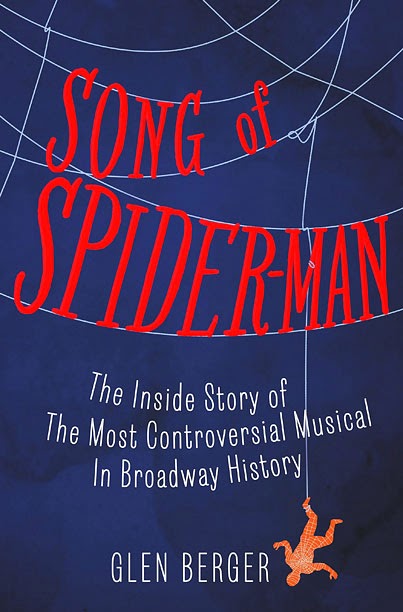
Book review: Song of Spider-Man: The Inside Story of the Most Controversial Musical in Broadway History.


No Broadway show in recent memory elicited a more potent blend of scapegoating and Schadenfreude than Spider-Man: Turn Off the Dark, which was conceived in 2002 by producer Tony Adams, scored by U2's Bono and The Edge, written by Glen Berger and Julie Taymor (and, later, sort of, Roberto Aguirre-Sacasa), directed by Taymor (and, later, sort of, William Philip McKinley), and which opened at the Foxwoods Theater on 14 June 2011. Between its conception and its opening night, the show went through enough trials and tribulations to make Job look like a dude who just hit a brief bad patch.

The efforts it took to get Spider-Man to the stage are the stuff of Broadway legend. It took three years to work out the creative team's contracts, and just as they were finally all being signed in The Edge's New York apartment, Tony Adams suffered a massive stroke and died. No joke. While Edge was looking around for a pen. Seriously. Rather than reading this as an omen and running, screaming, from the project, Adams' producing partner, Alan Garfinkle, took over as lead producer, but he had no Broadway experience, and the production soon ran out of money. Bono's friend, the rock impresario Michael Cohl, also chose not to run screaming from the project; instead, he came in as lead producer in 2009, just in time for the economy to tank. More money for Spider-Man was nevertheless eventually raised, and rehearsals started up again.