Cookies

Wednesday, April 17, 2019

Hadestown

It's a sad song
It's a sad tale, it's a tragedy
It's a sad song
But we sing it anyway

'Cause here's the thing: 
To know how it ends 
And still begin to sing it again
As if it might turn out this time
I learned that from a friend of mine

See, Orpheus was a poor boy
But he had a gift to give: 
He could make you see how the world could be
In spite of the way that it is

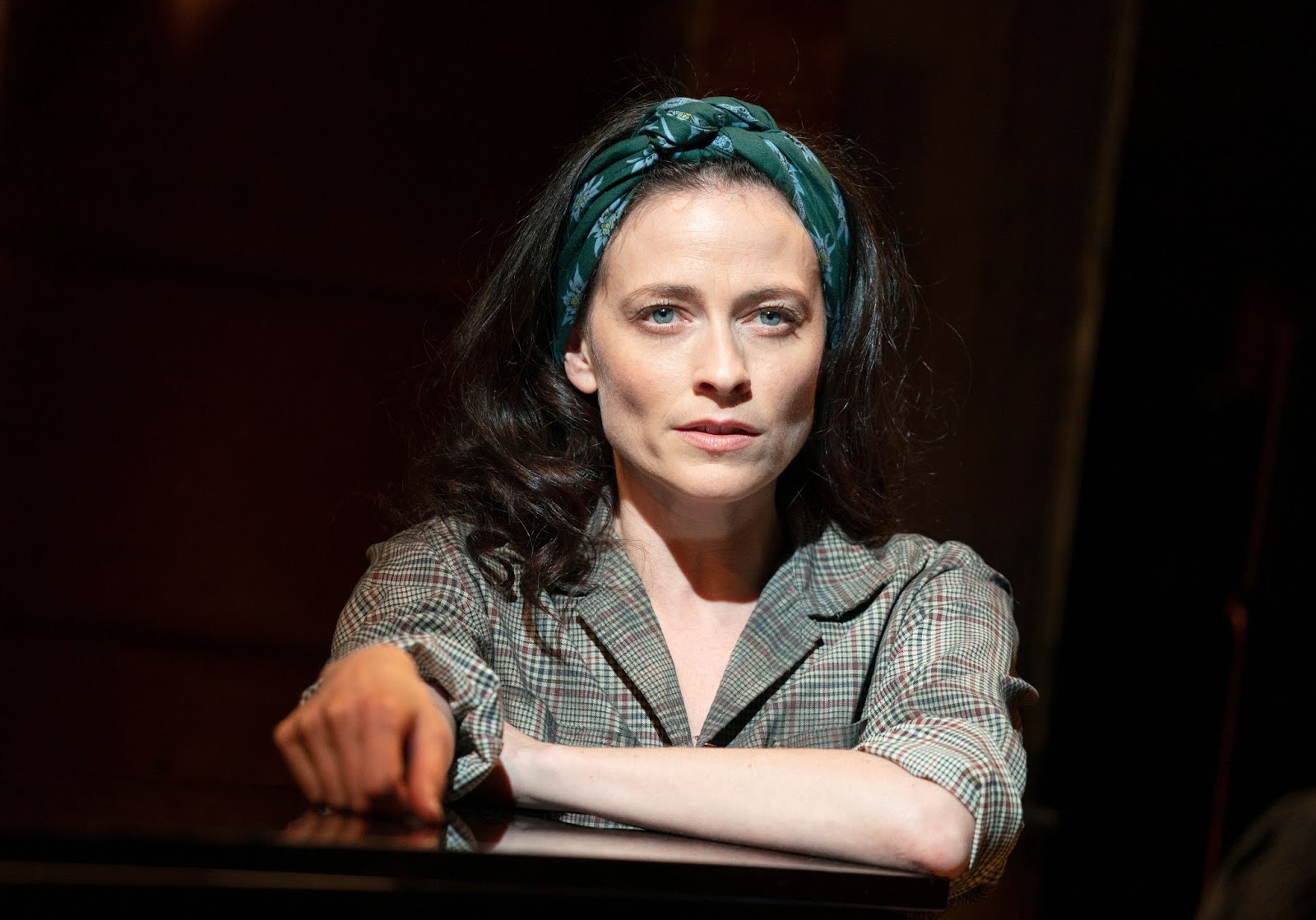
Helen Maybanks
One of the many miracles of Hadestown, Anaïs Mitchell and Rachel Chavkin's strange, stunning folk opera at the Kerr, is the richly bittersweet way it manages to simultaneously lament and celebrate the endless repetitions that make up human lives. In so many ways, most all of them beautiful in execution, this haunting show teases out the endless redundancies and rituals that lead us from birth to death, pointing out along that way that cycles can be a drag, but also the source of joy and celebration. Life might seem futile in its repetitions, Hadestown implies, but so long as there's the potential for beauty, love and ritual, it isn't a waste.

Wednesday, April 10, 2019

Bathsheba's Psalms Or, a Woman of Unusual Beauty Taking a Bath

Tanyamaria. Background - Elizabeth Kenny, Marisela Grajeda Gonzalez, C. Bain.
Photo credit: Jody Christopherson


A fresh take on the Old Testament’s tale of King David and Bathsheba, April Ranger’s play, in its world premiere at The Tank, uses vulgarity and contemporary touchstones to create an occasionally provocative discussion on sex and power politics.

The play updates the traditional story of how King David, who already had several wives, spies Bathesheba bathing as he walks along his palace roof and decides he must bed her. The married beauty reluctantly engages in a tryst, and David purposely sends her soldier husband to the frontlines where he perishes. In the biblical version, David eventually shows remorse for his deeds, and accepts his punishment. The story represents God’s forgiveness and the possibility for redemption.

In Ranger’s version, no redemption is possible. David embraces his lascivious ways until the end of his life and no character ever moves forward. Bathesheba is never more than a pawn trapped in a culture where power, privilege and masculinity rule. Despite giving her story centerstage as actors quote from the imaginary “Bathsheba’s Psalms” and “The Book of Beauty,” Ranger’s take only reinforces the reality of life’s unfairness for women, offering little new perspective. Still, she allows us to see the familiar trope in all its ugliness. When messengers come to bring Bathsheba to King David, one states: “Come to the palace so the king can hold your breasts and ass and smell you and fuck you.” The strong language jostles the audience, plunging them into Bathesheba’s hardship: a moral dilemma with no real choice, but acquiescence. The harshness would work better if the play employed less cursing though. The show uses salty language so consistently that it eventually becomes ineffectual.

Bathesheba faces her situation with grace and humor—elaborately running away although she knows there is no escape. Despite her lack of options, she still must endure the judgment of society. When Bathesheba visits a pharmacy to obtain the morning-after pill after the king impregnates her, the clerk mocks her, saying, “We’re a Christian nation now. No more murdered babies on our hands.”

The hypocrisy exposed by the situation is unfortunately not unfamiliar and while Ranger updates the story with pop-culture nods to movies such as "Top Gun" and video games, she never moves the topic beyond simply acknowledging that time and modernity have not remedied the inequity of power.

Bathesheba, played by Tanyamari, embraces a graceful outlook on what life offers her—something the actress, who seemingly glows from within, conveys. Instead, Bathesheba finds beauty in the sunrise. Production designer Itohan Edoloyi casts lovely lighting across the sparse stage during these moments, allowing the audience to see the potential of the brand new day even as Bathesheba’s reality closes around her. The future mother of King Solomon has an overt sexuality that mingles with her dignity. She is sexy and she knows it, but that trait doesn’t define her as a woman, even if it’s how society labels her.

Christina Roussos’ direction introduces whimsy into the story, with missives dropping from the ceiling and a child’s playroom box of costumes on stage. Actors use the accessories to suggest characters, grabbing the crown to play David and a vest to become Uriah, Bathesheba’s husband. Rousso uses just four actors, a Greek chorus of sorts, that play all of the secondary characters, mixing and matching personas and genders. Some do better than others. While Marisela Grajeda Gonzalez flubbed too many words, C Bain consistently recites lines with fluidity and emotion.

“Bathesheba” ends April 21. The Tank is at 312 W. 36th St.

(Press ticket, third row).


Wednesday, April 03, 2019

The Cradle Will Rock

Marc Blitzstein's 1937 "play in music," The Cradle Will Rock, uses theatre as a political soapbox. Its scathing depictions of the hypocrisies of capitalism, religion, and other societal icons remain painfully apt today, and there is no doubt that it is an important work. It is also dull.

Lara Pulver
Photo: Joan Marcus
John Doyle's direction uses cutesy devices to try to liven up the evening, but he can't fight the reality that 90 minutes of in-your-face lecturing set to nonmelodious music is a slog.

It doesn't help that Ann Hould-Ward's costumes, with all of the performers wearing blue and gray work clothes, add a layer of monotony to the proceedings and remove the physical cues that help to distinguish not only character from character but also class from class.

The cast--Ken Barnett, Eddie Cooper, Benjamin Eakeley, David Garrison, Ian Lowe, Kara Mikula, Lara Pulver, Sally Ann Triplett, Rema Webb, and Tony Yazbeck--is excellent. It is a treat to hear their beautiful unmiked voices.

But a lecture is a lecture, and the evening simply doesn't work for me. (However, the show received an enthusiastic standing ovation the night I saw it.)

Wendy Caster
(2nd row, audience right, press ticket)
Show-Score: 70

Sunday, March 31, 2019

The White Devil


John Webster wrote The White Devil in the early 1600s, and 400 years later it remains relevant and great fun. Red Bull director Louisa Proske underlines the play's timeliness with a modern-dress production, complete with cell phones and Skype. The plot is as confusing as an episode of Game of Thrones and not dissimilar in mood: unnoble noblemen jockey for power, married person A wants to sleep with married person B, person C is a murderer but charming, the powerful use the powerless, everyone has secrets, hypocrisy reigns, blood is spilled. The largely well-acted production moves along swiftly, and I suspect that Webster would be most pleased.

Wendy Caster
(2nd row, audience right, press ticket)
Show-Score: 85

Wednesday, March 20, 2019

MasterVoices: Night Songs And Love Waltzes

MasterVoices (formerly known as the Collegiate Chorale) has a long history of presenting wonderful evenings of song and theatre, and Night Songs and Love Waltzes fit right in. (There's also every reason to believe that MasterVoices' presentation of Lady in the Dark, starring Victoria Clark, will also be wonderful. For more info, click here.)

Night Songs and Love Waltzes was the work of many people, and they all deserve shout-outs.

Ted Sperling. The artistic director and conductor, Sperling loves his work and shares that love generously. And his taste and conducting are superb. When I see his name, I relax in the knowledge that I'm going to have a good time.


Ted Sperling

MasterVoices Singers. I love big groups of people singing, and MasterVoices' 120 singers sound glorious together. It's a thrill whenever they sing.

The Soloists. Nicole Cabell (soprano), Kate Aldrich (mezzo-soprano), Nicholas Phan (tenor), and Nmon Ford (baritone) acquitted themselves nicely throughout. 

Stephen Sondheim. He's Stephen Sondheim, y'know? And his music for A Little Night Music is some of the most luscious in his brilliant and insanely rich oeuvre. Ted Sperling made an arrangement of those Night Music songs originated by its quintet/chorus--including a song that didn't make it to the finished show--and the result is sheer pleasure.

Ricky Ian Gordon. Gordon's music is often stunning, and his Life is Love, a song cycle to poems of Langston Hughes, is beautiful.

Anderson & RoeGreg Anderson and Elizabeth Joy Roe play piano(s) with proficiency, brilliance, energy, humor, and a touch of insanity. They are fabulous musicians and incredible showpeople.

Anderson (right) & Roe

Brahms, Mendelssohn, Schumann (Clara and Robert), and Schubert. At the risk of revealing my middle-brow-ness, I appreciated rather than loved their pieces. In truth, I was counting the minutes until the work of Sondheim, Gordon, or Anderson & Roe.

The Musicians. When I initially saw cellists Peter Sachon and Mairi Dorman and the horn quartet led by Zohar Schondorf, I thought they made up an odd combination of instruments. Sperling, of course, knows better than I, and the band was terrific and just right.

Alice Tully.  Alice Tully, who died in her early 90s in the early '90s, was originally a singer but ended up focusing on philanthropy once she inherited her family's significant fortune. She pretty much paid for Alice Tully Hall, where Night Songs and Love Waltzes was performed, but she only allowed it to be named after her once she made sure it was up to her standards in acoustics and leg room. The result is a perfect venue in which to hear music, and it is much warmer in mood than its larger siblings in Lincoln Center.

All in all, Night Songs and Love Waltzes soared.

Wendy Caster
(mid-orchestra center)

Wednesday, March 13, 2019

If Pretty Hurts Ugly Must Be a Muhfucka

First, behold the title: If Pretty Hurts Ugly Must Be a Muhfucka, sparkling with energy. Next, the structure: playwright Tori Sampson's dynamic, emotional play riffs on folklore, African music and dance, pop culture, teen competitiveness, overparenting, and African and Western ideas of beauty and its value, with a nod to Beyoncé (but, of course). While parts of it are familiar to anyone who has ever worried about her looks, the play is also something new, in turns thrilling, touching, and funny. This show is Sampson's New York professional debut, but we will hear from her again. (And again, and again, I hope.)


Níkẹ Uche Kadri, Leland Fowler
Photo: Joan Marcus
The story is simple. Seventeen-year-old Akim is held by popular opinion to be the prettiest girl in Affreakah-Amirrorikah. Her father is insanely protective of her. She has few friends. When she manages to gain a sliver of freedom she discovers that sexy, confident Kasim has a crush on her--and she is ready and eager to crush right back. Just one problem: Kasim is held by popular opinion (not including his) to "belong" to Massassi. Massassi and her friends Adama and Kaya "befriend" Akim in an attempt to get Kasim back for Massassi. 

The presentation is not simple: It is narrated by Akim's cell phone (humanized as a charming, silly young man wearing bejeweled specs). Magic plays a big role. And a truly wonderful, exciting dance (choreography by Raja Feather Kelly) makes the afterlife seem extremely attractive and a great deal of fun. [spoiler] Everyone in the afterlife wears the same plain mask, freeing them all from the tyranny of looks and looksism. [end of spoiler]


Maechi Aharanwa, Phumzile Sitole (behind Maechi),
Jason Bowen, Níkẹ Uche Kadri,
Rotimi Agbabiaka, Leland Fowler
Photo: Joan Marcus

For all of Sampson's playfulness and creativity, her sense of the cost of beauty and the lack thereof is deadly serious. Akim's father is a possessive idiot, but he is also correct about the dangers threatening his daughter (although his possessiveness actually makes her more vulnerable rather than less). Each of the teenaged girls knows exactly her worth on the awful, artificial, yet painfully real scale of perceived attractiveness. And the sheer exhaustion of being a young female is vividly etched throughout.

If Pretty Hurts Ugly Must Be a Muhfucka brought to mind the often mis-quoted line "money is the root of all evil." The actual quote, as found in the King James Bible, is "the love of money is the root of all evil." Similarly, neither "pretty" nor "ugly" needs to hurt. It is the exaltation of beauty--good-looking people making more money, being more popular, being perceived as better people--that causes the pain, particularly to the nonbeautiful. 


***

In all the discussions of parity in theatre, with percentages of women and people of color getting work, etc., the emphasis tends to be on giving talented people a fair chance. What is also important is giving audiences new voices, different points of view, new forms of art. As an old-ish white woman who has seen thousands of shows, I am thrilled to be challenged and entertained and broadened by writers such as Sampson and directors such as Leah C. Gardiner and performers such as Rotimi Agbabiaka, Maechi Aharanwa, Jason Bowen, Antoinette Crowe-Legacy, Leland Fowler, Níkẹ Uche Kadri, Mirirai Sithole, Phumzile Sitole, and Carla R. Stewart, all of whom contribute mightily to the many strengths of If Pretty Hurts Ugly Must Be a Muhfucka. We all benefit when more and different people are heard.

Wendy Caster
(8th row orchestra; press ticket)
Show-Score: 90