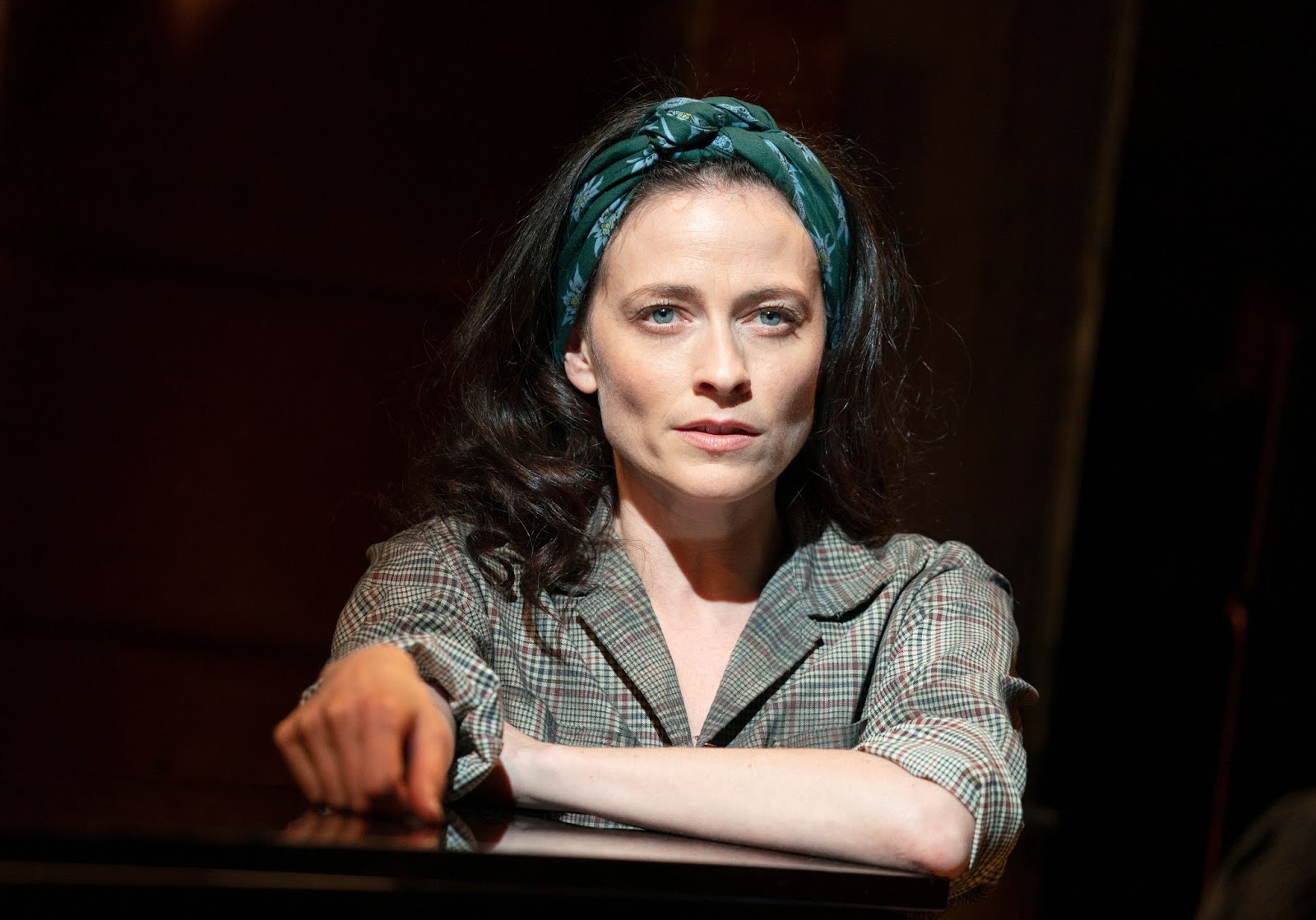
As you probably already know, in the old days theatre critics wrote their reviews right after seeing the performances. In fact, as the shows ended, the critics ran up the aisles to maximize their writing time before deadline.
If it were still the old days, and if I had written my review of King Lear right after seeing it, I would have given it an excellent review. I was caught up in the glow of a Saturday night performance in good seats watching a play I love starring many actors I deeply admire.
But time has passed, and the glow is gone. I have had time to realize that, yeah, the sound and fury did signify nothing. Glenda Jackson was great fun, but, really, Lear shouldn't be great fun. I respected and enjoyed her performance, but she didn't touch me. I thought that Ruth Wilson was quite good, while Elizabeth Marvel was not at her best (far from her best, really). The third sister, Aisling O'Sullivan, shrieked her way through the show; she was terrible, but I appreciated her commitment. (And, yeah, the three sisters all had different accents; consistency was not a characteristic of this production.) Jayne Houdyshell and John Douglas Thompson were excellent, as Jayne Houdyshell and John Douglas Thompson always are.
But what play was everybody in? Some seemed to be in Shakespeare's actual Lear; some seemed to be in a star-turn Lear; some seemed to be in a satire of Lear; and still others seemed to be in a college version directed by a young person with more imagination than skill.
This is not the first time I've seen such a distinguished cast end up in such a jambalaya of a classic. In fact, the criticism "they all seemed like they were in different shows" has become common in recent years, particularly when the cast is star-studded.
Way back when, in the days of affordable Broadway, before directors decided that their ideas are more important than the playwrights', classics weren't events. Instead, they were solid productions, true to the writing, with cast members all in the same time period and speaking the same language. Many of these productions lacked big stars, but they were excellent. I miss them.
Wendy Caster
(3rd row center; $159)
Show-Score: 70
Cookies
Monday, April 22, 2019
The Pain of My Belligerence
My sister once said that, while the worst men are incredibly sleazy, the worst women are incredibly stupid. In the world premiere of The Pain of My Belligerence at Playwrights Horizons, writer Halley Feiffer spends 80 interminable, tedious, painful minutes demonstrating this point.
The plot is simple: Cat, a needy woman, falls for an obnoxious, self-involved, asshole of a man named Guy who bites her, doesn't let her talk, and, oh, yeah, is married. They stay together for years. Time is marked--and faux significance is ham-handedly shoved into the show--by various elections, of course including that of Donald Trump. In her note in the program, Feiffer writes,
[spoiler]
In the third scene of The Pain of My Belligerence, Cat meets Guy's wife Yuki. She is a complicated, original character, and this scene is almost kinda sorta not terrible.
[end of spoiler]
Playwright Feiffer plays Cat; her acting is moderately better than her writing, but she lacks the sort of texture and subtlety that could make Cat bearable and/or sympathetic. Guy is played by Hamish Linklater, who is almost handsome enough to justify Cat's complete and voluntary subjugation to him. Yuki is beautifully played by Vanessa Kai, who brings way more class to the show than it deserves.
I have rarely hated a play as actively and deeply as I hated this one. The minutes nanometered along, and my desire to leave the theatre grew almost unbearable by the ninth hour of its ostensible 80 minutes. When it finally ended, I commented to my friend, "Of all the plays I've ever seen, this show would make the top 10 of shows I hated the most." She replied, "Top 5."
Wendy Caster
(third row on the aisle; press ticket)
Show-Score: 0
![]() |
| Feiffer, Linklater Photo: Joan Marcus |
This play aims to explore the corrosive effects of the patriarchy on women and men alike—to examine the culture that has created the phenomenon of toxic masculinity and its insidious effects, and to start imagining ways we can break free...Blah, blah, blah. Even the patriarchy deserves fairer representation than this boring, unpleasant play and the morons it depicts. Also, millions of humans have grown up in patriarchies but many still think for themselves, challenge themselves to grow, and take responsibility for their own behavior.
[spoiler]
In the third scene of The Pain of My Belligerence, Cat meets Guy's wife Yuki. She is a complicated, original character, and this scene is almost kinda sorta not terrible.
[end of spoiler]
Playwright Feiffer plays Cat; her acting is moderately better than her writing, but she lacks the sort of texture and subtlety that could make Cat bearable and/or sympathetic. Guy is played by Hamish Linklater, who is almost handsome enough to justify Cat's complete and voluntary subjugation to him. Yuki is beautifully played by Vanessa Kai, who brings way more class to the show than it deserves.
I have rarely hated a play as actively and deeply as I hated this one. The minutes nanometered along, and my desire to leave the theatre grew almost unbearable by the ninth hour of its ostensible 80 minutes. When it finally ended, I commented to my friend, "Of all the plays I've ever seen, this show would make the top 10 of shows I hated the most." She replied, "Top 5."
Wendy Caster
(third row on the aisle; press ticket)
Show-Score: 0
Wednesday, April 17, 2019
Hadestown
It's a sad song
It's a sad tale, it's a tragedy
It's a sad song
But we sing it anyway
'Cause here's the thing:
To know how it ends
And still begin to sing it again
As if it might turn out this time
I learned that from a friend of mine
See, Orpheus was a poor boy
But he had a gift to give:
He could make you see how the world could be
In spite of the way that it is
![]() |
| Helen Maybanks |
Wednesday, April 10, 2019
Bathsheba's Psalms Or, a Woman of Unusual Beauty Taking a Bath
Wednesday, April 03, 2019
The Cradle Will Rock
Marc Blitzstein's 1937 "play in music," The Cradle Will Rock, uses theatre as a political soapbox. Its scathing depictions of the hypocrisies of capitalism, religion, and other societal icons remain painfully apt today, and there is no doubt that it is an important work. It is also dull.
John Doyle's direction uses cutesy devices to try to liven up the evening, but he can't fight the reality that 90 minutes of in-your-face lecturing set to nonmelodious music is a slog.
It doesn't help that Ann Hould-Ward's costumes, with all of the performers wearing blue and gray work clothes, add a layer of monotony to the proceedings and remove the physical cues that help to distinguish not only character from character but also class from class.
The cast--Ken Barnett, Eddie Cooper, Benjamin Eakeley, David Garrison, Ian Lowe, Kara Mikula, Lara Pulver, Sally Ann Triplett, Rema Webb, and Tony Yazbeck--is excellent. It is a treat to hear their beautiful unmiked voices.
But a lecture is a lecture, and the evening simply doesn't work for me. (However, the show received an enthusiastic standing ovation the night I saw it.)
Wendy Caster
(2nd row, audience right, press ticket)
Show-Score: 70
![]() |
| Lara Pulver Photo: Joan Marcus |
It doesn't help that Ann Hould-Ward's costumes, with all of the performers wearing blue and gray work clothes, add a layer of monotony to the proceedings and remove the physical cues that help to distinguish not only character from character but also class from class.
The cast--Ken Barnett, Eddie Cooper, Benjamin Eakeley, David Garrison, Ian Lowe, Kara Mikula, Lara Pulver, Sally Ann Triplett, Rema Webb, and Tony Yazbeck--is excellent. It is a treat to hear their beautiful unmiked voices.
But a lecture is a lecture, and the evening simply doesn't work for me. (However, the show received an enthusiastic standing ovation the night I saw it.)
Wendy Caster
(2nd row, audience right, press ticket)
Show-Score: 70
Sunday, March 31, 2019
The White Devil
John Webster wrote The White Devil in the early 1600s, and 400 years later it remains relevant and great fun. Red Bull director Louisa Proske underlines the play's timeliness with a modern-dress production, complete with cell phones and Skype. The plot is as confusing as an episode of Game of Thrones and not dissimilar in mood: unnoble noblemen jockey for power, married person A wants to sleep with married person B, person C is a murderer but charming, the powerful use the powerless, everyone has secrets, hypocrisy reigns, blood is spilled. The largely well-acted production moves along swiftly, and I suspect that Webster would be most pleased.
Wendy Caster
(2nd row, audience right, press ticket)
Show-Score: 85
Subscribe to:
Comments (Atom)