Cookies

Wednesday, April 26, 2017

Spring roundup, Part I: Sweeney Todd and Come from Away


Spring in these parts means fluctuating temperatures, the hectic and drawn-out end of the semester, more theater than I know what to do with, and very little time. What is a theater-loving, overworked, end-of-semester-slaphappy blogger like me to do at a time like this? Why, report on the shows I've seen over the past month more briefly than I usually do, for fear of never writing about them at all! To follow are two writeups; stay tuned for a few more, as soon as I can find some down-time.

Sweeney Todd (Barrow Street)
Joan Marcus
Ah, Sweeney, you brilliant little vacation in hell, you manifestation of the notion that to be human is to suffer miserably or be bugshit crazy or both, you homage to all that is corrupt and morbid and vile. You're so relentlessly nihilistic, and yet your themes are so relevant, your characters so complex and amusing, your score so brilliantly deep and warm. You never cease to thrill, amaze, challenge, and scare the bejesus out of me, and for that, I salute you with all the sneering, pitch-black cynicism I can muster.

The production at the teeny, tiny Barrow Street Theater, which has been repurposed as a rundown pie shop, is great fun, which is not at all a weird thing to say about this musical. Audience members sit at long restaurant-style benches, along tables atop which you can, if you have the stomach, enjoy meat (or chicken or vegetarian) pies and mash before curtain. I didn't partake, but I hear the pies are good. And even if they aren't made of human flesh, the face of Sondheim comes stamped on them--so you can pretend, I guess?

Like all fads, immersive theater can get old pretty fast, and in truth, it irritates me in many cases. But this production fits well into the small, shadowy, cramped quarters it occupies. Performers often plop down at tables next to spectators, weave their way through the narrow aisles, or confront unsuspecting audience members directly and abruptly, which I genuinely hope has not caused any heart attacks (or complaints by sourpusses), because it's done to hilariously terrifying effect. The cast is dedicated, the three musicians adept, the production beloved by my husband and teenage daughter. I loved it too, though I admit I missed the traditional three-tiered set, with the barber chair and slide stacked atop the shop and then the basement, which the space was just too small to accommodate. Still, the use of harsh red light. and sometimes near-total darkness, make it clear that this is a musical in which people die violently and man literally makes mincemeat of man.

Saturday, April 01, 2017

The Glass Menagerie

Hi, Show Showdown visitors!

My take on the highly unconventional and mildly controversial Sam Gold production of The Glass Menagerie is currently featured on Broken and Woken, the blog affiliated with Extreme Kids & Crew. Extreme Kids is a nonprofit organization that provides play spaces and support for special-needs children and their people.

You can see the review here: http://brokenandwoken.blogspot.com/2017/03/the-glass-menagerie.html

If you like what you see, please consider poking around the Extreme Kids & Crew website, which you can link to here: http://www.extremekidsandcrew.org

Thank you,
Liz

Friday, March 31, 2017

Hello Dolly

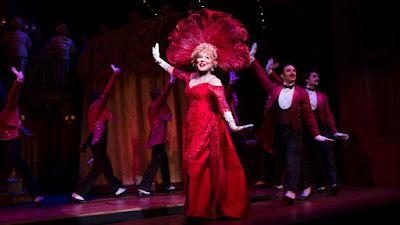
Bette Midler and Dolly Levi would seem to be as perfect a match as, oh, Glenn Close and Norma Desmond or Angela Lansbury and Mame. But, rather than giving us Dolly Levi, Bette has chosen to give us . . . Bette. Yes, she's funny and charming and lovely, but Dolly Levi is missing. Still, Bette does the star thing as no one else can, and the audience adores her. And she rocks the red "Hello, Dolly" dress and feathers. (Also, I saw a preview, and perhaps her performance will deepen.)

Bette Midler and Fabulous Dancers
Photo: Julieta Cervantes

I would have thought that not loving Midler would have meant not loving Hello Dolly, but I had a great time. Dolly is an old-time Broadway Musical, and this production beautifully captures its size, sweetness, and silliness. The book, by Michael Stewart, does what it needs to do, with some great silly jokes. The score by Jerry Herman is uneven, but the highlights are indeed highlights. It's also a pleasure to look at. The sets and backdrops are colorful, attractive, and full of detail. I could spend hours in Horace Vandergelder's and Irene Molloy's shops just enjoying the craft and artistry of the designs. The costumes are yummy eye candy, and there are a lot of them. Both the scenery and costumes are designed by the great Santo Loquasto, who has been delighting theatre and movie audiences for decades.

Tuesday, March 28, 2017

Sunset Boulevard

I won the lottery for Sunset Boulevard last Sunday matinee. The tickets were $55 each. I was thrilled when the box office woman handed me C2 and C4 in the orchestra. While they're arguably "partial view" seats--one corner of the stage simply cannot be seen--they're first row, which I love.

Cast of Sunset Boulevard raising money
for Broadway Cares/Equity Fights AIDS

I'm beginning my review with this information because the seats and the price I paid both greatly increased my enjoyment of Sunset Boulevard. I haven't yet spent $299 or more for a theatre ticket--and I don't know that I ever will--but paying such a large amount of money has to influence a person's response to a show, whether for good or ill.

I enjoyed Sunset for $55. At $299, it would have pissed me off.

Granted, Glenn Close's performance is extraordinary. Perhaps even priceless.

But worth $299? Not to me. (When I try to imagine what I might pay $299 for, I come up with things like Judy Garland in Gypsy. Ain't gonna happen.)

The show just isn't that good. Most of the sections that focus on Norma, Joe (Michael Xavier), Max (Fred Johanson), and Betty (Siobhan Dillon) are strong, particularly as played by this excellent cast. But the parties and other filler scenes are tedious. Many of the songs are indistinguishable from each other and dozens of other Lloyd Webber creations. The choreography is lame. The scenery is limited and uninteresting. (However, the large orchestra is fabulous.)

If you can win the ticket lottery, I recommend Sunset Boulevard. If you're someone for whom $299 isn't a lot of money, go ahead, give it a try; Glenn Close is really something. But if that's a lot of money to you, as it is to me, and you're not Glenn Close's biggest fan, stay home.

Wendy Caster
(lottery tix, $55, first row extreme side)

Monday, March 27, 2017

Best Worst Thing That Ever Could Have Happened

Best Worst Thing That Ever Could Have Happened, Lonnie Price's documentary on the making of Merrily We Roll Along, is jammed with treasures, such as footage of auditions, rehearsals, and performances from the original production and then-and-now interviews with members of the original cast. What a disappointment, then, that it's not a particularly good movie.


It might have hit me differently if I knew less about Merrily. But I know a lot about it, and I was annoyed by what the documentary left out. For example, at one point the movie refers to the successful productions after the original disaster. But no one mentions that it was extensively rewritten. I was also annoyed that so many cast members were barely mentioned or not mentioned at all. Surely it's worth a few seconds to acknowledge the presence of Liz Calloway and Giancarlo Esposito? It certainly would have been a better use of the movie’s precious minutes than the cliché shots of spooling film and of Manhattan that Price uses instead.

Monday, March 20, 2017

946: The Amazing Story of Adolphus Tips

Kneehigh's stage adaptation of the 2006 children's novel The Amazing Story of Adolphus Tips by Michael Morpurgo is so bubbly, energetic, and wacky that a few times during the performance, I was surprised by how suddenly I found myself choking up.


Told largely from the perspective of the feisty, funny, endearingly odd 12-year-old Lily (and, at the beginning and the end, her equally engaging elderly self), Adolphus Tips revolves around a search for the lost cat of the title. But since the setting is coastal England during World War II, and since the cat very quickly becomes a symbol for so many other kinds of absence--that of fathers and sons, of safe spaces, of food and supplies, of peace, and of a general sense of well-being--the production is ultimately a lot weightier than it can sometimes seem. Never heavy-handed or overwrought, Adolphus manages to tell a gentle, genuinely moving tale without cutting back on the clowning, drag, broad humor, folksy music, and energetic dance.