Cookies

Tuesday, December 13, 2022

Merrily We Roll Along


Merrily We Roll Along
was and shall always remain a hot mess of a musical. Based on a longer-running if also financially unsuccessful 1934 play of the same name by Kaufman and Hart, Merrily opened (and quickly closed) on Broadway in 1981, ending the storied decade-long collaboration between Stephen Sondheim and Hal Prince. Their version follows a spiritually bereft if materially successful playwright backward in time, beginning with scenes from a wealthy, empty life as a producer of junky films and ending with his idealistic youth as a promising composer and burgeoning Great Artist. Close friendships fray, marriages end badly, and a son becomes estranged in the process. Why should we care at all about a guy we're told from the outset has traded his soul for fame and fortune? The show never bothers to let us in on that secret, which is why it does not work and never will--unless, if your glass is half-full, maybe someday it might. That's the Gordion knot of Merrily in a nutshell. 

It fascinates me to think about all the machinery that has chugged along behind Merrily from its premiere. The show purports to draw a line between art and commerce, and to take a stand on the side that values Great Art and that trusts money only so far as a means toward more Great Art. But, irony of ironies, it's the impossibly famous, incredibly monied, insanely connected and endlessly revered Great Men who made Merrily that has kept it from having been forgotten in the first place. There's the score, which has plenty going for it even if it, like the much weaker book, was hardly rapturously received by critics (though Frank Rich did tip his hat to it while trashing the rest of the show). Only when Columbia Records granted the company the rare opportunity to record a cast album despite the show's flop status (again, because Sondheim) did the score catch on. The many frequent attempts at reviving and attempting to "fix" Merrily followed suit: there have been countless revivals, many of which have been recorded for posterity, too, featuring new or revised or reordered or retinkered material--as if a few nips and tucks would somehow solve the problem of three not-especially-developed characters stuck in a slowly decaying friendship that never comes off as especially meaningful or interesting to begin (or, whatever, end) with.

Don't get me wrong: Maria Friedman's production--done apparently because she was good friends with Sondheim and wanted to do his poor, suffering, misunderstood show more justice than it's apparently ever been given--does help the show as much, I think, as it can possibly be helped. The superb casting goes a long way: the star-studded cast digs deep, and the performances are gorgeous as a result. Daniel Radcliffe is adorably wiry and neurotic as Charlie, and his frustrations with his friend are crystal clear--but then, so too is the fact that his life isn't so terribly miserable or bereft without Franklin in it, anyway. Jonathan Groff is always appealing and watchable, and his Franklin is framed as a sad, wistful cipher who knows he's gone about all the things the wrong way, even as he can't fix any of them. But mining the emotions of these characters is still not enough to turn the show around: self-aware or not, Shepard's an id-driven, money-hungry, womanizing dick, and we are told as much from the outset, so whatevs. To that end, while the phenomenal Lindsay Mendez finds more depth to Mary than any other actor I've ever seen in the role, the character nevertheless remains an angry, empty drunk who harbors a blinding love of an angry, empty Franklin. Her relationship with booze still makes a lot more sense than anything else about her. 

In short, the NYTW production of Merrily is a wonderful thing to see if you love this show despite (or perhaps for) all its warts. If you, like me, enjoy watching Sisyphean attempts at getting this particular rock up to the very top of the hill, you'll get a kick out of this acme of a production. Otherwise? Maybe go instead to a show that's not as impossible to find a ticket for, or stay home and stream any or all of the many, many, many recordings of past attempts at pushing the rock up the hill. I'm sure this cast will add a new one to the ever-growing pile soon enough.  

Sunday, December 11, 2022

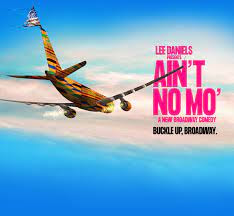
Ain't No Mo'

Closing notices have been posted for Jordan E. Cooper's wonderful Ain't No Mo', which is a  shame: the show, which only opened on Broadway three weeks ago, richly deserves to connect with audiences. I hope ticket sales pick up as a result of attempts on the part of the company to keep it alive. 

This season has been particularly rough-going for lesser-known properties, which struggle to find spectators even in good times. It's especially hard right now, given a muted holiday season in which tourism remains down and infections from Covid (along with a number of other dangerous ailments) remain up. Still, if you're in the mood for a heady, high-energy satire that lets everyone in on the joke even as it centers on the joys and trials of Black life in contemporary America, put on a high-quality mask and get your butt into a seat at the Belasco for a swift, deeply rewarding 90 minutes that, if you're like me, will leave you wishing for more. 

Ain't No Mo' is essentially a series of sketches held loosely together with an overarching conceit: the US government is offering all members of the African diaspora free one-way tickets back. Black people are free to stay in the US if they want, but the show regularly implies that such a choice isn't going to be especially safe or wise. That such a premise can be taken as both ridiculously funny and deeply painful results in dichotomies that are mined brilliantly and fluidly throughout the show: Ain't No Mo' is frequently laugh-out-loud hilarious, until all of a sudden it's unbearably sad. Don't worry: you'll be laughing again in a minute, even if you're wiping away tears as you do. 

A sketch show is inevitably going to suffer some inconsistencies, but even during Ain't's occasional lulls, I found myself all-in. The breakneck speed--not only of many of the sketches, but also of some of the more impressive monologues--helps a lot. So does the extraordinary ensemble, which includes the playwright in drag as a harried new employee at an airport check-in counter responsible for sending Black Americans off on the last flight out of the US. The rest of the cast is consistently on point, and so committed that I found myself occasionally wondering if there were uncredited ringers turning up on stage for star turns. Nope: it's just that the cast of six disappears so deeply into some of their characters that they're virtually and thrillingly unrecognizable when they pop up later as someone else. 

I'm pretty cleareyed about the fact that a lot of shows simply don't last for deeply unfair reasons: Broadway is a business, and business is not kind, so a lot of really good shit fails while a lot of not-at-all-good shit thrives. But if any show deserves an audience right now, it's this one: it's generous, hilarious, challenging and cathartic, and I appreciated it very, very much. I hope it stays alive for longer than the three weeks it's run so far--and I hope you get to see it, too.

Sunday, November 13, 2022

Some Like It Hot

I saw Some Like It Hot too early to give it a full review, but I do have some comments. 


At first I was put off by the show. It's so energetic, and so enthusiastic, and so cheerful that it feels like an attack. But eventually I surrendered and embraced its hyperactive broad-stroke old-fashioned Broadway-ness. (It would have been a big hit in 1980.) 

Many of the songs are catchy and fun (though there too many of them). The ensemble work their collective butts off. The choreography is clunky. For example, there's a farce-type extended number that lacks logic and rhythm and ends up abrasive and annoying. However, the ensemble sells everything with that wonderful Broadway-triple-threat energy and skill. 

The main performances make or break a show like this, and Some Like It Hot features two kick-ass, star-making turns. Adrianna Hicks as Sugar and J. Harrison Ghee as Daphne have all the skills you could possibly ask for, topped with great charm and likeability. They are both consistently delightful. Christian Borle is ok; I don't think he is well-cast.

There has been some controversy in the chat rooms about this being a "woke" musical. "Woke" is often used judgmentally, so I don't want to go there. However, the way that the show embraces the existence of people of color and differing sexualities and identities is lovely

The show needs polish. I hope that they will use the rest of previews to fix the timing on one-liners (give them a moment to breathe!), balance the sound (50% of the lyrics are not intelligible!), trim the show, and dial the vibe down from 125% to, oh, 110%.

Some Like It Hot is not great. It is fun. And Ghee and Hicks are fabulous.


Wendy Caster

Friday, October 28, 2022

Carmen

Benjamin Franklin said that nothing is certain but death and taxes. However, he left out another important certainty: when MasterVoices puts on a show, it is always worth seeing.

Ginger Costa-Jackson
Photo: Erin Baiano

Carmen, which MasterVoices recently presented, is a case in point. Although a concert production, it was fully performed, with top-of-the-line soloists, the excellent Orchestra of St. Luke's, enough costumes to set the scene and the mood, dancers, and that fabulous 120+ person chorus. Ted Sperling, MasterVoices's artistic director and general all-round gift to New York, led a lucid, energetic performance of the original Paris Opera Comique, with lyrics by Sheldon Harnick. It was a truly delightful evening, except for one thing. And that thing is not the fault of MasterVoices--it's Carmen itself, going back to the novel by Prosper Mérimée. 

Carmen (beautifully sung and acted by Ginger Costa-Jackson) could not be more open about who she is and what she wants. She explains, clearly, that the most important thing to her is freedom. She adds, in paraphrase, "If you love me, I won't love you. If you don't love me, I might love you. If we love each other at the same time, boy, are you in trouble." This is not a woman who wants to settle down. So, as occurs in about a million books, operas, and shows, after Corporal Don José, madly in love with Carmen, cannot force her to "be true" to him, he calls her a whore and kills her. 

Yes, the piece is of its time. Yes, it's just a show. Yes, people are spending too much time focusing on trees rather than forests these days. I get it! But, the bottom line for me, and for the friend I saw the show with, is that, yet again, we see a woman killed for not being who a man wants her to be. And Carmen is a fabulous vibrant character. She kicks ass. I wish she had kicked Don José's. 

But it was a great production. 

It always frustrates me that MasterVoices performances come and go so quickly, and that I can't tell you in time to make sure to catch them. But, since it's pretty much certain that their upcoming shows will be at least worthwhile and possibly wonderful, click here to get more info and perhaps tickets for the rest of their season.

Wendy Caster

Wednesday, October 26, 2022

F*ck7thGrade

Jill Sobule's terrific autobiographical rock-concert musical, F*ck7thGrade, traces her life from tomboy riding a Raleigh Blue Chopper, to junior high outcast, to accidental performer in a nightclub in Spain, to closeted Tonight Show guest, to--right now--proud queer woman in a proud queer show at the fabulous Wild Project. 


It's a delightful trip, despite some dips into sadness and even despair. In many ways, Sobule's life pivoted around her hit "I Kissed a Girl." It was the nineties, and she succumbed to pressure to treat it as a "novelty song" rather than the lesbian anthem it is. In a way, she broke her own heart by not standing up for herself. 

But she also grew up, and embraced herself and her music. She is really funny (the excellent book is by Liza Birkenmeier, but the voice is sheer Sobule), and her songs are wonderful musical short stories. Most importantly, the show takes place in the sweet spot where the specifics of an artist's particular story expand into universality. Really, how many people enjoyed 7th grade? (If you did, by the way, you still would probably like the show. But you won't be in the majority in the audience.)

The show could use more of a transition between Sobule singing "I sold my soul, and nothing happened" and her response to Katy Perry's different "I Kissed a Girl." All we are told is that years passed, and that Sobule found herself feeling that, although she had somewhat disowned the song, she was the "I Kissed a Girl" girl! Also, F*ck7thGrade ends three times, and the last song is one song too many. (That last song shouldn't be played for anyone under 50, or even 60, with its list of potential--and realistic--ways the world may go to hell; I saw the show with a 28-year-old, and that's way too young to be told that it's okay if everything comes to an end because you've had a "good, good life.") 

Now that I've finished the "I'm a reviewer" part of the review, I need to add the "I'm a lesbian of Sobule's generation who has had her CDs for years" part of the review. For me, much of F*ck7thGrade felt like catching up with an old friend. When "I Kissed a Girl" came out, my friends and I were thrilled. I managed to tape the music video (on BetaMax!) from TV, and that tape was passed around to friend to friend to friend. We assumed that the enforced heterosexuality of the ending of the video (Sobule and the woman she kissed are shown pregnant by their loser men) was not Sobule's choice, and we had no doubt that Sobule was one of us. It's sad to hear how much pain the whole thing caused Sobule, because that song and that video were major gifts to the rest of us. Honestly, in 1995 the song felt miraculous. (I dealt with that awful, stupid, tagged-on ending by simply pressing "stop" before it came on.)

Even now, in 2022, movie, TV, and theatre characters that I can truly identify with are rare. Watching F*ck7thGrade gave me that unusual, wonderful sense of being seen, of being. That's a real gift.

The excellent back-up band/supporting cast includes Nina Camp (guitar, back-up vocals, "the sexy characters"), Kristen Ellis-Henderson (drums, Jill's junior high nemesis, other characters), and Julie Wolf (keyboards, various characters).   

The show runs through November 8. You can get tickets here. I hope you do.


Wendy Caster

Saturday, October 01, 2022

Leopoldstadt

Leopoldstadt, Tom Stoppard's newest play, and possibly his last, offers a journey through the life of a Jewish family in Vienna, from 1899 to the 1950s. They are well-off and mostly happy. Some have married non-Jews (Protestants, to be specific, although the matriarch of the clan persists in calling them "Papists"). While not specifically based on Stoppard's family, it is clearly an outgrowth of his later-in-life discovery that his mother was Jewish and that most of her relatives--most of his relatives--were killed in the Holocaust. 


Leopoldstadt may be Stoppard's wordiest play, and that is saying something. It may also be his least play-like play. In the majority of scenes, two people disagree about an issue involving the Jews. They argue their points, lading their conversation with a tremendous amount of history. Stoppard makes this remarkably compelling, particularly for a Jewish audience. (I am an ethnic, nonreligious Jew whose family came to the US well before World War II.) Few of the scenes feature action of any sort; they are the best in the play. 

Overall, Leopoldstadt is a history lesson, largely ignoring the admonition to show, not tell. But it's elegantly written by Stoppard, smoothly directed by Patrick Marber, and well-acted by a large cast. And the final scene brings the show home with power and emotion.

The show has been called a masterpiece, and I respectfully disagree. I don't think I'd even put it in the top five of Stoppard's plays. But, for all its flaws, it's a Stoppard play. With occasional sparks of his genius. And it's possibly his final play. That makes it a must-see in my book.

Wendy Caster