Cookies

Friday, June 02, 2023

Tony Predictions, Because Why Not?

Well, it is that time of year again. The 76th Tony Awards will recognize theatrical achievements on Broadway for the 2022-23 season. Who will win? Below are Show Showdown's guesses.

Clip from New York, New York

Best Book of a Musical

Liz: Kimberly Akimbo

Wendy: Wow, one I’d finally bet on: Kimberly Akimbo, David Lindsay-Abaire.

Sandra: Ditto (I submitted my predictions last … so you might see this a few times).

Best Original Score (Music and/or Lyrics) Written for the Theatre
Liz: Kimberly Akimbo

Wendy: Kimberly Akimbo, Music: Jeanine Tesori, Lyrics: David Lindsay-Abaire

Sandra: Ditto

Best Performance by an Actor in a Leading Role in a Play
Liz: Wendell Pierce, Arthur Miller's Death of a Salesman. Pierce was revelatory as Willy Loman and richly deserving of the award. I thought Stephen McKinley Henderson was also brilliant in Between Riverside and Crazy, and I’d be delighted if he took this, but I suspect it’ll go to Pierce.

Wendy: Tough, tough, tough category to guess. I guess this is kinda cheating, but I predict the two men from Topdog/Underdog. I just hope that Sean Hayes doesn’t win; his winning would seem just too #TonysTooWhite

Sandra: The fate of Willy Loman and his family is always wrenching, but particularly so in this version … and Wendell Pierce’s take on the iconic role ups the ante.

Best Performance by an Actress in a Leading Role in a Play
Liz: Jodie Comer, Prima Facie. I confess I’ve seen none of these, so this is a shot in the dark, but Comer apparently gives a mesmerizing, scenery-chewing, shape-shifting, mountain-moving, buckets-of-sweat-spill-your-guts-out performance, which is just total Tony bait.  

Wendy: This category should have five nominees! That being said, I think Jodie Comer, Prima Facie, has got it. Her performance is astonishing, and the role is full of the dramatic opportunities that nab trophies. If Comer wasn’t in the list, I think Jessica Chastain, A Doll's House, would have been the winner. Truly, this category sums up the weirdness of awards: four nominees instead of five for no real reason, and comparing apples, oranges, kumquats and motorcycles.

Sandra: Let’s make this lucky number seven for Audra McDonald.

Best Performance by an Actor in a Leading Role in a Musical
Liz: J. Harrison Ghee, Some Like It Hot. Ghee’s performance as a trans jazz musician who discovers their true self as Daphne was by equal turns hilarious, graceful, beautiful to watch, and deeply moving.

Wendy: Everyone but Borle would be a legit winner here (I thought he was miscast and not all that interesting). I predict J. Harrison Ghee, Some Like It Hot, because their performance is lovely and something new.

Sandra: J. Harrison Ghee, Some Like It Hot. This was my favorite show of the season and part of that is because of Ghee who brings joy to this role and glorious tapping.


Some Like It Hot


Best Performance by an Actress in a Leading Role in a Musical
Liz: Victoria Clark, Kimberly Akimbo. Diamond could take this instead, but she never quite nails the southern accent; Clark makes what could have been a cliché of a character into a deeply nuanced, believable, lovable one.

Wendy: Victoria Clark, Kimberly Akimbo, is a shoo-in.

Sandra: Ditto. I have adored Victoria Clark since The Light in the Piazza and my admiration for her intensified after reading this New York Times article: https://www.nytimes.com/2023/05/10/theater/kimberly-akimbo-victoria-clark.html

Best Performance by an Actor in a Featured Role in a Play
Liz: Brandon Uranowitz, Leopoldstadt. Uranowitz was memorable in a very crowded cast of characters. That said, I’d be pleased if any of the nominees ended up winning this category.

Wendy: I’m going with Jordan E. Cooper, Ain't No Mo'. Fabulous performances!

Sandra: David Zayas, Cost of Living. I just loved this show … and he was wonderful — steadfast and moving.

Best Performance by an Actress in a Featured Role in a Play
Liz: Katy Sullivan, Cost of Living. This is total wishful thinking, but in both the original production and the Broadway one, Sullivan was funny and raw in the role of a paraplegic woman struggling to adjust to her new disabilities, and a life without her ex-husband.

Wendy: Katy Sullivan, Cost of Living. Though, once again, how can anyone possibly compare these performances?

Sandra: Katy Sullivan, Cost of Living. Who didn’t gasp during that bathtub scene? What a compelling and brave moment.

Best Performance by an Actor in a Featured Role in a Musical
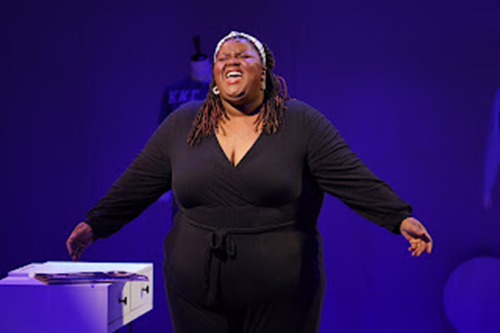
Liz: Alex Newell, Shucked. 
Newell stopped the show mid-act when I saw it, and apparently continues to do so every damn time with her barn-raiser of a solo number.  

Wendy: Kevin Del Aguila, Some Like It Hot, is a total crowd pleaser.

Sandra: Gotta go with Wendy on this one. You have to love Osgood Fielding III … if only Elon Musk was so open-minded and jovial.

Best Performance by an Actress in a Featured Role in a Musical
Liz: Bonnie Milligan, Kimberly Akimbo

Wendy: Bonnie Milligan, Kimberly Akimbo, is a crowd pleaser.

Sandra: I feel like Sweeney deserves some acknowledgment this season and Ruthie Ann Miles is its best shot, bringing a seething fury and sadness to the beggar woman.


Kimberly Akimbo


Best Scenic Design of a Play
Liz:  I had some other guess here, but I totally just changed it because I too think Wendy had the better guess. What she says: 

Wendy: Tim Hatley & Andrzej Goulding, Life of Pi

Sandra: I’m with Wendy. Look what they did with a boat …

Best Scenic Design of a Musical
Liz: Beowulf Boritt, New York, New York. New York, New York is not as genuinely terrible as most of the reviews imply…but then, the scenic design really did stand out as a particular strength.

Wendy: Beowulf Boritt, New York, New York

Sandra: Beowulf Boritt, New York, New York. I loved the subtle sketching of a city neighborhood that no longer exists — with its balconies overlooking everyone’s business.

Best Costume Design of a Play
Liz: Emilio Sosa, Ain't No Mo'. For Peaches’ glorious getups alone….

Wendy: Emilio Sosa, Ain't No Mo'

Sandra: Ditto

Best Costume Design of a Musical
Liz: Gregg Barnes, Some Like It Hot. I would happily wear the same pair of jeans and ratty t-shirt every day of my life if I could, and yet I coveted every damn outfit worn in this show.

Wendy: Gregg Barnes, Some Like It Hot

Sandra: Ditto


& Juliet


Best Lighting Design of a Play
Liz: Bradley King, Fat Ham

Wendy: Jon Clark, A Doll's House

Sandra: Tim Lutkin, Life of Pi

Best Lighting Design of a Musical
Liz: Natasha Katz. No idea who will win, so I’m guessing Katz because she’s nominated twice. For which show? Dunno.

Wendy: Ken Billington, New York, New York

Sandra: Natasha Katz, Some Like It Hot

Best Sound Design of a Play
Liz: Ben & Max Ringham. See "lighting design" above.

Wendy: Ben & Max Ringham, A Doll's House. Rarely has sound design had such a significant role in the ambience, meaning, and success of a play.

Sandra: Carolyn Downing, Life of Pi

Best Sound Design of a Musical
Liz: Gareth Owen, & Juliet

Wendy: Scott Lehrer & Alex Neumann, Into the Woods

Sandra: I’m with Wendy with this one.


Shucked Broadway Recording of "Corn."


Best Direction of a Play
Liz: Saheem Ali, Fat Ham

Wendy: Aargh! How to choose? I’m going with Stevie Walker-Webb, Ain't No Mo', for his breathtakingly energetic, theatrical directing.

Sandra:
Patrick Marber, Leopoldstadt

Best Direction of a Musical
Liz
: Lear deBessonet, Into the Woods. I was never a huge fan of this particular show, but deBessonet’s bubbly, joyous production was thoroughly delightful.

Wendy: Lear deBessonet, Into the Woods.

Sandra: Casey Nicholaw, Some Like It Hot. That chase scene alone deserves a Tony.

Best Choreography
Liz: Casey Nicholaw, Some Like It Hot. Call me a sucker for an old-fashioned tap-heavy musical, but come on, now.

Wendy: Another tough category. Casey Nicholaw, Some Like It Hot.

Sandra: Casey Nicholaw, Some Like It Hot. I haven’t seen such exciting tap since 42nd Street--and did I mention that chase scene?

Best Orchestrations
Liz: No clue, truly. May the best orchestrator win.

Wendy: Jason Howland, Shucked. Total guess!

Sandra: Bill Sherman and Dominic Fallacaro, & Juliet. Because I just want them to win something.

Best Play
Liz: Leopoldstadt. Stoppard’s legacy and the fact that this show keeps getting described as “probably his very last” will result, I think, in a symbolic win. That’ll be fine with me, but then, so would it be if any other show nominated wins for best play instead.

Wendy: I adore Stoppard, and I think he's going to win, but I'd love it to be Fat Ham.

Sandra: What Liz said.

Best Musical
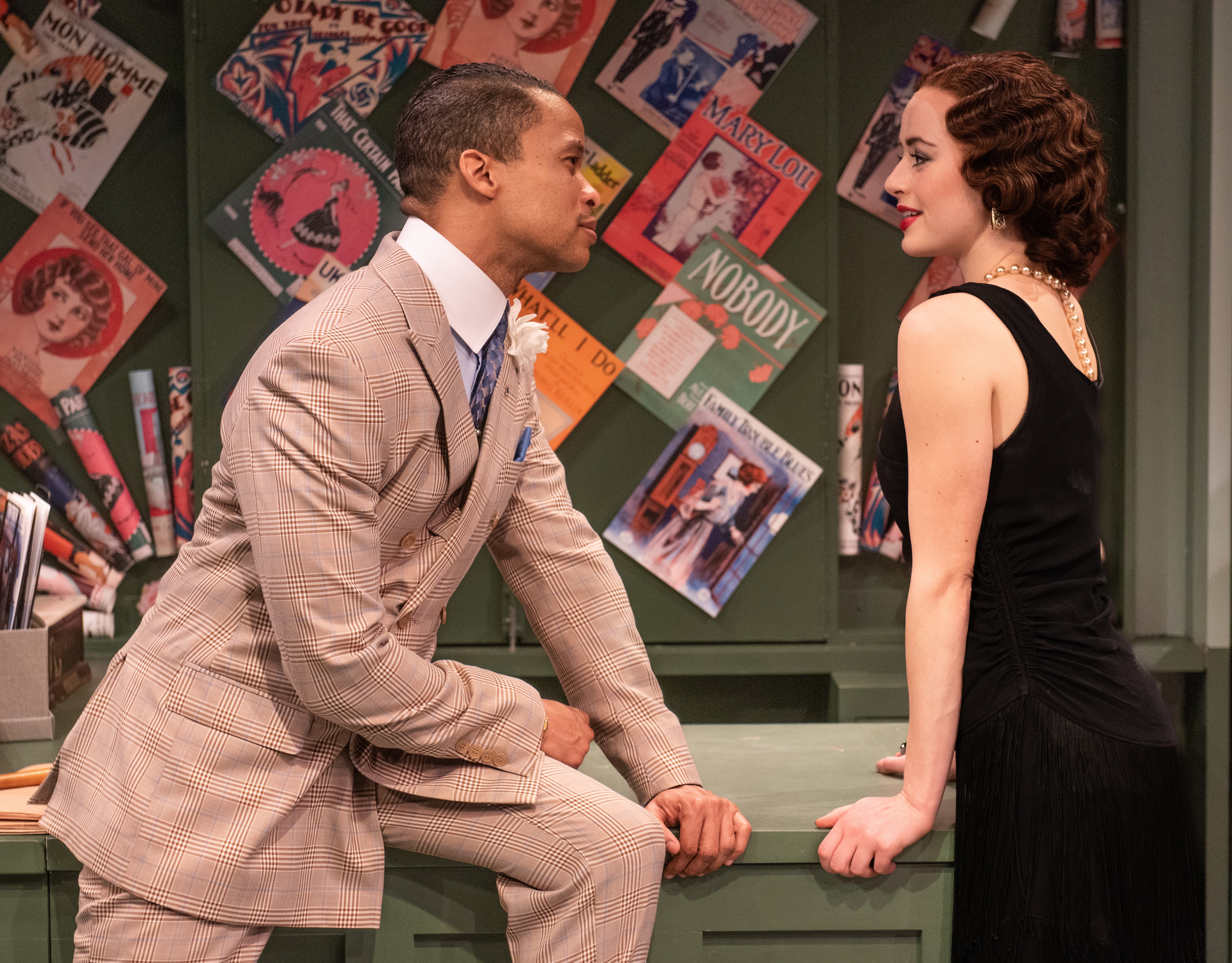
Liz: Some Like It Hot. Big, splashy, sweetly subversive, lotsa tap dance.

Wendy: I predict Kimberly Akimbo.

Sandra: Some Like It Hot. Really fun, exuberant, well-staged musical.

Best Revival of a Play
Liz: The Sign in Sidney Brustein's Window. I really loved this production and this play, even as I suspect I’m wrong and it won’t win.

Wendy: Topdog/Underdog, but I wouldn't bet a lot of money on it.

Sandra: The Piano Lesson

Best Revival of a Musical
Liz: Parade. I’m really not a big fan of this show, even as I recognize that the production is solid. I would be delighted if Into the Woods upset the cart, but that’s no longer running and Parade is.

Wendy: Into the Woods. I have more faith in people's memories, but, hey, I could be wrong.

Sandra: Parade. A moving production that offers context about the true story

All video clips from YouTube

Thursday, May 18, 2023

Blanche: The Life and Times of Tennessee Williams's Greatest Creation (book review)

I reviewed Blanche: The Life and Times of Tennessee Williams's Greatest Creation at Talkin' Broadway:

Blanche: The Life and Times of Tennessee Williams's Greatest Creation, by Nancy Schoenberger, is an odd little book. Saying that it runs some 193 pages of actual content is generous, as that includes a number of white pages, a faux obituary of Blanche DuBois, and four pages of sonnets, created by Schoenberger, that purport to be what Blanche's long-dead young husband might have written (!!!). Trimmed of its repetitions, the book could have made a fairly interesting long essay in The New Yorker or The New York Review of Books.

continue reading 


 Wendy Caster

Tuesday, May 16, 2023

Assassins

The Gallery Players production of Assassins is unfortunately not up to its usual standards. I admire the ambition of attempting Assassins, with its non-plot, odd politics, long swaths of spoken scenes, and challenging score. But: Some of the performers didn't sing well enough or act well enough. A few were completely miscast. The band lacked cohesion, and the sound design didn't help it or the performers. The sound effects didn't work: the noises of a bottle-making factory sounded more like someone snoring, and the gunshots were too low and distant to discomfort the audience as they should. Some of the costumes didn't work; in particular, John Wilkes Booth's suit seemed more appropriate for a comedian than a dashing serious actor. The lighting was occasionally murky.

Weirdly enough, however, I would not dissuade you from going. Despite its many flaws, the production was ultimately disturbing in the right way.

Wendy Caster


Friday, May 05, 2023

Some Numerical Thoughts on the Tonys

Entertainment awards are silly and they're also endlessly fascinating. Part of the allure is the fashion, pomp, and party atmosphere. A bigger part, for me, is the speeches--at least, those speeches that show some personality, humor, and emotion. Add exciting numbers from nominated musicals, and a good time is had by most.

However, what drives me the most crazy, personally, about the Tonys comes down to numbers. For example, with four nominees, someone could win with only 31% of the vote, with the other three nominees receiving an average of 23% each. With five nominees, the winner might only have 24% of the vote, with the other four nominees averaging 19% each. (At least the Tonys have nothing as silly as the 10 nominees for best picture, in which the winner could have as little as 20% of the vote, with the other nominees averaging 8.9% each.)


While the examples I have given are extreme, the point still stands that someone can win a "best" award without even getting a majority of the vote.

Then we get to the odd rules set by the Tonys. For example, if a category has nine or more potential nominees, there will be five nominations (barring any ties). But if it has fewer, there will be four nominations. What has that got to do with the quality of the productions or performances? In cases where there are four nominees, is there a lessening in quality for the potential fifth because he/she/it/they had fewer competitors? If another show opened at the last minute, bringing the total to nine in various categories, would that fifth potential nominee suddenly improve?

In the other direction, are there always four or five performances/productions that definitely deserve to be nominated? There have been many times where the fourth nominee definitely came across as filler. And that's not even mentioning painful years such as 1995 when Sunset Boulevard won a slew of awards with only one competitor or none! Does that make Sunset Boulevard's Tonys worth less? I guess it depends on how you feel about Sunset Boulevard. (IMHO, worse shows have won, but not many.)

The final numberical issue is the total number of nominations for a particular show. Yes, Some Like It Hot is an amiable and enjoyable musical, but ads screaming "13 nominations!" suggest the show is brilliant. Four of the noms are design nominations, and, yes, it is a beautifully designed show. But that doesn't make it a great show. Another four are performance nominations. And, yes, it is a beautifully performed show. But that doesn't make it a great show either. It's a nice show. I would have certainly voted for it had it been against Sunset Boulevard! But great, no.

So, the numbers work against the significance of the Tony Award.

I'll still be watching on June 11th.

Wendy Caster


Iolanthe

Once again, MasterVoices has provided an evening of charm, joy, and fabulous music. In this case, it was Gilbert and Sullivan's Iolanthe, not one of their best, but still great fun. (There are fairies, there are humans, there are misunderstandings, stuff happens.) 


Ashley Fabian
Photo: Toby Tenenbaum


The cast was amazing: Christine Ebersole (glorious), David Garrison, Santino Fontana (having a grand time in a supremely silly wig and demonstrating a gorgeous legit voice), Jason Daniely, Ashley Fabian (combining excellent comic chops with truly stunning singing), Phillip Boykin (adorable, with a bass that vibrated Carnegie Hall), Shereen Ahmed, Schyler Vargas, Nicole Eve Goldstein, Kaitlyn LeBaron, Emy Zener, and Tiler Peck.  


Christine Ebersole, Shereen Ahmed
Photo: Toby Tenenbaum

And then there are the MasterVoices singers and the MasterVoices Orchestra, doing their usual fine work, led by the incomparable Ted Sperling.


Ted Sperling
Photo: Toby Tenenbaum


And, although this performance was a staged reading, it was given an extra dimension by Tracy Christensen's beautiful and clever costumes. Also, the supertitles were clear, informative, and witty.


Santino Fontana, David Garrison
Photo: Toby Tenenbaum


As always, reviewing MasterVoices is frustrating, because their one-night performances are always gone by the time I write about them, and I can't urge you to go, go, go. However, I can give you a link to their website so that you can catch the next wonderful show: MasterVoices.

Phillip Boykin
Photo: Toby Tenenbaum

Wendy Caster


Thursday, April 27, 2023

The Knight of the Burning Pestle

The rollicking, deeply silly, remarkably funny production of the The Knight of the Burning Pestle currently at the Lucille Lortel Theatre, brought to us by Red Bull Theater and Fiasco Theater, has moments so seemingly contemporary that one has to wonder how much of Francis's Beaumont's 400-year-old play remains. The answer is, quite a lot. And it's wonderful.

The cast of The Knight of the Burning Pestle
Photo: Carol Rosegg

Considered to be the first whole play of its sort--that is, a parody (satirical) crossed with a pastiche (loving). While the main object of the parody--chivalric romance--is no longer a popular genre, The Knight also parodies theatre, actors, and audiences, all of which, I am happy to say, are still  with us. While not exactly like any of the following, The Knight shares at least some DNA with, to name a few, Pyramus and Thisbe (the play within the play in A Midsummer Night's Dream), Noises Off, Story Theatre (and story theatre), and various farces.

The Knight of the Burning Pestle presents us with two plays. In the outer play, a grocer complains to a company of actors that his profession is not well-represented in theatre. With the help of a fair of amount of bribery, and the logic/illogic of his wife, the grocer gets the company of actors to agree to add a Knight Errant to their play (The London Merchant). This character is to be performed by the grocer's assistant (who refers to the character as a Grocer Errant). As the original actors try to act their original play, the grocer and his wife object, interject, and correct, making very amusing pains of themselves.

The fabulous cast carries off these shenanigans with great energy and aplomb, and they surely must enjoy getting to play, for example, a horse, an idiot suitor, an aggressively happy man who sings rather than talks, a ghost, a mother who plays favorites, and so on. The cast includes Jessie Austrian, Royer Bockus, Tina Chilip, Paul L. Coffey, Devin E. Haqq, Teresa Avia Lim, Darius Pierce, Ben Steinfeld, Paco Tolson, and Tatiana Wechsler.

The direction, by Noah Brody and Emily Young, is endlessly creative and filled with the love of theatre, seamlessly merging modern and Jacobean tropes. 

Fiasco Theater has committed to practicing sustainability in their shows, and parameters were set to limit waste in all aspects of design. This frugality in no way restrained the creativity of the designers: scenery, Christopher Swader & Justin Swader; costumes, Yvonne Miranda; lighting, Reza Behjat; props, Samantha Shoffner.

By Wendy Caster

Tuesday, April 11, 2023

Smart

 I review Smart over at Talkin' Broadway: 

Elaine is committed to taking care of her mother, but it's far from easy. Ruth had a stroke, and she frequently has difficulty speaking, occasionally has difficulty moving around, and receives regular "visits" from her long-dead husband. Elaine tries to find caregivers, but Ruth is convinced that they steal from her, so she chases them away.

Click here to read more.


Thursday, March 30, 2023

Vanities

The York Theatre Company's production of Vanities, running through April 22, has many strong points. The main strength is the cast.

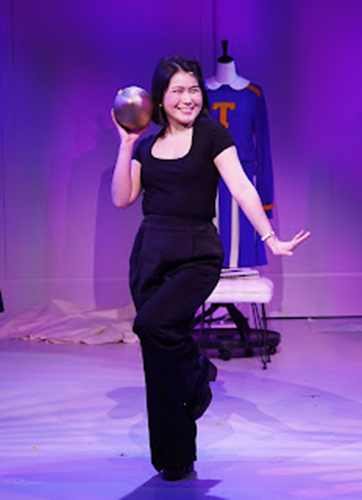
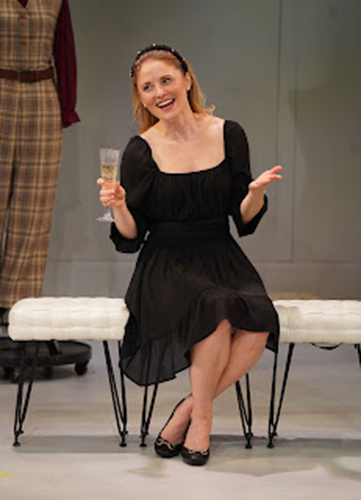
The story of three friends from roughly age 18 (in 1963) to roughly age 45 (in 1990), Vanities features terrific performances by Jade Jones, Amy Keum, and Hayley Podschun. They have good chemistry and provide full, textured characters. Most importantly, they all have truly beautiful voices.

Jade Jones
Photo: Carol Rosegg

The direction by Will Pomerantz, music direction by Deborah Abramson, and choreography by Shannon Lewis are also effective. The scenic design by James Morgan is elegant in its simplicity. The costume design by Barbara Erin Delo succeeds for two of the performers (but does no favors for the third). The band is small in number but not in sound: Deborah Abramson, conductor and keyboards; Jessie Linden, drums/percussion; Jim Donica, electric and acoustic bass; Matt SanGiovanni, electric and acoustic guitar and banjo; and Greg Thymius, flute, clarinet, and soprano, alto, and tenor sax.

Amy Keum 
Photo: Carol Rosegg

I was unimpressed by the show itself, unfortunately. First, I must specify that I believe that anyone should be allowed to write about anyone, across gender, race, and age. For example, Ibsen, John Sayles, and James Baldwin have all written believable compelling women characters. 

Hayley Podschun
Photo: Carol Rosegg

However, Vanities clearly was written by people who have never been--and don't understand--women. Throughout the show, the writers (book, Jack Heifner; music and lyrics, David Kirshenbaum) make mistake after mistake.

First, while the writers clearly want to depict real women in Vanities, they seem to believe that shallow depictions of cheerleaders from the past reflected actual human cheerleaders. As a result, the characters are thinly written, and their discussions are too often cutesy. When, for example, the women talk in 1963 about whether or not to have sex, the topics of birth control (not legal for single women in 1963) and abortion (not legal for anyone) are not mentioned. Potential pregnancy was not a joke in the early 1960s, and only cartoon cheerleaders wouldn't be concerned.

Throughout the show, there is way too much dialogue that relies on cheap, non-character-driven humor and makes the women look like idiots. For example, 

INTERCOM: Students, I am sad to announce the President has been shot.

JOANNE: The president of the student council has been shot?

KATHY And MARY: Oh my God.

INTERCOM: The President was gunned down in Dallas.

JOANNE: Dallas? I just saw him in algebra.

INTERCOM: If this report is true, classes will be dismissed for the rest of the day.

KATHY: What about the pep rally?

INTERCOM: In any case, the football game will take place as planned this evening.

ALL: Oh–THANK GOD.

For old-fashioned musical comedy characters, I guess this is okay. But for real women, which, again, seems to be the show's goal, it's unrealistic and insulting. 

In another example, one of the characters says, "When I found out that George Eliot was a woman, I got all confused." Really?

Also, the show focuses way too much on men. Yes, many women are very concerned, even obsessed, about men, particularly in their late teens and 20s. But that's not all they're concerned about.

[Spoiler] The show is ostensibly about the women's friendships, but only on the most surface level. In fact, the biggest plot point is when one woman sleeps with the other's husband. Why? Because the writers couldn't imagine anything else for female friends to fight about! Also, it's highly unlikely that the cheated-on woman would ever forgive her friend, but it's particularly unlikely that she would forgive her so easily. [End of spoiler]

Many writing books and teachers say, "Write what you know." That's limited advice that would nip the genres of sci fi and historical fiction in the bud. But it might have been a good idea for Heifner and Kirshenbaum. 

One last point: I am a big fan of inclusive casting, but when much of the show is about appearances, it can be awkward. Particularly when they are young, the characters in Vanities judge other people, harshly, by their looks. The show is called Vanities, after all. Having one of these characters be a large Black woman denies the reality (such as it is) of the show. If the other two women were capable of being best friends with a large Black woman--in 1963 in Texas!--they wouldn't be who the show claims they are. 

On the other hand, Jade Jones is a wonderful performer, and I imagine it's not a coincidence that there were many more people of color in the audience than usual, which is great. And I'm certainly glad to have seen Jones. I can't wait until there are enough good juicy roles to go around for people of every type and background.

Wendy Caster

Thursday, March 16, 2023

Arden of Faversham

Red Bull's fabulously entertaining production of Arden of Faversham, directed with a wry hand by Artistic Director Jesse Berger, tells the story of Alice (the terrific Cara Ricketts), a young wife who wants to trade in her boring husband for a hunky steward. Being as it's the late-16th century, divorce is not an option. But Alice has a plan!


Cara Ricketts, Thomas Jay Ryan
Photo: Carol Rosegg

Jeffrey Hatcher and Kathryn Walat have done a smooth job of adapting this Elizabethan farce, believed to be one of the earliest "ripped from the headlines" plays and possibly coauthored by Shakespeare. Hatcher and Walat compare Arden of Haverham, with its gruesome version of farce, to Coen Brothers movies. In their adaptation, they have leaned on the noir and expanded the women's roles. 


Tony Roach, Joshua David Robinson, Cara Ricketts
Photo: Carol Rosegg

In the Red Bull production, the farce wins out over the noir, as the characters aren't real enough to care about their lives or deaths. But that's not a problem--Arden of Faversham is completely satisfying as farce. The show is great fun from start to finish. The performances are calibrated in that wonderful realm of overacting-just-enough, and each character is beautifully delineated with quirks and particularities. Outstanding in addition to Ricketts are David Ryan Smith and Haynes Thigpen as two breathtakingly useless miscreants; Zachary Fine, as a goofy lovelorn suitor; and Joshua David Robinson, fabulously funny in three different roles. But the whole cast delivers. (Though a little better enunciation from the Widow Greene would have been appreciated.)

The set is by Christopher Swader and Justin Swader; the costumes by Mika Eubanks; the lighting by Reza Behjat; the music and sound by Greg Pliska; and the props by Samantha Shoffner. All are excellent.

[spoiler] As for the play possibly being cowritten by Shakespeare: (1) I am no expert; and (2) Red Bull's production is an adaptation, so it would be difficult to ferret out Shakespeare's voice. However, the only facet of the play that struck me as Shakespearean was the body count.

Wendy Caster

Friday, March 10, 2023

Dark Disabled Stories

I reviewed this show for Talkin' Broadway. The review can be accessed here.


I have very mixed feelings about this review, just as I had mixed feelings about the show. 

Tuesday, March 07, 2023

Crumbs from the Table of Joy

In 1995, Lynn Nottage had her first professional production: Crumbs from the Table of Joy, at Second Stage in New York. The Keen Company is now presenting Crumbs' first New York revival, well-directed by Colette Robert, in a solid production of this solid play. The writing is assured, insightful, wry, and open-hearted. (Nottage was only new to being produced; she had completed a full-length play by the time she finished high school and later went to the Yale School of Drama.)


Malika Samuel, Jason Bowen, Shanel Bailey
Photo: Julieta Cervantes

In Crumbs, 17-year-old Ernestine Crump's mother has died, and her father, Godfrey, responded to the loss by dragging his two daughters to Brooklyn from Florida. He chose Brooklyn because he mistakenly believed he was moving closer to his spiritual leader, Father Divine, who turns out to actually live in Philadelphia. Ernestine and her sister Ermina face major culture shock (a more challenging school; kids making fun of their home-made clothing), and racism is never far away. And deep grief is with the family always.

Then Ernestine's mother's sister Lily shows up, with all she owns, and moves in with them. Ernestine's father, although he can be difficult, bad-tempered, and controlling, is in many ways a good man, and he takes Lily in even knowing that she will rock his barely maintained equilibrium. And she does. Lily is a radical, a communist, and a drinker. She is full of herself, frightened, and angry. And she is attracted to Godfrey, which she expresses with a marked lack of subtlety.


Sharina Martin
Photo: Julieta Cervantes

Godfrey insists that his daughters live by the terribly restrictive rules of Father Devine: basically, don't have fun, don't have sex. For Godfrey, who wasn't remotely religious before his wife's death, Father Devine and his rules are the life savers he needs to get from day to day. For the daughters, they are a prison. Godfrey neither listens to his girls nor allows them any freedom; he has no sense of who they are.

Nottage's usual wit and compassion are on full display here, although the play bites off a bit more than it can chew, delving into growing up, grief, politics, racism, sex, intermarriage, and religion. (To avoid spoilers, I won't go into detail.) But that's just about the best fault a good play can have, and Nottage's brilliance pops out again and again. Also, while the play is predominantly Ernestine's coming-of-age story, with the help of director Robert and the fabulous cast it provides full inner and outer lives for all of the other characters (save Ermina, who is only partially developed). 

The terrific cast includes Shanel Bailey, Jason Bowen, Sharina Martin, Natalia Payne, and Malika Samuel. And the show is well-supported by Brendan Gonzales Boston's scenic design, Johanna Pan's costume design, and Anshuman Bhatia's lighting design.

Seeing a new play by Lynn Nottage is always an excellent way to spend time, even if it's an old new play. She's simply one of the best playwrights writing today, or ever.

Wendy Caster

Friday, March 03, 2023

The Trees

An odd and lovely play is opening at Playwrights Horizons on March 5th and running through March 19th. Written by Agnes Borinsky and directed by Tina Satter, The Trees is the story of a brother and sister whose feet become rooted into the ground in a small park near their childhood home. Little by little a community develops around them, while developers want to turn the area into a mall. Within this premise, Borinsky explores relationships, the meaning of life, value systems, the importance of change, and what it means to grow up.

Crystal A. Dickinson, Danusia Trevino, Jess Barbagallo,
Photo: Chelcie Parry

The Trees is

  • Written with compassion, insight, and humor by Borinsky
  • Directed smoothly and smartly by Satter
  • Remarkably well-acted by the entire cast: Jess Barbagallo, Marcia DeBonis, Crystal Dickinson, Sean Donovan, Xander Fenyes, Nile Harris, Max Gordon Moore, Pauli Pontrelli, Ray Anthony Thomas, Danusia Trevino, Sam Breslin Wright, and Becky Yamamoto
  • Beautifully designed by Enver Chakartash, whose costume design is whimsical and witty, and Parker Lutz, whose scenic design, while completely non-park-like, manages to be just right, and beautiful.
  • Though-provoking
  • Great fun
Wendy Caster

Tuesday, February 28, 2023

She's Got Harlem on Her Mind

When Eulalie Spence died in 1981 at age 86, her obituary noted that she was a retired school teacher but didn't mention that she was also an award-winning playwright of the Harlem Renaissance. Unfortunately, Spence only received money for her writing once, when she optioned a screenplay to Paramount Pictures in the early 1930s. Eventually, she gave up on her playwriting. (Spence taught high school elocution, English, and dramatics in New York City from 1927 to 1958; one of her students was Joseph Papp, who cited her as a major influence.)


Déja Denise Green and SJ Hannah in "The Starter"
Photo: Kat duPont Vecchio


Spence wrote comic plays depicting Black people as they were, despite pressure from W.E.B. DuBois to write serious propaganda pieces. She also insisted on writing in dialect, not a popular choice at the time. (For more on Spence, check out "From DuBois To Lupino To Papp, Harlem’s Legendary Eulalie Spence 1894–1981" on the site Harlem World here. My thanks to Harlem World for much of the information above.)


Jazmyn D Boone and Raven Jeannette in "Hot Stuff"
Photo: Kat duPont Vecchio


The Metropolitan Playhouse is presenting a wonderful evening of three of Spence's one-acts through March 12. The plays depict slices of Harlem life, with themes of trust, love, and getting by. They also underline the effect of money, and the lack thereof, in people's lives and relationships. In "The Starter," TJ proposes to Georgia, who immediately asks, "Has yuh got any money, T.J.?" "Hot Stuff" focuses on Fanny, who tirelessly hustles for money by working hard, selling sex, and cheating numbers players out of their winnings. And in "The Hunch," a major numbers win changes two people's lives.


Jazmyn D Boone and Terrell Wheeler in "The Hunch"
Photo: Kat duPont Vecchio


All three plays are funny, energetic, insightful, and well-acted. The solid cast includes Eric Berger, Jazmyn D Boone, Dontonio Demarco, Déja Denise Green, SJ Hannah, Raven Jeannette, Monique Paige, and Terrell Wheeler. The smooth, thoughtful, and smart direction is by Timothy Johnson. Musical numbers--music by Johnson--surround the plays, providing energy, atmosphere, and delight.

She's Got Harlem on Her Mind starts with a bare stage and Vincent Gunn's lovely backdrop. Appropriate and attractive scenery is brought on and off by cast members. Jevyn Nelms's costumes, with an assist from the tdf Costumes Collection, are fabulous. (Would it be churlish of me to suggest that some of the costumes were perhaps inappropriately fabulous/pricy for some of those characters?) The lighting, by Leslie Gray, is particularly good, providing both the appropriate atmosphere and some gorgeous stage pictures.


Photo: Wendy Caster

In a world where theatre has developed the reputation of being too expensive (as, indeed, Broadway is), Metropolitan Playhouse tickets max out at under $32. Three fascinating one-acts, solid acting, beautiful design, intimate seating, reasonably priced tickets--go, already!

Wendy Caster

Becomes a Woman

While Betty Smith is famous today for her novel A Tree Grows in Brooklyn, her great love was playwrighting; she wrote over 70 one-act and full-length dramas, some of which were performed in various venues and/or published. She only reached Broadway once, co-writing, with George Abbott, the libretto to the musical version of A Tree Grows in Brooklyn.

Pearl Rhein, Emma Pfitzer Price, Gina Daniels
Photo: Todd Cerveris

Smith's fascinating play, Becomes a Woman, is currently receiving its world premiere production at the inestimable Mint Theater Company, downstairs at City Center. In 1931, the play won the $1,000 Avery Hopwood Award from the University of Michigan, where Smith had audited classes and achieved great success as a playwright. She was then invited to study at the Yale Department of Drama. (She was denied degrees from both universities because she had never completed high school.) Scholar Maya Cantu suggests that Becomes a Woman was never produced due to its exploration of "socially transgressive themes." 

Today the play's themes are less socially transgressive but still hard-hitting. Francie Nolan (yes, the same name as the main character in a Tree Grows in Woman, but 19 and not, I think, the same person) works as a song plugger in Kress's Dime Store. Her job has her singing most of the day among the customers. Men hit on her constantly. The come-on of choice is, "By the way, are you doing anything tonight, baby?" She tells them, "Yes I am. And I'm busy every other night this week too. And next week." 

Peterson Townsend, Emma Pfitzer Price
Photo: Todd Cerveris

Francie is afraid of men, a stance that Becomes a Woman sees as reasonable. The root of Francie's fear is her horror at how her father treats her mother. Florry, Francie's more experienced co-worker, is annoyed that Francie keeps turning down dates and makes fun of her whenever possible. 

FRANCIE NOLAN: I'm afraid. 

FLORRY: Afraid of what? You can't be killed secretly in an elevated train or strangled on the sly in the subway. Go places where there's a crowd. Then you won't have to be afraid. But keep out of places like the movies or taxis. 

FRANCIE NOLAN: But they get so nasty if you don't go off alone somewhere with them on a petting party. 

FLORRY: That's right. I once heard of a girl in Jersey who dropped dead because a man spoke two cross words to her. 

FRANCIE NOLAN: You know what I mean. If I ever got into any trouble by going out with a man, my father would kill me. 

FLORRY: I guess you'll live forever then. 

Florry also explains "A girl has to really like a man before she gets intimate with him but a man has to get really intimate with a girl before he likes her. Anybody will tell you that." (In the 21st century, many people still will, but in more vernacular language). Florry and Francie's other coworker, Tessie, recognize that Francie's fear, rather than keeping her safe, actually makes her more vulnerable.

And then, along comes the boss's son, smooth, well-dressed, and charming. He flirts with Francie and doesn't immediately ask her out, which pleases her. But then he comes back and says, "Are you doing anything, tonight, baby?" She's briefly crushed, but then she decides to go out with him that very night. She thinks that because he is suave, cool, and upper class, he is different from other men. He isn't.

In the next two acts, Becomes a Woman goes some predictable places and some surprising ones. It manages to be both old-fashioned and melodramatic and forward-thinking and feminist. As with many of the plays that the Mint presents, Becomes a Woman reminds us that the past was not homogeneous. Nowadays, you will often hear people say, "Well, we didn't know better then," or "People didn't realize that then." But many did, and Becomes a Woman proves it.

The Mint's production is a bit uneven. Director Britt Berke works against the play's naturalism, particularly in the first act which is directed almost as a musical comedy. In the lead role, Emma Pfitzer Price is tentative at first but gets stronger act by act. Gina Daniels, as Tessie, gives the best performance in the show, full of nuance and humanity. Jason O’Connell is lovely as Max, Tessie's boyfriend and the rare decent man in the show. Phillip Taratula, as an agent who offers Francie cabaret work with many strings attached, manages to be both larger-than-life and absolutely real. Duane Boutté, as Kress, Sr, makes some odd character decisions and pulls them all off beautifully. Many of the other performances are mediocre, unfortunately.

Physically, Becomes a Woman is a treat from the second you enter the theatre and see the song-plugging and fake-flower departments of the Kress Store. The set is well-detailed, convincing, and attractive. The other sets, Francie's parents' home and the apartment Francie later occupies, are effective as well. And the set changes are entertaining in themselves, as is often true at the Mint, as you get to see the clever use of space through carousels and folding walls. Vicki R. Davis is the set designer.

Also top-notch are the costumes by Emilee McVey-Lee, the lighting design by M.L. Geiger, the sound and original music by M. Florian Staab, and the props by Chris Fields.

I can't help but think that Betty Smith would have been quite pleased to have a production of this quality done during her lifetime.

Wendy Caster 

Tuesday, February 21, 2023

Sunday in the Park With George

As made clear in James Lapine's must-read Putting It Together (review here), the development of his and Stephen Sondheim's Sunday in the Park With George was hectic, odd, and messy. In many ways, the show is too.

Sunday grew out of Lapine's and Sondheim's imaginative responses to Georges Serault's masterpiece, "A Sunday on the Island of La Grande Jatte," and their ideas on the creation of art (spoiler alert: it isn't easy). While most musicals might be seen as equivalent to novels, Sunday is an anthology. The result is sporadically brilliant, often gorgeous, occasionally boring, and sometimes off-putting. Many people love it; many hate it. I'm somewhere in between: I love parts of the show ("Finishing the Hat," "Sunday," "Move On," etc.) and could definitely live without the rest of it.

Photo by David Fuller

I've previously seen different versions of Sunday on Broadway, with full(-ish) orchestras and star casting. Theatre 2020's current uneven production is my first little Sunday. Having loved little versions of Follies and Night Music, I was intrigued to see how little Sunday would work.

First to be considered is the lack of an orchestra. While musical director Michael O'Dell is truly heroic on the sole piano, the other instruments are missed--that's just a given. On the other hand, the actors are unmiked, and that is a complete pleasure.

The show is performed without a conductor. While many piano-only shows are conducted from the bench, O'Dell is more than fully occupied playing the two or three million notes in the score. Considering that Sondheim is famous for producing difficult songs with odd timing, the cast's singing without being conducted is truly impressive. 

Josh Powell, Rae Hillman  
Photo: John Hoffman

Then there are the physical aspects of the show. The Theatre 2020 production is done on a bare stage with the occasional bench brought on and off and projections/video upstage. Projection/video designer Alex Kopnick's work is imaginative and attractive.

The costumes are less successful. While limitations are acceptable in a small production, sloppiness isn't. Dot's bustle is distractingly misshapen; Jules' clothing fits badly, undercutting a character who would likely be immaculate; some items referred to in the score--a hat, a parasol, etc--are simply missing; some costumes are remarkably unbecoming to their wearers. 

The cast and the direction are uneven. Rae Hillman, who plays Dot/Marie, took over the part after the first performance when the original performer fell ill. While she would profit from more prep time and direction (duh), she gives a solid, confident performance. George/George is, unfortunately, out of his depth here. Rather than being intense and art-centered, with an underlying sexiness and tenderness, this George is  petulant and whiny.

Standouts in the rest of the cast include Caryn Hartglass as the Old Lady/Blair Daniels. She makes "Beautiful" a highlight of the show. (She also gets the two of the best costumes.) Albert Neithropp impresses as Soldier/Alex; he is the George understudy, and I would love to see him in the role. And Raffaela Cicchetti (Louise/Photographer and Museum Assistant) is the rare adult who can totally pull off a kid's role without looking like an adult pulling off a kid's role. 

Director David Fuller pushes for too much theatricality in the acting for a small space and the movement lacks a certain polish. 

Sunday in the Park With George is an ambitious choice for a small theatre, and Fuller and O'Dell ultimately give us a decent, occasionally quite-good production.

Wendy Caster

Tuesday, February 07, 2023

Audience

Among Václav Havel's extraordinary traits--talent, bravery, more bravery--his compassion is in some ways the most impressive. In his one-act play Audience, Havel's stand-in, Ferdinand VanÄ›k, works in a brewery, often relegated to tedious, punitive tasks, because he has been forbidden in communist Czechoslovakia to be a playwright, and because he comes from wealth. VanÄ›k fascinates the Brewmaster, who holds him in endless conversations in which he tries to get VanÄ›k to drink and questions VanÄ›k about his previously glamorous life. 

Photo: Jonathan Slaff


BREWMASTER: You must've known all them actresses since you wrote for the theater.  
 
VANÄšK: Of course…  
 
BREWMASTER: Like that cutie-pie, Bohdalová? 
 
VANÄšK: Yes... 
 
BREWMASTER: Personally, I mean... Did you know her personally?  
 
VANÄšK: Yes…  
 
BREWMASTER: Tell you what, why don't you ask her down here for a beer one of these days... Have some fun like... Whadya say? 
 
VANÄšK: Hmmm. 

That "Hmmm" is one of Vaněk's main responses, as he is powerless to just excuse himself and leave. He manages to mostly avoid drinking, but the Brewmaster gets drunker and drunker, repeating himself and becoming increasingly volatile. He asks Vaněk if they are friends and Vaněk of course says they are. Vaněk deals with the Brewmaster as though he himself is a fly and the Brewmaster is a stupid but deadly spider.

Then Brewmaster dangles a carrot, offering Vaněk a job in the warm warehouse rather than the cold cellar where he currently works. Vaněk's actually wanting something from the Brewmaster (other than just getting away from him) changes the balance of the conversation. And still the Brewmaster drinks, becoming more and more dangerous.


Photo: Jonathan Slaff

And here's the thing: Havel lets us see that the Brewmaster is himself a victim--of mediocrity, of ignorance, of lack of opportunity. He holds VanÄ›k's/Havel's life in his hands, but Havel can still see things from his side and recognize his humanity. That's particularly impressive in a play written so secretly that Havel didn't get to see it performed for 16 years. To me, that's the best sort of writing, not to mention the best kind of being. 

In the La MaMa presentation of the Czechoslovak-American Marionette Theatre's version of Audience, translated, directed, and featuring Vít HorejÅ¡, and also starring Theresa Linnihan, the two main characters are active puppets and the other people mentioned in the play are seen in small, slightly motorized dioramas. Cameras provide a sense of surveillance and also make it possible to see the small dioramas.

What do the puppets bring to the show? First of all, the puppets are works of art in and of themselves. Also, they open up the play by showing other people and locations. Most importantly, they allow the physicalization of the power differential between the main characters. 

While largely successful, this production ultimately lacks the overwhelming sense of claustrophobic danger inherent in the play. The version I saw at PTP/NYC, for some reason called "Interview" there (click here for review), was terrifying to watch. 

On the other hand, this production does quite well with the absurdity and humor of the play. And the short opening documentary film provides excellent context.

Wendy Caster

Thursday, January 19, 2023

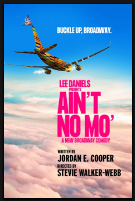
Ain't No Mo'

It was sad to see Ain't No Mo' come and go so quickly, but was Broadway the right place for it?

I get the attraction of Broadway. It's the place. But was there ever a chance that Ain't No Mo' would be profitable? 


Of course, that may not have been the point. Even a brief run on Broadway puts a play into a special category, and it probably improves the likelihood of other productions all over the country. Also, the chance for a Tony Award or two is certainly attractive.

But: wouldn't Ain't No Mo' fit Off-Broadway better? Might it still be running? 

Off-Broadway has two solid advantages: intimate space and cheaper tickets. I would personally be thrilled if most theatre occurred in small venues. For example, Merrily We Roll Along felt exactly right at NYTW, just as Kimberly Akimbo fit perfectly at the Atlantic. But with their fairly large casts, plus musicians, they need Broadway-size audiences to pay the bills. But Ain't No Mo', with its small cast, would be perfect for Off-Broadway. As would many other shows!

Wendy Caster

Monday, January 02, 2023

Hadestown

My third viewing of the amazing Hadestown was from third row mezz on a Wednesday matinee. Although I have an aversion to Wednesday matinees going back to the 1970s, I was pleasantly surprised by a full, enthusiastic, non-texting, non-talking, non-eating audience. Are Wednesday matinee audiences better than they used to be (they used to be awful) or was this an anomaly? Either way, it was a treat.


Also, there was no sense of the performers slacking off because it was a Wednesday matinee, something I have heard rumors of for decades. They brought their A game. 

Sitting in the mezzanine for the first time (versus front orchestra and back orchestra) gave me quite a different view of the show. From that vantage point, the mechanics of the show are on display, and they are fascinating and fabulous. The timing of the revolves, and the timing of the actors on them, is balletic. The constant movement and action is carried out impeccably. 

What a weird thing it is to be an actor dealing with moving here, turning there, going on this revolve and off that revolve, moving this table or that prop, and still being authentically in the emotional moment. I've been going to the theatre since the late 1960s, and I'm still impressed over and over by the skill and talent onstage all over New York.

I also want to give a shout-out to the stage management crew, who keep things moving like clockwork show after show after show. It's an impressive feat.

And, oh yeah, Hadestown is a brilliant, kick-ass musical, hurt only by the fact that Orpheus is a complete tool. Had their positions been reversed, Eurydice would not have looked back.

Wendy Caster

Sunday, January 01, 2023

1776

Here's the amazing thing: the musical 1776 is so solid, so excellent, that the creators of the current Roundabout production didn't manage to completely ruin it. Though they did try. 


When re-thinking a show like 1776, based on real events and people, there are two important things to keep in mind: (1) how much respect is owed to the people depicted, and (2) how much respect is owed to the original creators of the piece. 

Our so-called founding fathers were deeply flawed. One of the best moments in this production is Jefferson listening to congress read his Declaration of Independence (i.e., Declaration of Freedom!) while his slave dresses him. It's quiet, quick, and hard-hitting--and doesn't mess with the original show. It's also relatively subtle in a production in which subtlety is rare. 

Do Peter Stone (book) and Sherman Edwards deserve to have their work respected? Absolutely. The only legitimate reason to maybe mess with their show would be to make it better. This production doesn't, though at least--as said above--it doesn't completely destroy it.

The all-non-cis-male cast is fine as a concept. (There are many weak performances in the show, but that is due to bad acting and direction rather than gender.) The different sexual identities change the emphases and meaning by definition. For example, that gender is a performance is made vivid through women performing masculinity. So, okay, fine. The nontraditional casting is fine.

It's nearly everything else that's the problem. The direction (Jeffrey L. Page and Diane Paulus) is ham-fisted and frenetic. Every moment is underlined and mimed and exaggerated and overdone. Some scenes come across as though a bunch of kids are putting on a show and making all the mistakes kids make: indicating, emoting, telegraphing. 

One example: the solo song "Mama Look Sharp" depicts the horrors of war quietly and subtlely--and breaks the audience's heart. In this production, the song is blared, and the entire cast is on stage, pulling focus. The decision to have one performer play the "Mama" of the song by rending her clothing and tearing her hair, sobbing, pulls even more focus, and makes the audience feel less rather than more. (Well, it makes the audience feel less grief, but more embarrassment.) 

Simply put, Page and Paulus did not respect the material, evincing a serious lack of judgment on their parts. If they wanted a musical with which to judge the founding fathers harshly and reframe the revolution, they should have written one. 

Wendy Caster

Tuesday, December 13, 2022

Merrily We Roll Along


Merrily We Roll Along
was and shall always remain a hot mess of a musical. Based on a longer-running if also financially unsuccessful 1934 play of the same name by Kaufman and Hart, Merrily opened (and quickly closed) on Broadway in 1981, ending the storied decade-long collaboration between Stephen Sondheim and Hal Prince. Their version follows a spiritually bereft if materially successful playwright backward in time, beginning with scenes from a wealthy, empty life as a producer of junky films and ending with his idealistic youth as a promising composer and burgeoning Great Artist. Close friendships fray, marriages end badly, and a son becomes estranged in the process. Why should we care at all about a guy we're told from the outset has traded his soul for fame and fortune? The show never bothers to let us in on that secret, which is why it does not work and never will--unless, if your glass is half-full, maybe someday it might. That's the Gordion knot of Merrily in a nutshell. 

It fascinates me to think about all the machinery that has chugged along behind Merrily from its premiere. The show purports to draw a line between art and commerce, and to take a stand on the side that values Great Art and that trusts money only so far as a means toward more Great Art. But, irony of ironies, it's the impossibly famous, incredibly monied, insanely connected and endlessly revered Great Men who made Merrily that has kept it from having been forgotten in the first place. There's the score, which has plenty going for it even if it, like the much weaker book, was hardly rapturously received by critics (though Frank Rich did tip his hat to it while trashing the rest of the show). Only when Columbia Records granted the company the rare opportunity to record a cast album despite the show's flop status (again, because Sondheim) did the score catch on. The many frequent attempts at reviving and attempting to "fix" Merrily followed suit: there have been countless revivals, many of which have been recorded for posterity, too, featuring new or revised or reordered or retinkered material--as if a few nips and tucks would somehow solve the problem of three not-especially-developed characters stuck in a slowly decaying friendship that never comes off as especially meaningful or interesting to begin (or, whatever, end) with.

Don't get me wrong: Maria Friedman's production--done apparently because she was good friends with Sondheim and wanted to do his poor, suffering, misunderstood show more justice than it's apparently ever been given--does help the show as much, I think, as it can possibly be helped. The superb casting goes a long way: the star-studded cast digs deep, and the performances are gorgeous as a result. Daniel Radcliffe is adorably wiry and neurotic as Charlie, and his frustrations with his friend are crystal clear--but then, so too is the fact that his life isn't so terribly miserable or bereft without Franklin in it, anyway. Jonathan Groff is always appealing and watchable, and his Franklin is framed as a sad, wistful cipher who knows he's gone about all the things the wrong way, even as he can't fix any of them. But mining the emotions of these characters is still not enough to turn the show around: self-aware or not, Shepard's an id-driven, money-hungry, womanizing dick, and we are told as much from the outset, so whatevs. To that end, while the phenomenal Lindsay Mendez finds more depth to Mary than any other actor I've ever seen in the role, the character nevertheless remains an angry, empty drunk who harbors a blinding love of an angry, empty Franklin. Her relationship with booze still makes a lot more sense than anything else about her. 

In short, the NYTW production of Merrily is a wonderful thing to see if you love this show despite (or perhaps for) all its warts. If you, like me, enjoy watching Sisyphean attempts at getting this particular rock up to the very top of the hill, you'll get a kick out of this acme of a production. Otherwise? Maybe go instead to a show that's not as impossible to find a ticket for, or stay home and stream any or all of the many, many, many recordings of past attempts at pushing the rock up the hill. I'm sure this cast will add a new one to the ever-growing pile soon enough.  

Sunday, December 11, 2022

Ain't No Mo'

Closing notices have been posted for Jordan E. Cooper's wonderful Ain't No Mo', which is a  shame: the show, which only opened on Broadway three weeks ago, richly deserves to connect with audiences. I hope ticket sales pick up as a result of attempts on the part of the company to keep it alive. 

This season has been particularly rough-going for lesser-known properties, which struggle to find spectators even in good times. It's especially hard right now, given a muted holiday season in which tourism remains down and infections from Covid (along with a number of other dangerous ailments) remain up. Still, if you're in the mood for a heady, high-energy satire that lets everyone in on the joke even as it centers on the joys and trials of Black life in contemporary America, put on a high-quality mask and get your butt into a seat at the Belasco for a swift, deeply rewarding 90 minutes that, if you're like me, will leave you wishing for more. 

Ain't No Mo' is essentially a series of sketches held loosely together with an overarching conceit: the US government is offering all members of the African diaspora free one-way tickets back. Black people are free to stay in the US if they want, but the show regularly implies that such a choice isn't going to be especially safe or wise. That such a premise can be taken as both ridiculously funny and deeply painful results in dichotomies that are mined brilliantly and fluidly throughout the show: Ain't No Mo' is frequently laugh-out-loud hilarious, until all of a sudden it's unbearably sad. Don't worry: you'll be laughing again in a minute, even if you're wiping away tears as you do. 

A sketch show is inevitably going to suffer some inconsistencies, but even during Ain't's occasional lulls, I found myself all-in. The breakneck speed--not only of many of the sketches, but also of some of the more impressive monologues--helps a lot. So does the extraordinary ensemble, which includes the playwright in drag as a harried new employee at an airport check-in counter responsible for sending Black Americans off on the last flight out of the US. The rest of the cast is consistently on point, and so committed that I found myself occasionally wondering if there were uncredited ringers turning up on stage for star turns. Nope: it's just that the cast of six disappears so deeply into some of their characters that they're virtually and thrillingly unrecognizable when they pop up later as someone else. 

I'm pretty cleareyed about the fact that a lot of shows simply don't last for deeply unfair reasons: Broadway is a business, and business is not kind, so a lot of really good shit fails while a lot of not-at-all-good shit thrives. But if any show deserves an audience right now, it's this one: it's generous, hilarious, challenging and cathartic, and I appreciated it very, very much. I hope it stays alive for longer than the three weeks it's run so far--and I hope you get to see it, too.

Sunday, November 13, 2022

Some Like It Hot

I saw Some Like It Hot too early to give it a full review, but I do have some comments. 


At first I was put off by the show. It's so energetic, and so enthusiastic, and so cheerful that it feels like an attack. But eventually I surrendered and embraced its hyperactive broad-stroke old-fashioned Broadway-ness. (It would have been a big hit in 1980.) 

Many of the songs are catchy and fun (though there too many of them). The ensemble work their collective butts off. The choreography is clunky. For example, there's a farce-type extended number that lacks logic and rhythm and ends up abrasive and annoying. However, the ensemble sells everything with that wonderful Broadway-triple-threat energy and skill. 

The main performances make or break a show like this, and Some Like It Hot features two kick-ass, star-making turns. Adrianna Hicks as Sugar and J. Harrison Ghee as Daphne have all the skills you could possibly ask for, topped with great charm and likeability. They are both consistently delightful. Christian Borle is ok; I don't think he is well-cast.

There has been some controversy in the chat rooms about this being a "woke" musical. "Woke" is often used judgmentally, so I don't want to go there. However, the way that the show embraces the existence of people of color and differing sexualities and identities is lovely

The show needs polish. I hope that they will use the rest of previews to fix the timing on one-liners (give them a moment to breathe!), balance the sound (50% of the lyrics are not intelligible!), trim the show, and dial the vibe down from 125% to, oh, 110%.

Some Like It Hot is not great. It is fun. And Ghee and Hicks are fabulous.


Wendy Caster