Cookies

Showing posts with label The Mint. Show all posts

Saturday, November 01, 2025

Crooked Cross

In the early 1930s, Sally Carson, an English writer and dancing teacher, spent time in Germany. She then wrote Crooked Cross, which focuses on the insidious growth of Nazism, first as a novel and then as a play. The invaluable Mint Theater Company recently produced the play, slightly edited.


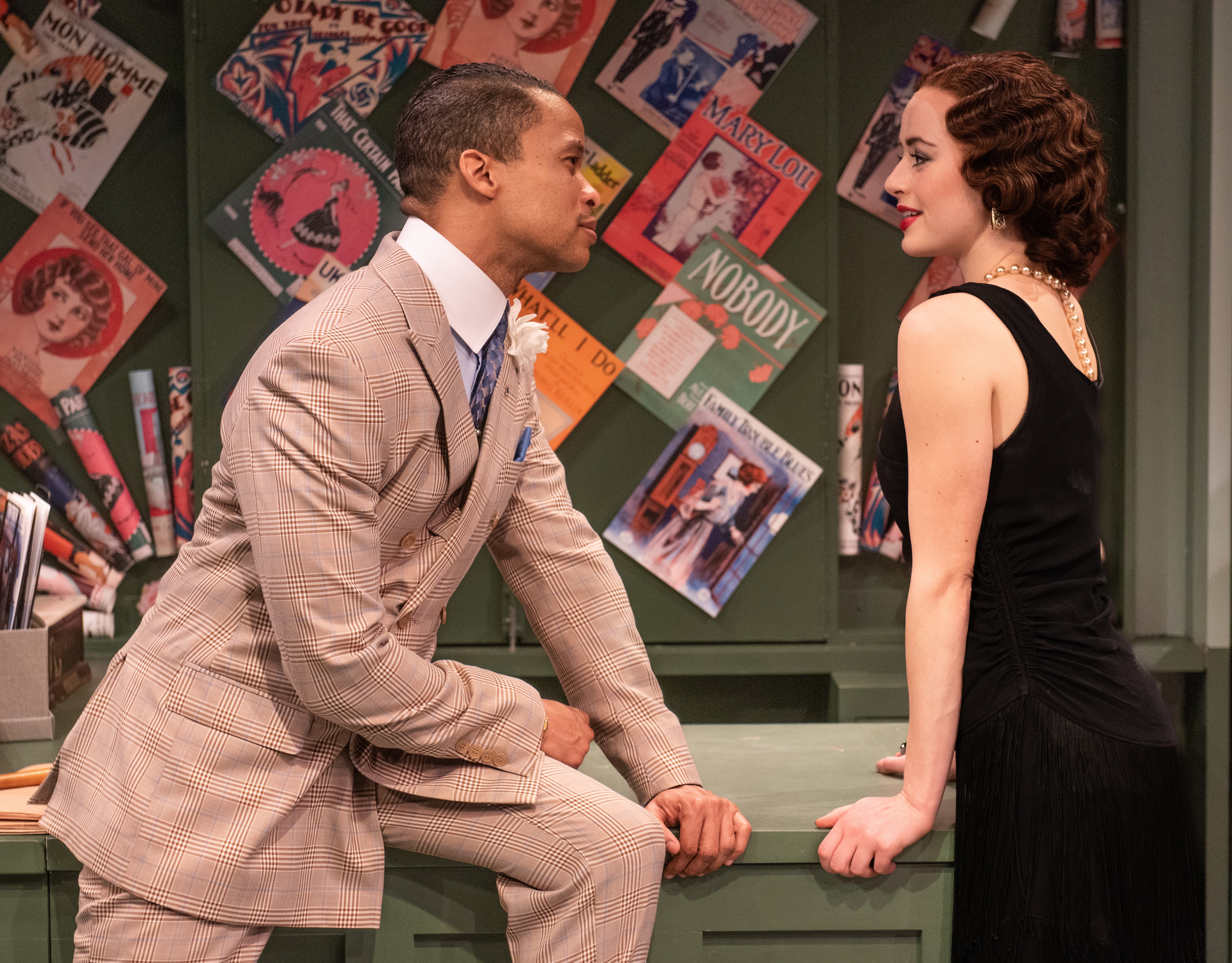
Photo: Todd Cerveris

The story of Lexa, a young woman in love with a Jewish man, Crooked Cross focuses on how her life changes as much of Germany, including her two brothers, join the Nazi party. Her boyfriend, a successful doctor, is fired from his hospital. Lexa's brothers pressure her to break up with him, and she lets them believe that she has, while still meeting him in secret.

It is fascinating to watch a play written in the early 1930s that sees clearly what is unfolding in Germany. Carson covers both what Nazism offers to disaffected, unemployed young men and how deadly dangerous it is. 


Photo: Todd Cerveris

Crooked Cross is not as interesting a play as it is a historic document. The characters are thinly drawn and the dialogue leans toward the pedantic. And the Mint's production is one of the company's rare misfires, coming across as flat and uninvolving. (In light of the many positive reviews that Crooked Cross has received, it's possible that I saw it on a bad night.)

As usual with the Mint, the design elements are strong and effective. The sound design for Crooked Cross, by Sean Hagerty, is particularly impressive. Through neighborhood noises, the sounds of a party, and other effects, he broadens the play, giving it considerably more dimension that it might have had in lesser hands.

For its next production, the Mint is going in a different direction with Zack, which has been reviewed as a "preposterous happy-ever-after tale, but one that should melt the most the most cynical heart." The Mint can be reached at minttheater.org. (Info on Zack has not yet been posted.)

Wendy Caster

Friday, October 11, 2024

Sump'n Like Wings

Lynn Riggs (1899-1954) wrote 30 plays, a few of which were produced on Broadway, along with screenplays and poetry. Nowadays he is known--when he is known at all--for having written Green Grow the Lilacs, which Rodgers and Hammerstein turned into Oklahoma!

A gay man and a Native American, Riggs had a strong sense of "otherness" and how it affected people's lives. He often wrote about Oklahoma, where he was born, in the early 1900s, and he was frank about the ways limited opportunity and frequent violence circumscribed the lives of many people, particularly women.


Joy Avigail Sudduth, Lukey Klein,
Julia Brothers, Mariah Lee
Photo: Maria Baranova 

In Sump'n Like Wings, currently being produced by the invaluable Mint Theatre, Riggs focuses on 16-year-old Willie, whose bitter mother is trying desperately to rein in her daughter's energy, desire, and anger. Willie's mother wants to protect Willie from the dangers of the world--i.e., men--but Willie is far from rein-in-able, and she breaks out of the role life has given her, at great cost.

This important theme is familiar from other Mint productions, including Becomes a Woman, by Betty Smith, and The King of Spain's Daughter, by Teresa Deevy. Unfortunately, Sump'n Like Wings is not at their level. It has one-dimensional characters, awkward dialogue, and weird plotting. On the other hand, it does do an excellent job of depicting the claustrophobia that results from women's legitimate fear of men. In the world of this play, fear of violence--particularly rape--runs women's lives. 

Riggs has little use for straight men. The one decent man in the play is a gentle bachelor who is described in the script as walking "about with quick nervous steps--like a bird," i.e., gay.

This production is not up to The Mint's usual standards. The acting is hampered by the dialect and accents used in the play, e.g.:

OSMENT: Well, she done it! I'm as shore of it as I'm shore of goin to heaven when I die—

CLOVIS: Well, I doan know about you and heaven—

MRS. CLOVIS: Pass me sump'n, fer heaven's sake!

And while, granted, the actors don't have a lot to work with, they rarely rise above the material. 

The overall result is an opportunity to catch a museum piece, but that's about all. I wish the Mint had done Green Grow the Lilacs instead, but perhaps they someday will.

Wendy Caster

Thursday, October 19, 2023

Partnership

The fabulous Mint Theater Company is presenting Partnership, the third in their "Meet Miss [Elizabeth] Baker" series. The first, The Price of Thomas Scott (review here), from 1913, movingly explores the clash between profit and principle. The second, Chains (review here), from 1910, vividly depicts how having a job can choke the joy out of life; it is sadly still timely. Both of these, while a little flabby, were effective, sometimes excellent, pieces of theatre, well-presented by the Mint. Unfortunately, the third play, Partnership, from 1917, falls short of the first two in both writing and presentation. 


Kate has a small dress shop. Now that Lady Smith-Carr-Smith is a customer--and plans to recommend the shop to a duchess--success seems guaranteed. Kate would like to acquire the shop next door to combine with her own. However,  rumor has it that George Pillatt, described as "a pig" and "cold as a tadpole," has taken the shop. To Kate's surprise, Pillatt suggests that they become partners in business, and in life. Kate says yes.

It's not clear why Kate would say yes. She knows that she is an "eligible" young woman. She doesn't need someone to support her. And she never even suggests to Pillatt that they be business partners only. 

Yes, women in the early 20th-century frequently made non-romantic marriages. I just don't see why Kate would. And, as you could probably predict, Kate promptly falls in love with someone else. Nothing that happens afterward is remotely surprising or particularly compelling. The play might come across better with a more lively production, but it is a surprisingly lackluster night at the Mint.

Wendy Caster

Tuesday, February 28, 2023

Becomes a Woman

While Betty Smith is famous today for her novel A Tree Grows in Brooklyn, her great love was playwrighting; she wrote over 70 one-act and full-length dramas, some of which were performed in various venues and/or published. She only reached Broadway once, co-writing, with George Abbott, the libretto to the musical version of A Tree Grows in Brooklyn.

Pearl Rhein, Emma Pfitzer Price, Gina Daniels
Photo: Todd Cerveris

Smith's fascinating play, Becomes a Woman, is currently receiving its world premiere production at the inestimable Mint Theater Company, downstairs at City Center. In 1931, the play won the $1,000 Avery Hopwood Award from the University of Michigan, where Smith had audited classes and achieved great success as a playwright. She was then invited to study at the Yale Department of Drama. (She was denied degrees from both universities because she had never completed high school.) Scholar Maya Cantu suggests that Becomes a Woman was never produced due to its exploration of "socially transgressive themes." 

Today the play's themes are less socially transgressive but still hard-hitting. Francie Nolan (yes, the same name as the main character in a Tree Grows in Woman, but 19 and not, I think, the same person) works as a song plugger in Kress's Dime Store. Her job has her singing most of the day among the customers. Men hit on her constantly. The come-on of choice is, "By the way, are you doing anything tonight, baby?" She tells them, "Yes I am. And I'm busy every other night this week too. And next week." 

Peterson Townsend, Emma Pfitzer Price
Photo: Todd Cerveris

Francie is afraid of men, a stance that Becomes a Woman sees as reasonable. The root of Francie's fear is her horror at how her father treats her mother. Florry, Francie's more experienced co-worker, is annoyed that Francie keeps turning down dates and makes fun of her whenever possible. 

FRANCIE NOLAN: I'm afraid. 

FLORRY: Afraid of what? You can't be killed secretly in an elevated train or strangled on the sly in the subway. Go places where there's a crowd. Then you won't have to be afraid. But keep out of places like the movies or taxis. 

FRANCIE NOLAN: But they get so nasty if you don't go off alone somewhere with them on a petting party. 

FLORRY: That's right. I once heard of a girl in Jersey who dropped dead because a man spoke two cross words to her. 

FRANCIE NOLAN: You know what I mean. If I ever got into any trouble by going out with a man, my father would kill me. 

FLORRY: I guess you'll live forever then. 

Florry also explains "A girl has to really like a man before she gets intimate with him but a man has to get really intimate with a girl before he likes her. Anybody will tell you that." (In the 21st century, many people still will, but in more vernacular language). Florry and Francie's other coworker, Tessie, recognize that Francie's fear, rather than keeping her safe, actually makes her more vulnerable.

And then, along comes the boss's son, smooth, well-dressed, and charming. He flirts with Francie and doesn't immediately ask her out, which pleases her. But then he comes back and says, "Are you doing anything, tonight, baby?" She's briefly crushed, but then she decides to go out with him that very night. She thinks that because he is suave, cool, and upper class, he is different from other men. He isn't.

In the next two acts, Becomes a Woman goes some predictable places and some surprising ones. It manages to be both old-fashioned and melodramatic and forward-thinking and feminist. As with many of the plays that the Mint presents, Becomes a Woman reminds us that the past was not homogeneous. Nowadays, you will often hear people say, "Well, we didn't know better then," or "People didn't realize that then." But many did, and Becomes a Woman proves it.

The Mint's production is a bit uneven. Director Britt Berke works against the play's naturalism, particularly in the first act which is directed almost as a musical comedy. In the lead role, Emma Pfitzer Price is tentative at first but gets stronger act by act. Gina Daniels, as Tessie, gives the best performance in the show, full of nuance and humanity. Jason O’Connell is lovely as Max, Tessie's boyfriend and the rare decent man in the show. Phillip Taratula, as an agent who offers Francie cabaret work with many strings attached, manages to be both larger-than-life and absolutely real. Duane Boutté, as Kress, Sr, makes some odd character decisions and pulls them all off beautifully. Many of the other performances are mediocre, unfortunately.

Physically, Becomes a Woman is a treat from the second you enter the theatre and see the song-plugging and fake-flower departments of the Kress Store. The set is well-detailed, convincing, and attractive. The other sets, Francie's parents' home and the apartment Francie later occupies, are effective as well. And the set changes are entertaining in themselves, as is often true at the Mint, as you get to see the clever use of space through carousels and folding walls. Vicki R. Davis is the set designer.

Also top-notch are the costumes by Emilee McVey-Lee, the lighting design by M.L. Geiger, the sound and original music by M. Florian Staab, and the props by Chris Fields.

I can't help but think that Betty Smith would have been quite pleased to have a production of this quality done during her lifetime.

Wendy Caster 

Thursday, June 23, 2022

Chains

In Elizabeth Baker's play Chains, currently in a strong production at the admirable Mint Theatre Company, Charley recognizes that he has much to be grateful for. He loves his wife Lily. He has a secure job in a terrible economy. He has a garden and a small but nice home. But his job is tedious and ill-paid; his garden is small with "filthy soil"; and he and Lily have had to take in a border to make ends meet. Still, Charley accepts his situation--albeit crabbily--until the border, Tennant, announces that he is moving to Australia. Friends and neighbors agree that Tennant is a "stupid ass" for giving up a steady job to try his luck on the other side of the world. But Charley too wants to break the invisible but oh-so-real chains that strangle his dreams and the dreams of many working class people.

Laakan McHardy, Jeremy Beck
Photo: Todd Cerveris

Chains was written in 1910, but the story is sadly resonant today. When a character says, "Last week our firm wanted a man to do overtime work, and they don't pay too high a rate—I can tell you. They had five hundred and fifteen applications—five hundred and fifteen! Think of that!" he sounds like many job hunters today. Similarly, the whole idea that workers should be grateful merely to have work, however unfulfilling or awful, remains alive and well. And Charley being called a socialist because he thinks there should be another way to live--that's very 2022 as well. 

Brian Owen, Olivia Gilliatt,  Peterson Townsend 
Photo: Todd Cerveris

As always, the Mint production is first-class all the way. The performers are excellent: Jeremy Beck, Anthony Cochrane, Christopher Gerson, Olivia Gilliatt, Laakan McHardy, Ned Noyes, Brian Owen, Claire Saunders, Peterson Townsend, Amelia White, and Avery Whitted. While I love multicultural casts in general, in this show, I wish the performers had been of one ethnic group/race (not necessarily white). In most Shakespeare plays and many musicals, for example, race is incidental. But in a play about class in 1910, race is not incidental. 

The production values are also, as always, superb: sets, John McDermott (the set changes are great fun); costumes, David Toser; lights, Paul Miller; sound, M. Florian Staab; props, Chris Fields. 

Overall, Chains does well in making vivid the invisible chains of being poor; however, the play takes too long to make its points and could easily have been a more powerful one-act (it was originally a one-act, as it happens, but Baker was convinced to expand it). Baker's The Price of Thomas Scott, done by the Mint a few years ago, was also a bit flabby, but it hit harder and said more. (Review here.) I am intrigued to see Partnership, the third play in the Mints' Meet Miss Baker.

Wendy Caster 

Wednesday, February 23, 2022

The Daughter-in-Law

The Mint Theater Company's production of D.H. Lawrence's drama, The Daughter-in-Law, so successfully evokes life in the East Midlands of England in 1912 that I was shocked when I glanced at the audience and saw people in contemporary clothing--and masks! This visit to another time and place is the cumulation of all the things that the fabulous creators at the Mint do so well: pick a compelling play, direct it with art and clarity, perform it beautifully--and provide scenery, costumes, lighting, and sound that perfectly set the scene, while also being a great pleasure to hear and see.

Tom Coiner, Amy Blackman
Photo: Maria Baranova

The mining families in Lawrence's play balance two serious concerns: (1)  the wear and tear of mining, with a strike looming, and (2) trying to understand, impress, escape, and love each other, while tangled in passivity, ambition, fear, and desire.

Mrs. Gascoyne's situation is ostensibly clear: she wants what's best for her grown sons. But what does that mean? And according to who? One son, Luther, a gruffly masculine man who has neither the intelligence nor the need to make much of himself, is married to Minnie, a woman he barely knows. Minnie has a small inheritance that becomes almost another character in the play, with its vibrations of power and class difference. Mrs. Gascoyne unsurprisingly has no use for Minnie. 

Over the course of the play, the characters surprise themselves and each other, and sometimes us as well. The plot also takes an unexpected turn or two. It's difficult to say how much Lawrence was trying to honestly represent the reality of the people of his time and how much he was working out his mother issues, and that adds texture to the story. The end is not exactly justified by all that precedes it, and that too is intriguing. Was Lawrence trying to make a point or was it a failure of his writing?

Sandra Shipley, Amy Blackman
Photo: Maria Baranova

The main thing to be said about The Daughter-in-Law is that it is a completely satisfying theatrical experience, often moving, often funny, and vivid in depicting class issues. Even the set changes are are compelling.

The Mint single-handedly keeps a whole subsection of theatre alive, rediscovering unappreciated plays and presenting them with astonishing consistency. In doing this, they also help keep alive the people of the past, as described in their present. It's so easy to think that people were different from us, partially because history and the arts have misled us, and partially because their clothing, surroundings, and values can seem so foreign. But the Mint reminds us again and again that being human has always been a messy and challenging adventure. (Yes, and that sex has always been complicated.)

CAST

  • Amy Blackman
  • Ciaran Bowling
  • Tom Coiner
  • Polly McKie
  • Sandra Shipley
CREATIVES

  • Director: Martin Platt
  • Sets: Bill Clarke
  • Costumes: Holly Poe Durbin
  • Lights: Jeff Nellis
  • Sound: Lindsay Jones
  • Props: Joshua Yocom
  • Dialects: Amy Stoller
  • Illustration: Stefano Imbert
Wendy Caster

Thursday, October 29, 2020

Conflict

Great news: It's not too late to watch The Mint's fabulous production of the painfully timely 1925 play Conflict. (Review of the production here.) For free. This is a nicely done video of the full production, and I recommend it highly. (BTW, it can only be watched from The Mint site and not on YouTube, but I ran a cable from my computer to my TV and the quality was excellent.) It's available through November 1.

Jeremy Beck and Jessie Shelton 
Photo: Todd Cerveris

Here's the info from their website:

Free On Demand Streaming of Miles Malleson’s election comedy CONFLICT runs from Monday October 19 through November 1. Closed Captioning is available.

If you need the Password, send an email to streaming@minttheater.org and watch for a response.

If you don’t see a reply, please check your spam folder and make sure you have a valid “reply to” address.

Mint is proud to have our artists back on payroll while offering you an opportunity to experience great plays and productions from the safety and comfort of your own home. We are gratified to know that we are providing a lift to out-of-work actors while sharing the Mint experience with old and new friends from around the world. Your support helps to make this possible.

Please consider making a gift to the Mint. Thank you!

The Mint itself can be reached at minttheater.org 

Wendy Caster


Wednesday, February 20, 2019

The Price of Thomas Scott

The invaluable Mint Theater Company has found another underappreciated playwright from early in the last century. Elizabeth Baker grew up in an extremely religious household and didn't see her first play until she was 30--theatre was considered immoral in her home.

Donald Corren and Tracy Sallows
Photo: Todd Cerveris
In Baker's The Price of Thomas Scott, Thomas Scott, very much the head of his household, is deeply religious and deeply conservative, keeping a tight leash on his children. No theatre, no dancing, no fancy clothing. The family has a millinery shop that is barely getting by. The son would like to go to a good school; the daughter would love to go to Paris to learn more about hats; and the wife would love to retire. An almost miraculous solution to their situation appears when a company offers a fortune to buy their home and shop. Only one problem: that company will turn the space into a dance hall.

The Price of Thomas Scott is a thin play in some ways; it would have been an excellent short piece. Even at only 90 minutes, it is repetitive and slow. Nevertheless, it is also quite involving. I found myself rooting against my own beliefs because Baker does such an excellent job at showing the roots and honor of other people's beliefs.

As always, the Mint production is top-notch and well-directed, although there are two dance numbers that are just wrong. They feel like winks at the audience: "We're not as backward as these characters," director Jonathan Bank seems to be saying.

Also as always, the production values are wonderful and evocative. The set is by Vicki R. Davis; the costumes by Hunter Kaczorowski; the lighting by Christian DeAngelis; and the sound and musical arrangements by Jane Shaw.

For a third "as always," the cast ranges from solid to outstanding. They are Donald Corren, Andrew Fallaize, Emma Geer, Josh Goulding, Mitchell Greenberg, Nick LaMedica, Jay Russell, Tracy Sallows, Mark Kenneth Smaltz, Ayana Workman, and Arielle Yoder.

The Mint plans to produce two more full productions of Baker's plays, as well as readings of some of her one acts. I'm looking forward to all of them!

Wendy Caster
(5th row; press ticket)
Show-Score: 88

Thursday, January 03, 2019

Best Performances of 2018

I am frequently blown away by the depth and quality of the New York acting community. Brilliant performances are everywhere.

(I've linked to my reviews for shows I did indeed review.)


THE ENSEMBLES

In the following shows, everyone was wonderful.

A Chorus Line

Band’s Visit


Dance Nation

Desperate Measures

Follies

Hello Dolly

Ordinary Days

The Possibilities/The After-Dinner Joke


ENSEMBLES, PLUS

In the following shows, everyone was wonderful but one or two people stood out, usually in lead roles.

Conflict--great cast, especially Jeremy Beck

Fabulation--great cast, especially Cherise Boothe

Ian Lassiter and Cherise Boothe
Photo: Monique Carboni

Happy Birthday, Wanda June--great cast, especially Jason O'Connell and Kate MacCluggage

Holy Ghosts--great cast, especially Oliver Palmer

Jerry Springer The Opera--great cast, especially Will Swenson


INDIVIDUAL PERFORMANCES

And then there are two individual performances I want to single out.

Farah Alvin was a new discovery for me in Inner Voices 2018. I think she can do pretty much anything.

Farah Alvin
Photo: Russ Rowland

In contrast, Ethan Hawke has long been a favorite of mine. I enjoy his all-in, balls-to-the-wall commitment to his roles, and I enjoy even more that he knows when to pull back. In True West, he is mesmerizing.


SECOND THOUGHTS?

Now I'm wondering if I should have included Jerry Springer The Opera, Ordinary Days, and The Possibilities/The After-Dinner Joke on my "best of" list. They were all wonderful. But what would I have removed from the existing list to make room?

Wendy Caster

Friday, August 31, 2018

Days to Come

Is any theatre company in New York more consistently satisfying than The Mint? IMHO, the answer is a great big "No!"

Larry Bull, Janie Brookshire, Ted Deasy, and Mary Bacon
Photo: Todd Cerveris
(The set is much better-looking in person than this picture shows)

Here's what you (nearly always) get when you go to The Mint:
  • An unsung play from decades ago that is at worst interesting and at best flat-out wonderful.
  • A playwright who is smart, insightful, compassionate, and, usually, forgotten. 
  • Direction that is clear, straightforward, smooth, and completely in service to the play.
  • A cast that ranges from good to extraordinary.
  • A set you'd like to move into.
  • Costumes that are often beautiful and usually just right for the character.
  • Excellent lighting, sound, props, and fights.
  • A satisfying evening.
The current show, Days to Come, is by Lillian Hellman, who is not forgotten, but the play mostly is. I usually think of Hellman's work as tightly plotted and smoothly structured; Days to Come is neither. (It was her second play to be produced, and it closed after seven performances.)

Hellman herself diagnosed the problem with the play: "I wanted to say too much." Indeed, while the plot focuses on how a strike at a brush-making firm affects the small town where it occurs, the show also has a lot to say about relationships, money, family secrets, how to live a worthwhile life, the underlying reality in friendships between people of different classes, violence, sexual mores, and what does or doesn't make a woman's life full.

The result is somehow both too flabby and too thin, but still compelling. Hellman's point of view is not simple, and it is that complexity that makes the play worthwhile. 

The current production has all the strengths listed in the bullet-point list above, but I'd like to give shout-outs to Jane Shaw's sound design, which makes real the world outside the play, and to fight director Rod Kinter and stage managers Jeff Meyers and Kristi Hess, who provide some really nice effects. 

Wendy Caster
(press ticket, fifth row)
Show-Score Score: 85


Cast: Mary Bacon, Janie Brookshire, Larry Bull, Chris Henry Coffey, Dan Daily, Ted Deasy, Roderick Hill, Betsy Hogg, Kim Martin-Cotten, Geoffrey Allen Murphy, and Evan Zes. Sets, Harry Feiner; costumes, Andrea Varga; lights, Christian DeAngelis; sound, Jane Shaw; props, Joshua Yocom; fight director, Rod Kinter; dialects and dramaturgy, Amy Stoller; casting, Stephanie Klapper, CSA; production stage manager, Jeff Meyers; stage manager, Kristi Hess; illustration, Stefano Imbert; graphics, Hey Jude Design, Inc.; press, David Gersten & Associates.


Thursday, June 21, 2018

Conflict

The wonderful people at The Mint have done it yet again. They have gifted us with a beautiful production of a lost gem of a play, complete with smart and clear direction, wonderful performances, and impeccable design elements. The Mint's batting average is extraordinary.

Jeremy Beck and Jessie Shelton 
Photo: Todd Cerveris

Specifically, the play is Conflict, written in the 1920s by Miles Malleson, author of Unfaithfully Yours (presented by The Mint in 2017). In both plays, Malleson uses characters as mouthpieces for particular points of view; however, the ratio of ideas to emotions is more effective in Conflict. Here's a description of the play from the press release:
Conflict is a love story set against the backdrop of a hotly contested election. It's the Roaring '20s in London. Lady Dare Bellingdon has everything she could want, yet she craves something more. Dare's man, Sir Major Ronald Clive, is standing for Parliament with the backing of Dare's father. Clive is a Conservative, of course, but he's liberal enough to be sleeping with Dare, who's daring enough to take Clive as a lover, but too restless to marry him. Clive's opponent, Tom Smith is passionate about social justice and understands the joy of having something to believe in. Dare is "the woman between" two candidates who both want to make a better world — until politics become personal, and mudslinging threatens to soil them all.

Thursday, January 18, 2018

Hindle Wakes

Sex. It's a tricky thing, is sex.

Throughout history, including now, cultures have sought to tame sex's complexity via rigid rules, assumptions, and limitations (particularly for women), with little success. In fact, the rules invariably make sex more complex by adding layers of morality, expectations, and even property ownership. Perhaps most importantly, rules deny sex's mundane side: sometimes people just want to get laid.

Jeremy Beck, Rebecca Noelle Brinkley
Photo: Todd Cerveris

In the excellent Hindle Wakes, it's the early 20th century, and Fanny Hawthorn (a weaver at the Jeffcote mill) has just had a weekend tryst with Alan Jeffcote (son of the mill's owner and engaged to be married to someone else). Due to an unexpected circumstance, their parents find out, and all hell breaks loose.

Saturday, August 26, 2017

The Suitcase Under the Bed

Playwright Teresa Deevy lived from 1894 to 1963. The youngest of 13 children, she lost her hearing in her late teens, roughly at the same time that her family's financial situation became much reduced. She used theatre as as a way to practice her lip-reading (she read the play first, when possible) and soon felt inspired to write plays herself. When she had trouble getting her work produced, she switched to writing radio plays. She went to mass every day, yet was critical of the restrictions placed on women by the Catholic church. The limited biographical information available does not mention any romance.

She must have been a fabulous lip-reader and an even better reader of people, as her plays are wise, subtle, and full of psychological insight.

Mace and Deaver in The King of Spain's Daughter
Photo: Richard Termine
If not for Jonathan Bank and the invaluable Mint, Deevy and her work might be unknown, which would be a big loss for audiences and theatre history. Bank has not only revived Deevy's work; he has also been instrumental in tracking down copies of lost plays. Bank's latest evening of Deevy's work, The Suitcase Under the Bed, features four one-acts that were found in the titular location.

Monday, May 22, 2017

The Lucky One

In A.A. Milne's The Lucky One, currently playing at The Mint, we hear it again and again: "Poor old Bob." "Poor old Bob." "Poor old Bob."

Bob's problem is simple: for years he has been withering away in the shadow of his younger brother, the golden boy Gerald. Bob is stuck in a finance job that he hates and doesn't understand; Gerald is at the beginning of a great career with the foreign office. Bob is not a jock; Gerald is the star player on the local cricket team. Bob is lonely; Gerald is engaged to the amazing Pamela. To many of their friends and relatives, Gerald can do no wrong and Bob can do no right. Even worse, they expect Bob to accept his second-class status cheerfully. And even worse than that, Bob and Gerald's parents are so partial to Gerald that they are totally blind to Bob's good points; whether they even really love him is in doubt.

Paton Ashbrook, Ari Brand
Photo: Richard Termine
It is easy to see how this situation developed. Going back to their childhoods, Gerald's successes were nourished, and they grew. Bob's insecurities and weaknesses were nourished, and they also grew. And, honestly, Bob is kinda whiny and annoying. (I kept thinking of the wonderful line in the movie Broadcast News when Albert Brooks says, "Wouldn't this be a great world if insecurity and desperation made us more attractive?")

Monday, January 30, 2017

Yours Unfaithfully

So much depends on where you begin a play. Do you start when character A is behaving well? Or when character B is? Do you start at the foundation of their relationship or in media res? In Yours Faithfully, written in 1933 but currently getting its world premiere at the invaluable Mint Theater Company, playwright Miles Malleson starts a little too in media res for my taste.

Max von Essen; Elisabeth Gray
(photo: Richard Termine)

[spoilers follow] 

Anne and Stephen have been together for eight years. Many of their friends consider them an amazing couple. In fact, their compatibility has been rated at 80%, when most couples are rated at 20%. But there is trouble in the 80% paradise, or at least a sense of unease. Stephen has lost his joie de vivre and succumbed to writer's block. Anne is happily busy with the school she runs and their children (never seen), and she suspects that Stephen needs a new muse/lover. She chooses their friend Diana, who is just coming out of mourning her husband. Stephen and Diana eagerly accept Anne's generosity, and soon Stephen is happy and writing again--and perhaps more in love with Anne than ever, due to his new freedom. Just one problem: no matter how much Anne tells herself that jealousy is beneath her, she cannot help what she feels: terribly, terribly, terribly jealous.

Sunday, October 16, 2016

A Day By the Sea

Perhaps it's time for me to make a template for my reviews of Mint Theater Company productions:
Thanks once again to the invaluable Mint for reintroducing the world to yet another fabulous play, __________, which was beautifully directed by __________, with excellent acting by the whole cast (particularly _________, _________, and _________), and gorgeous scenery (by _________) and costumes (by ___________). 
But, no, each of the Mint's gems deserves its own accolades, and anyway, it's a pleasure to write a glowing review. (I know that some reviewers have more fun writing pans; I don't.)

Julian Elfer, Katie Firth
Photo: Richard Termine
N.C. Hunter's rich and moving play, A Day by the Sea, is a Chekovian exploration of people dealing with stormy emotional crossroads on a mild summer day. It starts slowly and quietly, and it took a while for my 21st century brain to gear down to mid-20th century pacing.

Saturday, February 27, 2016

Women Without Men

Playwright Hazel Ellis seems to have had a low opinion of women, with an even lower opinion of powerless women stuck together in lives harshly circumscribed by need. Premiering in Ireland in 1938, Ellis's Women Without Men takes place in the teacher's sitting room of Malyn Park, a private girls' school where teachers get one afternoon off each week and coal is in short supply even in the frigid depths of winter. The women are a varied bunch: the silly Miss Ridgeway, the stern Miss Connor, the colorful Mademoiselle Vernier, the bitter Miss Willoughby, and the closed-off Miss Strong. But they have one important thing in common: they need these jobs desperately. (It is interesting that Ellis chose the title Women Without Men when Women Without Money might have been more apropos.)

Emily Walton, Dee Pelletier, Aedin Maloney, and Kate Middleton
Photo: Richard Termine
So, the teachers bicker and plot and complain. After years together, their nerves are shot, and they are all easily annoyed by one another. They fight like the trapped people they are, jostling for space and quiet and even hot water.

Saturday, September 26, 2015

The New Morality

Harold Chapin's The New Morality, the slight but delightful piece from 1915 currently on view at The Mint, resembles an Oscar Wilde play if Wilde wrote about (almost) real people.

Brenda Meaney
Photo: Richard Termine
Betty Jones has taken to her bed and refused a meal to perform a level of repentance she doesn't feel. Her crime? She unloaded on Muriel, the woman with whom her husband has been flirting all summer. She acknowledges to her good friend Alice that some of her language would be better left to dog shows, and she admits that she was probably pretty loud. She thanks Alice for visiting at risk to her own reputation.

And then Muriel's husband Wallace shows up, demanding that Betty apologize.

Chapin uses this thin plot as a skeleton for discussions of sexual politics, society, and the meaning of fidelity. He fleshes it out with scores of very funny lines. His take on sexual politics is fascinating, since it exists in a world that probably never was: the gorgeous homes of independently wealthy people, taken care of by servants, where women rule the roost and men fecklessly try to figure them out. Chapin ignores the true power that men have and had, particularly 100 years ago, yet there is a level on which his sense of sexual politics is advanced and even vaguely feminist. (Chapin was killed in World War I, one of the millions of tragic casualties of that stupid and useless war, so there's no way of knowing how his work would have developed.)

Sunday, March 01, 2015

Fashions for Men

Bravo to the Mint!

Once again, the Mint has revived and revitalized a neglected play with respect, creativity, fine acting, excellent direction, and knockout scenery and costumes. This time around it is Fashions for Men, by Hungarian playwright Ferenc Molnár, author of Lilliom (turned by Rodgers and Hammerstein into Carousel), The Guardsman (Lunt and Fontanne starred in the original Broadway production and the movie) , and The Play's the Thing (seen periodically in New York in the adaptation by P. G. Wodehouse).

Fashions for Men opens in a Hungarian habadashery shop owned and operated by Peter Juhász. Juhász is so kind that he cannot bear to stop offering credit to a poor aristocrat who will never pay him back, even though the shop is having financial problems. Also working at the shop are Juhász's wife Adele and his friend Oscar, who love him dearly--but not as dearly as they love each other. We also meet a fiercely loyal clerk who has worked for Juhász for years, another employee who wants desperately to be rich, the much older count who loves her, and an array of customers. The plot is in some ways predictable and in others surprising, but always engaging and satisfying.

Thursday, September 18, 2014

The Fatal Weakness

If there is a theatrical heaven whence long-deceased playwrights can watch their work, then I'm certain that George Kelly is thrilled with The Mint's new production of his fascinating play, The Fatal Weakness, elegantly directed by Jesse Marchese. And I imagine he is particularly delighted with Kristin Griffith's wryly subtle performance as Mrs. Ollie Espenshade, a woman who discovers that she has been taking her marriage, her husband, and herself for granted. Griffith has an astonishing ability to simultaneously hide and reveal her emotions, just as she can be simultaneously heartbreaking and funny. Add to that her crack timing and superb listening skills, and the result is one heck of a performance.

Kristin Griffith, Cynthia Darlow
Photo: Richard Termine