Cookies

Showing posts with label 59e59. Show all posts

Sunday, July 28, 2019

Summer Shorts: Series A

In Series A, the first part of Summer Shorts at 59E59, all three plays circle around death. This is a lot for a 90-minute evening.

The first show, Interior, is the most fully realized of the three. Two men stand outside a house, gathering their strength to give the people inside terrible news. Gracefully if somewhat repetitively written by Nick Payne, Interior is a sad and hard-hitting slice of life, well-acted by Bill Buell and Jordan Bellow.

Jordan Bellow, Bill Buell
Interior
Photo: Carol Rosegg
The Bridge Play by Danielle Trzcinski lives in the gray area between a skit and a play, with a simple plot: a man is getting ready to jump off a bridge and a younger man starts talking to him. The play moves along nicely and has some funny moments, but since we know that the guy isn't going to jump, the suspense is minimal. The play does offer two decent character studies, and James P. Rees and Christopher Dylan White are both quite good.

James P. Rees, Christopher Dylan White
The Bridge Play
Photo: Carol Rosegg
Here I Lie consists of two interlocking monologues that don't interlock; they just kind of interrupt each other. The characters are a young women and man (Libe Barer and Robbie Tann, both excellent) with difficult problems that aren't quite what they seem. The two stories sort of relate, but not enough to justify the constant momentum interruptions. I would have much preferred to see the monologues as standalone pieces; the writing by Courtney Baron is fluid and the characters are compelling. They just keep getting in each other's way.

Libe Barer, Robbie Tann
Here I Lie
Photo: Carole Rosegg
While none of the three plays is bad, as an evening, Series A lacks oomph. The sum of the parts is a tad smaller than the whole.

Wendy Caster
(press ticket, third row)

Wednesday, December 12, 2018

The Net Will Appear

At the beginning of Erin Mallon's The Net Will Appear, 75-year-old Bernard climbs out of his second-story window to use the roof of the first floor as a deck. He sets up his camping chair and pours himself what he will later refer to as his "Jim Beam juice." Not long afterward, 9-year-old next-door-neighbor Rory climbs out of her second-story window, full of questions and stories and malapropisms. He's crabby, though of course he has a heart. She's cheerful, despite plenty of reasons not to be. It quickly becomes clear that (1) she will win him over; (2) the play will offer no surprises along the way; and (3) the production will nevertheless provide a sweet little evening in the theatre.

Richard Masur
Photo: Jody Christopherson 

Author Mallon writes by the numbers, but she does so competently and with feeling. Richard Masur's performance as Bernard is also by the numbers, but he's a skillful, likable actor and it works. Eve Johnson as Rory talks very, very, very fast, often losing intelligibility along the way, and she could use some lessons in comic timing. She's not great, but she's good enough and also likable; in quieter scenes, she shows a level of promise that made me wish that director Mark Cirnigliaro had been able to elicit better work from her.

Eve Johnson
Photo: Jody Christopherson 

The physical production is fine, with the exception of the between-scenes music, which grows more and more annoying as time passes.

I don't mean to damn with faint praise here. The Net Will Appear is a nice, old-fashioned evening in the theatre, and Richard Masur's performance alone is worth the low-priced ticket. It is what it is, and it's a solid version thereof.

Wendy Caster
(4th row, press ticket)
Show-Score: 80

Friday, October 19, 2018

Goodbody


A woman becomes aware of her surroundings. She is standing on a table and holding a gun. Behind her is a man who looks like he has been tortured, or maybe hit by a car, his injured arm secured to his chest with duct tape. In front of her lays a man who she seems to have just shot. She doesn't remember who she is, and she has no idea what's going on. The injured man starts explaining, but should she believe him? It's a fabulous premise.

Photo: Carol Rosegg

Unfortunately, Goodbody, written by J.C. Ernst and directed by Melissa Firlit, loses steam as the evening progresses. Ernst attempts the violent insanity of a Martin McDonagh or Quentin Tarantino, but the humor isn't funny enough, the suspense isn't suspenseful enough, and the insanity isn't insane enough. Also, Goodbody is in a tiny theatre, and while the intimacy heightens the atmosphere, it also exposes the climactic violence as not-particularly-well-choreographed staged fighting.

Goodbody is not without its positives. There are genuinely funny moments (loved the Twinkie story), and some of the suspense works well. Amanda Sykes does a great job as the woman who doesn't know whether she's a nice person or really horrible. Raife Baker, as the injured man whose only weapon is words, provides a nice balance of eloquence, desperation, and suicidal ego. The set (by Matthew D. McCarren) is attractive and makes good use of the small space. Most importantly, Goodbody is never boring. But it just doesn't have the build and tension it needs to fulfill the promise of its premise.

Wendy Caster
(press ticket; 2nd row)
Show-Score: 70

Wednesday, June 13, 2018

Secret Life of Humans

Presented as either a lecture nestled in a drama or a drama nestled in a lecture, Secret Life of Humans focuses on whether evolution is an unbroken line of progress, with each living iteration superior to the one before, or considerably more messy. It also provides some tricky conundrums about the meaning of superior and of good. The first topic--evolution--is discussed in the lecture parts and in conversation. All of the arguments are laid out neatly and clearly. The second topic--what it means to be superior/good--unfolds in compelling, if contrived action. (Basic story: Female lecturer with contemporary ideas about evolution meets someone via dating app. She finds out that he just happens to be the grandson of the person most famous for older ideas about evolution.)

Richard Delaney, Olivia Hirst
Photo: David Monteith Hodge

The theoretical parts of Secret Life of Humans are smooth and well-done, but they tell us nothing new, nor do they ask new questions. (I say this as a 63-year-old with a strong interest in evolution. When I was younger and knew less, I would have found the show considerably more impressive.) The show was worth 90 minutes of my time for the acting and some truly charming stagecraft. I would not be happy to have spent $70 on a ticket.

Secret Life of Humans is written by David Byrne [not the Talking Heads David Byrne, BTW] and directed by David Byrne and Kate Stanley. Starring Richard Delaney, Olivia Hirst, Andy McLeod, Andrew Strafford-Baker, and Stella Blue Taylor.

Wendy Caster
(press tickets, 5th row)
Show-Score: 75

Tuesday, April 26, 2016

Echoes

The earnest and well-acted Echoes takes place in two times and places: Victorian England and Afghanistan, and present-day England and Syria. In both situations, a young woman has dreams. In both situations, she gets nightmares instead.

Braganca, Houlbrooke
Photo: Carol Rosegg
Tillie (Felicity Houlbrooke), the Victorian, wants to study the life cycle of flies, but ends up married to a dominating, humorless, repressive man who says that her "duty and sacrifice" in life is to have sex with him and procreate. She says, "Over the next three months, he makes sure I do my duty and sacrifice as frequently as possible. In fact sometimes he is so keen for me to do my duty and sacrifice that I worry his love of country may be too great."

Samira (Filipa Braganca), the present-day woman, wants to help build the Caliphate, but ends up married to a dominating, humorless, repressive man who already has a wife and finds his way around the rules of Islam. His first wife explains, "To get round the adultery laws, the fighters marry a woman for a week, then get a cleric to ‘divorce’ them. …He’s done it before.’"

Neither woman has a chance. The husbands are strong, violent men, and the woman are little more than slaves.

Echoes, written by written by Henry Naylor and directed by Naylor and Emma Buttler, is performed as alternating monologues. Despite being full of incident, the play never quite gels as theatre, and the politics are heavy-handed. Both husbands are one-dimensional creations; both women's situations come across as Women's Oppression 101 rather than the lived experiences of real individuals. Not to say that the stories aren't convincing, but they're not presented theatrically. The situations are effectively awful, but as lectures not a play.

Wendy Caster
(3rd row, press ticket)

Tuesday, June 16, 2015

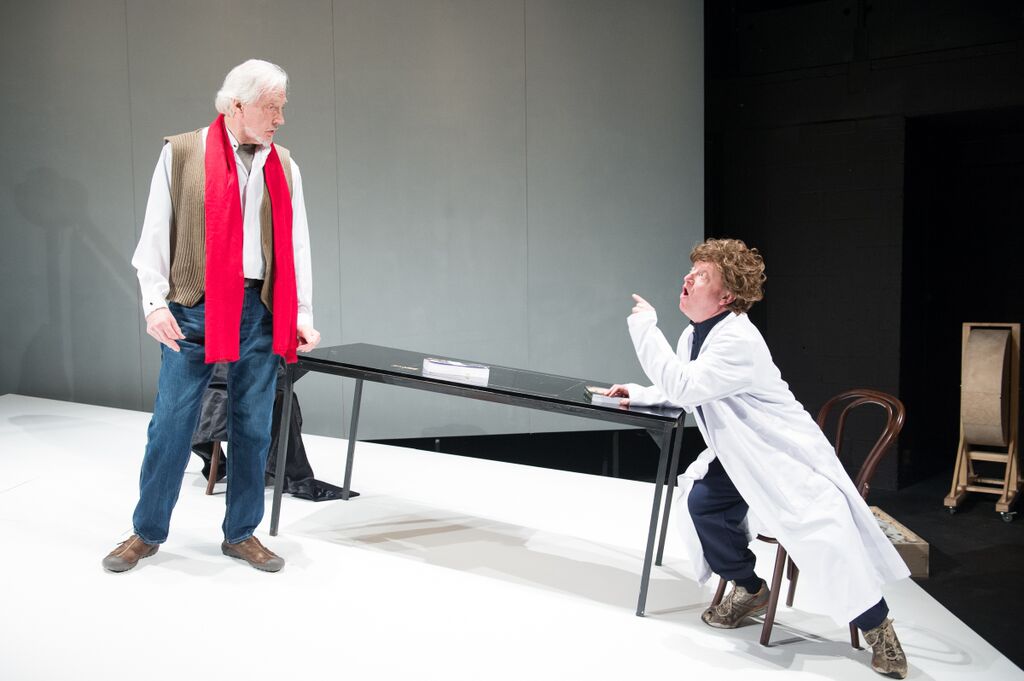
My Perfect Mind

Here is how My Perfect Mind is described in press materials and on the 59e59 website:

Petherbridge, Hunter
Photo: Manuel Harlan
Acclaimed classical actor and two-time Tony Award nominee Edward Petherbridge was cast as King Lear, when on the second day of rehearsals he suffered a stroke that left him barely able to move. As he struggled to recover Edward made a discovery: the entire role of Lear still existed word for word in his mind.

From being on the brink of playing one of Shakespeare's most revered roles, to lying in a hospital bed surrounded by doctors, Edward never imagined what tragedies and comedies lay in store for him.

I would have liked to see that play.