Cookies

Wednesday, July 06, 2011

Be Story Free


I admit it. I’m a Steve Burns groupie. With three children under the age of four, “Blue’s Clues” gets plenty of airtime on our television. So curiosity to see Steve sans his sidekick dog led me downtown to the Kirk Wood Bromley play, Be Story Free, performed on June 30th and July 1st as part of Ice Cubes, a one-time companion series to the 18th annual Ice Factory Festival that features new theatrical work.

Unfortunately, Burns’ part as The Device, a mysterious accessory that promises the antidote to well…almost anything, relegates him to movie snippets and voiceovers so fans never see him physically onstage. In a sense the role, like his long-ago days on the children’s program, still has him presenting the audience with a puzzle, encouraging them to find answers—only this time in lieu of following Blue’s paw prints, there’s periodic cell phone calls received by the cast and filmed segments of Steve engaging in random activities, such as playing with a top hat, to dismantle for meaning.

There’s much to admire in Bromley’s writing (who is also the artistic director of Inverse Theater, which co-produces the show) with its Mamet-like lyricism, featuring verbal acrobatics that demand precise articulation by the show’s actors. For roughly two hours, the five-member BSF (Be Story Free) Brigade explains their leader’s theories through a combination of film (by Leah Schrager), speeches, group shares and scripted “Q&A” sessions with the audience. Like true acolytes, they gaze at videos of Dr. Jip Syuzhet with absolute devotedness as he showcases his ability to free participants from “primordial narrative infections.” Imagine the fervidness of a Moony meeting crossed with the awkward audience/actor engagement during a performance of Tina and Tony’s Wedding and you’ll get the idea of this multi-platform theatrical experience: part performance art, part interactive theater, part YouTube video.

Despite the original premise of the show, this voyeuristic view into the cult-like seminars of the fictional Dr. Syuzhet sometimes feels like an overly long “Saturday Night Live” sketch. The play seems relentless at some points, berating the audience with its in-your-face philosophy on embracing life by eliminating story: you wish that the BSFers nonsensical lectures and frequent “shares”—brief bits of storytelling (despite their abhorrence for it)—ended after the sharpness of the first act. Everything past that point seems redundant.

Burns’ soothing voice as the narrator of the filmed clips fits perfectly as he questions the followers on their beliefs, gently mocking them as he asks for their stories or utters such counterfeit profundity as, “your love of truth condemns you to fiction.” Besides Burns, videos also feature dancers moving in Martha Graham-esque motions, sometimes by themselves, sometimes over props such as a table. All of the footage serves as a deliberate distraction, a commercial of sorts between the rants of the devoted, as Burns’ disembodied voice talks about an ultimate and unknown device with unlimited potential. What all of this means isn’t always clear, but it makes for an interesting conversation post-theater.

Often, the cast sits in the front row of the audience, almost part of the crowd, as they wait for their turns onstage. Sometimes this adds to the suffocating effect of attending an assembly geared to such constant persuasion—there’s no escape from the frenetic energy that surrounds you. However, it also allows you to see actors fall out of character occasionally as they yawn, drink a beer, or consult notes. Especially good here is Catherine McNelis, whose elastic face twists in anger as she recounts a tale, cursing a blue streak, then easily transforms later to a rapt, engaged follower.

The Ice Factory Festival, produced by Ohio Theater (under the banner Ohio Interrupted@3LD) runs from June 22 - July 30, 2011 at the 3LD Art & Technology Center. Ice Cubes performances are on Thursdays and Fridays. Upcoming shows includes: The Love Letter You’ve Been Meaning to Write New York (7/7, 7/8), Dead People (7/14, 7/15), Americans n’ Indians (7/21, 7/22), Will Sing (7/28, 7/29).

(Press ticket, front row)

Monday, July 04, 2011

A Streetcar Named Desire

Jessica Hecht
(photo: T. Charles Erickson)

Jessica Hecht has everything an actress could need to be a brilliant Blanche DuBois: talent, sensitivity, compassion, and intelligence. That's why her performance in A Streetcar Named Desire at Williamstown is so puzzling. To say that it is monochromatic doesn't sufficiently describe its lack of luster. This Blanche is sullen, one-note, and frequently unintelligible. This Blanche can barely be bothered to manipulate Stanley or fight for her life.

Not that Sam Rockwell as Stanley is any better. There's nothing theoretically wrong with having a bantam-weight Stanley. I can imagine James Cagney in the role with no problem. But Rockwell's performance is also monochromatic and sullen, and the only way his Stanley could get colored lights going would be by plugging in a Christmas tree. By the time Stanley is trying to stop the large, robust Mitch (nicely played by David Stewart Sherman) from going into the room where Blanche is, any suspension of disbelief is long gone, and it's hard not to laugh at the little guy supposedly restraining the big one.

While it can be difficult to tell from the audience where the director's responsibility ends and the actors' begins, it seems likely that director David Cromer supported, if not requested, these desultory performances. Cromer's aim seems to have been to get in the way of the show as much as possible, from lighting scenes with a single lightbulb, to setting up seats so that each section of the audience is forced to miss something important, to allowing a character to garble an entire joke with a cigarette in his mouth, to carefully casting the four main characters (the fourth, Ana Reeder as Stella, brought little to the table) so that no one has chemistry with anyone else.

I love Streetcar. I have seen six different productions. If this had been my first one, I wouldn't even know that it's a good play.

($35 including fee, not including cost of trip to Williamstown; sat on stage)

Wednesday, June 29, 2011

Zarkana


The magic of Zarkana begins as soon as you enter the gorgeous lobby at Radio City Music Hall. It may take a moment to notice amid the hubbub of the crowd, but there's a white-faced muscular man almost floating above you, singing a mysteriously alluring song. And then there's the Rag Doll woman with her liquid black eyes and impressively creepy rag doll. And . . . well, I don't want to say too much.

Once you're inside and the show begins, your eyes and mind are fed almost to bursting with staggering acrobatic acts, stunning 3D projections (designed by Raymond St-Jean) that seem like full-bodied holograms, and other-worldly costumes (designed by Alan Hranitelj). The stark, dramatic lighting (by Alain Lortie) throws huge shadows on the walls, so that watching the acrobats' shadows is almost as compelling as watching the acrobats.

And, oh, the performers! Carole Demers' jumps and flips on the Russian Bar make Olympic gymnasts seem like wimps. Maria Choodu's juggling is impressive and also beautiful. The trapeze artists utilize four platforms instead of two to allow frighteningly intricate flips and catches. Erika Chen's sand painting is an elegant and welcome respite from the intensity of the acrobatics. Ray Navas Velez and Rudy Navas Velez make you believe that the Wheel of Death is well-named--especially when one of them jumps rope in midair for 10 seconds or so. And Anatoly Zalevskiy uses every one of his perfect muscles in his hand-balancing act, which combines the athleticism of a sport with the beauty of a ballet.

One complaint: there is too much music and it is too loud. Much of it is beautiful, and the singers are excellent, but I would have preferred it to fade into the background during the acts, particularly during the subtlety of the sand painting and hand balancing. There are times the music almost feels assaultive.

Overall, however, Zarkana is glorious.

(press ticket, 31st row, center)

Thursday, June 23, 2011

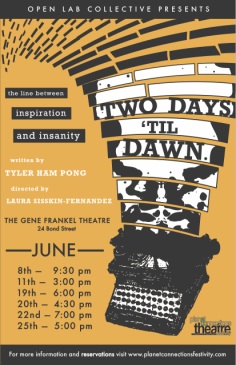
Two Days 'Til Dawn


[spoilers below]

Sol is in trouble. No matter how hard he tries, he cannot write anymore. He can drink. He can make a mess. He can whine. He can speak with great eloquence. He can have a nervous breakdown and chat with  literary figures of the past. But he cannot write. He didn't even win the poetry contest he entered. His wife did.

And here's where Two Days 'Til Dawn, by Tyler Ham Pong, starts to fall apart. Or maybe it would be more accurate to say that it splits into two.

On one hand, we have Sol's fantasy world. Pong shows some originality here, and while the visits from the literary figures are a little mannered and predictable, they are intriguing. The play that takes place in Sol's head has the potential to be an interesting one.

The play that takes place in Sol's life, however, is overloaded and unrealistic. Sol's a novelist, so his wife keeps asking him why he writes poetry at all--but he came in second in the contest, which surely shows some talent. And while his wife is worried that Sol will find out that she won the contest--she entered anonymously--it turns out that he has known all along. But there is no explanation of how he knows, which makes it sound as though there are maybe five poets in the entire world entering contests.

Also, while the prize for the contest is never specified, it sounds like much more money than any poet ever gets for anything. Sol also seems to have made an unusually large amount of money for his fiction. And all this matters, because it turns out that Sol's brother Charlie has been stealing from him due to jealousy, resentment that Sol never told Charlie that Charlie was adopted, and greed. This ostensibly major revelation has little emotional punch because the audience hasn't had the opportunity to get involved with Sol and Charlie as people, and because the combination of the writer's block, the writing competition between the spouses, Sol's nervous breakdown, and Charlie's betrayal is too much for a one-hour play. Oh, and there's maybe a baby who died and maybe a pregnancy now.

The play might have come across better if director Laura Sisskin-Fernández had insisted that her actors consistently enunciate and project, and if she had enticed better performances out of the three supporting cast members. On the other hand, Geoffrey Pomeroy as Sol is nothing short of amazing. He inhabits Sol fully and bravely, and he makes sense of the character's ups and downs and ins and outs, even bringing a bit of charm to his despair.

While there is much wrong with Two Days 'Til Dawn, Pong is a writer to keep an eye on. He aimed high with this show, which is admirable, and there were definite moments of wit, lyricism, and intelligence.

(press ticket, fourth row on the aisle)

Sunday, June 19, 2011

Finding Elizabeth Taylor

Elizabeth Taylor
as Elizabeth Taylor

The one-woman show Finding Elizabeth Taylor started late today because of technical difficulties. At one point, the star and playwright, Elizabeth Taylor, came out and chatted with the audience. She took questions, and she was charming and funny. Unfortunately, she was less interesting during the actual show.

Finding Elizabeth Taylor is a series of scenes about this Elizabeth Taylor's life. Sometimes Taylor plays herself, sometimes other people, and sometimes the world-famous Elizabeth Taylor. The scenes are separated by screens moving across stage, leaving various props and furniture as they go. The screens soon become annoying and give a staccato feel to the show.

Taylor is a good actress and a good writer, but the show doesn't coalesce. The charming person who took questions isn't there, and the show wanders from theme to theme (individuality, dealing with ridicule, weight issues, activism) without adding up to a cohesive whole. I admire Taylor's energy and skills, and I appreciate that she works so hard to show rather than tell. However, some narration might give the show a much-needed spine. As it is, Finding Elizabeth Taylor is too scattershot to be the show that it might be.

(press ticket, fourth row)

The Eyes of Babylon


By coincidence, I saw three plays about soldiers in Iraq this weekend (in order of viewing): Ajax in Iraq (not reviewed), Goliath, and The Eyes of Babylon. The Eyes of Babylon is the only one that was written and acted by a Iraq war veteran. How odd, then, that it turned out to be anticlimactic.

Jeff Key joined the marines in his thirties, eager to defend the constitution, protect defenseless people, and promote peace on earth. Once in Iraq, he had to deal with the fact that he was doing none of those things. In addition, as a gay man he was forced to stay in the closet, which is a galling location for someone whose dream is to fight for freedom for all.

The Eyes of Babylon is structured as a series of vignettes based on Key's journal entries, some of which are considerably more compelling than others. The best is the story of flirting with an Iraqi man in a code that they invent as they speak. Key is also good with the particulars of daily noncombat life as a marine in Iraq, from the sort of food eaten to the interactions with other marines to the graffiti on the walls of the port-o-potty. But the show meanders and runs too long, and Key is not a good enough performer to bring to full life the other people he wants us to meet. By the time Key is sent home for hernia surgery, The Eyes of Babylon has lost its focus.

Key has a lot to say, and his writing is often strong. However, I would have been more affected by The Eyes of Babylon as a series of essays.

(press ticket, third row on the aisle)