Cookies

Sunday, January 08, 2012

Scott Siegel's Broadway Ballyhoo: A Show Tune Hootenanny!


Nancy Anderson
When it comes to Scott Siegel's Broadway Ballyhoo: A Show Tune Hootenanny, currently playing late Thursday nights at Feinstein's, there's good news and there's bad news. 

The good news is that it exists. The seemingly indefatigable Scott Siegel presents a different handful of Broadway and cabaret performers each Thursday, accompanied by the protean, energetic, and wonderful Jesse Kissel on piano. Appearing thus far have been Alice Ripley, Nancy Anderson, Kevin Early, Kyle Scatliffe, Steve Ross, and many others. Feinstein's is a nice room, the cover and minimum aren't too bad (for more info, click here), and the performers chat and tell stories as well as sing. It's a nice set-up.

The bad news is that the show is highly overmiked. People who regularly perform live should not need mikes in this small-ish, albeit odd-shapped room. Kevin Early certainly doesn't need a mike. Hell, he could be heard a mile away sans mike; with one, particularly as over-amped as he was last Thursday, his singing was ear-injuringly painful. It should have been a pleasure to listen to him; instead, it was an ordeal. 

The "it-depends-on-you" news is that you get to pick evenings that feature performers you love. I went specifically to see Alice Ripley, who unfortunately took ill late that afternoon. Of the other performers, Kevin Early was good but, again, way too loud. Nancy Anderson is a little cutesy for my taste. And Carol J. Buford overacts and over-sings to an impressively awful extent; I didn't believe a word she expressed. (Or, should that be EXPRESSED?) Scott Siegel emceed with his usual rumpled charm. 


Keep an eye out for announcements of each week's performers. It's a great opportunity to see favorites sing two or three songs. And if you find the miking as horrible as I do, please tell Scott. 


(press ticket, audience left)
 

Sandra's Faves of 2011


My New Year's resolution is to see more theater. I just joined Show Showdown last spring, and, as a result, only saw about 16 shows last year. That does not qualify me to do a "Best of" list, but I do have a few favorites I'd like to gush over.

Favorite Revival: The Normal Heart

The Normal Heart--I never saw the original so I can't compare this year's incarnation with the 1985 version. Still, this remarkable show still resonates 25 years later. Audible crying in the audience is heard throughout the conclusion (yes, I shed tears, too) and feels like a communal mourning to all the lives lost to AIDS. Joe Mantello plays Ned Weeks with magnetic earnestness and caps the performances of a truly wonderful cast, including Ellen Barkin, Lee Pace, John Benjamin Hickey, Mark Harelik and Jim Parsons.

Favorite Play: Tape
I'm cheating here because this was also a revival but Stephen Belber’s Tape moved me like no other show in 2011. This Off-Broadway production showed the after effect of high school through sharp observation and gun-fire paced dialogue. Especially good was Don DiPaolo as the lovable loser, Vince.

Favorite Musical: Follies
Oops...another cheat since this is also a revival (Do you see a pattern here? I never saw the wunderkind Book of Mormon so perhaps that's what should be here. But of all the new musicals I viewed (Catch Me If You Can, Wonderland, etc.) not one surpassed Follies in musicality, compelling characters, or plot. Sondheim's show offers songs infused with insight that betray their character's hopes and fears in such a intimate way that even this flawed production levels a hefty emotional impact that lingers far after the initial viewing.


Favorite Actress: Nina Arianda
The prom queen of last year's theater season has to be Nina Arianda, who played Vanda in Venus in Fur, as a remarkable combination of the ultimate ditz turned cunning avenger. Not every actress could don dominatrix wear, sputter out curse-infused blue streaks of dialogue, and still seem realistic as an upper class Victorian socialite.


Favorite Set: Stick Fly Yes, when everyone talks about Stick Fly they mention the uniqueness of the playwright's characters and some of the stunning performances of the cast, but I want to highlight the scenic design for a moment. What a phenomenal set! Lovingly detailed by David Gallo (who also did The Mountaintop), the stage becomes a weekend getaway that reveals several rooms in the house through a clever bookcase cutaway that exposes the kitchen and a slight porch. The intimacy of the set acts almost like another character, revealing family details with photo magnets on the refrigerator, fine works of art on the walls and whimsical stone animals out in the garden.

Friday, January 06, 2012

Marilyn by Request: Marilyn Maye at the Metropolitan Room


If you have never seen Marilyn Maye, really, what are you waiting for? She's an amazing jazz singer, a brilliant interpreter, and funny to boot. She's a delight to spend an evening with. She's a classic. Timeless. The real thing.

In her most recent show, at the Metropolitan Room, Maye combined her  thematic medleys and standards with requests from the audience. The result was a pot pourri of different forms of bliss. Consider this partial set list: Celebrate Good Times, Hey Old Friend, Too Good to Be True, Start of Something Big, I Love You Today, Too Late Now, I Don't Want to Know, Pennies From Heaven, It Might as Well Be Spring, If I Were a Bell, Bye Bye Country Boy, Take Five, and the Best of Time Is Now. Her wonderful, youthful (she's in her 80s!), throaty voice, her sense of emotional complexity and joy, and her seductive personality made each and every song a winner. Her backup band, led by Billy Stritch (who sang with her on a handful of numbers) provided smart, elegant accompaniment with the wonderful Tom Hubbard on bass and Ray Marchica on drums..

I wish there were a way to truly describe the experience of seeing Maye, but what can be stranger than trying to explain how someone sings, how they express emotion, how they make magic happen? It's kind of impossible.

But I can describe the audience's reactions: Hugh grins. Cheers. Bravas. Ecstasy.

Really, truly, you have to see Marilyn Maye.


(For Maye's schedule of upcoming dates, click here. For the Metropolitan Room's calendar, click here.)


(press ticket, audience left)

Thursday, January 05, 2012

How the World Began


Heidi Schreck and Adam LeFevre
Photo: Carol Rosegg

After her life in New York falls apart, Susan Pierce (Heidi Schreck) ends up in Plainview, KS, teaching science to high schoolers whose town was recently decimated by a tornado. Susan has a tendency to say whatever pops into her head, no matter how inappropriate. She makes jokes to her student Micah Staab (Justin Kruger) about a herd of cows that were killed in the tornado. But the Christian Micah is more put off that she said, in class, "The leap from non-life to life is the greatest gap in scientific theories of the Earth's early history, unless, of course, you believe in all that other gobbledy gook." (At least that's what he claims she said. We do not see the scene.) In fact, he is highly offended and wants Susan to apologize. After Susan refuses to do so, Micah's unofficial guardian, Gene Dinkel (Adam Lefevre)--a Christian who believes in evolution and sees natural selection as "God's hand" at work--also tries to get her to apologize.

This is the basic story of How the World Began, Catherine Trieschmann's new play, currently being presented by the excellent Women's Project at Playwright's Horizon. It goes on to examine belief versus nonbelief, relationships, grief and loss, and standing by one's principles. Parts of it are fascinating; the characters are three-dimensional and occasionally surprising in convincing ways.  Rather than being a pseudo-screenplay like many contemporary plays, How the World Began unfolds in the sort of long, thoughtful scenes that theatre does best of all the art forms.

There's so much I liked about this play that I'm sad about my reservations, but here they are:

[possible spoilers below]

The most important one is that the character of Susan is whiny and dishonest. Since she represents my point of view, I wanted very much to like her, but she won't take responsibility for what she said--in fact, she denies having said it--and then won't take responsibility for what it means. She even claims that she didn't mean religion when she said "all that other gobbledy gook," although clearly she did. I didn't want Susan to be perfect or Joan of Arc. I understood that she feared for her job. But her dishonesty cast a pall over her actions and beliefs. (I suppose it's possible that she genuinely forgot what she said, but that seems highly unlikely.)

Another problem I had was with the structure of the play. Micah's true motivation is not revealed til toward the end of the play. However, the delay felt too much like a plot device. There was no character-driven reason for him not to have explained his thinking earlier.

Susan's interactions with Gene--which I actually found more interesting that her interactions with Micah--are never resolved. She says something horrible to him, and we never see him again.


Some of the humor struck me as easy laughs for the knowing, evolution-savvy theatregoer. (Though on a whole I found Trieschmann to be respectful of the two Christian characters--perhaps more respectful than she was of Susan.) And some moments were heavy-handed. For example, right at the beginning Susan is freaked out by the smell of manure (oh, she's not in New York anymore!).  Even the name of the town--Plainview--is a little too on the nose.

And I wish all playwrights would stop having scenes where the characters are waiting for someone we know will never come because we know how many people are in the cast (exception: Beckett). It just comes across as fake.

[no more spoilers]

The show is well-directed (by Daniella Topol) and largely well-acted. I had some trouble with Schreck as Susan, but I came to think that my problem was actually with the character. Adam Lefevre gives great depth and warmth to Gene, and Justin Kruger wears Micah's emotions on his sleeve.

I recommend How the World Began to people interested in the topic. But I can't help but think that there's a better play in there.

(press ticket; 4th row center)

Friday, December 30, 2011

Wendy's Top Ten of 2011


2011 continued my personal trend of seeing many more Off-Off-Broadway shows and considerably fewer Broadway Shows, with Off-Broadway holding steady. In fact, of over 70 shows, only eight were on Broadway. And this year, it's not just the insanely high price of tickets keeping me away--it's also the lackluster offerings. Perhaps my life will be forever diminished because I never saw Bonnie and Clyde or Mountaintop or the latest Anything Goes, but I'm willing to risk that, particularly because Off-Off- and Off-Broadway boast such high-quality offerings.

Here, then, in alphabetical order, is my top ten list, with links to the reviews:

Chris Wight, Lori E. Parquet, and Liz Douglas in Dog Act
(Photo: Isaiah Tanenbaum)
    Daniel Morgan Shelley and David King in
    The Man Who Ate Michael Rockefeller
    (Photo: Lia Chang)

Thursday, December 22, 2011

Stick Fly

Photo: Richard Termine

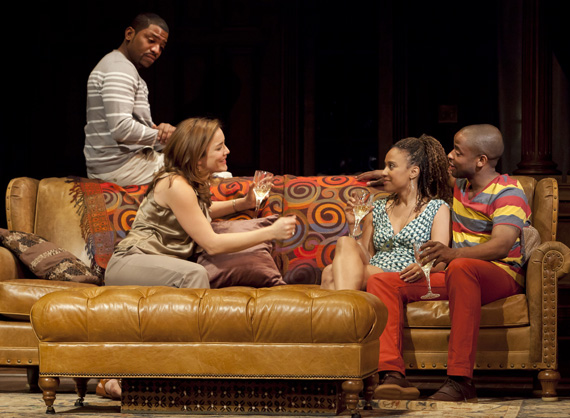
Stick Fly, which is currently running at the Cort Theater on Broadway after bouncing around the country, has been described as an old-fashioned, domestic melodrama, and in some respects, that description fits the show just fine: The multigenerational members of a highly intellectual, accomplished, affluent family meet at their Cape Cod summer home for a weekend of rest, relaxation, and bonding over food, drink, and board games. Yet questions arise almost immediately, and the audience knows that they'll all be solved by the final curtain: How do the elder brother and the fiancée of the younger brother know one another? Where is the family matriarch, who was expected to show up with her husband, but hasn't? What does the aging maid--who is terminally ill, but so tied to this family that she has sent her teenage daughter to cover for her--want her daughter to talk to the family patriarch about? Why is said patriarch being so evasive, and so snippy? The audience--most of whom, unless they are watching the show from the rock they've been raised under, can see what's coming from miles away--nevertheless thrills to the ways in which such revelations occur. This is, in short, the stuff of classic domestic drama: heavy-handed and over-the-top sometimes, sure, but lots of dishy, dirty fun nonetheless.

Were it just a melodrama, Stick Fly would have been enough for me: the show was engaging, the characters were likeable for their flaws, and the story-line certainly held my attention, even though I, having not been raised under said rock, figured out the trajectory pretty quickly. But there's so much to this play that it defies traditional labels, and thus to simply call it a domestic melodrama is not fair, or accurate, in the end.

So here's the jist of Stick Fly, in a nutshell (ok, fine, larger than a nutshell; perhaps smaller, though, than a breadbox):
For all its accomplishments, brilliance, and wealth, the members of the LeVay family can't brush the chips from their shoulders. No one quite knows who they are in this play, and no one feels totally comfortable in their own skins, their own settings, their own homes. Joe LeVay, the patriarch (Ruben Santiago-Hudson), is a successful neurosurgeon who can't stop driving his two grown sons to succeed (but on his terms--not theirs), and can't shake the feeling that he is less of a man because he married into so much of his money. Harold "Flip" LeVay, the elder son (Mekhi Phifer), is a skirt-chasing plastic surgeon who's just a little too smooth with the many women he beds but can't, for the life of him, commit to. Kent "Spoon" LeVay (Dulé Hill), the far more sensitive little brother, is seriously overeducated, but for all his advanced degrees, can't settle on a career he feels comfortable with, let alone one that will please his exacting dad. The fact that both brothers have invited women to join them for a weekend that features a mysteriously absent matriarch and the gloomy presence of Cheryl (Condola Rashad), the daughter of the family's long-time maid, only complicates an already fraught family dynamic. You can escape the city for the fresh air of the Cape, sure, but you sure as hell can't escape your family when you go on vacation with them.

The two women, like their men, don't feel like they belong anywhere, and especially not at the LeVay summer home. Spoon's fianc
ée, Taylor (Tracie Thoms), seems, at least on the surface, to be a more comfortable fit for the LeVay family: an extraordinarily intelligent, almost ludicrously well-educated black woman, she is the daughter of a famous (deceased) professor of sociology. Yet her dad, who left her mother when she was young, never fully acknowledged her, and certainly didn't help her financially, which has left her positively trigger-happy with anger, defensiveness, and self-described exhaustion at feelings of alienation, abandonment, and of never "having a space that's all mine." Flip's newest girlfriend, Kimber (Rosie Benton), seems, again at least on the surface, comparatively more comfortable with herself, with material wealth, and with the privileges she's enjoyed and taken for granted through her life. But it doesn't escape her for a moment that, as a white woman who has fallen in love with a black man, she represents an awful lot of cultural baggage, and that she is not necessarily as welcome in the LeVay home as she is stiffly, and usually but not always pleasantly, tolerated.

The fact that the LeVay family is black adds a dimension right away, sure. Seriously, how many plays out there are about affluent, educated, cohesive black families? And then, how many of them are written (by Lydia R. Diamond), directed (by Kenny Leon), and produced (by Alicia Keyes) by black professionals, and how many of those run on the Great White Way to audiences that are, at least the day I saw Stick Fly, easily 65- to 70% black? Broadway, which remains stubbornly segregated at best, and lily white at worst, despite enormous, if maddeningly recent, strides, needs lots and lots more shows like this (and lots and lots more audiences like the one I watched the show with yesterday), but really, that's not Stick Fly's problem--it's ours. Thus: this is really not so much a show about race per se as it is about assumptions about race, and then, not so much assumptions about race as assumptions about class and gender.

The gender angle is not quite as pronounced as the class angle; while this is much a show by and about women, it wears its gender politics gracefully and intelligently. It should be noted that some of the best performances take place in some of the best scenes, which tend to be segregated along gender lines. A scene where the three women in the cast gather in the kitchen late at night for a drunken bitch-session is just wonderful, as is a revelatory scene between Hill and Phifer. Hill has been criticized for being a bit stiff in his role, but this particular scene is so effective and layered that it more than compensates for some of the clunkier, more expository stuff Hill has to work with earlier in the show. The cast, in general, is strong to excellent, but these scenes will stay with me the longest.

And while the class angle is hit the hardest throughout the show, there are quiet moments that speak loudest because they are so well-acted. A scene near the end of the show during which Rashad slowly, deliberately, self-consciously takes a seat at the kitchen table--which she has been manically setting, clearing, and cleaning for most of the show--is particularly profound.

So...race, gender, and class can't really, truly be separated in any realistic way, can they? And what do we mean by these terms? And in talking and talking and talking about them, as these characters do, what is helping, and what is hurting, and what is digging us all merely more deeply into our own, angry, hurt, defensive "post-racial" little corners? Diamond's characters--like many educated, affluent people I know--practically contort themselves to avoid offending one another along race, gender, or class lines. But the way they all, in avoiding certain assumptions, so easily and unconsciously step right into others is where the play gathers steam and force, and its most biting commentary; Diamond's refusal to let any of her characters off the hook, while at the same time refusing to punish them for being, in the end, human beings, makes Stick Fly downright powerful.

Stick Fly defies melodramatic trappings right up to the end: it concludes not by tying up all the loose ends and resolving all the family baggage by the time Sunday rolls around. Because, face it, I'll bet money that that's never going to happen in your family--it certainly won't happen anytime soon in mine. But the ending is hopeful, caused me to shed a couple of genuine, if totally unexpected tears, and left me with real affection for these flawed characters, all of whom deserve to find themselves and to find happiness, and thus to come to terms with whatever skin-tone, class status, and sex designation they've been handed in the process.