Cookies

Wednesday, June 03, 2015

Show Showdown's Totally Unscientific, Completely Biased, Absolutely Pointless Tony Forecast, 2015


This year's Tony Awards are going to be aired on Sunday, June 7, and we at Show Showdown are so excited that we couldn't help but weigh in with our first ever forecast. There are a number of categories that are totally up for grabs this time around, and the close competition should make for a ceremony that is filled with surprises.

Our picks are listed below, with occasional commentary, and omissions when one or the other of us had no strong opinions about a particular category, or hadn't seen enough to weigh in comfortably.


BEST PLAY
Cameron, Wendy, Sandra and Liz
Will win: The Curious Incident of the Dog in the Night-Time
Wendy: Curious Incident couldn't do what it does as a movie or TV show; it makes full use of the magic of theatre to take us on a journey both with someone and in his head.

Cameron
Should win: Disgraced

Monday, June 01, 2015

Tuesdays at Tesco's

In many ways, it's a familiar story. An adult child continues to care for her elderly parent despite never receiving simple acknowledgement and acceptance of who she is. The adult child might have married out of the faith or chosen a profession against the parent's advice. The adult child might be gay. Whatever the circumstances, the elderly parent remains withholding, no matter how helpful the adult child is or how many sacrifices and compromises she makes.

Simon Callow
Photo: Carol Rosegg
In Tuesdays at Tesco's the adult child is transwoman Pauline. Pauline's father makes no secret of his disgust at her physical presentation, insists on calling her Paul, and stands as far away as possible when they do their weekly shopping at the titular Tesco's, a British grocery/department store.

Written by Emmanuel Darley (adapted and translated by Matthew Hurt and Sarah Vermande) and directed by Simon Stokes, Tuesday at Tesco's stars Simon Callow. While it's sort of a one-person show, Callow shares the stage with musician Conor Mitchell, who accompanies Pauline's periodic dance breaks, which are physical expressions of her emotions and personality. When not playing, Mitchell takes notes, slumps at the piano, and otherwise pulls focus. Together, the dances and Mitchell's presence add little and take away a lot. They would not be missed in a show that feels oddly long at 75 minutes.

Friday, May 29, 2015

Nice Girl

What does it mean to be a "nice girl"? And is it really a positive label? In Melissa Ross's Nice Girl at the Labyrinth, Jo (the smart and subtle Diane Davis) doesn't feel nice at all. She knows that she is angry and even bitter, and that she only carries out the actions that make her seem nice because she's too passive not to.

Diane Davis
Photo: Monique Carboni
Jo lives with and takes care of her mother, Francine (Kathryn Kates), a woman who rarely changes out of her housecoat and whose only exercise is pressing Jo's buttons. Although Jo was once student at Radcliffe, her father's death and her mother's neediness truncated her education. She is now a secretary at an accounting firm, depressed and lonely. She is 37 and stuck.

One day Jo's coworker Sherry (the wonderfully vivid Liv Rooth) reaches out to her. Where Jo is turned inward and doesn't even know what she wants, Sherry explodes outward, with a loud voice, overdone makeup, and strong appetites that she fulfills whenever she can. Sherry tells Jo that has been dating--and loving--a man who just recently mentioned that he has a wife (they're separated) and child. Sherry is furious at him, but she is also angry at herself for the general messiness of her life. She sees Jo as, yes, a nice girl, and she thinks that a friendship might be good for both them.

Tuesday, May 26, 2015

The King and I

The King and I is an odd classic. Full of wonderful songs, it features a dumb plot with a cutesy approach to female enslavement, a condescending view of Siamese culture, unconvincing scenes that rely too heavily on the charms of the leads to cover their flaws, and a truly bizarre combination of cheerfulness, silliness, seriousness, and weirdness.
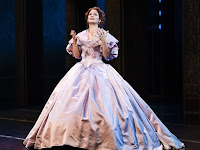
Kelli O'Hara
Photo: Paul Kolnik
Say we're willing to buy that a king would show so much interest in a teacher of his children. Say that we dismiss the ickiness of his receiving a woman as a gift as a cultural difference. Say we even give him credit for doing the best he can. We're still supposed to be pleased that the teacher--a smart and independent woman--is attracted to him, even though he's basically a slave owner who has sex with dozens of women whether or not they want to have sex with him.

And then, the teacher kills him by calling him a barbarian and making him look weak by stopping him from whipping a wayward wife--and in front of other people!

In the production of The King and I at Lincoln Center, Kelli O'Hara (lovely but not all that interesting as Anna) and Ken Watanabe (chewing the exquisite scenery as the king) lack the charm and chemistry to distract from the show's weak points. It doesn't help that Ashley Park as Tuptim and Conrad Ricamora as Lun Tha are more interested in the sounds of their own voices than each other. Nor does it help that Bartlett Sher blocks the show with constant and distracting movement.  I respect that Sher is (I assume) trying to make sure that everyone in the difficult Beaumont Theatre has a chance to see what is going on, but the show starts to look busy for busy-ness' sake. In particular, the King and Anna circle each other like boxers in the ring, which is effective up to a point but becomes annoying.

The show doesn't lack strengths. O'Hara's singing is often wonderful, and "Getting to Know You" is a pleasure. Ruthie Ann Miles is a formidable and excellent Lady Thiang. And the show is gorgeous to look at, from the second you set foot in the theatre. The sets, designed by Michael Yeargan, are downright scrumptious.

(third row, to audience left of center, member ticket)

Sunday, May 24, 2015

Blood Red Roses: The Female Pirate Project

The questions asked by Blood Red Roses: The Female Pirate Project are fascinating ones. How did certain women in history to break away from stifling expectations and become pirates? How did these women survive traveling on ships full of men? Money helped (Jeanne de Clisson, 1330-1359; Grace O'Malley, 1530-1603; Ching Shih, 1775-1844). If you owned the fleet, you didn't have to answer to anyone. Another option was to pass as a male (Anne "Bonne" Bonney, 1697-1720; Mary "Mark" Read, 1700-1782), hiding in plain sight. 

Why would a woman take this unusual and dangerous road? According to Blood Red Roses, presented by Drama of Works, the reasons include, respectively, revenge, honor, power, escape, and survival. These are juicy motivations, and these are fascinating women, Unfortunately, the amiable, intermittently clever Blood Red Roses doesn't begin to do them justice. 

The show is broken into five parts, each focusing on one or two of the women. The sections begin with brief songs of introduction, using the melody of "Rolling Sea" (based on "Sailor Laddie") with new lyrics. Sometimes three-syllable words are jammed into one-syllable spaces; sometimes one-syllable words are stretched to three beats. The results are awkward and difficult to understand.

The stories are told with the help of shadow puppets, some of which (e.g., the sailboats) get old fast. There is a lot of narration and little in the way of scenes, and the women's great adventures end up reduced to little more than shadows themselves. (The brief bios of the women in the program have more depth.) In addition, the pacing is uneven; the show occasionally grinds to a halt. On the positive side, there are many songs, nicely sung, and the occasional good joke.

The overall quality of Blood Red Roses is that of a high school show, but I'm not sure why. There are moments here and there that reveal both writing and acting talent; why weren't these skills used to a fuller extent? I wonder if the ensemble--who also created, wrote, and designed the show--simply aimed too low, settling for friendly and cute. I can't help but think that Blood Red Roses could have been a much more enjoyable--and meaningful--evening in the theatre if the ensemble had taken the time to write real scenes, hone the lyrics, and polish the pacing. (Also, six pirates may just be too many for one show.)

These amazing women pirates--and the audience--deserve  that extra effort.

(press ticket; first row)

Thursday, May 21, 2015

Permission

Jenny Anderson
Permission, Robert Askins' new play at MCC, is an entertaining if undercooked tangle of ideas that don't fully cohere. Using, as a springboard, the apparently real and squirmingly icky subculture of couples who practice Christian Domestic Discipline, the play ponders--if, ultimately, not all that deeply--broader questions about religion, power relationships, personal happiness, and marital bliss.

Act I opens on two couples--Zach and Michelle (Lucas Near-Verbrugghe and Nicole Lowrance) and Eric and Cynthia (Justin Bartha and Elizabeth Reaser)--gathering for dinner at Zach and Michelle's well-appointed Waco, Texas, home. Zach, a slickly confident sporting-goods salesman, informs Eric that business is so great that he'll be opening a second store. Eric is not as happy or as sure of himself as Zach seems. A professor at the nearby university, he wants the Dean to make him chair of the computer science department, but doesn't have the self-esteem to fight for the position. (Look, I've got insider information here, but seriously, Askins needs to spend maybe five minutes learning about the way college administrations function, because no, that's just not even how it works a little bit, ever.) Also, his marriage isn't at its best: Cynthia drinks too much and has been spending her days actively avoiding the novel she's supposed to be writing.