Cookies

Friday, July 10, 2015

Happy Days

In the first act of Samuel Beckett's Happy Days, Winnie is buried up to her waist in a large mound of barren earth. In the second act, she is buried up to her neck. The mound of earth can be seen as life, or aging, or even just a mound of earth. No matter the interpretation, Winnie tries to make the best of it, carrying out her (limited) rituals, sharing her thoughts with a man we barely see whom she has clearly know for years (her husband? lover?), and being ever grateful when a day turns out to have a good moment or two. "Oh, this is a happy day," she says. She adds, "This will have been another happy day," as though to file it for the future when it will be a precious memory.

Brooke Adams
Photo: Joan Marcus
In the production currently at The Flea, directed by Andrei Belgrader and starring Brooke Adams and (her husband) Tony Shalhoub, Winnie chirps along, accentuating the positive and barely listening to her own words. Adams' performance is flat, with a largely monotonal presentation. She recites words rather than inhabiting them. (Full disclosure: the night I saw Happy Days, the audience gave Adams a standing ovation, so mine is clearly a minority opinion.)

[spoilers] 

The production as a whole doesn't listen to Beckett's words or else fails to examine the anguish behind them. It is a coarsened version of Happy Days, complete with masturbation and flying snot. Willie's reappearance at the end of act two is treated as slapstick rather than desperation. These decisions, while lessening the impact of the play, can be justified based on the text. Less justifiable is the moment when Winnie signals the audience to clap to try to entice Willie to sing. If Winnie is aware of the audience, than her isolation is considerably less isolated.

Saturday, July 04, 2015

The Weir

Photo: Carol Rosegg
Irish theater values the act of storytelling as much as -- if not more than -- the story itself. The danger each playwright faces is that taken too far, this approach can feel like fetishization. Unfortunately, that's my impression of Conor McPherson's 1997 drama The Weir, which the Irish Repertory Theatre is reviving at its current digs in Union Square (the company previously presented this play -- with several of the same cast members -- two years ago). The play is little more than storytelling: in a remote Irish pub, the locals belt Jameson and Harp and indulge in spinning supernatural yarns they claim as true. McPherson is fascinated by the supernatural -- his plays The Seafarer and Shining City address the spirit world more directly -- and The Weir is a humanist attempt at a ghost story. It's also neither particularly poetic nor convincingly chilling. The actors give mostly fine performances, although more than a few line readings felt oddly tentative, and Amanda Quaid -- the lone woman, who shares the most disturbing story -- seemed young for her role. However, although only ninety-five minutes, Ciaran O'Reilly's production feels like a night where you stayed at the pub a few drinks past your limit.

[4th row, discounted ticket]

Thursday, June 25, 2015

Shows For Days

photo: Joan Marcus

The trickiest part of crafting a memoir is getting your very personal story to speak to something universal and recognizable for a wide audience. The best works of autobiography -- whether on the page (think Helen Keller's The Story of My Life or, more recently, Joan Didion's The Year of Magical Thinking) or the stage (Long Day's Journey Into Night, The Glass Menagerie) -- burrow deep into their authors' most private, painful and significant life experiences to create work whose power supersedes the specific. In an era where memoirs are more ubiquitous than ever, it is becoming harder and harder to strike this balance.

Unfortunately, Douglas Carter Beane's Shows For Days (at Lincoln Center's Mitzi E. Newhouse Theater) misses the mark by a wide margin. In telling his own story, Beane is so hyper-specifically focused on minutiae that you're left to wonder if the people he's writing about would care to spend time with -- much less recognize the humanity in -- themselves.

Monday, June 22, 2015

Men on Boats

In Clubbed Thumb's production of Jaclyn Backhaus's extraordinary Men on Boats, perfectly directed by Will Davis, it is 1869, and ten men are canoeing down the Colorado River in search of the "big canyon." They are in many ways a familiar bunch: the laconic hunter, the effete Englishman, the quirky old man (think Walter Brennan), the young man on his first adventure, the brilliant map-maker, and so on. They are led by a brave, stubborn one-armed captain. Their adventures and misadventures echo those of dozens of movies, old and new. No cliché goes unturned.

This might be business as usual, except that the actors are all women. They play the men as men, with no sense of drag or winking at the audience. They commit! They are a brilliant bunch of performers, and they nail the male clichés, all of which become sparkling new in their hands. Macho posturing, half-whispered voices, plaintive campfire songs, jostling for command, and other manly activities and traits all demand a fresh look when played by these amazing women. That the cast is multi-racial adds another layer of built-in commentary.

Tuesday, June 16, 2015

My Perfect Mind

Here is how My Perfect Mind is described in press materials and on the 59e59 website:

Petherbridge, Hunter
Photo: Manuel Harlan
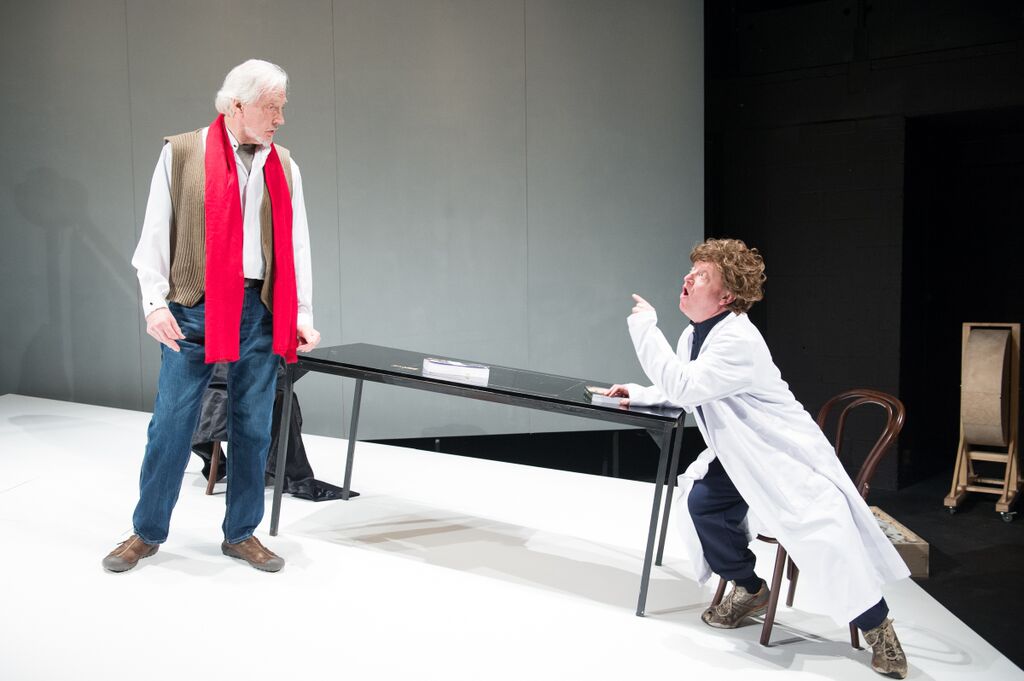
Acclaimed classical actor and two-time Tony Award nominee Edward Petherbridge was cast as King Lear, when on the second day of rehearsals he suffered a stroke that left him barely able to move. As he struggled to recover Edward made a discovery: the entire role of Lear still existed word for word in his mind.

From being on the brink of playing one of Shakespeare's most revered roles, to lying in a hospital bed surrounded by doctors, Edward never imagined what tragedies and comedies lay in store for him.

I would have liked to see that play.