 |
| photo: Kevin Parry |

Monday, September 14, 2015
Spring Awakening
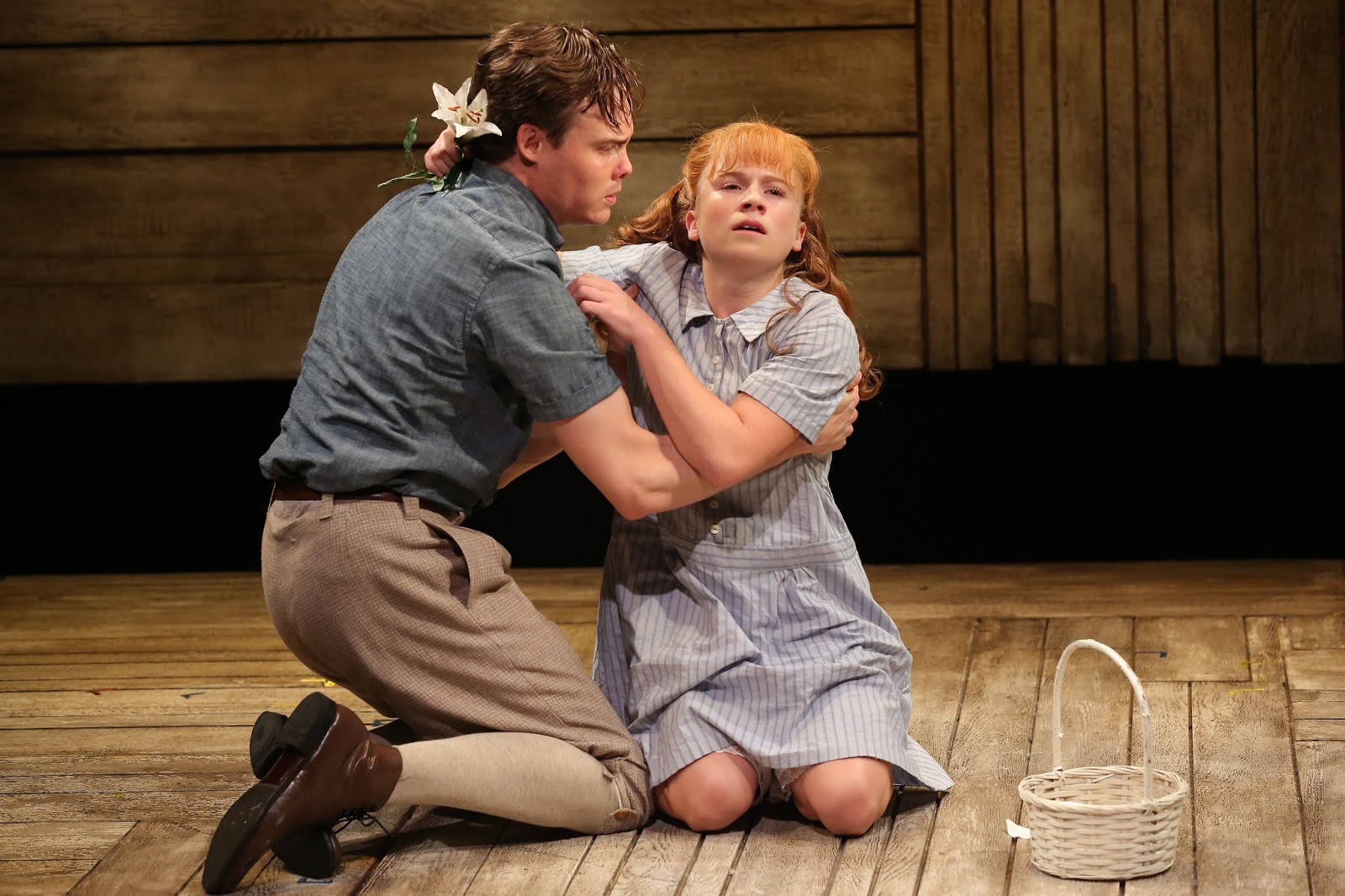
Two young women reflect each other through a mirror. One is dark-haired and slight, with a deeply expressive face. The other is blond and fuller-bodied, with a guitar strapped to her back. They both sing: one uses her voice; the other, her hands. Despite their differences, there is no question that they reflect the same person. This is how Deaf West's extraordinary production of Duncan Sheik and Steven Sater's Spring Awakening announces itself.
Directed by the actor Michael Arden, this revival of the 2006 musical -- currently playing at the Brooks Atkinson Theatre, after a successful run in Los Angeles -- puts the action in the context of the 1880 Second International Conference on Education of the Deaf, which occurred a decade prior to the publication of Franz Wedekind's Spring's Awakening, on which the musical is based. Known colloquially as the Milan Conference, it banned the teaching of sign language in favor of lip reading and oralism. Assimilation was prescribed as the only answer to the "deaf question;" those who could not essentially pass for hearing had no place in society.


Friday, September 11, 2015
Wendy Caster Now Theatre Writer for Art Times
I'm pleased to announce that I now have the honor of being the theatre writer for Art Times, where I will write essays most months. Here's a link to the latest issue. And here's a link to the Art Times website.
 And here is a taste of my first essay, "The New Audience: How a Culture Evolves."

In Shakespeare’s day, heckling was common. The groundlings (people who bought cheap tickets and stood right in front of the stage) flirted, argued, got drunk, and even urinated right there, while the show was going on. The wealthier people carried on their own intrigues in the more expensive seats, including the hiring of prostitutes.
I would have hated it. Patti LuPone would have hated it more! But it was the accepted theatre-going culture of its time.
(read more--on page 11 of the pdf)I will of course continue to review shows here.
Thursday, September 10, 2015
Desire
At first glance, The Acting Company's production of Desire would seem to be an evening of works by Tennessee Williams. After all, the six one-acts are ostensibly based on his short stories, and they burst with Williams-isms: the explosive horror of thwarted desire, needy heartbroken women, scared homosexual men, people unable to defy the world's expectations, glass figurines, even cannibalism. But the one acts offer us Williams' sensibility by way of Beth Henley, Elizabeth Egloff, John Guare, Marcus Gardley, David Grimm, and Rebecca Gilman. These playwrights bring much of themselves to the plays, and many of the results are vibrant, vigorous hybrids.
The evening begins with Beth Henley's "The Resemblance Between a Violin Case and a Coffin." Williams' short story is narrated by Tom, a young man uncomfortable with his homosexual urges and crushed by the loss of his older sister Roe--his one friend--to womanhood. Henley moves the focus to Roe, with Tom more of a supporting character, even giving Roe some of Tom's words. She retains, however, the focus on the high price of sexual desire.
When Richard Miles comes into their lives, his beauty and light throws both siblings for a loop. In the play, Tom's discomfort with his attraction to Richard is played somewhat for laughs, while in the short story Tom feels himself to be a monster. Roe's challenges remain the same. Simply put, her attraction to Richard takes away her power as surely as Samson's haircut removed his.
 |
Mickey Theis, Juliet
Brett
“The Resemblance Between a Violin Case and a Coffin” Photo: Carol Rosegg |
When Richard Miles comes into their lives, his beauty and light throws both siblings for a loop. In the play, Tom's discomfort with his attraction to Richard is played somewhat for laughs, while in the short story Tom feels himself to be a monster. Roe's challenges remain the same. Simply put, her attraction to Richard takes away her power as surely as Samson's haircut removed his.
Wednesday, September 09, 2015
The Legend of Georgia McBride
The Legend of Georgia McBride is maybe not the deepest show out there, but it's great fun, nonetheless. Performed by a committed cast whose kind, well-meaning characters are impossible not to root for, McBride relies on a few unexpected plot turns and character motivations to steer clear of the cliches it regularly threatens to sink into. I expected to be indifferent about the show at best, but I left hoping everyone else who sees it has as much fun with it as I did. It's a sweet, charming hoot.


The Legend of Georgia McBride
The MCC Theater’s latest offering, The Legend of Georgia McBride, shows drag queens at work: those who dress up as a sparkly symbol of protest against discrimination; those who
are just born for a life of high heels and sequined evening gowns; and those who find that their best male selves lie in the lip-synced songs of a woman.

Matt McGrath, Keith Nobbs and Dave Thomas Brown. Photo credit: Joan Marcus
When Casey (Dave Thomas Brown) discovers his Elvis
impersonator act at Cleo’s, a backwater bar in Florida, will be replaced by a
drag queen show he only agrees to stay on as bartender because there is a baby
on the way for him and his wife, Jo (Afton Williamson). It’s the same reason he
dresses up in drag to do an Edith Piaf number when a regular cast member, Rexy Nervosa
(Keith Nobbs), goes on a bender. He awkwardly moves through the song, coached
by drag queen extraordinaire Tracy Mills (Matt McGrath, who also appeared in
the Denver Center for the Performing Arts premiere). By the third night, though,
Casey is something of an expert impersonator and he find he enjoys performing as much as the money, a fact he cannot confess to his wife.
This gem of a show pleasantly explores the nature of self
and the transformative power of fantasy, and while no surprising insight is
revealed, the characters seem real and likeable. As their personal epiphanies
are slowly unveiled, an unexpected emotional punch underlines the simplicity of
playwright Matthew Lopez’s plot. Plus, the performances, directed by Mike
Donahue (who also directed the show’s 2014 Denver premiere) are just oh-so much
fun to watch.
Seeing Casey transform from bad Elvis to country vixen, mouthing
tunes by hit makers such as Dolly Parton and Tammy Wynette, is pure entertainment.
If Thomas Brown wasn’t slated to play Michael on the first national tour of The Bridges of Madison County this fall,
he could give up conventional acting and become a full-time drag queen … if he
wanted. Equally terrific is the
supporting cast, especially McGrath, whose exuberant sweetness always hints at
the steel that lies beneath the middle-aged queen.
The production staff utilizes all the assets of the Lucille
Lortel Theatre’s small space—transforming it seamlessly from Casey’s apartment
to Cleo’s dressing room and stage, with all the glittery upgrades as the drag show
gains momentum. There’s no curtain; even as the audience enters the theatre,
the show begins with the staff in headsets, moving on and off the stage as they roll in dressing racks and
check the goods in the refrigerator.
The scenic design by Donyale Werle exposes a tired watering
hole with simple details, such as the shining, mismatched holiday lights that add
a bit of sparkle, despite the insinuation that this establishment is the type
that leaves their decorations out all year. Adding to the glitz and fantasy of
the drag show are costumes by Anita Yavich and makeup/wig design by Jason Hayes, which transform Dave Thomas Brown into a true star and, as his pregnant wife
eventually laments, a woman prettier than her.
Its New York premiere may be short-lived (August 20-October
4) but hopefully, this sweet show with sharp dialogue will come back again.
(Press tickets, orchestra).
Monday, September 07, 2015
Mercury Fur
I find it hard to believe that Philip Ridley's Mercury Fur -- written in 2005, but just now receiving its New York premiere, under the auspices of The New Group -- caused such ire upon its original London bow that the critic Charles Spencer to basically call Ridley a pervert and the author's regular publisher, Faber and Faber, refused to issue the text in print. After all, the play premiered a decade after Sarah Kane's Blasted, a truly unsettling piece that actually simulated rape, mutilation and cannibalism in full view. Horrible things are the purview of this dystopian drama, but the vehicle is almost entirely talk. The talk is laced with fucks and cunts, but it's hardly shocking on the language or the content level. The play portrays a post-apocalyptic world in which any fantasy can be bought for the right price; brothers Elliot (Zane Pais) and Darren (Jack DiFalco) facilitate these encounters and act as purveyors of the drug-du-jour, taken in the form of butterflies.
I won't reveal the particular fantasy being bought in Mercury Fur, though other critics have. But I will say that by the time it becomes clear -- after nearly two intermissionless hours -- it's hard not to feel that the playwright hasn't earned the shock he's trying to sell. Ridley is obsessed with the minutiae of life in a dystopia -- surviving in a nightmarish landscape becomes just as boring as trying to climb the corporate ladder. But does his writing and the action that surrounds it (Pais and DiFalco spend much of the play's first half-hour cleaning an apartment, doing little else) have to actually be so boring in order to portray banality?
 |
| photo: Michelle V. Agins |
Although the acting is largely good -- Tony Revolori (late of The Grand Budapest Hotel) and Paul Iacono (apparently playing a cisgender woman, for reasons never fully understandable) are particular standouts -- the play never catches fire. And it never feels disquieting. The best works of art in this genre should make you question the darker aspects of your own society. That is something Mercury Fur simply doesn't achieve.
[discounted ticket, almost impossible to accurately describe my seat given the theater's current configuration]
Subscribe to:
Posts (Atom)