 |
| Emily Skeggs, William Jackson Harper, Cotter Smith, Michele Pawk, Tyne Daly, Sydney Lucas, Caleb McLaughlin, Anthony Edwards, Jenny Jules, Will Pullen Photo: Paul Zimmerman/WireImage |

Tuesday, September 22, 2015
Hollywood Arms
There are two ways of looking at the anniversary reading of Carrie Hamilton and Carol Burnett's Hollywood Arms at Merkin Hall last night. As an event, it was a huge success. Just getting to see Burnett on stage and express our love for her was a major treat. She received a wonderful, slowly-evolving ovation. People clapped and cheered, and one by one, began to stand as we realized that the applause and cheers weren't enough. It took a long standing O to acknowledge the tremendous joy that Burnett has brought into our lives.
And just seeing the cast--Tyne Daly, Michele Pawk, Emily Skeggs and Sydney Lucas of Fun Home (once again playing the same character), Cotter Smith, and Anthony Edwards--walk on stage was exciting.


Tuesday, September 15, 2015
The desnudas in Times Square

I wrote a thing for OUP blog, and figured I'd share it here. It's about the "painted ladies" in Times Square, the history of that particularly raunchy neighborhood, and how silly this news story is.
Monday, September 14, 2015
Spring Awakening
Two young women reflect each other through a mirror. One is dark-haired and slight, with a deeply expressive face. The other is blond and fuller-bodied, with a guitar strapped to her back. They both sing: one uses her voice; the other, her hands. Despite their differences, there is no question that they reflect the same person. This is how Deaf West's extraordinary production of Duncan Sheik and Steven Sater's Spring Awakening announces itself.
Directed by the actor Michael Arden, this revival of the 2006 musical -- currently playing at the Brooks Atkinson Theatre, after a successful run in Los Angeles -- puts the action in the context of the 1880 Second International Conference on Education of the Deaf, which occurred a decade prior to the publication of Franz Wedekind's Spring's Awakening, on which the musical is based. Known colloquially as the Milan Conference, it banned the teaching of sign language in favor of lip reading and oralism. Assimilation was prescribed as the only answer to the "deaf question;" those who could not essentially pass for hearing had no place in society.
 |
| photo: Kevin Parry |
Friday, September 11, 2015
Wendy Caster Now Theatre Writer for Art Times
I'm pleased to announce that I now have the honor of being the theatre writer for Art Times, where I will write essays most months. Here's a link to the latest issue. And here's a link to the Art Times website.
 And here is a taste of my first essay, "The New Audience: How a Culture Evolves."

In Shakespeare’s day, heckling was common. The groundlings (people who bought cheap tickets and stood right in front of the stage) flirted, argued, got drunk, and even urinated right there, while the show was going on. The wealthier people carried on their own intrigues in the more expensive seats, including the hiring of prostitutes.
I would have hated it. Patti LuPone would have hated it more! But it was the accepted theatre-going culture of its time.
(read more--on page 11 of the pdf)I will of course continue to review shows here.
Thursday, September 10, 2015
Desire
At first glance, The Acting Company's production of Desire would seem to be an evening of works by Tennessee Williams. After all, the six one-acts are ostensibly based on his short stories, and they burst with Williams-isms: the explosive horror of thwarted desire, needy heartbroken women, scared homosexual men, people unable to defy the world's expectations, glass figurines, even cannibalism. But the one acts offer us Williams' sensibility by way of Beth Henley, Elizabeth Egloff, John Guare, Marcus Gardley, David Grimm, and Rebecca Gilman. These playwrights bring much of themselves to the plays, and many of the results are vibrant, vigorous hybrids.
The evening begins with Beth Henley's "The Resemblance Between a Violin Case and a Coffin." Williams' short story is narrated by Tom, a young man uncomfortable with his homosexual urges and crushed by the loss of his older sister Roe--his one friend--to womanhood. Henley moves the focus to Roe, with Tom more of a supporting character, even giving Roe some of Tom's words. She retains, however, the focus on the high price of sexual desire.
When Richard Miles comes into their lives, his beauty and light throws both siblings for a loop. In the play, Tom's discomfort with his attraction to Richard is played somewhat for laughs, while in the short story Tom feels himself to be a monster. Roe's challenges remain the same. Simply put, her attraction to Richard takes away her power as surely as Samson's haircut removed his.
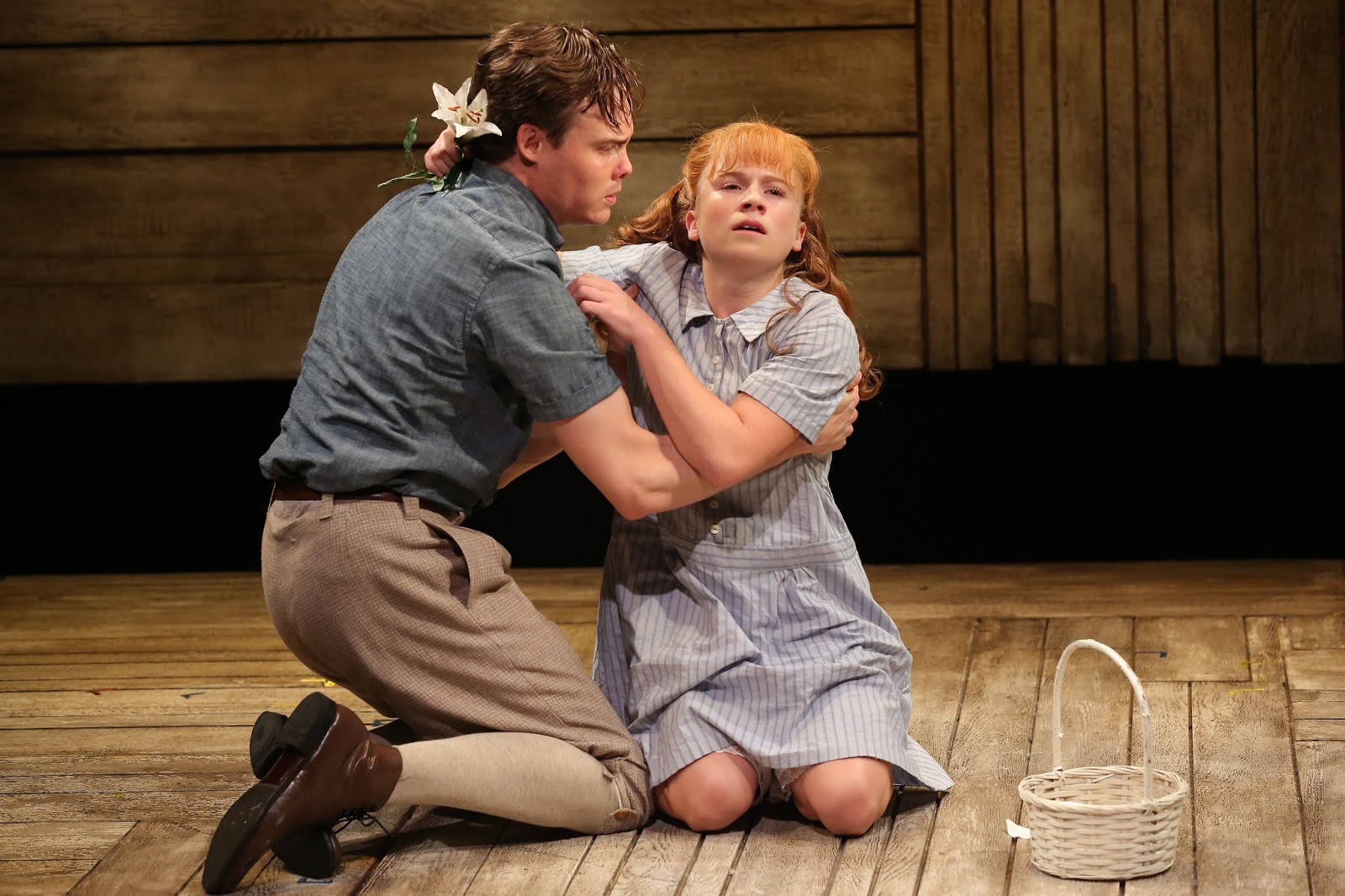 |
Mickey Theis, Juliet
Brett
“The Resemblance Between a Violin Case and a Coffin” Photo: Carol Rosegg |
When Richard Miles comes into their lives, his beauty and light throws both siblings for a loop. In the play, Tom's discomfort with his attraction to Richard is played somewhat for laughs, while in the short story Tom feels himself to be a monster. Roe's challenges remain the same. Simply put, her attraction to Richard takes away her power as surely as Samson's haircut removed his.
Wednesday, September 09, 2015
The Legend of Georgia McBride
The Legend of Georgia McBride is maybe not the deepest show out there, but it's great fun, nonetheless. Performed by a committed cast whose kind, well-meaning characters are impossible not to root for, McBride relies on a few unexpected plot turns and character motivations to steer clear of the cliches it regularly threatens to sink into. I expected to be indifferent about the show at best, but I left hoping everyone else who sees it has as much fun with it as I did. It's a sweet, charming hoot.


Subscribe to:
Posts (Atom)