Cookies

Monday, May 29, 2017

Lou

Mieko Gavia as Lou Salome. Photo credit: Jody Christopherson.


More than 100 black and white copies of photos and letters, adhered on black stock, suspend from the rafters and hang on the walls at The Second Theater @ Paradise Factory showing a snapshot version of the life of psychoanalyst and author Lou Andreas-Salomé. Theatre 4the People,  a company founded in 2010 by director Isaac Byrne to support the creation of new theatrical work,  presents the world premiere of Lou, a biographical play by first-time playwright Haley Rice as part of its 2017 season's mission to feature drama by women about famous females. The intent is admirable, though Marisa Kaugers' scenic design offers a more insightful look into the pioneering Lou than the play.


Salomé provides a good topic for immersion -- a student of psychoanalysis founder Sigmund Freud, she became one of the first female psychoanalysts and wrote prolifically on philosophy and other topics. She also is linked romantically to doctor/philosopher/author Paul Rée, philosopher/author/composer Friedrich Nietzsche and poet Rene Maria Rilke, whom she dubbed Rainer, since she felt the German variation of the name seemed more masculine. Salomé, while not as well known as her contemporaries, has been the subject of novels, plays, films and even a 1981 opera by Giuseppe Sinopoli.

The hanging portraits of Salomé show a beguiling, bright-eyed woman -- someone worth learning more about, yet Rice's play offers a harsh portrayal of a complex individual that emphasizes her strident, stubborn, selfish nature without showing the softer side that made her appealing to some of the most brilliant men of the time period. In the opening scene, a nameless character says, "I once saw her walk in a room and every head turned like someone had cast a spell." Yet the audience never sees this magnetic allure and that absence hurts our understanding of Lou. 


That depiction isn't diluted by the all-female cast, especially Mieko Gavia as the lead character.  While Gavia gives Lou a regal air with her rim-rod straight posture and blazing eyes, she focuses more on capturing the argumentative Lou who could intimidate and aggravate with her combative perspective of the world rather than showing us a multi-layered person. Under director Kate Moore Heaney, Gavia makes Lou seem more unrelenting than driven, more petulant than persistent. 


Lou's relationships often feel passionless. Whether she's sparring with Nietzsche (Jenny Leona) or bedding Rilke (Erika Phoebus, T4TP's artistic director), there is a diffident sameness to scenes that should contain fire (Rilke and Lou's intense love letters still exist if you want a real glimpse into the relationship). Occasionally, the mood lifts: her interactions with husband of convenience -- married for 43 years, the couple never consummated their relationship -- Friedrich Andreas (a subtlety funny Olivia Jampol )adds much-needed levity.


Rice (T4TP's 2017 playwright in residence) often relies on tricks to tell Lou's story -- like starting off with four narrators to introduce her, creating a seamless cadence with word repetition: one person saying, "Spelled out a word in Russian then made its translation into a literary pun with /ease," and the next following with, "Ease she had with silence, like comfort between old friends." Lou, as a historical figure, should be compelling enough without a tag-team chorus. Some scenes are too noisy, filled with piped-in prerecorded chatter or juxtaposed with other characters, interrupting a moment between Lou and another by reading a letter they sent her. Even when the drama contains potent moments such as Rilke asking Lou, after their first night together, "One picks one's lovers to begin to heal, or to continue the hurt. Which am I?" rather than answering like a future psychoanalyst, Lou offers a simple rom-com answer: "I know what it's like to have everything inside you, and for no one to see it. You and I, we are made from the same stuff. I did not choose you. We chose each other."


Ultimately, while Rice's play paints a historical time period worth visiting and she succeeds at showing the uncommon freedom Lou enjoyed for a women living at the turn of the century, she fails to provide insight into her character. And that's a shame, because Rice makes Lou intriguing enough that you want to see more.


Lou information:
Second Theater @ Paradise Factory
(64 East 4th St. between 2nd Ave. and Bowery)
May 19, 2017 - June 3, 2017 with performances Tuesday through Saturday at 8pm
and Sundays at 3pm. Tickets ($25): lousalome.brownpapertickets.com

Monday, May 22, 2017

The Lucky One

In A.A. Milne's The Lucky One, currently playing at The Mint, we hear it again and again: "Poor old Bob." "Poor old Bob." "Poor old Bob."

Bob's problem is simple: for years he has been withering away in the shadow of his younger brother, the golden boy Gerald. Bob is stuck in a finance job that he hates and doesn't understand; Gerald is at the beginning of a great career with the foreign office. Bob is not a jock; Gerald is the star player on the local cricket team. Bob is lonely; Gerald is engaged to the amazing Pamela. To many of their friends and relatives, Gerald can do no wrong and Bob can do no right. Even worse, they expect Bob to accept his second-class status cheerfully. And even worse than that, Bob and Gerald's parents are so partial to Gerald that they are totally blind to Bob's good points; whether they even really love him is in doubt.

Paton Ashbrook, Ari Brand
Photo: Richard Termine
It is easy to see how this situation developed. Going back to their childhoods, Gerald's successes were nourished, and they grew. Bob's insecurities and weaknesses were nourished, and they also grew. And, honestly, Bob is kinda whiny and annoying. (I kept thinking of the wonderful line in the movie Broadcast News when Albert Brooks says, "Wouldn't this be a great world if insecurity and desperation made us more attractive?")

Sunday, May 14, 2017

Spring Roundup, Part II: Anastasia and A Doll's House Part 2

Anastasia
Time was when a middle-of-the-road, slightly overstuffed show like Anastasia would have sent me into paroxysms of self-righteous outrage, but I'm older, wiser, wearier, and maybe a titch less self-righteous these days. Plus, there's so much other stuff--more urgent, meaningful, relevant stuff--to get outraged about lately. Anyway, despite its vanilla predictability and its failed attempt to successfully emulate the very slickest of Disney's slick confections, I just couldn't muster the energy to get mad at--or even mildly irked by--Anastasia.

Joan Marcus
Sure, the musical doesn't quite nail the landing. But it zips along amiably enough, features sturdy and committed performances from its large and uniformly buff cast, has lots of fluid scene changes, and boasts some genuinely beautiful costumes. It's not really all that funny or deep, but it does a lot of what big splashy, classic Broadway musicals do well. Anastasia strikes me as a perfectly good show to see if you're coming in from (or hosting people from) out of town, have never seen a Broadway show before, have long wondered what all the fuss is about, and want to dip your toe in without thinking too hard or taking out a second mortgage on your house for top Hamilton tickets. It's shiny and pretty and consistently engaging, and the audience really seemed to have a great time watching it.

Count my daughter among the thrilled crowds. For some reason that I think relates to dim memories of one of the many films this musical was inspired by, she really wanted to see Anastasia when we found ourselves hanging out during spring break with nothing much to do. She wanted to see it so much, in fact, that she agreed to have lunch and attend the show with no one in tow but her boring, lame mom, which is a rare event these days (she's 14). Anastasia might not have been my cup of tea (she drinks a lot of tea, by the way; I much prefer coffee), but my starry-eyed, dreamily romantic girlie loved every goopy, attractive minute of it. She's even thinking she'd like to see it again.

Maybe that, in the end, is why I just couldn't muster much but fond if slightly bemused appreciation for Anastasia. Watching my daughter watch it--from front-row seats that allowed us both to watch the stage and the pit simultaneously!--was well worth the (reduced) price of admission. In sum: See it, if you have the time and the desire--ideally, with your favorite moony, uncomplicatedly romantic teen.

Wednesday, April 26, 2017

Spring roundup, Part I: Sweeney Todd and Come from Away


Spring in these parts means fluctuating temperatures, the hectic and drawn-out end of the semester, more theater than I know what to do with, and very little time. What is a theater-loving, overworked, end-of-semester-slaphappy blogger like me to do at a time like this? Why, report on the shows I've seen over the past month more briefly than I usually do, for fear of never writing about them at all! To follow are two writeups; stay tuned for a few more, as soon as I can find some down-time.

Sweeney Todd (Barrow Street)
Joan Marcus
Ah, Sweeney, you brilliant little vacation in hell, you manifestation of the notion that to be human is to suffer miserably or be bugshit crazy or both, you homage to all that is corrupt and morbid and vile. You're so relentlessly nihilistic, and yet your themes are so relevant, your characters so complex and amusing, your score so brilliantly deep and warm. You never cease to thrill, amaze, challenge, and scare the bejesus out of me, and for that, I salute you with all the sneering, pitch-black cynicism I can muster.

The production at the teeny, tiny Barrow Street Theater, which has been repurposed as a rundown pie shop, is great fun, which is not at all a weird thing to say about this musical. Audience members sit at long restaurant-style benches, along tables atop which you can, if you have the stomach, enjoy meat (or chicken or vegetarian) pies and mash before curtain. I didn't partake, but I hear the pies are good. And even if they aren't made of human flesh, the face of Sondheim comes stamped on them--so you can pretend, I guess?

Like all fads, immersive theater can get old pretty fast, and in truth, it irritates me in many cases. But this production fits well into the small, shadowy, cramped quarters it occupies. Performers often plop down at tables next to spectators, weave their way through the narrow aisles, or confront unsuspecting audience members directly and abruptly, which I genuinely hope has not caused any heart attacks (or complaints by sourpusses), because it's done to hilariously terrifying effect. The cast is dedicated, the three musicians adept, the production beloved by my husband and teenage daughter. I loved it too, though I admit I missed the traditional three-tiered set, with the barber chair and slide stacked atop the shop and then the basement, which the space was just too small to accommodate. Still, the use of harsh red light. and sometimes near-total darkness, make it clear that this is a musical in which people die violently and man literally makes mincemeat of man.

Saturday, April 01, 2017

The Glass Menagerie

Hi, Show Showdown visitors!

My take on the highly unconventional and mildly controversial Sam Gold production of The Glass Menagerie is currently featured on Broken and Woken, the blog affiliated with Extreme Kids & Crew. Extreme Kids is a nonprofit organization that provides play spaces and support for special-needs children and their people.

You can see the review here: http://brokenandwoken.blogspot.com/2017/03/the-glass-menagerie.html

If you like what you see, please consider poking around the Extreme Kids & Crew website, which you can link to here: http://www.extremekidsandcrew.org

Thank you,
Liz

Friday, March 31, 2017

Hello Dolly

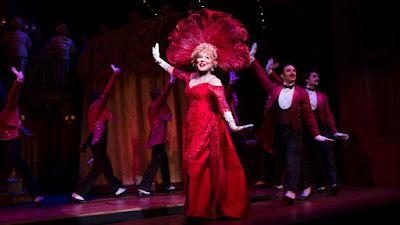
Bette Midler and Dolly Levi would seem to be as perfect a match as, oh, Glenn Close and Norma Desmond or Angela Lansbury and Mame. But, rather than giving us Dolly Levi, Bette has chosen to give us . . . Bette. Yes, she's funny and charming and lovely, but Dolly Levi is missing. Still, Bette does the star thing as no one else can, and the audience adores her. And she rocks the red "Hello, Dolly" dress and feathers. (Also, I saw a preview, and perhaps her performance will deepen.)

Bette Midler and Fabulous Dancers
Photo: Julieta Cervantes

I would have thought that not loving Midler would have meant not loving Hello Dolly, but I had a great time. Dolly is an old-time Broadway Musical, and this production beautifully captures its size, sweetness, and silliness. The book, by Michael Stewart, does what it needs to do, with some great silly jokes. The score by Jerry Herman is uneven, but the highlights are indeed highlights. It's also a pleasure to look at. The sets and backdrops are colorful, attractive, and full of detail. I could spend hours in Horace Vandergelder's and Irene Molloy's shops just enjoying the craft and artistry of the designs. The costumes are yummy eye candy, and there are a lot of them. Both the scenery and costumes are designed by the great Santo Loquasto, who has been delighting theatre and movie audiences for decades.