I reviewed this show for Talkin' Broadway. The review can be accessed here.
I have very mixed feelings about this review, just as I had mixed feelings about the show.

I reviewed this show for Talkin' Broadway. The review can be accessed here.
I have very mixed feelings about this review, just as I had mixed feelings about the show.
In 1995, Lynn Nottage had her first professional production: Crumbs from the Table of Joy, at Second Stage in New York. The Keen Company is now presenting Crumbs' first New York revival, well-directed by Colette Robert, in a solid production of this solid play. The writing is assured, insightful, wry, and open-hearted. (Nottage was only new to being produced; she had completed a full-length play by the time she finished high school and later went to the Yale School of Drama.)
 |
| Malika Samuel, Jason Bowen, Shanel Bailey Photo: Julieta Cervantes |
In Crumbs, 17-year-old Ernestine Crump's mother has died, and her father, Godfrey, responded to the loss by dragging his two daughters to Brooklyn from Florida. He chose Brooklyn because he mistakenly believed he was moving closer to his spiritual leader, Father Divine, who turns out to actually live in Philadelphia. Ernestine and her sister Ermina face major culture shock (a more challenging school; kids making fun of their home-made clothing), and racism is never far away. And deep grief is with the family always.
Then Ernestine's mother's sister Lily shows up, with all she owns, and moves in with them. Ernestine's father, although he can be difficult, bad-tempered, and controlling, is in many ways a good man, and he takes Lily in even knowing that she will rock his barely maintained equilibrium. And she does. Lily is a radical, a communist, and a drinker. She is full of herself, frightened, and angry. And she is attracted to Godfrey, which she expresses with a marked lack of subtlety.
 |
| Sharina Martin Photo: Julieta Cervantes |
Godfrey insists that his daughters live by the terribly restrictive rules of Father Devine: basically, don't have fun, don't have sex. For Godfrey, who wasn't remotely religious before his wife's death, Father Devine and his rules are the life savers he needs to get from day to day. For the daughters, they are a prison. Godfrey neither listens to his girls nor allows them any freedom; he has no sense of who they are.
Nottage's usual wit and compassion are on full display here, although the play bites off a bit more than it can chew, delving into growing up, grief, politics, racism, sex, intermarriage, and religion. (To avoid spoilers, I won't go into detail.) But that's just about the best fault a good play can have, and Nottage's brilliance pops out again and again. Also, while the play is predominantly Ernestine's coming-of-age story, with the help of director Robert and the fabulous cast it provides full inner and outer lives for all of the other characters (save Ermina, who is only partially developed).
The terrific cast includes Shanel Bailey, Jason Bowen, Sharina Martin, Natalia Payne, and Malika Samuel. And the show is well-supported by Brendan Gonzales Boston's scenic design, Johanna Pan's costume design, and Anshuman Bhatia's lighting design.
Seeing a new play by Lynn Nottage is always an excellent way to spend time, even if it's an old new play. She's simply one of the best playwrights writing today, or ever.
Wendy Caster
An odd and lovely play is opening at Playwrights Horizons on March 5th and running through March 19th. Written by Agnes Borinsky and directed by Tina Satter, The Trees is the story of a brother and sister whose feet become rooted into the ground in a small park near their childhood home. Little by little a community develops around them, while developers want to turn the area into a mall. Within this premise, Borinsky explores relationships, the meaning of life, value systems, the importance of change, and what it means to grow up.
 |
| Crystal A. Dickinson, Danusia Trevino, Jess Barbagallo, Photo: Chelcie Parry |
The Trees is
Kat%20duPont%20Vecchio.jpg) |
| Déja Denise Green and SJ Hannah in "The Starter" Photo: Kat duPont Vecchio |
Kat%20duPont%20Vecchio.jpg) |
| Jazmyn D Boone and Raven Jeannette in "Hot Stuff" Photo: Kat duPont Vecchio |
Kat%20duPont%20Vecchio.jpeg) |
| Jazmyn D Boone and Terrell Wheeler in "The Hunch" Photo: Kat duPont Vecchio |
 |
| Photo: Wendy Caster |
While Betty Smith is famous today for her novel A Tree Grows in Brooklyn, her great love was playwrighting; she wrote over 70 one-act and full-length dramas, some of which were performed in various venues and/or published. She only reached Broadway once, co-writing, with George Abbott, the libretto to the musical version of A Tree Grows in Brooklyn.

Smith's fascinating play, Becomes a Woman, is currently receiving its world premiere production at the inestimable Mint Theater Company, downstairs at City Center. In 1931, the play won the $1,000 Avery Hopwood Award from the University of Michigan, where Smith had audited classes and achieved great success as a playwright. She was then invited to study at the Yale Department of Drama. (She was denied degrees from both universities because she had never completed high school.) Scholar Maya Cantu suggests that Becomes a Woman was never produced due to its exploration of "socially transgressive themes."
Today the play's themes are less socially transgressive but still hard-hitting. Francie Nolan (yes, the same name as the main character in a Tree Grows in Woman, but 19 and not, I think, the same person) works as a song plugger in Kress's Dime Store. Her job has her singing most of the day among the customers. Men hit on her constantly. The come-on of choice is, "By the way, are you doing anything tonight, baby?" She tells them, "Yes I am. And I'm busy every other night this week too. And next week."
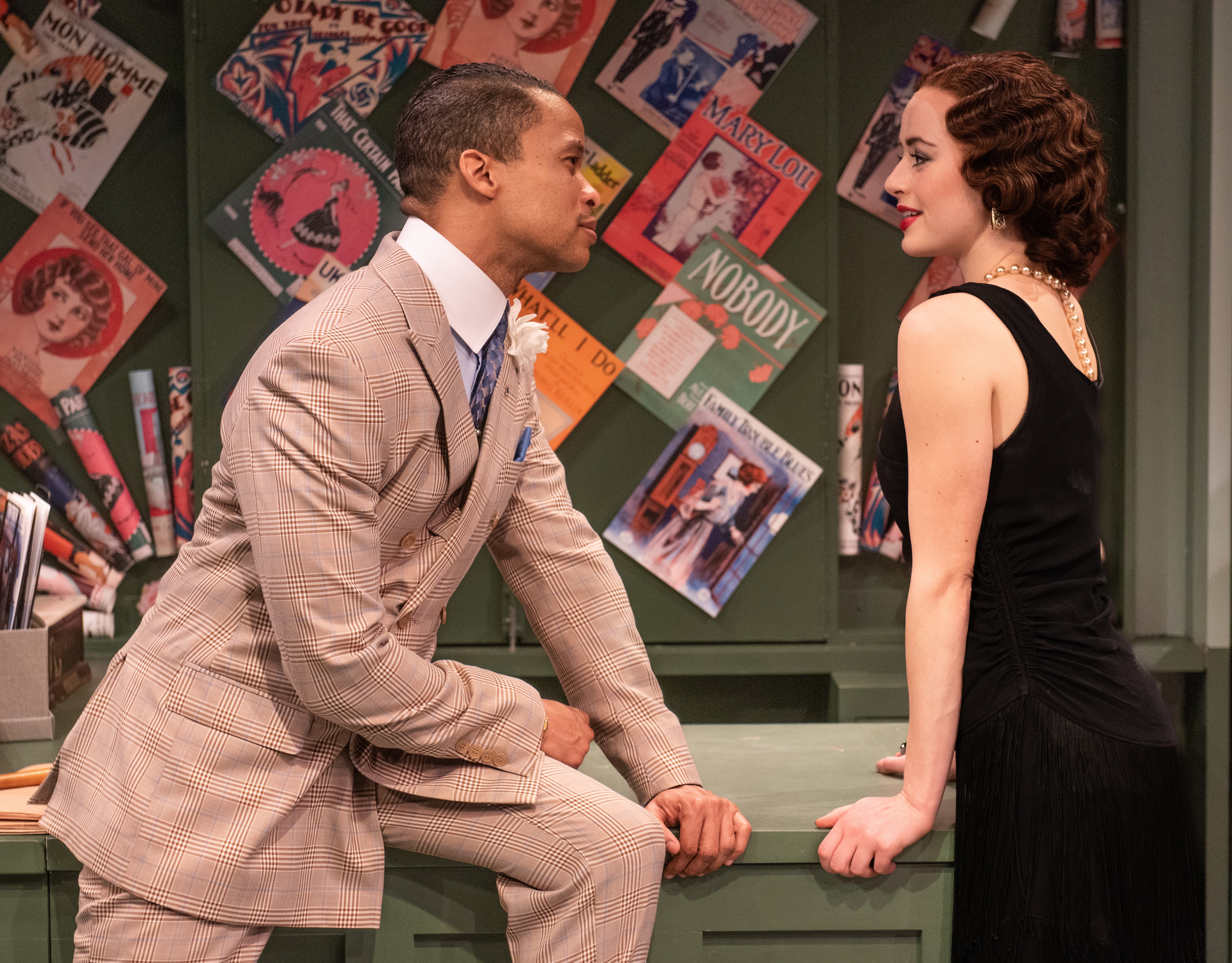 |
| Peterson Townsend, Emma Pfitzer Price Photo: Todd Cerveris |
Francie is afraid of men, a stance that Becomes a Woman sees as reasonable. The root of Francie's fear is her horror at how her father treats her mother. Florry, Francie's more experienced co-worker, is annoyed that Francie keeps turning down dates and makes fun of her whenever possible.
FRANCIE NOLAN: I'm afraid.
FLORRY: Afraid of what? You can't be killed secretly in an elevated train or strangled on the sly in the subway. Go places where there's a crowd. Then you won't have to be afraid. But keep out of places like the movies or taxis.
FRANCIE NOLAN: But they get so nasty if you don't go off alone somewhere with them on a petting party.
FLORRY: That's right. I once heard of a girl in Jersey who dropped dead because a man spoke two cross words to her.
FRANCIE NOLAN: You know what I mean. If I ever got into any trouble by going out with a man, my father would kill me.
FLORRY: I guess you'll live forever then.
Florry also explains "A girl has to really like a man before she gets intimate with him but a man has to get really intimate with a girl before he likes her. Anybody will tell you that." (In the 21st century, many people still will, but in more vernacular language). Florry and Francie's other coworker, Tessie, recognize that Francie's fear, rather than keeping her safe, actually makes her more vulnerable.
And then, along comes the boss's son, smooth, well-dressed, and charming. He flirts with Francie and doesn't immediately ask her out, which pleases her. But then he comes back and says, "Are you doing anything, tonight, baby?" She's briefly crushed, but then she decides to go out with him that very night. She thinks that because he is suave, cool, and upper class, he is different from other men. He isn't.
In the next two acts, Becomes a Woman goes some predictable places and some surprising ones. It manages to be both old-fashioned and melodramatic and forward-thinking and feminist. As with many of the plays that the Mint presents, Becomes a Woman reminds us that the past was not homogeneous. Nowadays, you will often hear people say, "Well, we didn't know better then," or "People didn't realize that then." But many did, and Becomes a Woman proves it.
The Mint's production is a bit uneven. Director Britt Berke works against the play's naturalism, particularly in the first act which is directed almost as a musical comedy. In the lead role, Emma Pfitzer Price is tentative at first but gets stronger act by act. Gina Daniels, as Tessie, gives the best performance in the show, full of nuance and humanity. Jason O’Connell is lovely as Max, Tessie's boyfriend and the rare decent man in the show. Phillip Taratula, as an agent who offers Francie cabaret work with many strings attached, manages to be both larger-than-life and absolutely real. Duane Boutté, as Kress, Sr, makes some odd character decisions and pulls them all off beautifully. Many of the other performances are mediocre, unfortunately.
Physically, Becomes a Woman is a treat from the second you enter the theatre and see the song-plugging and fake-flower departments of the Kress Store. The set is well-detailed, convincing, and attractive. The other sets, Francie's parents' home and the apartment Francie later occupies, are effective as well. And the set changes are entertaining in themselves, as is often true at the Mint, as you get to see the clever use of space through carousels and folding walls. Vicki R. Davis is the set designer.
Also top-notch are the costumes by Emilee McVey-Lee, the lighting design by M.L. Geiger, the sound and original music by M. Florian Staab, and the props by Chris Fields.
I can't help but think that Betty Smith would have been quite pleased to have a production of this quality done during her lifetime.
Wendy Caster
As made clear in James Lapine's must-read Putting It Together (review here), the development of his and Stephen Sondheim's Sunday in the Park With George was hectic, odd, and messy. In many ways, the show is too.
Sunday grew out of Lapine's and Sondheim's imaginative responses to Georges Serault's masterpiece, "A Sunday on the Island of La Grande Jatte," and their ideas on the creation of art (spoiler alert: it isn't easy). While most musicals might be seen as equivalent to novels, Sunday is an anthology. The result is sporadically brilliant, often gorgeous, occasionally boring, and sometimes off-putting. Many people love it; many hate it. I'm somewhere in between: I love parts of the show ("Finishing the Hat," "Sunday," "Move On," etc.) and could definitely live without the rest of it.
 |
Photo by David Fuller |
I've previously seen different versions of Sunday on Broadway, with full(-ish) orchestras and star casting. Theatre 2020's current uneven production is my first little Sunday. Having loved little versions of Follies and Night Music, I was intrigued to see how little Sunday would work.
First to be considered is the lack of an orchestra. While musical director Michael O'Dell is truly heroic on the sole piano, the other instruments are missed--that's just a given. On the other hand, the actors are unmiked, and that is a complete pleasure.
The show is performed without a conductor. While many piano-only shows are conducted from the bench, O'Dell is more than fully occupied playing the two or three million notes in the score. Considering that Sondheim is famous for producing difficult songs with odd timing, the cast's singing without being conducted is truly impressive.
 |
Josh Powell, Rae Hillman Photo: John Hoffman |
Then there are the physical aspects of the show. The Theatre 2020 production is done on a bare stage with the occasional bench brought on and off and projections/video upstage. Projection/video designer Alex Kopnick's work is imaginative and attractive.
The costumes are less successful. While limitations are acceptable in a small production, sloppiness isn't. Dot's bustle is distractingly misshapen; Jules' clothing fits badly, undercutting a character who would likely be immaculate; some items referred to in the score--a hat, a parasol, etc--are simply missing; some costumes are remarkably unbecoming to their wearers.
The cast and the direction are uneven. Rae Hillman, who plays Dot/Marie, took over the part after the first performance when the original performer fell ill. While she would profit from more prep time and direction (duh), she gives a solid, confident performance. George/George is, unfortunately, out of his depth here. Rather than being intense and art-centered, with an underlying sexiness and tenderness, this George is petulant and whiny.
Standouts in the rest of the cast include Caryn Hartglass as the Old Lady/Blair Daniels. She makes "Beautiful" a highlight of the show. (She also gets the two of the best costumes.) Albert Neithropp impresses as Soldier/Alex; he is the George understudy, and I would love to see him in the role. And Raffaela Cicchetti (Louise/Photographer and Museum Assistant) is the rare adult who can totally pull off a kid's role without looking like an adult pulling off a kid's role.
Director David Fuller pushes for too much theatricality in the acting for a small space and the movement lacks a certain polish.
Sunday in the Park With George is an ambitious choice for a small theatre, and Fuller and O'Dell ultimately give us a decent, occasionally quite-good production.
Wendy Caster

