Cookies

Thursday, March 16, 2023

Arden of Faversham

Red Bull's fabulously entertaining production of Arden of Faversham, directed with a wry hand by Artistic Director Jesse Berger, tells the story of Alice (the terrific Cara Ricketts), a young wife who wants to trade in her boring husband for a hunky steward. Being as it's the late-16th century, divorce is not an option. But Alice has a plan!


Cara Ricketts, Thomas Jay Ryan
Photo: Carol Rosegg

Jeffrey Hatcher and Kathryn Walat have done a smooth job of adapting this Elizabethan farce, believed to be one of the earliest "ripped from the headlines" plays and possibly coauthored by Shakespeare. Hatcher and Walat compare Arden of Haverham, with its gruesome version of farce, to Coen Brothers movies. In their adaptation, they have leaned on the noir and expanded the women's roles. 


Tony Roach, Joshua David Robinson, Cara Ricketts
Photo: Carol Rosegg

In the Red Bull production, the farce wins out over the noir, as the characters aren't real enough to care about their lives or deaths. But that's not a problem--Arden of Faversham is completely satisfying as farce. The show is great fun from start to finish. The performances are calibrated in that wonderful realm of overacting-just-enough, and each character is beautifully delineated with quirks and particularities. Outstanding in addition to Ricketts are David Ryan Smith and Haynes Thigpen as two breathtakingly useless miscreants; Zachary Fine, as a goofy lovelorn suitor; and Joshua David Robinson, fabulously funny in three different roles. But the whole cast delivers. (Though a little better enunciation from the Widow Greene would have been appreciated.)

The set is by Christopher Swader and Justin Swader; the costumes by Mika Eubanks; the lighting by Reza Behjat; the music and sound by Greg Pliska; and the props by Samantha Shoffner. All are excellent.

[spoiler] As for the play possibly being cowritten by Shakespeare: (1) I am no expert; and (2) Red Bull's production is an adaptation, so it would be difficult to ferret out Shakespeare's voice. However, the only facet of the play that struck me as Shakespearean was the body count.

Wendy Caster

Friday, March 10, 2023

Dark Disabled Stories

I reviewed this show for Talkin' Broadway. The review can be accessed here.


I have very mixed feelings about this review, just as I had mixed feelings about the show. 

Tuesday, March 07, 2023

Crumbs from the Table of Joy

In 1995, Lynn Nottage had her first professional production: Crumbs from the Table of Joy, at Second Stage in New York. The Keen Company is now presenting Crumbs' first New York revival, well-directed by Colette Robert, in a solid production of this solid play. The writing is assured, insightful, wry, and open-hearted. (Nottage was only new to being produced; she had completed a full-length play by the time she finished high school and later went to the Yale School of Drama.)


Malika Samuel, Jason Bowen, Shanel Bailey
Photo: Julieta Cervantes

In Crumbs, 17-year-old Ernestine Crump's mother has died, and her father, Godfrey, responded to the loss by dragging his two daughters to Brooklyn from Florida. He chose Brooklyn because he mistakenly believed he was moving closer to his spiritual leader, Father Divine, who turns out to actually live in Philadelphia. Ernestine and her sister Ermina face major culture shock (a more challenging school; kids making fun of their home-made clothing), and racism is never far away. And deep grief is with the family always.

Then Ernestine's mother's sister Lily shows up, with all she owns, and moves in with them. Ernestine's father, although he can be difficult, bad-tempered, and controlling, is in many ways a good man, and he takes Lily in even knowing that she will rock his barely maintained equilibrium. And she does. Lily is a radical, a communist, and a drinker. She is full of herself, frightened, and angry. And she is attracted to Godfrey, which she expresses with a marked lack of subtlety.


Sharina Martin
Photo: Julieta Cervantes

Godfrey insists that his daughters live by the terribly restrictive rules of Father Devine: basically, don't have fun, don't have sex. For Godfrey, who wasn't remotely religious before his wife's death, Father Devine and his rules are the life savers he needs to get from day to day. For the daughters, they are a prison. Godfrey neither listens to his girls nor allows them any freedom; he has no sense of who they are.

Nottage's usual wit and compassion are on full display here, although the play bites off a bit more than it can chew, delving into growing up, grief, politics, racism, sex, intermarriage, and religion. (To avoid spoilers, I won't go into detail.) But that's just about the best fault a good play can have, and Nottage's brilliance pops out again and again. Also, while the play is predominantly Ernestine's coming-of-age story, with the help of director Robert and the fabulous cast it provides full inner and outer lives for all of the other characters (save Ermina, who is only partially developed). 

The terrific cast includes Shanel Bailey, Jason Bowen, Sharina Martin, Natalia Payne, and Malika Samuel. And the show is well-supported by Brendan Gonzales Boston's scenic design, Johanna Pan's costume design, and Anshuman Bhatia's lighting design.

Seeing a new play by Lynn Nottage is always an excellent way to spend time, even if it's an old new play. She's simply one of the best playwrights writing today, or ever.

Wendy Caster

Friday, March 03, 2023

The Trees

An odd and lovely play is opening at Playwrights Horizons on March 5th and running through March 19th. Written by Agnes Borinsky and directed by Tina Satter, The Trees is the story of a brother and sister whose feet become rooted into the ground in a small park near their childhood home. Little by little a community develops around them, while developers want to turn the area into a mall. Within this premise, Borinsky explores relationships, the meaning of life, value systems, the importance of change, and what it means to grow up.

Crystal A. Dickinson, Danusia Trevino, Jess Barbagallo,
Photo: Chelcie Parry

The Trees is

  • Written with compassion, insight, and humor by Borinsky
  • Directed smoothly and smartly by Satter
  • Remarkably well-acted by the entire cast: Jess Barbagallo, Marcia DeBonis, Crystal Dickinson, Sean Donovan, Xander Fenyes, Nile Harris, Max Gordon Moore, Pauli Pontrelli, Ray Anthony Thomas, Danusia Trevino, Sam Breslin Wright, and Becky Yamamoto
  • Beautifully designed by Enver Chakartash, whose costume design is whimsical and witty, and Parker Lutz, whose scenic design, while completely non-park-like, manages to be just right, and beautiful.
  • Though-provoking
  • Great fun
Wendy Caster

Tuesday, February 28, 2023

She's Got Harlem on Her Mind

When Eulalie Spence died in 1981 at age 86, her obituary noted that she was a retired school teacher but didn't mention that she was also an award-winning playwright of the Harlem Renaissance. Unfortunately, Spence only received money for her writing once, when she optioned a screenplay to Paramount Pictures in the early 1930s. Eventually, she gave up on her playwriting. (Spence taught high school elocution, English, and dramatics in New York City from 1927 to 1958; one of her students was Joseph Papp, who cited her as a major influence.)


Déja Denise Green and SJ Hannah in "The Starter"
Photo: Kat duPont Vecchio


Spence wrote comic plays depicting Black people as they were, despite pressure from W.E.B. DuBois to write serious propaganda pieces. She also insisted on writing in dialect, not a popular choice at the time. (For more on Spence, check out "From DuBois To Lupino To Papp, Harlem’s Legendary Eulalie Spence 1894–1981" on the site Harlem World here. My thanks to Harlem World for much of the information above.)


Jazmyn D Boone and Raven Jeannette in "Hot Stuff"
Photo: Kat duPont Vecchio


The Metropolitan Playhouse is presenting a wonderful evening of three of Spence's one-acts through March 12. The plays depict slices of Harlem life, with themes of trust, love, and getting by. They also underline the effect of money, and the lack thereof, in people's lives and relationships. In "The Starter," TJ proposes to Georgia, who immediately asks, "Has yuh got any money, T.J.?" "Hot Stuff" focuses on Fanny, who tirelessly hustles for money by working hard, selling sex, and cheating numbers players out of their winnings. And in "The Hunch," a major numbers win changes two people's lives.


Jazmyn D Boone and Terrell Wheeler in "The Hunch"
Photo: Kat duPont Vecchio


All three plays are funny, energetic, insightful, and well-acted. The solid cast includes Eric Berger, Jazmyn D Boone, Dontonio Demarco, Déja Denise Green, SJ Hannah, Raven Jeannette, Monique Paige, and Terrell Wheeler. The smooth, thoughtful, and smart direction is by Timothy Johnson. Musical numbers--music by Johnson--surround the plays, providing energy, atmosphere, and delight.

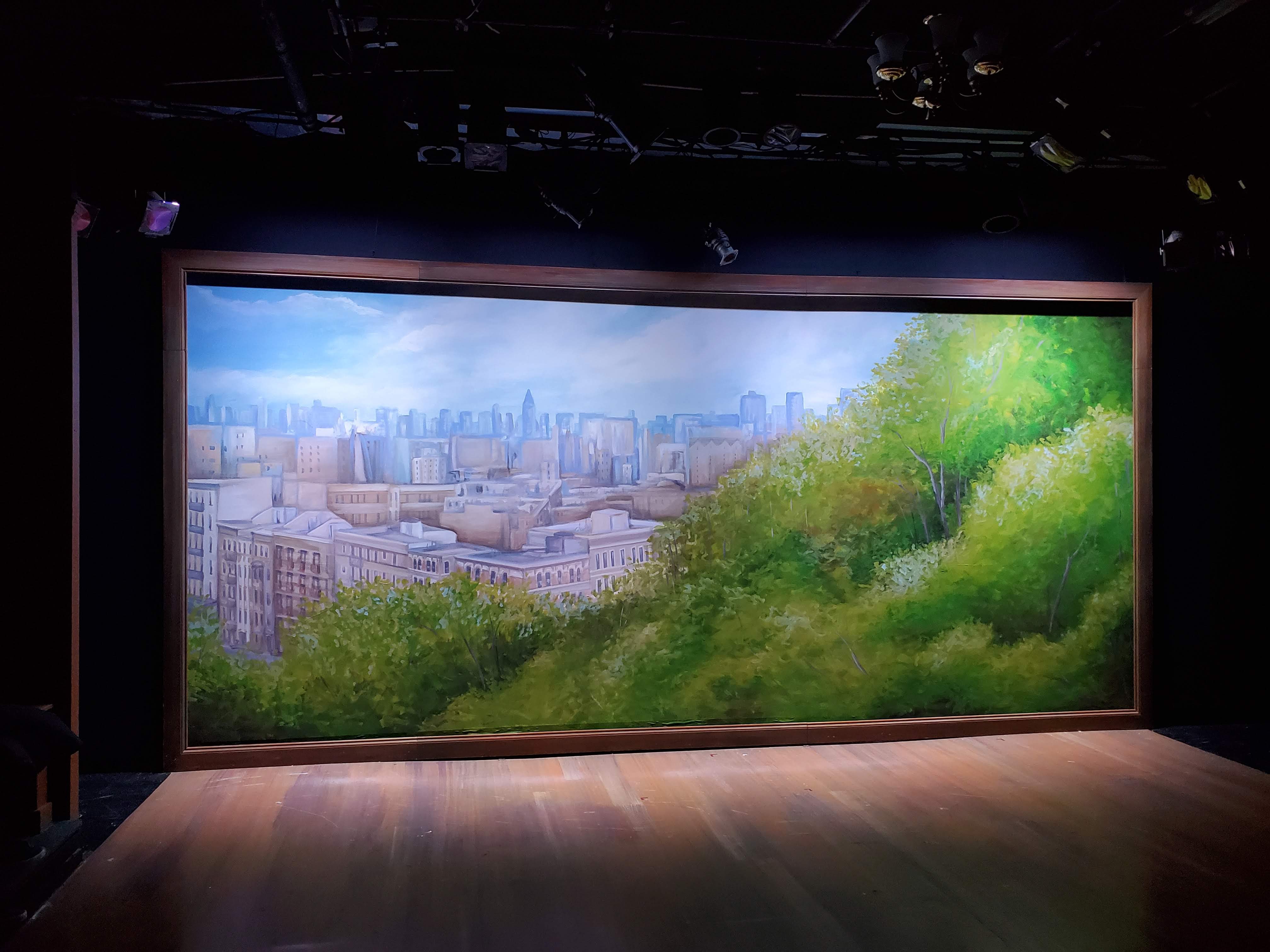
She's Got Harlem on Her Mind starts with a bare stage and Vincent Gunn's lovely backdrop. Appropriate and attractive scenery is brought on and off by cast members. Jevyn Nelms's costumes, with an assist from the tdf Costumes Collection, are fabulous. (Would it be churlish of me to suggest that some of the costumes were perhaps inappropriately fabulous/pricy for some of those characters?) The lighting, by Leslie Gray, is particularly good, providing both the appropriate atmosphere and some gorgeous stage pictures.


Photo: Wendy Caster

In a world where theatre has developed the reputation of being too expensive (as, indeed, Broadway is), Metropolitan Playhouse tickets max out at under $32. Three fascinating one-acts, solid acting, beautiful design, intimate seating, reasonably priced tickets--go, already!

Wendy Caster

Becomes a Woman

While Betty Smith is famous today for her novel A Tree Grows in Brooklyn, her great love was playwrighting; she wrote over 70 one-act and full-length dramas, some of which were performed in various venues and/or published. She only reached Broadway once, co-writing, with George Abbott, the libretto to the musical version of A Tree Grows in Brooklyn.

Pearl Rhein, Emma Pfitzer Price, Gina Daniels
Photo: Todd Cerveris

Smith's fascinating play, Becomes a Woman, is currently receiving its world premiere production at the inestimable Mint Theater Company, downstairs at City Center. In 1931, the play won the $1,000 Avery Hopwood Award from the University of Michigan, where Smith had audited classes and achieved great success as a playwright. She was then invited to study at the Yale Department of Drama. (She was denied degrees from both universities because she had never completed high school.) Scholar Maya Cantu suggests that Becomes a Woman was never produced due to its exploration of "socially transgressive themes." 

Today the play's themes are less socially transgressive but still hard-hitting. Francie Nolan (yes, the same name as the main character in a Tree Grows in Woman, but 19 and not, I think, the same person) works as a song plugger in Kress's Dime Store. Her job has her singing most of the day among the customers. Men hit on her constantly. The come-on of choice is, "By the way, are you doing anything tonight, baby?" She tells them, "Yes I am. And I'm busy every other night this week too. And next week." 

Peterson Townsend, Emma Pfitzer Price
Photo: Todd Cerveris

Francie is afraid of men, a stance that Becomes a Woman sees as reasonable. The root of Francie's fear is her horror at how her father treats her mother. Florry, Francie's more experienced co-worker, is annoyed that Francie keeps turning down dates and makes fun of her whenever possible. 

FRANCIE NOLAN: I'm afraid. 

FLORRY: Afraid of what? You can't be killed secretly in an elevated train or strangled on the sly in the subway. Go places where there's a crowd. Then you won't have to be afraid. But keep out of places like the movies or taxis. 

FRANCIE NOLAN: But they get so nasty if you don't go off alone somewhere with them on a petting party. 

FLORRY: That's right. I once heard of a girl in Jersey who dropped dead because a man spoke two cross words to her. 

FRANCIE NOLAN: You know what I mean. If I ever got into any trouble by going out with a man, my father would kill me. 

FLORRY: I guess you'll live forever then. 

Florry also explains "A girl has to really like a man before she gets intimate with him but a man has to get really intimate with a girl before he likes her. Anybody will tell you that." (In the 21st century, many people still will, but in more vernacular language). Florry and Francie's other coworker, Tessie, recognize that Francie's fear, rather than keeping her safe, actually makes her more vulnerable.

And then, along comes the boss's son, smooth, well-dressed, and charming. He flirts with Francie and doesn't immediately ask her out, which pleases her. But then he comes back and says, "Are you doing anything, tonight, baby?" She's briefly crushed, but then she decides to go out with him that very night. She thinks that because he is suave, cool, and upper class, he is different from other men. He isn't.

In the next two acts, Becomes a Woman goes some predictable places and some surprising ones. It manages to be both old-fashioned and melodramatic and forward-thinking and feminist. As with many of the plays that the Mint presents, Becomes a Woman reminds us that the past was not homogeneous. Nowadays, you will often hear people say, "Well, we didn't know better then," or "People didn't realize that then." But many did, and Becomes a Woman proves it.

The Mint's production is a bit uneven. Director Britt Berke works against the play's naturalism, particularly in the first act which is directed almost as a musical comedy. In the lead role, Emma Pfitzer Price is tentative at first but gets stronger act by act. Gina Daniels, as Tessie, gives the best performance in the show, full of nuance and humanity. Jason O’Connell is lovely as Max, Tessie's boyfriend and the rare decent man in the show. Phillip Taratula, as an agent who offers Francie cabaret work with many strings attached, manages to be both larger-than-life and absolutely real. Duane Boutté, as Kress, Sr, makes some odd character decisions and pulls them all off beautifully. Many of the other performances are mediocre, unfortunately.

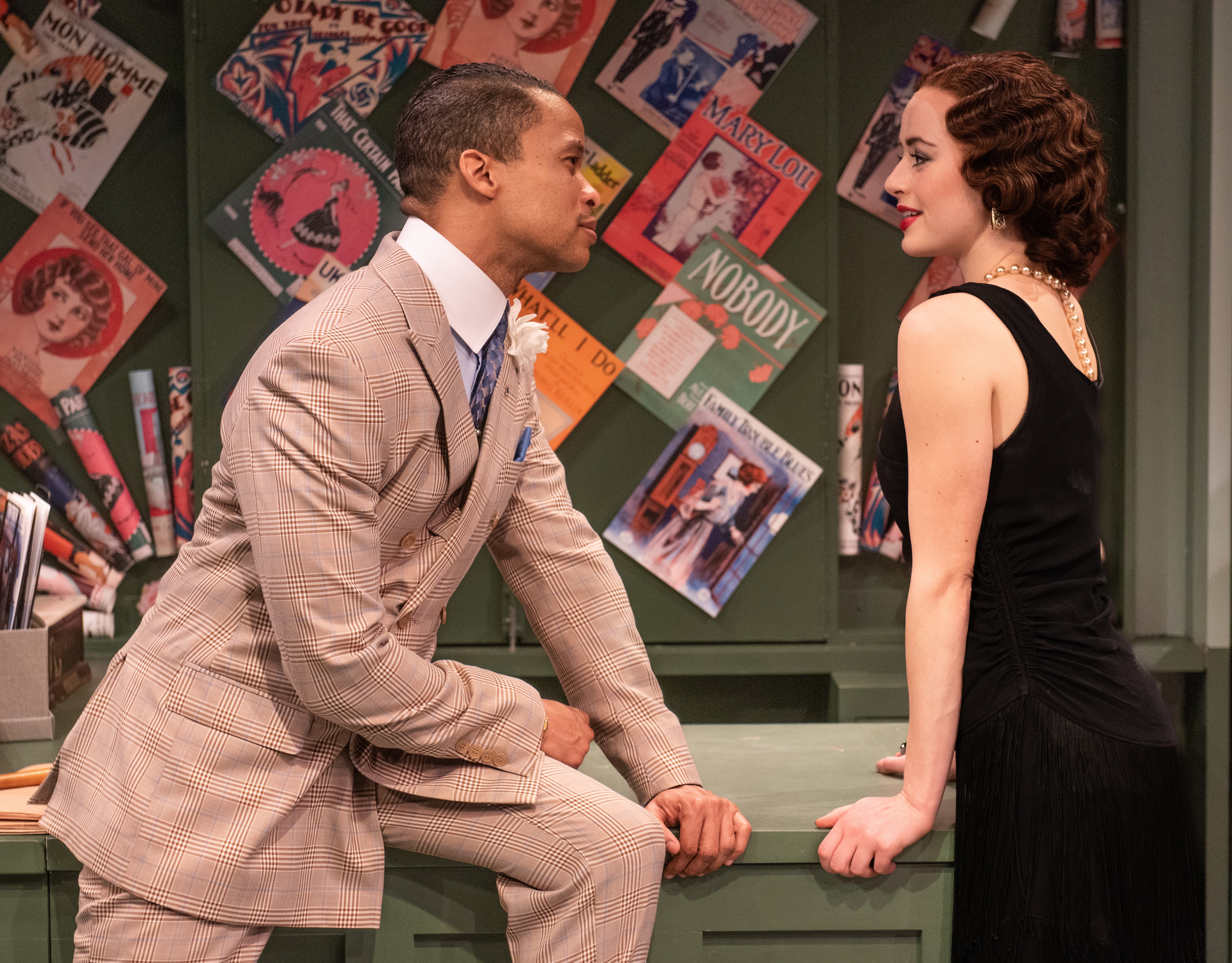
Physically, Becomes a Woman is a treat from the second you enter the theatre and see the song-plugging and fake-flower departments of the Kress Store. The set is well-detailed, convincing, and attractive. The other sets, Francie's parents' home and the apartment Francie later occupies, are effective as well. And the set changes are entertaining in themselves, as is often true at the Mint, as you get to see the clever use of space through carousels and folding walls. Vicki R. Davis is the set designer.

Also top-notch are the costumes by Emilee McVey-Lee, the lighting design by M.L. Geiger, the sound and original music by M. Florian Staab, and the props by Chris Fields.

I can't help but think that Betty Smith would have been quite pleased to have a production of this quality done during her lifetime.

Wendy Caster