Cookies
Wednesday, June 29, 2011
Zarkana
The magic of Zarkana begins as soon as you enter the gorgeous lobby at Radio City Music Hall. It may take a moment to notice amid the hubbub of the crowd, but there's a white-faced muscular man almost floating above you, singing a mysteriously alluring song. And then there's the Rag Doll woman with her liquid black eyes and impressively creepy rag doll. And . . . well, I don't want to say too much.
Once you're inside and the show begins, your eyes and mind are fed almost to bursting with staggering acrobatic acts, stunning 3D projections (designed by Raymond St-Jean) that seem like full-bodied holograms, and other-worldly costumes (designed by Alan Hranitelj). The stark, dramatic lighting (by Alain Lortie) throws huge shadows on the walls, so that watching the acrobats' shadows is almost as compelling as watching the acrobats.
And, oh, the performers! Carole Demers' jumps and flips on the Russian Bar make Olympic gymnasts seem like wimps. Maria Choodu's juggling is impressive and also beautiful. The trapeze artists utilize four platforms instead of two to allow frighteningly intricate flips and catches. Erika Chen's sand painting is an elegant and welcome respite from the intensity of the acrobatics. Ray Navas Velez and Rudy Navas Velez make you believe that the Wheel of Death is well-named--especially when one of them jumps rope in midair for 10 seconds or so. And Anatoly Zalevskiy uses every one of his perfect muscles in his hand-balancing act, which combines the athleticism of a sport with the beauty of a ballet.
One complaint: there is too much music and it is too loud. Much of it is beautiful, and the singers are excellent, but I would have preferred it to fade into the background during the acts, particularly during the subtlety of the sand painting and hand balancing. There are times the music almost feels assaultive.
Overall, however, Zarkana is glorious.
(press ticket, 31st row, center)
Thursday, June 23, 2011
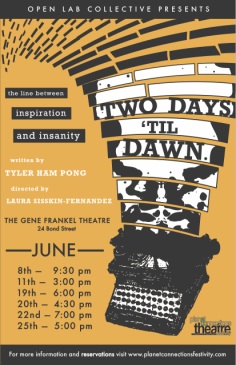
Two Days 'Til Dawn
And here's where Two Days 'Til Dawn, by Tyler Ham Pong, starts to fall apart. Or maybe it would be more accurate to say that it splits into two.
On one hand, we have Sol's fantasy world. Pong shows some originality here, and while the visits from the literary figures are a little mannered and predictable, they are intriguing. The play that takes place in Sol's head has the potential to be an interesting one.
The play that takes place in Sol's life, however, is overloaded and unrealistic. Sol's a novelist, so his wife keeps asking him why he writes poetry at all--but he came in second in the contest, which surely shows some talent. And while his wife is worried that Sol will find out that she won the contest--she entered anonymously--it turns out that he has known all along. But there is no explanation of how he knows, which makes it sound as though there are maybe five poets in the entire world entering contests.
Also, while the prize for the contest is never specified, it sounds like much more money than any poet ever gets for anything. Sol also seems to have made an unusually large amount of money for his fiction. And all this matters, because it turns out that Sol's brother Charlie has been stealing from him due to jealousy, resentment that Sol never told Charlie that Charlie was adopted, and greed. This ostensibly major revelation has little emotional punch because the audience hasn't had the opportunity to get involved with Sol and Charlie as people, and because the combination of the writer's block, the writing competition between the spouses, Sol's nervous breakdown, and Charlie's betrayal is too much for a one-hour play. Oh, and there's maybe a baby who died and maybe a pregnancy now.
The play might have come across better if director Laura Sisskin-Fernández had insisted that her actors consistently enunciate and project, and if she had enticed better performances out of the three supporting cast members. On the other hand, Geoffrey Pomeroy as Sol is nothing short of amazing. He inhabits Sol fully and bravely, and he makes sense of the character's ups and downs and ins and outs, even bringing a bit of charm to his despair.
While there is much wrong with Two Days 'Til Dawn, Pong is a writer to keep an eye on. He aimed high with this show, which is admirable, and there were definite moments of wit, lyricism, and intelligence.
(press ticket, fourth row on the aisle)
Sunday, June 19, 2011
Finding Elizabeth Taylor
![]() |
| Elizabeth Taylor as Elizabeth Taylor |
The one-woman show Finding Elizabeth Taylor started late today because of technical difficulties. At one point, the star and playwright, Elizabeth Taylor, came out and chatted with the audience. She took questions, and she was charming and funny. Unfortunately, she was less interesting during the actual show.
Finding Elizabeth Taylor is a series of scenes about this Elizabeth Taylor's life. Sometimes Taylor plays herself, sometimes other people, and sometimes the world-famous Elizabeth Taylor. The scenes are separated by screens moving across stage, leaving various props and furniture as they go. The screens soon become annoying and give a staccato feel to the show.
Taylor is a good actress and a good writer, but the show doesn't coalesce. The charming person who took questions isn't there, and the show wanders from theme to theme (individuality, dealing with ridicule, weight issues, activism) without adding up to a cohesive whole. I admire Taylor's energy and skills, and I appreciate that she works so hard to show rather than tell. However, some narration might give the show a much-needed spine. As it is, Finding Elizabeth Taylor is too scattershot to be the show that it might be.
(press ticket, fourth row)
The Eyes of Babylon
By coincidence, I saw three plays about soldiers in Iraq this weekend (in order of viewing): Ajax in Iraq (not reviewed), Goliath, and The Eyes of Babylon. The Eyes of Babylon is the only one that was written and acted by a Iraq war veteran. How odd, then, that it turned out to be anticlimactic.
Jeff Key joined the marines in his thirties, eager to defend the constitution, protect defenseless people, and promote peace on earth. Once in Iraq, he had to deal with the fact that he was doing none of those things. In addition, as a gay man he was forced to stay in the closet, which is a galling location for someone whose dream is to fight for freedom for all.
The Eyes of Babylon is structured as a series of vignettes based on Key's journal entries, some of which are considerably more compelling than others. The best is the story of flirting with an Iraqi man in a code that they invent as they speak. Key is also good with the particulars of daily noncombat life as a marine in Iraq, from the sort of food eaten to the interactions with other marines to the graffiti on the walls of the port-o-potty. But the show meanders and runs too long, and Key is not a good enough performer to bring to full life the other people he wants us to meet. By the time Key is sent home for hernia surgery, The Eyes of Babylon has lost its focus.
Key has a lot to say, and his writing is often strong. However, I would have been more affected by The Eyes of Babylon as a series of essays.
(press ticket, third row on the aisle)
Goliath: A Choreopoem
![]() |
| M. Scott Frank |
When I tell you the plot of the choreopoem Goliath, written by Takeo Rivera and directed by Alex Mallory, you may find it cliche: David, a smart and sensitive teenager, joins the military to prove to his hypercritical father that he is a man. However, as beautifully rendered by Rivera, Mallory, and an excellent cast, there is nothing here that is anything less than fresh, honestly emotional, heartbreaking, and true. Rivera and Mallory use scenes and monologues, choral testimony and hard-hitting visuals to find new ways to say something simple but profound: war is a perversion of humanity. It has its own momentum and twisted logic and it can anti-alchemize good into evil.
Rivera explains why he needs to say that which has been said before:
Ladies and gentlemen,
this is the poem written and rewritten
because our memories last only as long as our consciences
and our consciences last as long as they're convenient
this is the poem written in Troy, in China, in Bangladesh,
in Germany, in Zaire, in America, in the Holy Land
mathematical, universal
so it can be read by all
this is the poem written and rewritten
because our memories last only as long as our consciences
and our consciences last as long as they're convenient
this is the poem written in Troy, in China, in Bangladesh,
in Germany, in Zaire, in America, in the Holy Land
mathematical, universal
so it can be read by all
And Rivera knows that the road to universality is careful details. David is this particular teen, with this particular dominating father, in this particular culture. Every character is multidimensional despite the brevity of the piece (forty-five minutes), and Rivera's rich, robust language says more in five minutes than many plays manage in fifty.
M. Scott Frank, as David, gives a vivid, subtle, brilliant performance as good as any I've seen in years. Although David works hard to be guarded, Frank allows his emotions and true soul to come through, and it is because we know David so well that the ultimate horror of the piece is so very very horrible. The rest of the cast is also top-notch: Samantha Cooper, Dontonio Demarco, Natalia Duong, Edgar Eguia, Elmer King, and Monique Paige.
My sole complaint about this production is that an audience discussion was started too quickly after the show ended. I, for one, needed to just sit with my feelings.
My thanks to Poetic Theater Productions Co-Artistic Director Jeremy Karafin for gently nudging me into seeing Goliath.
(press tix, good seats)
The Importance of Being Earnest
Having actors direct is always a tricky prospect. It's complicated even further when the actor who is directing is also playing a leading role in the same production. That's the main problem with Brian Bedford's oddly static production of Wilde's The Importance of Being Earnest, currently entering its last week of performances at The American Airlines Theatre. As played out on Desmond Heeley's gorgeous set, the actors move around awkwardly and deliver Wilde's brilliant bon mots with very little commitment. Perhaps it has to do with the fact that its six months into a long Broadway run, but it's hard to imagine Charlotte Parry's almost indescribably cloying Cecily or David Furr's deadly stiff Jack Worthy ever seeming fresh. Bedford's Lady Bracknell is at least entertaining, but that has more to do with camp than the shaping of an actual performance. As the playwright himself once wrote: "The world is a stage, but the play is badly cast."
($20 tickets, Row E of the mezzanine)
Subscribe to:
Comments (Atom)