Cookies

Friday, March 11, 2022

Anyone Can Whistle: MasterVoices

The MasterVoices' concert of Anyone Can Whistle was a lovely and poignant reminder that although we have lost Stephen Sondheim, we will always have his work. And, oh!, that work!


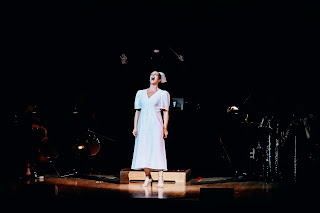
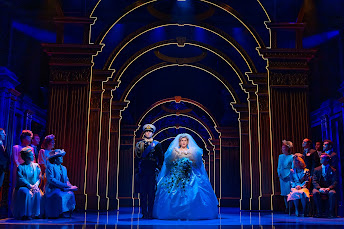
Elizabeth Stanley
Photo: Nina Westervelt

Anyone Can Whistle is, to say the least, a problematic musical, bloated here, thin there, sometimes smart but too often cutesy. But the score includes gems: in particular, "There Won't Be Trumpets," "Anyone Can Whistle," and "With So Little to Be Sure Of." And, like all of Sondheim's work, Anyone Can Whistle rewards multiple hearings and viewings. I have known the original cast recording by heart since the late 1970s, yet I was surprised and delighted over and over again by Sondheim's brilliance, humor, and heart.

The cast of the MasterVoices concert was uneven. Elizabeth Stanley was magnetic, brilliant, moving, thrilling, superb, and fabulous. On the other hand, Vanessa Williams was little better than mediocre; frequently, she seemed uncomfortable with the music, and she lacks the presence necessary to give dimension to the Mayoress. She just wasn't interesting. Santino Fontana is always likeable, and he has a lovely voice, but his performance was bland. While Stanley prepared for and gave a full performance, Williams and Fontana seemed less prepared, and they sang songs rather than playing characters.

One of the highlights of the evening was Joanna Gleason's entrance (she narrated the show). Over 2,800 people greeted her as an old friend, roaring and clapping as she beamed with pleasure. And of course she was wonderful as the narrator. 


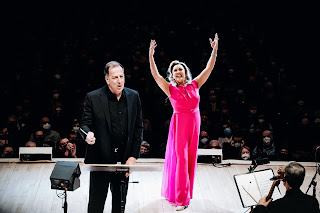
Ted Sperling, Vanessa Williams
Photo: Nina Westervelt

Ted Sperling did a nice job as director and an excellent job as conductor. The orchestra sounded terrific. The MasterVoices chorus was entertaining but underused. Weirdly enough, the sound was erratic. Carnegie Hall is famous for its acoustics, and during intermission my friend told me of sitting in the last row of the highest balcony years ago and hearing every unmiked word. I guess the miking was a problem, because the sound was sometimes murky, and occasionally crackly, with much dialogue completely lost.

Before the concert started, Sperling spoke a few words of introduction. He showed us his vocal score, given to him by Victoria Clark in 1984. It was a mistake to put Victoria Clark in our minds, because it was so easy to imagine how amazing she would have been as the Mayoress. 

But the evening's two stars made it a concert well worth seeing: Stephen Sondheim and Elizabeth Stanley. They made astonishingly beautiful music together.

Wendy Caster

Monday, March 07, 2022

JANE ANGER or The Lamentable Comedie of JANE ANGER, that Cunning Woman, and also of Willy Shakefpeare and his Peasant Companion, Francis, Yes and Also of Anne Hathaway (also a Woman) Who Tried Very Hard.

As I watched the annoyingly written, directed, acted, and titled JANE ANGER,or The Lamentable Comedie JANE ANGER, that Cunning Woman, and also of Willy Shakefpeare and his Peasant Companion, Francis, Yes and Also of Anne Hathaway (also a Woman) Who Tried Very Hard, I pondered why so many of the people around me were laughing so hard and so long.

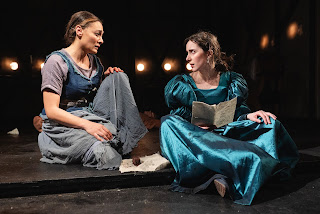
Amelia Workman, Talene Monahon
Photo: Valerie Terranova
  

I came up with a few theories:

  • They had never seen first-rate camp, so were easily pleased.
  • They had never seen a farce before, so were easily pleased.
However, the conversations I overheard before the show suggested an experienced audience, so I considered other theories:

  • The audience simply enjoyed the cheap, predictable anachronistic humor.
  • They were just in the mood to laugh.
    • My friend, who didn't find the show as annoying as I did, but also didn't like it, had another theory, perhaps the best one:

      • They were friends of the cast, writer, director, and/or crew.
      In all fairness, I can be a bit on the crabby side when it comes to humor, though shows that have reduced me to hysterics include Noises Off, A Little Night Music, The Real Inspector Hound, Musical of Musicals, many generations of Forbidden Broadway, and most recently, Red Bull's fabulous production of The Alchemist. Perhaps the show just was not my cup of tea. And, like I said, many people had a great time.

      The plot, such as it is, focuses on William Shakespeare (Michael Urie, working hard) during the great plague. He is stuck inside a small apartment with a creepy member of his theatre troupe whom he happily mistreats and insults, much to the amusement of the audience. A "cunning woman" by the name of Jane Anger (Amelia Workman, also working hard) appears, having climbed up a drain pipe to avoid the barricaded door to the building. Jane is a woman with many pasts who is trying to get her writing published. Shakespeare cannot comprehend a woman writing, but Jane tries to get him to support her work, as the name "Shakespeare" would of course open many doors. Then Anne Hathaway appears, also via the drainpipe. She is angry at Shakespeare due to his long neglect of her and the family; he didn't even go home when their son Hamnet died.

      Author Talene Monahon has some interesting things to say about originality, feminism, and creativity, and under the noise she seems to be aiming for meaning. I wish that she had been more choosy with her jokes, replacing the many subpar specimens with more substance. (Monahon provided the best performance of the evening, with her silly yet human Anne Hathaway.)

      I sometimes envy reviewers and critics who consider their own opinions to be the correct opinions. It might be fun to have that level of confidence, but it would be pointless (and pompous). Everyone's feelings about the arts, and particularly about theatre, are affected by our personalities, our frames of reference, our moods, the people sitting next to us, and our dinners. What we love Saturday we might hate Monday, and vice versa.

      So I'll end on this. I believe very strongly that JANE ANGER or The Lamentable Comedie of JANE ANGER, that Cunning Woman, and also of Willy Shakefpeare and his Peasant Companion, Francis, Yes and Also of Anne Hathaway (also a Woman) Who Tried Very Hard was bad. But I might be wrong.

      Wendy Caster

      Wednesday, February 23, 2022

      The Daughter-in-Law

      The Mint Theater Company's production of D.H. Lawrence's drama, The Daughter-in-Law, so successfully evokes life in the East Midlands of England in 1912 that I was shocked when I glanced at the audience and saw people in contemporary clothing--and masks! This visit to another time and place is the cumulation of all the things that the fabulous creators at the Mint do so well: pick a compelling play, direct it with art and clarity, perform it beautifully--and provide scenery, costumes, lighting, and sound that perfectly set the scene, while also being a great pleasure to hear and see.

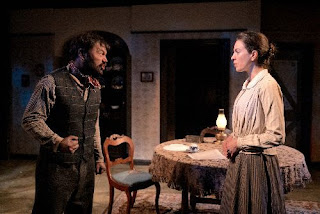
      Tom Coiner, Amy Blackman
      Photo: Maria Baranova

      The mining families in Lawrence's play balance two serious concerns: (1)  the wear and tear of mining, with a strike looming, and (2) trying to understand, impress, escape, and love each other, while tangled in passivity, ambition, fear, and desire.

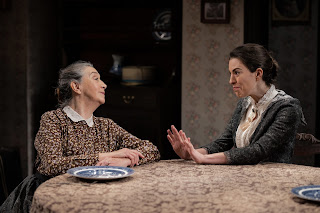
      Mrs. Gascoyne's situation is ostensibly clear: she wants what's best for her grown sons. But what does that mean? And according to who? One son, Luther, a gruffly masculine man who has neither the intelligence nor the need to make much of himself, is married to Minnie, a woman he barely knows. Minnie has a small inheritance that becomes almost another character in the play, with its vibrations of power and class difference. Mrs. Gascoyne unsurprisingly has no use for Minnie. 

      Over the course of the play, the characters surprise themselves and each other, and sometimes us as well. The plot also takes an unexpected turn or two. It's difficult to say how much Lawrence was trying to honestly represent the reality of the people of his time and how much he was working out his mother issues, and that adds texture to the story. The end is not exactly justified by all that precedes it, and that too is intriguing. Was Lawrence trying to make a point or was it a failure of his writing?

      Sandra Shipley, Amy Blackman
      Photo: Maria Baranova

      The main thing to be said about The Daughter-in-Law is that it is a completely satisfying theatrical experience, often moving, often funny, and vivid in depicting class issues. Even the set changes are are compelling.

      The Mint single-handedly keeps a whole subsection of theatre alive, rediscovering unappreciated plays and presenting them with astonishing consistency. In doing this, they also help keep alive the people of the past, as described in their present. It's so easy to think that people were different from us, partially because history and the arts have misled us, and partially because their clothing, surroundings, and values can seem so foreign. But the Mint reminds us again and again that being human has always been a messy and challenging adventure. (Yes, and that sex has always been complicated.)

      CAST

      • Amy Blackman
      • Ciaran Bowling
      • Tom Coiner
      • Polly McKie
      • Sandra Shipley
      CREATIVES

      • Director: Martin Platt
      • Sets: Bill Clarke
      • Costumes: Holly Poe Durbin
      • Lights: Jeff Nellis
      • Sound: Lindsay Jones
      • Props: Joshua Yocom
      • Dialects: Amy Stoller
      • Illustration: Stefano Imbert
      Wendy Caster

      Friday, December 17, 2021

      Diana The Musical (Broadway edition)

      Sometimes--maybe especially when the whole world is screaming and sad and broken--a not-very-good musical can be the perfect balm. On Broadway at the Longacre for a few more days before it shutters, Diana The Musical remains the not-very-good production it was on film, though I'd argue that the stage version is vastly superior to the Netflix debacle that dropped this fall. I've been pretty jokey about the show, but I've also grown weirdly attached to it. I've long harbored a large place in my heart for stage musicals that don't quite work despite the time, energy, hope, labor and money that get poured into them. I think I've connected with Diana as well because of all the things it tries and does not manage to be in this exceedingly weird time and this thoroughly damaged place. Yes, sure, Diana is culturally irrelevant, dramaturgically sloppy, unsure of what tone it is supposed to take, and saddled with ridiculous lyrics. It doesn't ever do much more than shine, glimmer, pop, and blare at top volume. Is it a little backward, a little sexist, a little heavy on the visuals, and a lot short on any perceptible message? Oh, you bet your ass. Then again, I'm sad and anxious and frustrated and exhausted and enraged all the damn time lately, so I just don't have the time or energy it takes to get even the teeniest bit riled up about....Diana The Musical. The show has become, at least for me, a delightfully, garishly wonderful distraction from right now, and I find I am deeply grateful for it--jewel-encrusted warts and all.


      Unlike like the Netflix version, which was comparatively ponderous (and which I thus consumed in multiple minutes-long excerpts over a few weeks), the stage production swirls, gyrates, rotates and swings in and back out again at a remarkable clip. The show still doesn't make much sense, even with a few improvements in the form of some new exposition about the existence in the show (and in general) of Barbara Cartland, a bit more attention to Diana's struggles with postpartum depression and self-harm, and even more scenery, set-pieces, and shiny stuff to look at. The people of Wales are no longer dressed like chimney sweeps--they instead wear an enormous amount of tweed; lest they get confused with other tweed-wearing populations, there's now a huge new sign dangling above them that spells WALES in huge wrought-iron letters. The AIDS scene remains genuinely touching, even if the ward it takes place in still makes its patients sit around in a large circle on folding chairs. Judy Kaye as Queen Elizabeth is still in an entirely different show, though her Barbara Cartland is slightly campier now, as is Diana's butler. Try as I might, I cannot and likely never will figure out what "a lonely girl aswirl" means. And Diana's death scene at the end of the production remains utterly pointless and tacked-on. But then, that's cool with me given all the actually traumatizing, genuinely sad, enormously relevant death happening right outside the doors of the Longacre. 

      A live audience makes a world of difference, especially compared with the cavernously weird film that was shot without one. At the performance I attended, the spectators were kind, supportive and clearly eager to be entertained, even as they frequently erupted in hoots, hollers and applause at some of its clunkier moments, and the occasional jeer (I assume Roe Hartrampf, as Prince Charles, expects to be called an asshole at least once a performance at this point). Even as the James Hewitt scene fell flatter onstage than it did on film (dammit!), the number about the fuckety dress so delighted the crowd that its--um--lyrics were hard to hear at points. Diana may still be made up of about 50 different puzzles, some of which are missing half their pieces because the dog ate them. But the pieces that have made it into the mix sure are pretty. And as an added bonus, none of them will end up killing you.   

      I've said it before, but it needs to be said again: absolutely enormous kudos to the company. To a one, the cast is professional and hard-working, but not so much that they can't be in on the joke. Not a one broke character or came off as if they were phoning it in, and a significant number seemed to be having as good a time as the audience was. I hope very much that they were. I also hope that every single one of them moves on to other, better projects--and that, in the meantime, they have all become dear friends who go out together and drink and laugh and bond over their strange situation, performing mid-pandemic in a show that dips and soars into mawkish melodrama, keeps its distance from the current moment, and functions as a true distraction in a historic stretch where precious little diverts. 


      Sunday, November 21, 2021

      The Alchemist

      Robert Frost once said, "Poetry is what gets lost in translation." To this I add, theatre is what gets lost in streaming. Please don't misunderstand: I am totally grateful for all the theatre-related material available during the covid-induced shutdown. I loved, eg, the Sondheim 90th birthday celebration, the plays that The Mint shared, and new work such as PCP/NYC's Standing on the Edge of Time and MasterVoices Myths and Hymns. And I don't know what the ticket price would have been if Meryl Streep, Audra McDonald, and Christine Baranski sang "Ladies in Lunch" in person, though I do know I couldn't afford it.

      Manoel Felciano, Reg Rogers
      Photo: Carol Rosegg

      But: theatre is about being there, in the moment, with those wonderful living people on stage in front of you, sharing their talents and working their butts off. Eight performances a week they are shot out of a cannon and expected to be perfect--every time, with no pauses, pratfalls, or do-overs. Live performance is in many ways the bravest of arts, and perhaps the most human. It's all of us, in a room, interacting in real time, having an experience that will never be--can never be--repeated.

      All this leads me to the rollicking Red Bull Production of Ben Jonson's The Alchemist, as adapted by Jeffrey Hatcher and directed by Jesse Berger. It is that most theatrical form of theatre, the farce, full of schemes and changing identities and bawdy humor and pointed satire and greed and hypocrisy and, yes, doors swinging open and closed as near-miss follows near-miss. 

      Hatcher's adaptation is first-rate--clear, funny, and witty. In one aspect I think he actually improves on the original (it would be a spoiler to say anything more). There are some disappointing facets to his work. For example, there is no good reason why one female character spends much of the first scene wearing so little clothing that she is in danger of flashing the audience. For another example, having the one Black character, a full-out fop, suddenly spew a "Goddamn motherfuckers!" is, if not racist, at least racially uncomfortable and cheap. But the play's strengths far outweigh its weaknesses (which actually makes the disappointments that much more disappointing).

      Berger's direction is as madcap, quick, and fluid as one could wish. And, oh, that cast. Reg Rogers as the alchemist delights with a performance that boasts the stamina, speed, and reflexes of an Olympian. Also delightful are, well, everyone else: Nathan Christopher, Stephen DeRosa, Carson Elrod, Manoel Felciano, Teresa Avia Lim, Jacob Ming-Trent, Louis Mustillo, Jennifer Sánchez, and Allen Tedder.

      The design elements are attractive, appropriate, and hard-working. Alexis Distler provided the handsome, clever set, Tilly Grimes the splendid costumes. Cha See and Greg Pliska (lighting and sound design, respectively) also contributed richly.

      The Alchemist was the second show I saw after that long, painful covid entertainment desert, but the first one was mediocre, and this one was so  much fun, and so thoroughly theatrical, that I consider it my real first time back. Thank you, Red Bull. Missed you a lot.

      Wendy Caster

      Monday, November 15, 2021

      Diana: The Musical (Netflix version)

      Hi, it's been a while because--well, you know. But I'm back with news of Diana: The Musical, which received mixed to positive reviews during its 2019 La Jolla run, despite what were cited (politely and with weary resignation) as minor problems (among them: character development, lyrics, scene-work, plot trajectory, length, tone, depth, pacing, set design, and an unsettling distance from anything remotely British). Clearly encouraged though they probably should not have been, the producers transferred the show to Broadway, where it ran for nine previews before the shut-down of March 2020. At some point thereafter, the producers made the innovative if fateful decision to film a performance of Diana before an empty house for an October 2021 release on Netflix in hopes of stimulating the box office in time for the production to resume at the Longacre (it finally opens on November 17). 

      This is one jolly well-done son, Diana! 

      The decision to prerelease Diana is easily the most interesting thing about the show. In the Before Times, it was typically argued that audiences wouldn't pay to see something live if they could stream it at home. But the industry has an enormous amount of restructuring and rethinking to do as it drags itself out of the pandemic. At the moment, attempting to lure audiences to live versions of productions they've fallen in love with from home no longer seems like such a ridiculous idea. So while Diana gets props for introducing a new approach that can truly only be improved upon, I have less faith in the musical itself.

      That's a shame, because a show about how Diana challenged and modernized the royal family would seem musical theater-ready in lots of ways: it's a melodramatic story that justifies some serious pomp and circumstance, it has hugely famous characters that people nevertheless want to know more about, and it ends in Great Tragedy but also offers Much Hope and Enormous Promise. Alas, Diana is a huge fail in that it never digs into the characters or their motivations, so none seem to have even a hint of an inner life. The result is two hours with a bunch of stick figures who change costumes many, many times, between performing frantic dance numbers and singing a sequence of late-80s-power-pop songs set with thuddingly unimaginative lyrics (composer-lyricist David Bryan played keyboards and wrote songs for Bon Jovi).   

      Some of the weirdness of the filmed version is that it was taped before an empty house, which surely helped the production avoid health risks but did nothing to boost it artistically. Live theatre, after all, depends on an audience--especially when your show is wildly inconsistent in tone and mood, and features characters with the collective depth of water in a toilet bowl. Is Diana a straightforward biography? A campy romp that winkingly shows us a royal marriage we all know is doomed? A flight of fancy that takes wild, fantastically liberties for the sake of entertainment? Are Charles and Camilla evil manipulators or just two innocent kids in love? Is Diana a scheming, monarch-challenging mastermind, or just relatively down to earth, lonely and bored? Why does the Queen double as Barbara Cartland, and who slept with whom to get Judy Kaye to be part of this exercise? Absent an audience whose reactions might have provided valuable clues for schmucks like me viewing from home, it's difficult to figure out what parts of the show were meant to be funny, moving or serious. I ended up settling on "inadvertently hilarious" as my go-to interpretation, which was fun for me but not a good sign for Diana.   

      Anyway, here's what happens: the show opens with Diana alone, singing a huge rock anthem about how she's livin' large but feelin' small. This number, like virtually all to follow, sounds like those late-80s MTV-ready rock anthems where dudes with electric guitars sing wistfully about how hard touring can be, and how they are forced to take comfort in an unending supply of groupies and blow. I guess Diana's rosy life had its thorns, too, man.

      Charles, who in this show is supposed to be (a) dashingly handsome and (b) a huge enough player that he can't find a wealthy woman in all of England that he hasn't already nailed and dumped, is under pressure to marry because of some stiff exposition the Queen utters at him about The People. Everyone holds their arms very still and in formal positions to imply their royalness, and I found myself disappointed that no one did the Queen wave even once, especially because this is the kind of show where such a move, correctly timed, might actually work to bring the house down.

      Camilla Parker-Bowles is supposed to be the real villain in Diana because she is (a) older and (b) not as beautiful as Diana and (c) that's the way mainstream entertainment created by men tends to roll. Camilla pushes Charles to marry Diana because she strikes them both as unintelligent, young and foolish, and thus surely someone who will leave them to their affair(s) in exchange for getting to be a princess.

      Charles takes Diana to a concert and Diana gripes about how Charles likes the music of Dead White Men (like Bach and Beethoven), while she prefers the much cooler music of Slightly Younger Dead White Men (like Freddie Mercury and David Bowie). She also mentions Elton John, whose involvement in this show would have surely made it less cringeworthy, and I say this as someone who loathes that fucking song about the fucking candle and the fucking wind. The Queen sings Charles a song about love and her own experiences, which are thoroughly unrelated to anything Charles is concerned about, so he and Diana get hitched. The press dances maniacally around Diana while singing about having a wank and drinking Guinness because oo, British references!

      Charles and Diana meet the People of Wales, who apparently all dress like chimney sweeps and live horrible, dark lives that improve instantly when Diana says hello to them. Charles is not nice to Diana but does manage to congratulate her for having their child by singing appropriately bad lyrics at her. Charles and Camilla sing of their everlasting love for one another with more bad lyrics. Diana sings in passing about her struggles with self-harm and bulimia, but then realizes that changing up her wardrobe will be truly liberating for her, hurrah.

      Diana does genuinely impressive charity work, which in this production apparently involves sending cases of eyeliner to an AIDS ward because she's good with makeup. The patients are initially camera shy, given the fact that their illness might result in all sorts of inconveniences like losing their homes, jobs, and families, but once she bonds with them over clothing, they come right around and smile pretty for the camera. Charles attempts to contain Diana's popularity by speaking publicly about architecture. Diana starts an affair with James Hewitt, who rises shirtless from beneath the stage floor on a pommel horse, and whose name surely made the lyricist's day by conveniently rhyming with "Let's do it!"

      All of the characters debate the possibility of divorce while they dance, fight, drink tea and hop into bed with one another. Diana's affair with Hewitt ends when, despite constant pleas to run off with her to America, he suddenly decides that his career matters and that his new position in Germany will make it absolutely impossible to ever again see one of the richest and most powerful women on the planet because borders are difficult to navigate and flights are prohibitively expensive, or something. Diana becomes newly bothered by the fact that Charles and Camilla are still Doing It now that she and Hewitt are no longer going to Do It, so there is a fight that is likened to a thrilla in Manila but instead is just a shoutfest in some palace basement or moat or back alley or something.

      Finally, the Queen tells Diana they are a lot alike before launching into a song about how they are nothing alike. She insists that Diana will never be permitted to divorce and then magically grants her a divorce. Diana sings about how she is newly happy and motivated and eager to make good in the world and maybe have a daughter or several. Then she does a slow walk upstage that is meant to represent her death. The ensemble, clearly exhausted from gyrating in multiple outfits, earnestly tells the audience that the people you don't think are going to make change in the world sometimes do, and that is the end.

      Is the show any better in front of a live audience? Hell if I know, but I think now I need to find out. Stay tuned....