 |
| Joan Marcus |

Saturday, October 03, 2015
The Christians
Lucas Hnath's The Christians, which has recently been extended through mid-October at Playwrights Horizons, is a compelling play about contemporary evangelical Christianity. It asks a number of interesting and complicated questions about religion as a means to unite and to divide, to connect and to alienate, to sustain and to harm. It also touches on the need for religions to grow and change in order to adapt to the contemporary world, and on altogether more earthly matters: building maintenance, membership numbers, mortgages, money. It is not a perfect play, but it is a very good one, which is worth seeing for the questions it raises, its conception and direction, its strong and committed cast, and its totally excellent megachurchy set.
At the start of the play, which begins with a few energetic (if seriously underharmonized) numbers by the church choir, Pastor Paul (an appropriately soothing Andrew Garman) delivers a sermon in celebration of his huge church's final mortgage payment. Professing a spiritual crisis that began when he learned of a boy who gave up his own life to save his sister from a burning building, he announces to his congregants that such a boy should not be damned to Hell because he was not a Christian. Even further, he informs them, he no longer believes in the concept of Hell and feels that no one in his congregation should, either.


Thursday, October 01, 2015
Cinderella
The intimate atmosphere of the Minetta Lane Theater -- a venue that seats just under 400 -- provides a perfect place for Company XIV's 2015-2016 season. With their signature slinky and sexy dances, the venue heightens the voyeuristic nature of the Company's burlesque-infused take on classics such as Cinderella, their first offering, running from September 22-November 15th.
From the moment the audience enters the space, spectacle begins with scantily clad chorus girls and boys erasing the fourth wall, a trait you see often in Company XIV productions, as they peer into mirrors and recline on chairs before the "performance." This re-imagined version of Charles Perrault's Cinderella also showcases artistic director/founder Austin McCormick's knack for offering familiar narratives blended alluringly with opera, circus, vaudeville, cabaret and Baroque dance (Who else would feature the step-sisters singing Irving Berlin's "Sisters" in German while wearing a conjoined twins/sumo wrestler suit?).

Like vaudeville, which challenged class and racial values with the diversity of its acts while still maintaining its audience's interest, McCormick's choreography and direction explores sexuality in an open, ambitious way that might feel uncomfortable to mainstream folk even as they remain undeniably entertained. The cast contains an androgynous appearance featuring heavy makeup (by Sarah Cimino) that gives them a soft, other worldly look and costumes designed by Zane Pihlstrom and seemingly inspired by Las Vegas, Victoria Secrets and the Moulin Rouge (gilded thong, check; nipple glitter, check; garter belts, check; angel wings, check). Often, it is enough just to gape at the beauty of the actors and their lean, Grecian-statue-like bodies. McCormick exploits this by allowing performers to linger on stage, posing between scenes and acting as silent narrators as they hold chalkboards above their head, which contain scene details.
The cast is strong, especially Marcy Richardson (as the step-sister) who makes pole-dancing while singing opera more sexy than strange and Davon Rainey as the stepmother. He deliciously dominates the stage with his animalistic poses, lean look, over-the-top headresses and diva-like attitude (think Grace Jones in her heyday), making the most of the evil role while delivering some beautiful dancing that makes his ballet background apparent. Cinderella (Allison Ulrich) looks vulnerable in all she does, from becoming a table for her step family's use to meeting her fey prince (Steven Trumon Gray). This fragility offers a delicate version of the character, but also makes her appear wan in comparison to the more vivid personalities in the performance.
Cinderella also has vaudeville's pastiche quality: the audience always has something to look at. Here's another number. Another bit. During intermissions (and there are two), the show continues (so don't linger at the bar). Even the act of wiping down the stripper pole in preparation for the next scene becomes an exercise in expression. But that madcap variety doesn't always work. Some of the intermission pieces, especially a spirited mambo and a feisty, fun-filled cast dance party, captivate more than the main show -- which at two-and-a-half-hours and three acts is too long. The ball, for example features multiple dance numbers when one strong number would suffice.
Next up in the season is the revival of the holiday show Nutcracker Rouge (Nov. 24—Jan. 17, 2016), an erotic version of The Nutcracker, followed by the the world premiere of Snow White (Jan. 26—March 12, 2016).
(Press ticket, orchestra)
See Company XIV work, here:
From the moment the audience enters the space, spectacle begins with scantily clad chorus girls and boys erasing the fourth wall, a trait you see often in Company XIV productions, as they peer into mirrors and recline on chairs before the "performance." This re-imagined version of Charles Perrault's Cinderella also showcases artistic director/founder Austin McCormick's knack for offering familiar narratives blended alluringly with opera, circus, vaudeville, cabaret and Baroque dance (Who else would feature the step-sisters singing Irving Berlin's "Sisters" in German while wearing a conjoined twins/sumo wrestler suit?).

The cast of Cinderella/Photo credit: Phillip Van Nostrand
Like vaudeville, which challenged class and racial values with the diversity of its acts while still maintaining its audience's interest, McCormick's choreography and direction explores sexuality in an open, ambitious way that might feel uncomfortable to mainstream folk even as they remain undeniably entertained. The cast contains an androgynous appearance featuring heavy makeup (by Sarah Cimino) that gives them a soft, other worldly look and costumes designed by Zane Pihlstrom and seemingly inspired by Las Vegas, Victoria Secrets and the Moulin Rouge (gilded thong, check; nipple glitter, check; garter belts, check; angel wings, check). Often, it is enough just to gape at the beauty of the actors and their lean, Grecian-statue-like bodies. McCormick exploits this by allowing performers to linger on stage, posing between scenes and acting as silent narrators as they hold chalkboards above their head, which contain scene details.
The cast is strong, especially Marcy Richardson (as the step-sister) who makes pole-dancing while singing opera more sexy than strange and Davon Rainey as the stepmother. He deliciously dominates the stage with his animalistic poses, lean look, over-the-top headresses and diva-like attitude (think Grace Jones in her heyday), making the most of the evil role while delivering some beautiful dancing that makes his ballet background apparent. Cinderella (Allison Ulrich) looks vulnerable in all she does, from becoming a table for her step family's use to meeting her fey prince (Steven Trumon Gray). This fragility offers a delicate version of the character, but also makes her appear wan in comparison to the more vivid personalities in the performance.
Cinderella also has vaudeville's pastiche quality: the audience always has something to look at. Here's another number. Another bit. During intermissions (and there are two), the show continues (so don't linger at the bar). Even the act of wiping down the stripper pole in preparation for the next scene becomes an exercise in expression. But that madcap variety doesn't always work. Some of the intermission pieces, especially a spirited mambo and a feisty, fun-filled cast dance party, captivate more than the main show -- which at two-and-a-half-hours and three acts is too long. The ball, for example features multiple dance numbers when one strong number would suffice.
Next up in the season is the revival of the holiday show Nutcracker Rouge (Nov. 24—Jan. 17, 2016), an erotic version of The Nutcracker, followed by the the world premiere of Snow White (Jan. 26—March 12, 2016).
(Press ticket, orchestra)
See Company XIV work, here:
Saturday, September 26, 2015
The New Morality
Harold Chapin's The New Morality, the slight but delightful piece from 1915 currently on view at The Mint, resembles an Oscar Wilde play if Wilde wrote about (almost) real people.
Betty Jones has taken to her bed and refused a meal to perform a level of repentance she doesn't feel. Her crime? She unloaded on Muriel, the woman with whom her husband has been flirting all summer. She acknowledges to her good friend Alice that some of her language would be better left to dog shows, and she admits that she was probably pretty loud. She thanks Alice for visiting at risk to her own reputation.
And then Muriel's husband Wallace shows up, demanding that Betty apologize.
Chapin uses this thin plot as a skeleton for discussions of sexual politics, society, and the meaning of fidelity. He fleshes it out with scores of very funny lines. His take on sexual politics is fascinating, since it exists in a world that probably never was: the gorgeous homes of independently wealthy people, taken care of by servants, where women rule the roost and men fecklessly try to figure them out. Chapin ignores the true power that men have and had, particularly 100 years ago, yet there is a level on which his sense of sexual politics is advanced and even vaguely feminist. (Chapin was killed in World War I, one of the millions of tragic casualties of that stupid and useless war, so there's no way of knowing how his work would have developed.)
 |
| Brenda Meaney Photo: Richard Termine |
And then Muriel's husband Wallace shows up, demanding that Betty apologize.
Chapin uses this thin plot as a skeleton for discussions of sexual politics, society, and the meaning of fidelity. He fleshes it out with scores of very funny lines. His take on sexual politics is fascinating, since it exists in a world that probably never was: the gorgeous homes of independently wealthy people, taken care of by servants, where women rule the roost and men fecklessly try to figure them out. Chapin ignores the true power that men have and had, particularly 100 years ago, yet there is a level on which his sense of sexual politics is advanced and even vaguely feminist. (Chapin was killed in World War I, one of the millions of tragic casualties of that stupid and useless war, so there's no way of knowing how his work would have developed.)
Friday, September 25, 2015
Show Showdown Theatre Links Updated
In a long-needed piece of housekeeping, we have updated our list of Theatre Links in the right-hand column of this blog (scroll down). If you'd like us to add your theatre blog/website to our list, please put the info in the comment section of this post. Thanks.--Wendy Caster


Wednesday, September 23, 2015
Cameron Kelsall Joining Talkin' Broadway
I am pleased to announce that I will be joining Talkin' Broadway as a contributing critic. I will be covering theatrical productions in New Jersey and Philadelphia. Although I can't provide a firm date at this time, I expect to begin filing reviews sometime in the very near future. I will continue to serve in my capacity as a contributor for Show Showdown. -- Cameron Kelsall
Tuesday, September 22, 2015
Hollywood Arms
There are two ways of looking at the anniversary reading of Carrie Hamilton and Carol Burnett's Hollywood Arms at Merkin Hall last night. As an event, it was a huge success. Just getting to see Burnett on stage and express our love for her was a major treat. She received a wonderful, slowly-evolving ovation. People clapped and cheered, and one by one, began to stand as we realized that the applause and cheers weren't enough. It took a long standing O to acknowledge the tremendous joy that Burnett has brought into our lives.
And just seeing the cast--Tyne Daly, Michele Pawk, Emily Skeggs and Sydney Lucas of Fun Home (once again playing the same character), Cotter Smith, and Anthony Edwards--walk on stage was exciting.
 |
| Emily Skeggs, William Jackson Harper, Cotter Smith, Michele Pawk, Tyne Daly, Sydney Lucas, Caleb McLaughlin, Anthony Edwards, Jenny Jules, Will Pullen Photo: Paul Zimmerman/WireImage |
Tuesday, September 15, 2015
The desnudas in Times Square

I wrote a thing for OUP blog, and figured I'd share it here. It's about the "painted ladies" in Times Square, the history of that particularly raunchy neighborhood, and how silly this news story is.
Monday, September 14, 2015
Spring Awakening
Two young women reflect each other through a mirror. One is dark-haired and slight, with a deeply expressive face. The other is blond and fuller-bodied, with a guitar strapped to her back. They both sing: one uses her voice; the other, her hands. Despite their differences, there is no question that they reflect the same person. This is how Deaf West's extraordinary production of Duncan Sheik and Steven Sater's Spring Awakening announces itself.
Directed by the actor Michael Arden, this revival of the 2006 musical -- currently playing at the Brooks Atkinson Theatre, after a successful run in Los Angeles -- puts the action in the context of the 1880 Second International Conference on Education of the Deaf, which occurred a decade prior to the publication of Franz Wedekind's Spring's Awakening, on which the musical is based. Known colloquially as the Milan Conference, it banned the teaching of sign language in favor of lip reading and oralism. Assimilation was prescribed as the only answer to the "deaf question;" those who could not essentially pass for hearing had no place in society.
 |
| photo: Kevin Parry |
Friday, September 11, 2015
Wendy Caster Now Theatre Writer for Art Times
I'm pleased to announce that I now have the honor of being the theatre writer for Art Times, where I will write essays most months. Here's a link to the latest issue. And here's a link to the Art Times website.
 And here is a taste of my first essay, "The New Audience: How a Culture Evolves."

In Shakespeare’s day, heckling was common. The groundlings (people who bought cheap tickets and stood right in front of the stage) flirted, argued, got drunk, and even urinated right there, while the show was going on. The wealthier people carried on their own intrigues in the more expensive seats, including the hiring of prostitutes.
I would have hated it. Patti LuPone would have hated it more! But it was the accepted theatre-going culture of its time.
(read more--on page 11 of the pdf)I will of course continue to review shows here.
Thursday, September 10, 2015
Desire
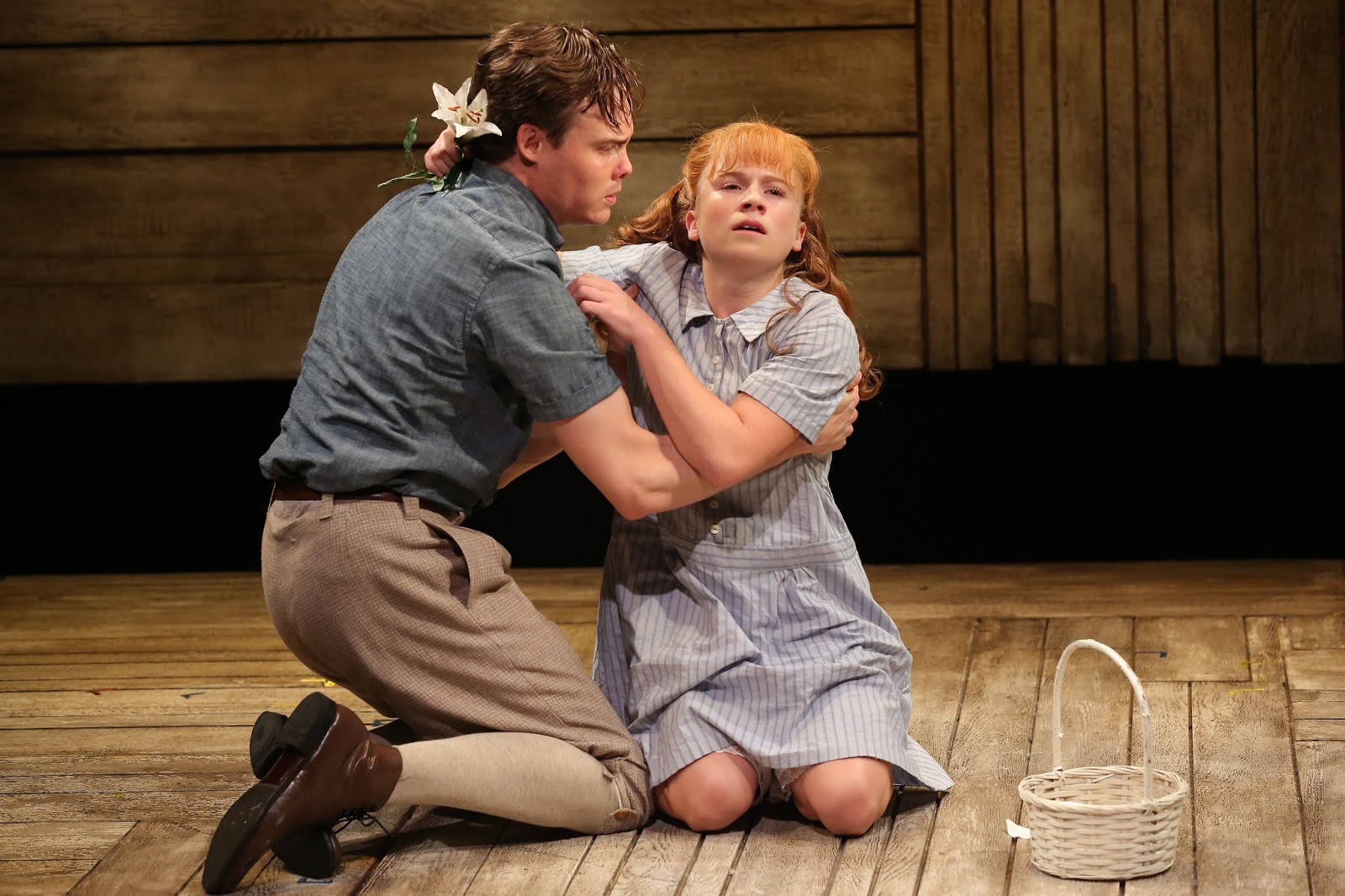
At first glance, The Acting Company's production of Desire would seem to be an evening of works by Tennessee Williams. After all, the six one-acts are ostensibly based on his short stories, and they burst with Williams-isms: the explosive horror of thwarted desire, needy heartbroken women, scared homosexual men, people unable to defy the world's expectations, glass figurines, even cannibalism. But the one acts offer us Williams' sensibility by way of Beth Henley, Elizabeth Egloff, John Guare, Marcus Gardley, David Grimm, and Rebecca Gilman. These playwrights bring much of themselves to the plays, and many of the results are vibrant, vigorous hybrids.
The evening begins with Beth Henley's "The Resemblance Between a Violin Case and a Coffin." Williams' short story is narrated by Tom, a young man uncomfortable with his homosexual urges and crushed by the loss of his older sister Roe--his one friend--to womanhood. Henley moves the focus to Roe, with Tom more of a supporting character, even giving Roe some of Tom's words. She retains, however, the focus on the high price of sexual desire.
When Richard Miles comes into their lives, his beauty and light throws both siblings for a loop. In the play, Tom's discomfort with his attraction to Richard is played somewhat for laughs, while in the short story Tom feels himself to be a monster. Roe's challenges remain the same. Simply put, her attraction to Richard takes away her power as surely as Samson's haircut removed his.
 |
Mickey Theis, Juliet
Brett
“The Resemblance Between a Violin Case and a Coffin” Photo: Carol Rosegg |
When Richard Miles comes into their lives, his beauty and light throws both siblings for a loop. In the play, Tom's discomfort with his attraction to Richard is played somewhat for laughs, while in the short story Tom feels himself to be a monster. Roe's challenges remain the same. Simply put, her attraction to Richard takes away her power as surely as Samson's haircut removed his.
Wednesday, September 09, 2015
The Legend of Georgia McBride
The Legend of Georgia McBride is maybe not the deepest show out there, but it's great fun, nonetheless. Performed by a committed cast whose kind, well-meaning characters are impossible not to root for, McBride relies on a few unexpected plot turns and character motivations to steer clear of the cliches it regularly threatens to sink into. I expected to be indifferent about the show at best, but I left hoping everyone else who sees it has as much fun with it as I did. It's a sweet, charming hoot.


The Legend of Georgia McBride
The MCC Theater’s latest offering, The Legend of Georgia McBride, shows drag queens at work: those who dress up as a sparkly symbol of protest against discrimination; those who
are just born for a life of high heels and sequined evening gowns; and those who find that their best male selves lie in the lip-synced songs of a woman.

Matt McGrath, Keith Nobbs and Dave Thomas Brown. Photo credit: Joan Marcus
When Casey (Dave Thomas Brown) discovers his Elvis
impersonator act at Cleo’s, a backwater bar in Florida, will be replaced by a
drag queen show he only agrees to stay on as bartender because there is a baby
on the way for him and his wife, Jo (Afton Williamson). It’s the same reason he
dresses up in drag to do an Edith Piaf number when a regular cast member, Rexy Nervosa
(Keith Nobbs), goes on a bender. He awkwardly moves through the song, coached
by drag queen extraordinaire Tracy Mills (Matt McGrath, who also appeared in
the Denver Center for the Performing Arts premiere). By the third night, though,
Casey is something of an expert impersonator and he find he enjoys performing as much as the money, a fact he cannot confess to his wife.
This gem of a show pleasantly explores the nature of self
and the transformative power of fantasy, and while no surprising insight is
revealed, the characters seem real and likeable. As their personal epiphanies
are slowly unveiled, an unexpected emotional punch underlines the simplicity of
playwright Matthew Lopez’s plot. Plus, the performances, directed by Mike
Donahue (who also directed the show’s 2014 Denver premiere) are just oh-so much
fun to watch.
Seeing Casey transform from bad Elvis to country vixen, mouthing
tunes by hit makers such as Dolly Parton and Tammy Wynette, is pure entertainment.
If Thomas Brown wasn’t slated to play Michael on the first national tour of The Bridges of Madison County this fall,
he could give up conventional acting and become a full-time drag queen … if he
wanted. Equally terrific is the
supporting cast, especially McGrath, whose exuberant sweetness always hints at
the steel that lies beneath the middle-aged queen.
The production staff utilizes all the assets of the Lucille
Lortel Theatre’s small space—transforming it seamlessly from Casey’s apartment
to Cleo’s dressing room and stage, with all the glittery upgrades as the drag show
gains momentum. There’s no curtain; even as the audience enters the theatre,
the show begins with the staff in headsets, moving on and off the stage as they roll in dressing racks and
check the goods in the refrigerator.
The scenic design by Donyale Werle exposes a tired watering
hole with simple details, such as the shining, mismatched holiday lights that add
a bit of sparkle, despite the insinuation that this establishment is the type
that leaves their decorations out all year. Adding to the glitz and fantasy of
the drag show are costumes by Anita Yavich and makeup/wig design by Jason Hayes, which transform Dave Thomas Brown into a true star and, as his pregnant wife
eventually laments, a woman prettier than her.
Its New York premiere may be short-lived (August 20-October
4) but hopefully, this sweet show with sharp dialogue will come back again.
(Press tickets, orchestra).
Monday, September 07, 2015
Mercury Fur
I find it hard to believe that Philip Ridley's Mercury Fur -- written in 2005, but just now receiving its New York premiere, under the auspices of The New Group -- caused such ire upon its original London bow that the critic Charles Spencer to basically call Ridley a pervert and the author's regular publisher, Faber and Faber, refused to issue the text in print. After all, the play premiered a decade after Sarah Kane's Blasted, a truly unsettling piece that actually simulated rape, mutilation and cannibalism in full view. Horrible things are the purview of this dystopian drama, but the vehicle is almost entirely talk. The talk is laced with fucks and cunts, but it's hardly shocking on the language or the content level. The play portrays a post-apocalyptic world in which any fantasy can be bought for the right price; brothers Elliot (Zane Pais) and Darren (Jack DiFalco) facilitate these encounters and act as purveyors of the drug-du-jour, taken in the form of butterflies.
I won't reveal the particular fantasy being bought in Mercury Fur, though other critics have. But I will say that by the time it becomes clear -- after nearly two intermissionless hours -- it's hard not to feel that the playwright hasn't earned the shock he's trying to sell. Ridley is obsessed with the minutiae of life in a dystopia -- surviving in a nightmarish landscape becomes just as boring as trying to climb the corporate ladder. But does his writing and the action that surrounds it (Pais and DiFalco spend much of the play's first half-hour cleaning an apartment, doing little else) have to actually be so boring in order to portray banality?
 |
| photo: Michelle V. Agins |
Although the acting is largely good -- Tony Revolori (late of The Grand Budapest Hotel) and Paul Iacono (apparently playing a cisgender woman, for reasons never fully understandable) are particular standouts -- the play never catches fire. And it never feels disquieting. The best works of art in this genre should make you question the darker aspects of your own society. That is something Mercury Fur simply doesn't achieve.
[discounted ticket, almost impossible to accurately describe my seat given the theater's current configuration]
Sunday, September 06, 2015
The Flick
Not much happens in The Flick, but you probably know that already. The play's languid running time -- three-and-a-half hours, with the fist act clocking in at almost two -- and liberal use of silence caused a minor stir when it premiered at Playwrights Horizons, in 2013. The controversy was such at PH's artistic director, Tim Sanford, took the somewhat unprecedented step of actually writing an open letter to the company's subscribers to explain why he programmed the play. When Annie Baker's play went on to win the Pulitzer Prize for Drama the following year, the award was met by cheers from some and eye-rolls from others. That award -- and the growing interest in Baker's works, with include the currently-running John (Wendy's and my reviews here) -- prompted a commercial return of The Flick, which is currently playing at Barrow Street Theatre in the West Village until January 2016.
Like most of Baker's plays, The Flick is set in a somewhat crumbling corner of New England -- in this case, a run-down single-screen movie theater in Worcester, Massachusetts. The theater's claim to fame, if it can be described as such, is the presence of one of the last 35mm projectors in the state. This is the express reason why Avery (Kyle Beltran), a 20 year old cinephile on leave from college, decides to work there. His colleagues include Sam (Matthew Maher), a 35-year-old lifer who seems to hide a wellspring of sadness under his Red Sox cap, and Rose (Nicole Rodenburg), a mysterious, sexually vivacious projectionist. Over the course of the play, we watch these three enact the mundane indignities of daily life, from sweeping popcorn to threading projectors, punctuated by a healthy amount of movie trivia and hard-won personal revelations.
The Flick is not as grand and philosophically concerned as John; nor is it as precise as Baker's 2009 breakthrough play, Circle Mirror Transformation. It does, however, feature her most astute characterizations of human life. The trio of movie theater works -- a fourth actor, Brian Miskell -- plays two small parts -- regularly find profundity in minutiae, whether or not they realize it. The acting is unbelievably good, especially considering that Beltran, Rodenburg, and Miskell are only in their first week of performances. (The peerless Maher has been involved since the Playwrights Horizons run). Beltran especially puts a quivering voice and tender, expressive face to good use in projecting both Avery's savant-like cinema knowledge and deep-seeded self-doubt.
The Flick won't be for everyone. Large swaths of the audience at the performance I attended fled at intermission; many of the audience members who stayed allowed their boredom to give way to boorish behavior. (I also witnessed this behavior at John, which is similarly lengthy). I question whether these attitudes towards Baker's plays have less to do with her content -- even though the plays are long, and slow, they are fairly conventional -- and more to do with her style. My suggestion is that if you go to see an Annie Baker play, give yourself over to the experience. You might end up beguiled.
[Rear orchestra]
 |
| photo: Joan Marcus |
The Flick is not as grand and philosophically concerned as John; nor is it as precise as Baker's 2009 breakthrough play, Circle Mirror Transformation. It does, however, feature her most astute characterizations of human life. The trio of movie theater works -- a fourth actor, Brian Miskell -- plays two small parts -- regularly find profundity in minutiae, whether or not they realize it. The acting is unbelievably good, especially considering that Beltran, Rodenburg, and Miskell are only in their first week of performances. (The peerless Maher has been involved since the Playwrights Horizons run). Beltran especially puts a quivering voice and tender, expressive face to good use in projecting both Avery's savant-like cinema knowledge and deep-seeded self-doubt.
The Flick won't be for everyone. Large swaths of the audience at the performance I attended fled at intermission; many of the audience members who stayed allowed their boredom to give way to boorish behavior. (I also witnessed this behavior at John, which is similarly lengthy). I question whether these attitudes towards Baker's plays have less to do with her content -- even though the plays are long, and slow, they are fairly conventional -- and more to do with her style. My suggestion is that if you go to see an Annie Baker play, give yourself over to the experience. You might end up beguiled.
[Rear orchestra]
Wednesday, September 02, 2015
The Sound of Murder (book review)
Ivy Meadows (nee Olive Ziegwart) is an actress by night and a P.I. in training by day. Her current evening gig is The Sound of Murder, a Cabaret-Sound of Music mashup that I'd definitely go to see. In Ivy's day job, her Uncle Bob, who is also her boss, has her filing old paperwork while he does the actual detecting. But then recent widower Charlie Small commits suicide, and Ivy becomes convinced he was murdered. She decides to do some detecting of her own. Let's just say it goes less than smoothly.
 Ivy Meadows is a likable, funny, hapless narrator. She goes too far, says too much, sticks her nose in where it doesn't belong, suffers from camel toe in her costumes, and kinda burns down her house. And, like any good narrator in a mystery series, she knows a lot of people who get murdered. But the mysteries are only part of the fun in Cindy Brown's Ivy Meadows Mystery series. (The first book in the series is Macdeath.)
Brown worked in theatre for years, and she gets the charm, craziness, ego, fear, silliness, and bravery of the people who make shows happen. She gives us the has-been star, the sometime porn actress, the diva with memory problems, the creepy womanizer, 60-year-old cheerleaders, and people who just can't help saying "Macbeth" out loud in a theatre. They're entertaining company.
 Brown's books are well-designed cotton candy, page turners sprinkled with genuine character-based humor and delightfully bad jokes. I greatly enjoyed both Macdeath and The Sound of Murder, and I look forward to the next one.
(By the way, the Kindle pre-order price for The Sound of Murder is only $2.99. It's also available in paperback for $15.95.)
(reviewer copies)

Brown worked in theatre for years, and she gets the charm, craziness, ego, fear, silliness, and bravery of the people who make shows happen. She gives us the has-been star, the sometime porn actress, the diva with memory problems, the creepy womanizer, 60-year-old cheerleaders, and people who just can't help saying "Macbeth" out loud in a theatre. They're entertaining company.

(By the way, the Kindle pre-order price for The Sound of Murder is only $2.99. It's also available in paperback for $15.95.)
(reviewer copies)
Friday, August 28, 2015
Looking Forward: The 2015/2016 Season
The 2015/2016 theater season has already begun, with the much lauded Broadway premiere of Hamilton (and the less-lauded debut of Amazing Grace) and the first new shows of the Off-Broadway season -- Annie Baker's highly acclaimed John, which Wendy and I both greatly admired, for instance -- cropping up. However, like kids going back to school, we often associate a theater season with a calendar that starts in September and ends in June, with the Tony Awards. And looking ahead, this promises to be a busy and interesting year on the Great White Way and beyond. A particularly busy fall season -- by my count, nineteen plays and revivals opening or beginning previews on Broadway between September 1 and December 31 -- gives way to a spring that will host the likes of Audra McDonald, Jessica Lange, Ben Whishaw, Frank Langella, Sophie Okonedo, Brian Stokes Mitchell, and Saorsie Ronan, to name just a few. Off-Broadway remains as vibrant as ever, with world premieres from David Lindsay Abaire, Michael John Lachiusa, Naomi Wallace, Danai Gurira, and Nick Payne on the docket, and appearances by Lupita N'yongo, Kristine Nielson, Mario Cantone, Mamie Gummer, Sherie Rene Scott, Dame Harriet Walter, and Holland Taylor.

To the folks at Show Showdown, the impending arrival of a new theater season makes us giddy as kids at Christmas. We're happy to each offer a brief overview of what excites us the most from the crop of upcoming shows.
To the folks at Show Showdown, the impending arrival of a new theater season makes us giddy as kids at Christmas. We're happy to each offer a brief overview of what excites us the most from the crop of upcoming shows.
Thursday, August 20, 2015
Cymbeline--Words for Its Final Four Days
Three Reasons to Go See One of Shakespeare's Least Liked Plays
There are four days left to see Cymbeline, the second offering of The Public's annual Free Shakespeare in the Park at the Delacorte Theater. This flawed production (see Cameron Kelsall's excellent July review here) is worth seeing if you can get tickets (learn how to get tickets here).
One:
In the mid-August production I saw Lily Rabe (Imogen) was radiant, a fact I mention because some reviews dismissed her performance, calling her too "bitter" or that she "doesn't quite find access to the character’s radiant innocence and the pathos of her long suffering." Perhaps she grew into the role, but that night she gave a nuanced, rich interpretation of a character who changes drastically through the play, from a sweet innocent to a betrayed lover to an anguished mourner. Plus, her resonant, opulent voice is perfect for Shakespeare. Heck, it's fantastic for reading the phone book, too.
Two:
The other highlight of the show is Kate Burton as the Queen and the evil stepmother to Imogen. She brings the snarky out in a dark character who likes to play with poisons. Plus, she wears the show's only decent costume, a big, pitch-black hoop-skirted confection that makes you understand what Cymbeline, the King of Britain (Patrick Page, who also is solid in his role) sees in her. Like many of the actors, she plays a second character. Her Belarius, a banished lord from court, is not as compelling as the queen, but she does bring an emotional center to this rough-hewn back hills poser who, on one hand, fiercely loves the two boys she stole from the king and raised, and yet is someone who seethes with an underlying bitterness.
Three:
The original music by Tony Award-winner, Tom Kitt (Next to Normal, If/Then) strengthens the potency of some of the passages, allowing sweet or sorrowful notes to linger in the night air.
The final show in the Shakespeare in the Park series, The Odyssey, runs September 4-7 and will unite onstage professional actors with regular New Yorkers.

There are four days left to see Cymbeline, the second offering of The Public's annual Free Shakespeare in the Park at the Delacorte Theater. This flawed production (see Cameron Kelsall's excellent July review here) is worth seeing if you can get tickets (learn how to get tickets here).
One:
In the mid-August production I saw Lily Rabe (Imogen) was radiant, a fact I mention because some reviews dismissed her performance, calling her too "bitter" or that she "doesn't quite find access to the character’s radiant innocence and the pathos of her long suffering." Perhaps she grew into the role, but that night she gave a nuanced, rich interpretation of a character who changes drastically through the play, from a sweet innocent to a betrayed lover to an anguished mourner. Plus, her resonant, opulent voice is perfect for Shakespeare. Heck, it's fantastic for reading the phone book, too.
Two:
The other highlight of the show is Kate Burton as the Queen and the evil stepmother to Imogen. She brings the snarky out in a dark character who likes to play with poisons. Plus, she wears the show's only decent costume, a big, pitch-black hoop-skirted confection that makes you understand what Cymbeline, the King of Britain (Patrick Page, who also is solid in his role) sees in her. Like many of the actors, she plays a second character. Her Belarius, a banished lord from court, is not as compelling as the queen, but she does bring an emotional center to this rough-hewn back hills poser who, on one hand, fiercely loves the two boys she stole from the king and raised, and yet is someone who seethes with an underlying bitterness.
Three:
The original music by Tony Award-winner, Tom Kitt (Next to Normal, If/Then) strengthens the potency of some of the passages, allowing sweet or sorrowful notes to linger in the night air.
The final show in the Shakespeare in the Park series, The Odyssey, runs September 4-7 and will unite onstage professional actors with regular New Yorkers.

Photo credit: Carol Rosegg
John
In her absorbing new play, John (directed by frequent collaborator Sam Gold), Annie Baker shows that there are many ways to be haunted and many ways to be in touch with the universe--but perhaps fewer ways to love.
It's the present. Jenny and Elias are staying at a bed and breakfast in Gettysburg, where Elias wants to see the historical sights and both want to work on their damaged relationship. They are haunted by one partner's past indiscretion, their childhoods, and even an American Girl doll. Mertis, known as Kitty, is the owner of the bed and breakfast. At first glance she seems to be kind of simple, even silly, but she isn't, and her relationship with the universe is unusually close. Genevieve, Kitty's blind best friend, speaks frankly of "the time I went crazy," explaining how her ex-husband took over her brain after their split, in the most intimate form of haunting. Genevieve's craziness was the literalization of heartbreak.
 |
| Engel, Abbott, Smith Photo: Matthew Murphy |
Wednesday, August 19, 2015
Mercury Fur
Two brothers come into a deserted room strewn with debris. Elliot is clearly the leader, smart and full of authority. Darren is the ne'er-do-well, slow-witted and stoned. They are preparing for some sort of party. Elliot starts cleaning up and badgers Darren to clean up as well. They argue. They bicker. They say "fuck" and "fucking" about a million times. Elliot in particular uses a form of English I would label as "faux-lyrical ugly." Little by little we learn that ugliness is the state of their apocalyptic world. And the party will not be a joyous occasion.
Philip Ridley's play Mercury Fur (directed by Scott Elliott) explores the struggle for humanity in an inhumane world, and parts of it are hard-hitting and thought-provoking. It runs over 2 hours without an intermission and would be well-served by some judicious trimming, particularly in the first half hour. The dialogue is not always intelligible, which is a tremendous weakness in such a verbal work. Many stories are told, and while they are well-written, they eventually hurt the play's momentum. The cast is uniformly strong: they are Jack DiFalco, Bradley Fong, Paul Iacono, Peter Mark Kendall, Emily Cass McDonnell, Sea McHale, Zane Pais, and Tony Revolori.
 |
| Jack DiFalco, Zane Pais Photo: Monique Carboni |
Schooled
I cannot predict that Schooled will be the breakout hit of this year's Fringe, the vagaries of theatre being what they are. However, I can say that it should be. Schooled is just this side of superb.
 |
| Stein, Maré Photo: Andrea Reese |
Smartly written by Lisa Lewis and smoothly directed by James Kautz, Schooled focuses on the triangle of Claire, an ambitious screenwriting student at a ritzy film school; her professor Andrew, a semi-successful screenwriter who mentors her, or perhaps "mentors" her; and her rich boyfriend Jake, also a student and also ambitious, with whom she is competing for an important grant.
Monday, August 17, 2015
An Inconvenient Poop: Fringe Festival
On hearing the phrase "political theatre," most of us think of painful shows discussing life-or-death issues, often with unhappy endings. (Anyway, that's what I think of, and not without reason.) Shawn Shafner's one-man show, An Inconvenient Poop, is political theatre as stand-up comedy meets crazy professor. Shafner's humor is the proverbial spoonful of sugar, and An Inconvenient Poop--which, yes, considers life-or-death issues--is often delightful. And Shafner makes it clear (without guilt-tripping) that whether the ending is happy or unhappy is up to us all.


An Inconvenient Poop is not coyly or symbolically named. It is truly about poop, including taboos about poop, the history of humans' relationship to poop, and how composting toilets might (literally!) save the world. Shafner knows that many people in the audience will have objections to hearing about excrement for 70 minutes, so he (with his co-writer Julia Young) has a Dr. Oscar von Shtein stand in for us. Dr. von Shtein initially believes he is about to give a "Fred talk" on Proust, so he is astonished and horrified when faced with "The Puru." As The Puru insists on discussing mores about pooping--and farting--from ancient times to the present, Dr. von Shtein tries to get him to be less blatant and less crude. The von Shtein-Puru debate takes what might be a lecture and makes it a play.
An Intervention
 |
| photo: Paul Fox |
It's certainly taking a big leap of faith to assume that your play is good enough that an audience will want to watch a play, take a ten-minute break, then immediately watch it again, albeit with different actors. And there were a handful of walkouts after the first cast performance yesterday. However, after watching Sanyal and Gilpin, I couldn't wait to see it again with Long and Hamilton.
In brief, the action centers around a friendship between A (Gilpin/Hamilton), a socially conscious teacher, and B (Sanyal/Long), his so-called best friend. Their relationship becomes strained when their government initiates the intervention of the title, which B supports and A vehemently opposes. Further, A is openly hostile towards B's new girlfriend, who views him/her as an incorrigible alcoholic and bad influence.
Although both pairs have their strong selling points, I felt it worked better with Gilpin and Sanyal. There was something kinetic about the male/female dynamic that was missing from Hamilton and Long's interpretation of a platonic heterosexual male friendship. Also, Betty Gilpin -- of whom I've heard but I don't think seen in anything before yesterday -- is a star in the making. What a committed, daring, and heartbreaking performance she is turning in.
Neugebauer's staging is bare bones, yet effective, with subtle differences in pacing and blocking to accommodate the variances in style between the two acting partners. An Intervention runs through Sunday, with Gilpin and Sanyal performing tomorrow night and both performances on Saturday, Long and Hamilton performing at the Thursday and Sunday matinees, and both casts performing on Wednesday, Thursday, and Friday nights. See one or both casts, but see the play if you can. Bartlett is an undeniable talent.
[Rush tickets, house left box seat]
Subscribe to:
Posts (Atom)