Cookies

Tuesday, April 26, 2022

The Skin of Our Teeth

My review of The Skin of Our Teeth is up at Talkin' Broadway: 


Thornton Wilder won the Pulitzer Prize three times: for the novel "The Bridge of San Luis Rey" and for the plays Our Town and The Skin of Our Teeth. In distinctly different ways, all three focus on the meaning of life for individuals and for humanity in general. While "The Bridge of San Luis Rey" and Our Town are quiet and subtle creations, The Skin of Our Teeth throbs with energy and noise, bursting out of theatrical conventions, time, and reality.

read more

Thursday, April 14, 2022

Penelope, Or How the Odyssey Was Really Written

I was excited to see the York Theatre Company's new musical Penelope, Or How the Odyssey Was Really Written (book and lyrics by Peter Kellogg) because I had had sooooo much fun at Desperate Measures (book and lyrics by Peter Kellogg). While I ended up enjoying Penelope, it was no Desperate Measures.

Britney Nicole Simpson
Photo: Carol Rosegg

The first problem was the first act, which slogged along, covering the same ground over and over. While Penelope waits for Odysseus to come home, a gaggle of suitors try to woo her, meanwhile eating her out of house and home. The songs, although often entertaining and listener-friendly, do little to advance the plot, except in the most expository manner. They largely ignore the writing 101 admonition to show, not tell. 

Another problem is the suitors; they come across as a group of petulant gay men in a jokey way that was tired years ago. Each gets maybe half a trait to distinguish him. They are boring company, and while they have way too much to do in terms of stage time, they have way too little to do in terms of remotely being characters. Why not have one who actually loves Penelope? Maybe have two that are a couple but need/want to marry into money and power? And maybe one who is embarrassed at being a parasite, but has no other options? Yes, this is a comedy and, yes, you don't want to focus on them too much, but they could be twice as interesting in half the time. And the feyness is just old.

The third problem is the direction, which focuses heavy-handedly on silly, which is okay in and of itself, but silly for the sake of being silly grows tiresome. 

The thing with silly comedy is that it is still theatre and still benefits from calibration, characterization, and a sense of actual stakes. To me, the best comedies are the ones where you care about the characters. 

Luckily, in the second act, stuff actually starts to happen. The scenes between Penelope and Odysseus work because they are actual scenes, with conflict, interaction, and, yes, actual stakes. I suspect that with the first act cut in half, no intermission, and subtler and more specific direction, Penelope could be a pretty wonderful show.

In terms of performance, the women steal Penelope. Britney Nicole Simpson is excellent and sometimes even thrilling as Penelope. She comes across as the love child of Debbie Allen and Patti LuPone, and really, could you ask for better parents? It's her Off-Broadway debut, and I suspect/hope that she has an exciting career ahead of her. Leah Hocking nails the role of Odysseus's mother, and Maria is lovely as Daphne, shepherdess of the pigs and love interest to Odysseus's son. Among the men, Ben Jacoby and Philippe Arroyo stand out as Odysseus and his son, respectively.

The music, by Stephen Weiner, is fairly generic but quite pretty, and it is well presented by the five-piece band (musical director David Hancock Turner, Gregory Jones, John Skinner, Mike Raposo, and Allison Seidner). While Kellogg's book definitely needs work, his lyrics are clever and often quite funny. James Morgan's set is attractive, and while I wish the show wasn't miked in that small theatre, Bradlee Ward's sound design is clean and well-modulated. 

As it stands, Penelope's second act is a fun ride, but a much better overall show is definitely in there.

Wendy Caster

Monday, April 11, 2022

Queens Girl in the World

By Linda Drummond Johnson, Guest Reviewer 

Queens Girl in the World is an extraordinary one-woman play currently in its New York debut at Theater Row. It stars Felicia Curry, an actor with many honors, awards, and accolades, and it was written by the also multiple-award-winning playwright Caleen Sinnette Jennings. It is part of a “Queens Girl” trilogy, which has been performed across the country. Queens Girl in the World is the first to be performed in New York City.


Queens Girl is a semi-autobiographical tale about a Black girl growing up in a middle income/working class Black enclave in Queens in the 60s. I also was a Black girl growing up in a middle-income/working class Black enclave in Queens in the 60s. Apparently, so was the writer, Ms. Jennings, who is pitch perfect in capturing the tone, dilemmas, personalities, sounds, conversation, and backdrop of what it meant to be a young, naive Negro girl of (relative) privilege coming of age during a politically and culturally turbulent time. 

I was grinning from ear to ear under my mask a full 30 minutes before I was aware of it. Felicia Curry as Jacqueline Marie Butler (“Jackie”) wastes no time luring us into her orbit. With her shining face and beaming smile, she is wide-eyed with promise, and she inhabits the body of a self-conscious, flat-chested, “pre-mens” young lady. You will laugh every time Jackie screams as she learns about how s-e-x actually works!) 

We, the audience, are seated in an intimate theater with the set of a simple stoop (“front steps” for you non-urban dwellers) and a house’s brick front backed by a large silk screen on which is projected everything from sunny skies to stars to historical figures. With Motown sounds piped in and Daisy Long’s ingenious lighting design, we are taken back to the early 1960s where Jacqueline Marie lives with her Caribbean doctor-father Charles and proper genteel mother, Grace. They, along with neighborhood and City folk, Black, Jewish, white, male, female, and of varying ages are all deftly portrayed by Ms. Curry. 

Sometimes, it is a subtle change of inflection with shoulders and back hunched forward, an authentic dialect, and a particular gesture that signals the change from one character to another in a choreographed call and response. Other times, with a hip thrown one way with her body leaning the other, Curry uses a voice like a screeching metal swing to mimic the bobble-headed wise-aleck girl down the block. Ms. Curry is able, even wearing a skirt and with her hair in two “Afro puffs,” to morph into a tall, full-bodied teenage boy without becoming the caricature of one. Kudos to director /choreographer Paige Hernandez, who clearly knows when enough is enough but never too much as she keeps us in the story throughout these changes, even during one shocking encounter. 

While it has a timeless coming of age theme, this story is set in a very specific place and time, where a girl “assigned Negro at birth” is hemmed in by unique circumstances: her assigned identity, the nationally burgeoning “Black” identity, and finding a personage of her own, all within unspoken class warfare between “Strivers” (the first real Black professional class, disproportionately represented in Queens by Caribbean immigrants) and their lower income American neighbors.

If that is not enough, Jackie is sent by her parents to an elite all-white private school in Greenwich village where she must navigate a progressive Jewish establishment and where she goes from being the smartest girl in her local school to needing a tutor to keep up. “Caught between the Irwin School and Erickson Street” is one of the ways she describes her quandary. (During one scene where I probably laughed a little too loudly, Jacqueline “interprets” the items in her overnight bag to a white friend during a sleepover. When she got to hair products, I lost it.) 

Dad, Dr. Butler, is an activist and separatist, with a healthy distrust of white America. He is friends with Malcolm X and a fan of natural, Black beauty. The regal Mrs. Grace Butler wants her beloved only child to succeed and integrate into American society, and she grooms her to keep up with the establishment that her father disdains. Mom Grace reminds Jackie that she is not like those other (read: lower class, Southern born) Negro girls. Grace Butler also acts as the “grammar police,” ensuring that her daughter enunciates every  i-n-g  at the end of a word and never, ever, answers a question with, “Huh?” That was spot on enough to give me flashbacks! 

Racism is a concept too new to Jackie to have formed an opinion about, but when it hits, it hits. She goes through puberty during a civil rights period that is moving from nonviolent resistance to the beginnings of the Black liberation movement following Malcolm’s death. Her political consciousness develops simultaneously with her breasts going from training bras to “big girl” brassieres. 

This often upbeat and entertaining rendering can also wring a tear out of you as the realities of a violent world slowly leave their stain on Jackie’s innocence (while never dampening her resilience). You may also cry with laughter watching Jackie/Ms. Curry do “the Pony,” "the Jerk," and other 60’s dances with hilarious over-enthusiasm. And most everyone will identify with trying to put on the personage that will please the audience you are with, while eventually realizing, usually far into adulthood, that the audience you most need to please is in the mirror. Run, do not walk, and get your tickets to this marvelous experience. Prepare to be transported and transformed. 

Linda Drummond Johnson 

Friday, March 11, 2022

Anyone Can Whistle: MasterVoices

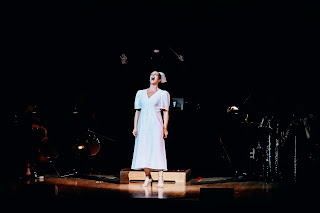
The MasterVoices' concert of Anyone Can Whistle was a lovely and poignant reminder that although we have lost Stephen Sondheim, we will always have his work. And, oh!, that work!


Elizabeth Stanley
Photo: Nina Westervelt

Anyone Can Whistle is, to say the least, a problematic musical, bloated here, thin there, sometimes smart but too often cutesy. But the score includes gems: in particular, "There Won't Be Trumpets," "Anyone Can Whistle," and "With So Little to Be Sure Of." And, like all of Sondheim's work, Anyone Can Whistle rewards multiple hearings and viewings. I have known the original cast recording by heart since the late 1970s, yet I was surprised and delighted over and over again by Sondheim's brilliance, humor, and heart.

The cast of the MasterVoices concert was uneven. Elizabeth Stanley was magnetic, brilliant, moving, thrilling, superb, and fabulous. On the other hand, Vanessa Williams was little better than mediocre; frequently, she seemed uncomfortable with the music, and she lacks the presence necessary to give dimension to the Mayoress. She just wasn't interesting. Santino Fontana is always likeable, and he has a lovely voice, but his performance was bland. While Stanley prepared for and gave a full performance, Williams and Fontana seemed less prepared, and they sang songs rather than playing characters.

One of the highlights of the evening was Joanna Gleason's entrance (she narrated the show). Over 2,800 people greeted her as an old friend, roaring and clapping as she beamed with pleasure. And of course she was wonderful as the narrator. 


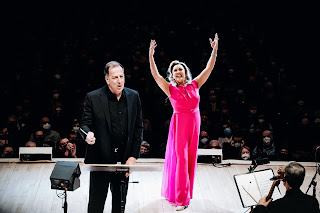
Ted Sperling, Vanessa Williams
Photo: Nina Westervelt

Ted Sperling did a nice job as director and an excellent job as conductor. The orchestra sounded terrific. The MasterVoices chorus was entertaining but underused. Weirdly enough, the sound was erratic. Carnegie Hall is famous for its acoustics, and during intermission my friend told me of sitting in the last row of the highest balcony years ago and hearing every unmiked word. I guess the miking was a problem, because the sound was sometimes murky, and occasionally crackly, with much dialogue completely lost.

Before the concert started, Sperling spoke a few words of introduction. He showed us his vocal score, given to him by Victoria Clark in 1984. It was a mistake to put Victoria Clark in our minds, because it was so easy to imagine how amazing she would have been as the Mayoress. 

But the evening's two stars made it a concert well worth seeing: Stephen Sondheim and Elizabeth Stanley. They made astonishingly beautiful music together.

Wendy Caster

Monday, March 07, 2022

JANE ANGER or The Lamentable Comedie of JANE ANGER, that Cunning Woman, and also of Willy Shakefpeare and his Peasant Companion, Francis, Yes and Also of Anne Hathaway (also a Woman) Who Tried Very Hard.

As I watched the annoyingly written, directed, acted, and titled JANE ANGER,or The Lamentable Comedie JANE ANGER, that Cunning Woman, and also of Willy Shakefpeare and his Peasant Companion, Francis, Yes and Also of Anne Hathaway (also a Woman) Who Tried Very Hard, I pondered why so many of the people around me were laughing so hard and so long.

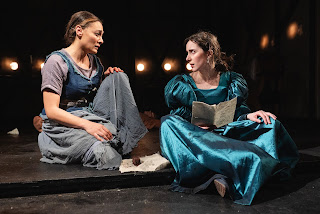
Amelia Workman, Talene Monahon
Photo: Valerie Terranova
  

I came up with a few theories:

  • They had never seen first-rate camp, so were easily pleased.
  • They had never seen a farce before, so were easily pleased.
However, the conversations I overheard before the show suggested an experienced audience, so I considered other theories:

  • The audience simply enjoyed the cheap, predictable anachronistic humor.
  • They were just in the mood to laugh.
    • My friend, who didn't find the show as annoying as I did, but also didn't like it, had another theory, perhaps the best one:

      • They were friends of the cast, writer, director, and/or crew.
      In all fairness, I can be a bit on the crabby side when it comes to humor, though shows that have reduced me to hysterics include Noises Off, A Little Night Music, The Real Inspector Hound, Musical of Musicals, many generations of Forbidden Broadway, and most recently, Red Bull's fabulous production of The Alchemist. Perhaps the show just was not my cup of tea. And, like I said, many people had a great time.

      The plot, such as it is, focuses on William Shakespeare (Michael Urie, working hard) during the great plague. He is stuck inside a small apartment with a creepy member of his theatre troupe whom he happily mistreats and insults, much to the amusement of the audience. A "cunning woman" by the name of Jane Anger (Amelia Workman, also working hard) appears, having climbed up a drain pipe to avoid the barricaded door to the building. Jane is a woman with many pasts who is trying to get her writing published. Shakespeare cannot comprehend a woman writing, but Jane tries to get him to support her work, as the name "Shakespeare" would of course open many doors. Then Anne Hathaway appears, also via the drainpipe. She is angry at Shakespeare due to his long neglect of her and the family; he didn't even go home when their son Hamnet died.

      Author Talene Monahon has some interesting things to say about originality, feminism, and creativity, and under the noise she seems to be aiming for meaning. I wish that she had been more choosy with her jokes, replacing the many subpar specimens with more substance. (Monahon provided the best performance of the evening, with her silly yet human Anne Hathaway.)

      I sometimes envy reviewers and critics who consider their own opinions to be the correct opinions. It might be fun to have that level of confidence, but it would be pointless (and pompous). Everyone's feelings about the arts, and particularly about theatre, are affected by our personalities, our frames of reference, our moods, the people sitting next to us, and our dinners. What we love Saturday we might hate Monday, and vice versa.

      So I'll end on this. I believe very strongly that JANE ANGER or The Lamentable Comedie of JANE ANGER, that Cunning Woman, and also of Willy Shakefpeare and his Peasant Companion, Francis, Yes and Also of Anne Hathaway (also a Woman) Who Tried Very Hard was bad. But I might be wrong.

      Wendy Caster

      Wednesday, February 23, 2022

      The Daughter-in-Law

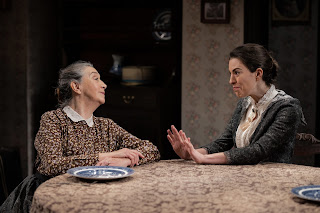
      The Mint Theater Company's production of D.H. Lawrence's drama, The Daughter-in-Law, so successfully evokes life in the East Midlands of England in 1912 that I was shocked when I glanced at the audience and saw people in contemporary clothing--and masks! This visit to another time and place is the cumulation of all the things that the fabulous creators at the Mint do so well: pick a compelling play, direct it with art and clarity, perform it beautifully--and provide scenery, costumes, lighting, and sound that perfectly set the scene, while also being a great pleasure to hear and see.

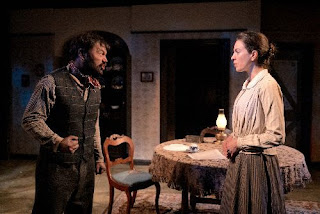
      Tom Coiner, Amy Blackman
      Photo: Maria Baranova

      The mining families in Lawrence's play balance two serious concerns: (1)  the wear and tear of mining, with a strike looming, and (2) trying to understand, impress, escape, and love each other, while tangled in passivity, ambition, fear, and desire.

      Mrs. Gascoyne's situation is ostensibly clear: she wants what's best for her grown sons. But what does that mean? And according to who? One son, Luther, a gruffly masculine man who has neither the intelligence nor the need to make much of himself, is married to Minnie, a woman he barely knows. Minnie has a small inheritance that becomes almost another character in the play, with its vibrations of power and class difference. Mrs. Gascoyne unsurprisingly has no use for Minnie. 

      Over the course of the play, the characters surprise themselves and each other, and sometimes us as well. The plot also takes an unexpected turn or two. It's difficult to say how much Lawrence was trying to honestly represent the reality of the people of his time and how much he was working out his mother issues, and that adds texture to the story. The end is not exactly justified by all that precedes it, and that too is intriguing. Was Lawrence trying to make a point or was it a failure of his writing?

      Sandra Shipley, Amy Blackman
      Photo: Maria Baranova

      The main thing to be said about The Daughter-in-Law is that it is a completely satisfying theatrical experience, often moving, often funny, and vivid in depicting class issues. Even the set changes are are compelling.

      The Mint single-handedly keeps a whole subsection of theatre alive, rediscovering unappreciated plays and presenting them with astonishing consistency. In doing this, they also help keep alive the people of the past, as described in their present. It's so easy to think that people were different from us, partially because history and the arts have misled us, and partially because their clothing, surroundings, and values can seem so foreign. But the Mint reminds us again and again that being human has always been a messy and challenging adventure. (Yes, and that sex has always been complicated.)

      CAST

      • Amy Blackman
      • Ciaran Bowling
      • Tom Coiner
      • Polly McKie
      • Sandra Shipley
      CREATIVES

      • Director: Martin Platt
      • Sets: Bill Clarke
      • Costumes: Holly Poe Durbin
      • Lights: Jeff Nellis
      • Sound: Lindsay Jones
      • Props: Joshua Yocom
      • Dialects: Amy Stoller
      • Illustration: Stefano Imbert
      Wendy Caster