Cookies

Wednesday, January 25, 2012

3 Shows With a Black Thread

I didn’t go looking for shows about people of color, didn’t have an agenda in grouping these three together. I simply happened to see them about the same time and, since all had been running a while, decided to review them at once.

Stick Fly

The message in Stick Fly is pretty simple—rich people can be assholes regardless of race; and just because George and Weezie moved on up doesn’t mean they brought anybody else along for the ride— the have nots have been caste aside, left behind, and without a place at the table. The only way into the dining room is through the bedroom. It suggests race has evolved to a white versus black conversation, but economic disparity gets stuck in your throat.

It is a more intriguing idea than it is a play, mostly because nothing very surprising happens. Dialogue is a lot less riveting when you are able to see it coming, pick a side, and write a rebuttal in your head. The best to be said about Lydia R. Diamond’s play is that it exists. She’s done little more than take the Huxtables on vacation and make them hateful. The plot is more edgy but not much more insightful than a sitcom episode. Kenny Leon doesn’t add much as far as mining between the lines for drama.

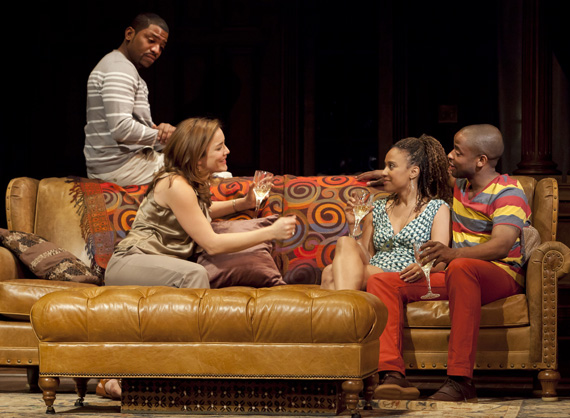
The star of the show is David Gallo, the set designer. He has created a world that tells you both who and where these people are. Actually, he tells you more about the fictional inhabitants than those cast to inhabit the fiction.

Ruben Santiago-Hudson as the family patriarch who married into money, carried the burden of head-of-household while feeling a guest who could be disinvited at any moment, plays the role as little more than a philandering asshole. Mikhi Phifer, trying to fill his father’s boxer shorts, is a philandering asshole. Dule Hill, breaking the mold, is a philosophizing asshole. The female cast really mixes it up. Tracie Thoms, poor by divorce and discarded by a rich and noteable father, is shriekingly annoying. Rosie Benton, engaging in helping the poor as emotional porn and cleansing conscience through do-gooding, is annoying at inside-voice decibles. Condola Rashad (the daughter of real-life Mrs. Huxtable), is broodingly annoying for three quarters of the play, then unloads for the pivotal twist that comes a couple of hours too late in the evening. She has the chops, delivers the goods, and it might have made for a stronger play had the maid played a bigger role.

Kudos to Alicia Keys for producing. Putting more African American actors to work and putting more African American characters at the center of that work makes theatre better—moving on up to the front of the stage is only a good thing for all of us, on both sides of the proscenium. I just wish there was a stronger play waiting once we all got there.

The Road to Mecca

Photo by Walter McBride

Athol Fugard gives us an opposite view of the character of color in the apartheid-era play, The Road to Mecca—none make the stage and barely make mention. The story is actually only set in the time of apartheid, it isn’t really about that. It isn’t really about much at all. There may be something in there, but it is too convoluted to care.

There isn’t much story, and there is even less drama. It was a thrill to see Rosemary Harris on stage; but neither the role nor the performance is worthy of her legend. Carla Gugino delivers some spark but not much fire. Jim Dale arrives late and leaves early and neither much matter—not his fault. The play sets him up to be the desperately-needed crux of the story, but this lame drama needs a crutch before it is ready for a crux.

The worst I can say about this play is that it exists. It is just boring. Who cares? There’s ten minutes of drama draped in an evening of blather. I am no better for having met these people. No closer to Mecca having traveled their Road. If you need to have your life shortened by a couple of hours, this is the euthanasia for you.

Alvin Ailey American Dance Theater

Yes, the show has closed for this winter, but it will be back at the end of the year; and it is never too early to make it a priority. I make it a point to see Alvin Ailey at City Center every year. A year without Revelations is no revelation. This year, I caught it twice.

The first time was less than perfect. The seats were far right, and while I like to move around from year to year for perspective, something gets lost at the extremes. My favorite way to see the show is in the first couple of rows. The tickets are $25, the view is thrilling, the intimacy is eye-opening because you can see the incredible work, talent, and control on an individual basis. You trade shape and scale for individual perfection. That perfection is especially clear when watching the solo number, I Wanna Be Ready, which was performed in rotation this year by two guest artists, Clifton Brown and Matthew Rushing, both long-standing, stand-out members of the company. They couldn’t be more different (two master classes, Brown’s in precision and Rushing’s in personality). If these two dancers are not on your list of not-to-be-missed performers, add them, remember them, and see them.

You can never go wrong with an all-Ailey evening. Someone else bought my ticket on the first visit, so it wasn’t all-Ailey and what could go wrong did. The first number, some assault choreographed by Geoffrey Holder, was barely bearable. It was followed by something forgettable, choreographed by Judith Jamison. Even Revelations was diminished by some ill-advised, “special” event that included members of Ailey II and some children from Ailey Elementary or some such. It was too many people adding little. I’m not a big fan of other people’s children to begin with and certainly wouldn’t knowingly attend their annual recital.

I couldn’t let that be my experience for the year, so I returned, this time sitting in the balcony. It couldn’t have been a more different experience. The evening started with Anointed, choreographed by Christopher L. Huggins. What a thrilling beginning. The final movement of the dance is as emotional and moving as anything I have ever seen. The second, a hip-hop number, Home, choreographed by Rennie Harris and inspired by photos and essays submitted for the Fight HIV Your Way campaign was excellent, although I wish I hadn’t known in advance about the supposed subject matter. I expected more of a connection. It turned out to be a lovely hip-hop number. I just missed the inspiration. Finally, Revelations renewed my faith. Fix Me Jesus was absolute perfection.

Revelations is a quintessentially African American story, but it’s emotions and arc and connection are universal and for me, simply essential.

Sunday, January 22, 2012

Menders


Raushanah Simmons,
Ingrid Nordstrom
  Photo: Justin Hoche
Something there is that doesn't love a wall. So begins Robert Frost's well-loved poem "Mending Wall," and so also begins Erin Browne's flawed but compelling new play, Menders, currently being presented by the fabulous Flux Theatre Ensemble. Menders takes place in a future world where a giant wall separates safety and "us" from all that is ugly, wrong, and "them." At least that's what Corey and Ames have been brought up to believe.

Corey and Ames are trainee wall menders. Both are just recently out of school. Ames is nervous, but Corey is confident, gung-ho, and absolutely certain that their side of the wall is the right side. Their trainer is the burnt-out and disappointed Drew, who passes the time telling Corey and Ames stories that seem magical to the young trainees. Their world has been so circumscribed that the tale of a winged woman doesn't seem all that much more exotic than a tale of two women falling in love.

But somewhere along the way, Corey is jailed. We--and she--never find out what her crime is, and the play occurs in flashback as she tells the audience--her jury--everything that has happened since she first became a mender.

Playwright Browne cares about the world. She cares about politics and feminism and self-expression and governmental repression. She sees vividly how today's world could turn into tomorrow's dystopia. In an interview with blogger Zach Calhoon, Browne explains that the play grew out of a "melange" of ideas and that "Robert Frost's idyllic and concrete world of everyday things guided all of those ideas into the first draft of Menders." However, her play goes well past Frost's poem--in fact, the frequent use of Frost's words is distracting and misleading. The people on the two sides of Frost's poem are civil neighbors; they are not "us" and "them." Frost's poem is small and neat; Browne's play is large and messy (messy isn't a criticism here--the wealth of ideas is one of the play's greatest strengths). However, this part of the poem does resonate in the play: "Before I built a wall I'd ask to know/What I was walling in or walling out." Corey doesn't mean to ask that question, but she becomes unable not to.

Browne's play doesn't totally work at a plot and detail level. Corey is perhaps a bit too gung-ho. The stories that Drew tells don't offer enough to justify the time they are given. The characters' growth and changing relationships sometimes seem mistimed. What's actually on each side of the wall is not as clear as it might be. But the play's energy, ideas, and big heart more than make up for its weaknesses. 

Heather Cohn's direction is imaginative and clear and well-paced. Asa Wember's sound design is quietly unsettling, providing just the right emotional effect. Some of Trevor James Martin's video projections work better than others. In some cases, they come across as visual noise; in others, they are just right; and in a few, they are (appropriately) chilling.

As always with Flux productions, the cast is excellent. Sol Marina Crespo handles Corey's development and the play's fractured chronology very well. Matt Archambault as Drew provides exactly the right mix of smooth charm, exhaustion, and manipulativeness. Isaiah Tanenbaum does a lovely job depicting Ames' awakening. And Raushanah Simmons and Ingrid Nordstrom are wonderful as wooer and wooee, though Simmons may be a little too beautiful for the part--it's hard to understand why anyone would say no to her.

Overall, Menders is well worth seeing. 

(press ticket; third row on the aisle)

Saturday, January 21, 2012

The Mountaintop


Katori Hall's The Mountaintop, which was a surprise hit in London and which has been running on Broadway since the autumn, hasn't really fallen off my radar since it began previews. The subject interests me, sure, but so too do the performers, both of whom I admire and have not seen perform live before. So when the opportunity to see the show, which is closing tomorrow, arose late last week, I took it. I didn't much like the play, but I'm still glad I saw it.

Jackson and Bassett didn't disappoint--they are both fine actors, and, alone together on the stage for 90 minutes, they work hard, command attention, and look exceptionally fabulous in the process. While I am not entirely sure they meshed as well as they might have, I think that inevitably spoke to flaws in the writing itself, and not so much to their interpretations of the characters. Jackson plays Martin Luther King, Jr., who has just returned to the Lorraine Motel after his "Mountaintop" speech--the last one he gives before being assassinated, and the one which seems to foreshadow his own death. He is tired, has a hacking cough and a lot of work to do, it's pouring rain outside, and Coretta forgot to pack his toothbrush. While awaiting the return of his colleague, the Reverend Ralph Abernathy, with a pack of much-craved Pall Malls, he takes an offstage leak, paces, checks his room for bugs, and nearly jumps out of his skin every time the thunder claps. Soon, he calls down to room service for a pot of coffee, which is delivered by Angela Bassett's character, Camae, a new hotel maid with a foul mouth, irresistible good looks, and way more knowledge about the Civil Rights movement and King's private life than makes much sense. She Is Not Who She Seems, which is a major plot device here, and one that kind of doesn't work at all.

That said, I think some of my negative reaction to the play is what some might argue gives it strength: I am not one who is terribly interested in, comforted by, or intrigued by the teeny trivialities of great figures. We are all flawed, so why should it be such a big deal to learn that our heroes are, too? Thus, the fact that King, at least as depicted by Hall, smoked too much, cheated on his wife, occasionally needed to pee, and had smelly feet doesn't really grab me. On the other hand, I understand the desire to humanize King, as well as to be reassured that he felt no pain at his death and that he has been embraced in Heaven. And whether you care or not about the smelly feet, Jackson's take on King is graceful, understated, and sharp.

Bassett's character is in many ways even more of an uphill battle than Jackson's. We know who King was as a public figure, which I am sure has its own challenges for the actor. But we do not know Camae--she is fictional, and her presence propels the plot forward. I'm still not sure of exactly who she is--the play is clearly more interested in having her play off King than it is in filling its audience in on the finer details of her character. Bassett does well with the part, but then again, if she's filled in the blanks for herself about the character, it's not terribly clear during the play. For all her joking, cursing, flirting, and admonishing, she's sort of a cipher.

I was also disappointed about the show's lack of stance. On anything. Is this play about religion and the divine? Is it about the intricacies of black politics and the Civil Rights movement through the 1960s? Is it about King's legacy? Is it about his private life and his flaws? The show throws a lot of stuff at the audience, who murmers in recognition at all the names, incidents, and references that get flung about. But ultimately the play teaches nothing, and doesn't encourage spectators to ponder anything new.

There were some high points, however. The final sequence, in which the entire set spins up to reveal a swirling black hole of projected images, is pretty damned cool, as is the lightening-fast monologue Camae delivers during it. And a sequence in which Camae dons King's suitjacket and imitates his public persona is hilarious. I imagine The Mountaintop will make the rounds after it closes on Broadway; I would hope Hall revisits it to address at least some of its weaknesses.

Tuesday, January 17, 2012

Once


Steve Kazee and Cristin Milioti
Photo: Joan Marcus
I am very grateful that I saw Once (based on the movie of the same name) at the New York Theatre Workshop rather than on Broadway. (Thank you Mark and Rodney.) I am sure the show will still be lovely in its new home, but it is unlikely to retain all of its small-theatre delicacy, intimacy, and soul. On the other hand, on Broadway, Once can run indefinitely. And that is a very good thing.

The Irish guy (who is never named) is at the end of his rope, deeply depressed and ready to give up his music. The Czech girl (who is a woman, but, hey, called "girl" in the program) also has reason to be depressed, but giving up is seriously against her world view. She convinces him to keep on trying. They fall in love (duh).

But Once is not about plot. It is about belonging and family and faith and miracles and humor. More importantly, it is about music.

To get one of the show's few faults out of the way: The songs (by Glen Hansard and Marketa Irglova) don't match the plot or characters as well as they might (should?). The lyrics are generic and not really theatrical. But the music is often beautiful and always entertaining and it is played with exuberance by the 13-person cast of actor-musicians and musician-actors.

Steve Kazee plays the guy. He is attractive and charming and sings well. Cristin Milioti is the girl. She takes a potentially annoying, potentially cartoon character and turns her into flesh and blood--and her singing voice is heart-touchingly emotional. The rest of the cast members are more or less wonderful (one or two are much more musicians than actors): David Abeles, Claire Candela, Will Connolly, Elizabeth A. Davis, David Patrick Kelly, Anne L. Nathan, Lucas Papaelias, Andy Taylor, Erikka Walsh, Paul Whitty, and J. Michael Zygo.

The direction by John Tiffany (Black Watch) and movement by Steven Hoggett give the show a physical flow that both reveals the characters' emotions and adds beauty to even the scene changes. The movement reminded me of Bill T. Jones' work on Spring Awakening in that it uses somewhat bizarre gestures to evocatively express people's inner workings and longings.

The thing I loved the most about Once--a facet I fear won't make the trip to Broadway intact--is the sense of being there. Parts feel like the best party you've ever gone to. Other parts invite you right into the characters' hearts.

But don't let me dissuade you from seeing Once on Broadway--it is a wonderful show.

(full-price ticket; first row center)


Monday, January 16, 2012

Follies (CD Review)


There are two components to a review of the recording of a musical: the discussion of the musical itself and the discussion of its presentation on the CD. Since four of us on this blog have reviewed the current production of Follies a total of six times (see links below), this post will focus on the CD itself.

And an excellent CD it is.

Its main claim to fame is that it is two discs, totaling almost 100 minutes (my estimate), with previously unrecorded chunks of dialogue. Producer Tommy Krasker explains in the CD booklet that the aim was "to do an expansive recording that not only conveyed the glories of the score, but captured the experience of the show itself." To the extent that a purely audio version could do so, this CD achieves Krasker's goal. While I suspect the CD will be more evocative for people who are already familiar with Follies, even a newcomer will get some of the flavor of the book. (I don't think that this CD expresses the full flavor of the Follies score, but my complaint is with the production rather than with the recording per se.)

Recreating dialogue for a recording is a particular skill, I think, and not everyone has it. Jan Maxwell, for example, sounds very good: clear and in character and completely believable. Ron Raines sounds stiff and unconvincing. Bernadette Peter's performance is calmer than the weepy one she often gives on stage, but her delivery of some of the lines remains downright embarrassing. Danny Burstein comes across fine. Elaine Paige is so hampered by trying to have an American accent that her dialogue comes out murky and marble-mouthed, and her timing is mediocre. (Polly Bergen's performance in the Roundabout Production was so much richer and funnier and sadder and realer that Paige seems like a cardboard cutout in comparison.)

The CD booklet is beautiful, with the complete lyrics and many pictures. It also includes an interesting essay on the show by Patrick Pacheco, Krasker's "Note From the Album Producer," and a synopsis by Sean Patrick Flahaven, which is somewhat overwritten ("To eyes unfocused by nostalgia and alcohol, it might appear that no time at all has passed . . .") but useful.

If you are a Sondheim completist, you must have this CD. And if you loved this production and its performances, you will find this CD to be a treasure.

Friday, January 13, 2012

Parsons Dance


Ian Spring, and Melissa Ullom in
David Parson's Round My World
Photo: Krista Bonura

Let's cut to the chase: David Parsons' piece Caught is stunning, impressive, and magical. I see it at least once a year, and it never fails to delight me. A thrilling athletic solo, it is far more successful than any CGI in convincing you that a man can fly. It's part of every performance at Parsons Dance; if you haven't seen it, give yourself a treat and go. (Parsons Dance is at the Joyce through January 22.)

And the rest of the evening isn't shabby either.

Parsons Dance is currently premiering Parsons' Round My World, an entertaining, often beautiful piece set to music by Zoe Keating. As you can see from the picture above, Parsons means "round" literally, and the shape is threaded liberally throughout, in formations, poses, and gestures. The first movement pulsates; the second features insane lifts that are sometimes more interesting as mechanical contraptions than dance; the third utilizes arms and pelvises to create a sort of Rube Goldberg cascade of movement; and the forth consists of flowing waves of changing shapes. While Round My World is a pleasure to watch, the whole is not greater than the sum of its parts. It comes across as a very thorough exercise--do everything you can with roundness--rather than a fully realized dance.

This is a complaint I have with Parsons' work not infrequently--and with that of Paul Taylor, for whom Parsons danced for years, and who was definitely a major influence. Both men have endless amounts of creativity. There isn't a part of the body they haven't mined for all its gestural potential. They are never boring. Many of their pieces are visually and emotionally whole, and wonderful--but many others just don't add up.

This problem reappears with Swing Shift, Parsons' 2002 piece to music by Kenji Bunch. Again, Parsons' imagination and skill can't be faulted, and there is much that is lovely, but the choreography is almost semaphoric in its use of the dancers' bodies, with little flow between defined almost-tableaus.

The evening also features Katarzyna Skarpetowska's piece A Stray's Lullaby, to music arranged and performed by Kenji Bunch in a Tom Waits' growl. Skarpetowska's choreography ably presents the challenges and aspirations of a quartet of lost people in a grim city. These characters' tensions and despair resonate in their every muscle, and the choreography offers a unique spastic grace.

Unfortunately, the program update I received did not specify who danced which piece. But since the Parsons Dance dancers are so often amazing, I'm glad to simply list them all: Eric Bourne, Sarah Braverman, Steven Vaughn, Melissa Ullom, Christina Ilisije, Jason MacDonald, Ian Spring, Elena D’Amario, and apprentice Christopher Bloom.

(press ticket; last row orchestra)

Sunday, January 08, 2012

Scott Siegel's Broadway Ballyhoo: A Show Tune Hootenanny!


Nancy Anderson
When it comes to Scott Siegel's Broadway Ballyhoo: A Show Tune Hootenanny, currently playing late Thursday nights at Feinstein's, there's good news and there's bad news. 

The good news is that it exists. The seemingly indefatigable Scott Siegel presents a different handful of Broadway and cabaret performers each Thursday, accompanied by the protean, energetic, and wonderful Jesse Kissel on piano. Appearing thus far have been Alice Ripley, Nancy Anderson, Kevin Early, Kyle Scatliffe, Steve Ross, and many others. Feinstein's is a nice room, the cover and minimum aren't too bad (for more info, click here), and the performers chat and tell stories as well as sing. It's a nice set-up.

The bad news is that the show is highly overmiked. People who regularly perform live should not need mikes in this small-ish, albeit odd-shapped room. Kevin Early certainly doesn't need a mike. Hell, he could be heard a mile away sans mike; with one, particularly as over-amped as he was last Thursday, his singing was ear-injuringly painful. It should have been a pleasure to listen to him; instead, it was an ordeal. 

The "it-depends-on-you" news is that you get to pick evenings that feature performers you love. I went specifically to see Alice Ripley, who unfortunately took ill late that afternoon. Of the other performers, Kevin Early was good but, again, way too loud. Nancy Anderson is a little cutesy for my taste. And Carol J. Buford overacts and over-sings to an impressively awful extent; I didn't believe a word she expressed. (Or, should that be EXPRESSED?) Scott Siegel emceed with his usual rumpled charm. 


Keep an eye out for announcements of each week's performers. It's a great opportunity to see favorites sing two or three songs. And if you find the miking as horrible as I do, please tell Scott. 


(press ticket, audience left)
 

Sandra's Faves of 2011


My New Year's resolution is to see more theater. I just joined Show Showdown last spring, and, as a result, only saw about 16 shows last year. That does not qualify me to do a "Best of" list, but I do have a few favorites I'd like to gush over.

Favorite Revival: The Normal Heart

The Normal Heart--I never saw the original so I can't compare this year's incarnation with the 1985 version. Still, this remarkable show still resonates 25 years later. Audible crying in the audience is heard throughout the conclusion (yes, I shed tears, too) and feels like a communal mourning to all the lives lost to AIDS. Joe Mantello plays Ned Weeks with magnetic earnestness and caps the performances of a truly wonderful cast, including Ellen Barkin, Lee Pace, John Benjamin Hickey, Mark Harelik and Jim Parsons.

Favorite Play: Tape
I'm cheating here because this was also a revival but Stephen Belber’s Tape moved me like no other show in 2011. This Off-Broadway production showed the after effect of high school through sharp observation and gun-fire paced dialogue. Especially good was Don DiPaolo as the lovable loser, Vince.

Favorite Musical: Follies
Oops...another cheat since this is also a revival (Do you see a pattern here? I never saw the wunderkind Book of Mormon so perhaps that's what should be here. But of all the new musicals I viewed (Catch Me If You Can, Wonderland, etc.) not one surpassed Follies in musicality, compelling characters, or plot. Sondheim's show offers songs infused with insight that betray their character's hopes and fears in such a intimate way that even this flawed production levels a hefty emotional impact that lingers far after the initial viewing.


Favorite Actress: Nina Arianda
The prom queen of last year's theater season has to be Nina Arianda, who played Vanda in Venus in Fur, as a remarkable combination of the ultimate ditz turned cunning avenger. Not every actress could don dominatrix wear, sputter out curse-infused blue streaks of dialogue, and still seem realistic as an upper class Victorian socialite.


Favorite Set: Stick Fly Yes, when everyone talks about Stick Fly they mention the uniqueness of the playwright's characters and some of the stunning performances of the cast, but I want to highlight the scenic design for a moment. What a phenomenal set! Lovingly detailed by David Gallo (who also did The Mountaintop), the stage becomes a weekend getaway that reveals several rooms in the house through a clever bookcase cutaway that exposes the kitchen and a slight porch. The intimacy of the set acts almost like another character, revealing family details with photo magnets on the refrigerator, fine works of art on the walls and whimsical stone animals out in the garden.

Friday, January 06, 2012

Marilyn by Request: Marilyn Maye at the Metropolitan Room


If you have never seen Marilyn Maye, really, what are you waiting for? She's an amazing jazz singer, a brilliant interpreter, and funny to boot. She's a delight to spend an evening with. She's a classic. Timeless. The real thing.

In her most recent show, at the Metropolitan Room, Maye combined her  thematic medleys and standards with requests from the audience. The result was a pot pourri of different forms of bliss. Consider this partial set list: Celebrate Good Times, Hey Old Friend, Too Good to Be True, Start of Something Big, I Love You Today, Too Late Now, I Don't Want to Know, Pennies From Heaven, It Might as Well Be Spring, If I Were a Bell, Bye Bye Country Boy, Take Five, and the Best of Time Is Now. Her wonderful, youthful (she's in her 80s!), throaty voice, her sense of emotional complexity and joy, and her seductive personality made each and every song a winner. Her backup band, led by Billy Stritch (who sang with her on a handful of numbers) provided smart, elegant accompaniment with the wonderful Tom Hubbard on bass and Ray Marchica on drums..

I wish there were a way to truly describe the experience of seeing Maye, but what can be stranger than trying to explain how someone sings, how they express emotion, how they make magic happen? It's kind of impossible.

But I can describe the audience's reactions: Hugh grins. Cheers. Bravas. Ecstasy.

Really, truly, you have to see Marilyn Maye.


(For Maye's schedule of upcoming dates, click here. For the Metropolitan Room's calendar, click here.)


(press ticket, audience left)

Thursday, January 05, 2012

How the World Began


Heidi Schreck and Adam LeFevre
Photo: Carol Rosegg

After her life in New York falls apart, Susan Pierce (Heidi Schreck) ends up in Plainview, KS, teaching science to high schoolers whose town was recently decimated by a tornado. Susan has a tendency to say whatever pops into her head, no matter how inappropriate. She makes jokes to her student Micah Staab (Justin Kruger) about a herd of cows that were killed in the tornado. But the Christian Micah is more put off that she said, in class, "The leap from non-life to life is the greatest gap in scientific theories of the Earth's early history, unless, of course, you believe in all that other gobbledy gook." (At least that's what he claims she said. We do not see the scene.) In fact, he is highly offended and wants Susan to apologize. After Susan refuses to do so, Micah's unofficial guardian, Gene Dinkel (Adam Lefevre)--a Christian who believes in evolution and sees natural selection as "God's hand" at work--also tries to get her to apologize.

This is the basic story of How the World Began, Catherine Trieschmann's new play, currently being presented by the excellent Women's Project at Playwright's Horizon. It goes on to examine belief versus nonbelief, relationships, grief and loss, and standing by one's principles. Parts of it are fascinating; the characters are three-dimensional and occasionally surprising in convincing ways.  Rather than being a pseudo-screenplay like many contemporary plays, How the World Began unfolds in the sort of long, thoughtful scenes that theatre does best of all the art forms.

There's so much I liked about this play that I'm sad about my reservations, but here they are:

[possible spoilers below]

The most important one is that the character of Susan is whiny and dishonest. Since she represents my point of view, I wanted very much to like her, but she won't take responsibility for what she said--in fact, she denies having said it--and then won't take responsibility for what it means. She even claims that she didn't mean religion when she said "all that other gobbledy gook," although clearly she did. I didn't want Susan to be perfect or Joan of Arc. I understood that she feared for her job. But her dishonesty cast a pall over her actions and beliefs. (I suppose it's possible that she genuinely forgot what she said, but that seems highly unlikely.)

Another problem I had was with the structure of the play. Micah's true motivation is not revealed til toward the end of the play. However, the delay felt too much like a plot device. There was no character-driven reason for him not to have explained his thinking earlier.

Susan's interactions with Gene--which I actually found more interesting that her interactions with Micah--are never resolved. She says something horrible to him, and we never see him again.


Some of the humor struck me as easy laughs for the knowing, evolution-savvy theatregoer. (Though on a whole I found Trieschmann to be respectful of the two Christian characters--perhaps more respectful than she was of Susan.) And some moments were heavy-handed. For example, right at the beginning Susan is freaked out by the smell of manure (oh, she's not in New York anymore!).  Even the name of the town--Plainview--is a little too on the nose.

And I wish all playwrights would stop having scenes where the characters are waiting for someone we know will never come because we know how many people are in the cast (exception: Beckett). It just comes across as fake.

[no more spoilers]

The show is well-directed (by Daniella Topol) and largely well-acted. I had some trouble with Schreck as Susan, but I came to think that my problem was actually with the character. Adam Lefevre gives great depth and warmth to Gene, and Justin Kruger wears Micah's emotions on his sleeve.

I recommend How the World Began to people interested in the topic. But I can't help but think that there's a better play in there.

(press ticket; 4th row center)

Friday, December 30, 2011

Wendy's Top Ten of 2011


2011 continued my personal trend of seeing many more Off-Off-Broadway shows and considerably fewer Broadway Shows, with Off-Broadway holding steady. In fact, of over 70 shows, only eight were on Broadway. And this year, it's not just the insanely high price of tickets keeping me away--it's also the lackluster offerings. Perhaps my life will be forever diminished because I never saw Bonnie and Clyde or Mountaintop or the latest Anything Goes, but I'm willing to risk that, particularly because Off-Off- and Off-Broadway boast such high-quality offerings.

Here, then, in alphabetical order, is my top ten list, with links to the reviews:

Chris Wight, Lori E. Parquet, and Liz Douglas in Dog Act
(Photo: Isaiah Tanenbaum)
    Daniel Morgan Shelley and David King in
    The Man Who Ate Michael Rockefeller
    (Photo: Lia Chang)

Thursday, December 22, 2011

Stick Fly

Photo: Richard Termine

Stick Fly, which is currently running at the Cort Theater on Broadway after bouncing around the country, has been described as an old-fashioned, domestic melodrama, and in some respects, that description fits the show just fine: The multigenerational members of a highly intellectual, accomplished, affluent family meet at their Cape Cod summer home for a weekend of rest, relaxation, and bonding over food, drink, and board games. Yet questions arise almost immediately, and the audience knows that they'll all be solved by the final curtain: How do the elder brother and the fiancée of the younger brother know one another? Where is the family matriarch, who was expected to show up with her husband, but hasn't? What does the aging maid--who is terminally ill, but so tied to this family that she has sent her teenage daughter to cover for her--want her daughter to talk to the family patriarch about? Why is said patriarch being so evasive, and so snippy? The audience--most of whom, unless they are watching the show from the rock they've been raised under, can see what's coming from miles away--nevertheless thrills to the ways in which such revelations occur. This is, in short, the stuff of classic domestic drama: heavy-handed and over-the-top sometimes, sure, but lots of dishy, dirty fun nonetheless.

Were it just a melodrama, Stick Fly would have been enough for me: the show was engaging, the characters were likeable for their flaws, and the story-line certainly held my attention, even though I, having not been raised under said rock, figured out the trajectory pretty quickly. But there's so much to this play that it defies traditional labels, and thus to simply call it a domestic melodrama is not fair, or accurate, in the end.

So here's the jist of Stick Fly, in a nutshell (ok, fine, larger than a nutshell; perhaps smaller, though, than a breadbox):
For all its accomplishments, brilliance, and wealth, the members of the LeVay family can't brush the chips from their shoulders. No one quite knows who they are in this play, and no one feels totally comfortable in their own skins, their own settings, their own homes. Joe LeVay, the patriarch (Ruben Santiago-Hudson), is a successful neurosurgeon who can't stop driving his two grown sons to succeed (but on his terms--not theirs), and can't shake the feeling that he is less of a man because he married into so much of his money. Harold "Flip" LeVay, the elder son (Mekhi Phifer), is a skirt-chasing plastic surgeon who's just a little too smooth with the many women he beds but can't, for the life of him, commit to. Kent "Spoon" LeVay (Dulé Hill), the far more sensitive little brother, is seriously overeducated, but for all his advanced degrees, can't settle on a career he feels comfortable with, let alone one that will please his exacting dad. The fact that both brothers have invited women to join them for a weekend that features a mysteriously absent matriarch and the gloomy presence of Cheryl (Condola Rashad), the daughter of the family's long-time maid, only complicates an already fraught family dynamic. You can escape the city for the fresh air of the Cape, sure, but you sure as hell can't escape your family when you go on vacation with them.

The two women, like their men, don't feel like they belong anywhere, and especially not at the LeVay summer home. Spoon's fianc
ée, Taylor (Tracie Thoms), seems, at least on the surface, to be a more comfortable fit for the LeVay family: an extraordinarily intelligent, almost ludicrously well-educated black woman, she is the daughter of a famous (deceased) professor of sociology. Yet her dad, who left her mother when she was young, never fully acknowledged her, and certainly didn't help her financially, which has left her positively trigger-happy with anger, defensiveness, and self-described exhaustion at feelings of alienation, abandonment, and of never "having a space that's all mine." Flip's newest girlfriend, Kimber (Rosie Benton), seems, again at least on the surface, comparatively more comfortable with herself, with material wealth, and with the privileges she's enjoyed and taken for granted through her life. But it doesn't escape her for a moment that, as a white woman who has fallen in love with a black man, she represents an awful lot of cultural baggage, and that she is not necessarily as welcome in the LeVay home as she is stiffly, and usually but not always pleasantly, tolerated.

The fact that the LeVay family is black adds a dimension right away, sure. Seriously, how many plays out there are about affluent, educated, cohesive black families? And then, how many of them are written (by Lydia R. Diamond), directed (by Kenny Leon), and produced (by Alicia Keyes) by black professionals, and how many of those run on the Great White Way to audiences that are, at least the day I saw Stick Fly, easily 65- to 70% black? Broadway, which remains stubbornly segregated at best, and lily white at worst, despite enormous, if maddeningly recent, strides, needs lots and lots more shows like this (and lots and lots more audiences like the one I watched the show with yesterday), but really, that's not Stick Fly's problem--it's ours. Thus: this is really not so much a show about race per se as it is about assumptions about race, and then, not so much assumptions about race as assumptions about class and gender.

The gender angle is not quite as pronounced as the class angle; while this is much a show by and about women, it wears its gender politics gracefully and intelligently. It should be noted that some of the best performances take place in some of the best scenes, which tend to be segregated along gender lines. A scene where the three women in the cast gather in the kitchen late at night for a drunken bitch-session is just wonderful, as is a revelatory scene between Hill and Phifer. Hill has been criticized for being a bit stiff in his role, but this particular scene is so effective and layered that it more than compensates for some of the clunkier, more expository stuff Hill has to work with earlier in the show. The cast, in general, is strong to excellent, but these scenes will stay with me the longest.

And while the class angle is hit the hardest throughout the show, there are quiet moments that speak loudest because they are so well-acted. A scene near the end of the show during which Rashad slowly, deliberately, self-consciously takes a seat at the kitchen table--which she has been manically setting, clearing, and cleaning for most of the show--is particularly profound.

So...race, gender, and class can't really, truly be separated in any realistic way, can they? And what do we mean by these terms? And in talking and talking and talking about them, as these characters do, what is helping, and what is hurting, and what is digging us all merely more deeply into our own, angry, hurt, defensive "post-racial" little corners? Diamond's characters--like many educated, affluent people I know--practically contort themselves to avoid offending one another along race, gender, or class lines. But the way they all, in avoiding certain assumptions, so easily and unconsciously step right into others is where the play gathers steam and force, and its most biting commentary; Diamond's refusal to let any of her characters off the hook, while at the same time refusing to punish them for being, in the end, human beings, makes Stick Fly downright powerful.

Stick Fly defies melodramatic trappings right up to the end: it concludes not by tying up all the loose ends and resolving all the family baggage by the time Sunday rolls around. Because, face it, I'll bet money that that's never going to happen in your family--it certainly won't happen anytime soon in mine. But the ending is hopeful, caused me to shed a couple of genuine, if totally unexpected tears, and left me with real affection for these flawed characters, all of whom deserve to find themselves and to find happiness, and thus to come to terms with whatever skin-tone, class status, and sex designation they've been handed in the process.

Saturday, December 17, 2011

Follies


Is it too much to say that Stephen Sondheim is our Shakespeare? I don't think so. His range of topics is epic; he's endlessly surprising; his work is deep and textured enough for dozens of interpretations; he's raised his art form to previously unimagined levels; directors sometimes go overboard conceptually when doing his shows; and performing his work is extremely challenging and even more rewarding. And comparing Richard Burton's Hamlet to Kevin Kline's to Laurence Olivier's is fascinating, so is comparing Dorothy Collins' Sally to Judith Ivy's to Victoria Clark's to Bernadette Peter's.

Don Correia, Susan Watson, Jayne Houdyshell, Mary Beth Peil.
Photo: Joan Marcus.
Of all of Sondheim's shows, Follies may offer the most opportunities for dissection and comparisons and disagreements. Last week I was in a Pain Quotidien and heard a young woman reciting lines from "In Buddy's Eyes" and then debating their meaning with her companions. (I agreed with her that Sally never did really love Buddy.) There are a lot of popular musicals, but there are few that people debate in this way. And most of them are by Sondheim.

Different productions of Follies add to the debates by using different versions of James Goldman's ever-problematic book. Seeing a variety of productions can be an education in the significance of a single line or two: it matters whether or not Sally has a suicide attempt in her past.

The version of Follies currently on Broadway is, unfortunately, the least impressive one I've seen (others: Papermill, Roundabout, Signature in Virginia, St. Bart's, Encores!).

Here's why:
  • The ballroom dancers Vincent and Vanessa have been cut from the show. When Old Vincent grasps Vanessa's waist as a pale imitation of the glorious lift that Young Vincent is carrying out behind him, when Old Vincent and Vanessa are a sweet old couple while Young Vincent and Vanessa are strapping and gorgeous and graceful and sexy, the whole of Follies is summed up in a glorious, heartbreaking microcosm.
  • The use of the ghosts is heavy-handed and not choreographed for maximum effect. For example, this Follies loses the wonderful coup de theatre during "Mirror, Mirror," when the young versions of the women appear en masse. Instead, they sort of trickle in. 
  • Also, the older women dance a little too well and the young women not spectacularly enough for the contrast to be as hard-hitting as it can be. (Also, why was there no young Stella on the other night? Perhaps the usual actress was out sick, but no understudy? Please.)
  • "Mirror, Mirror" lacks the poignancy it should have. Part of this is because Terri White is a disappointment. She loses her laughs with awkward timing, and she’s too smug in her singing.
  • The young versions of the characters are a too aware of the old versions. They are memories, ethereal. They shouldn't pull focus, except at very specific times.
  • In "Too Many Mornings," the switch from Old-Ben-Old-Sally to Old-Ben-Young-Sally is clunky. In one of the versions I saw (I believe it was Papermill), as Ben sings he seems to be reaching out to Sally but he is actually reaching out to Young Sally in back of her. It was a striking moment, as Ben's lies and self-delusions were made palpable.
  • Jan Maxwell voluntarily limits Phyllis's range. Yes, Phyllis is enraged, but she is also yearning, wistful, confused, and even the tiniest bit hopeful.
  • Ron Raines involuntarily limits Ben's range--he just doesn't have the chops to catch the full depth of Ben's anguish and regrets. 
  • Bernadette Peters is in over her head. I know people love her. I love her. I have articles I saved about her from 1969. But there is more to Sally than crying. And crying. And crying. And whipping her head around occasionally. And crying.
  • The transition into the Follies segment is unexciting.
  • Since the interpretations of three of the four leads are shallow, and since the use of the ghosts is a little clunky, Follies loses its inexorable build.
Are there good things in this Follies? Yes.
  • It's Follies. The music is gorgeous. The overture/entrance music is pure heaven. (If someone put a gun to my head and said that I had to pick my one favorite Sondheim melody--an impossibility, really--it might be "All Things Bright and Beautiful.")
  • During that opening music, two chorus-girl ghosts come out together, dancing to a tune only they can hear. The contrast between their period kicks and twirls and the show’s present-day look touches the sort of emotion the show is mostly lacking.
  • Natasca Katz’s lighting and Gregg Barnes’ costumes combine perfectly to delineate the scenes from the past with a washed-out, ghostly look.
  • Mary Beth Peil is a wonderful Solange, sexy, funny, self-aware. And you can understand every word of "Ah, Paree." (When Solange mentioned that she is 69, I thought, “It must be weird for Peil to have to say that she’s 69 when she’s so much younger.” My bad. Peil is 71—and rocking!)
  • Jayne Houdyshell makes “Broadway Baby” her own. The entire world has sung it before her, yet she makes it her own! It’s a simple, heartfelt interpretation. She’s lonely with just that bed and that chair. But she’ll survive it. She’s a Broadway Baby!
  • Danny Burstein is a convincing Buddy. Of the four leads, Buddy is the most “regular guy” and he would just like a “regular guy’s” life. Burstein gets that poignancy, and he does well by “Buddy’s Blues.”
  • Jonathan Tunick’s orchestrations are exquisite, as always, though the orchestra should have been even larger, as always.
General thoughts on the book:
  • The book has a leaning toward cheap jokes, such as Sally naming her kids Tom and Tim.
  • It drives me crazy that Sally is the character who forgets the name of the place where they went dancing 30 years earlier—she’s the one who would remember!
  • The exposition is amazingly clunky. “It’s 1971 and though the years have changed me, yes, I am Dmitri Weisman.” (Paraphrased.) That’s just one example.
  • I find it odd that Carlotta talks about how strangers tell her their life stories “not just the bad stuff” and soon after Buddy talks about how he remembers the whole past, “not just the bad stuff.” (Again, paraphrases.) Since Goldman uses this concept twice, I’ve got to think he believes that most people focus on the “bad stuff.” Interesting.
I am glad that Follies is on Broadway. I am glad that people are going to it and enjoying it. But, damn, I wish it were a better production.

(Row L, audience right, tdf ticket.)

Barbara Cook at Feinstein's


Reviewing Barbara Cook is as easy as one, two, three.
1. Barbara Cook is an incomparable interpreter of the American Songbook.
2. Barbara Cook lives her songs as freshly and honestly the hundreth time she sings them as the first.
3. Barbara Cook is a charming raconteur.

Okay, I guess maybe one, two, three isn't enough. Maybe ten?
4. Barbara Cook is a master at wielding a mike so that it doesn't block her face and the sound is always just right.
5. Barbara Cook is also a master at working a room, embracing people in the furthest nooks and crannies.
6. Barbara Cook is a generous, giving brilliant master classes and nurturing the next generation--and the next and the next.
7. Barbara Cook is open to all sorts of music, from discovering a song on Cathouse: The Series to admiring Lady Gaga's intelligence and voice.
8. Barbara Cook is a master class in aging gracefully.
9. Barbara Cook is funny.
10. Barbara Cook is cool.

Mind you, I know that Cook is not everyone's cup of tea. In fact, I'm not a huge fan of her CDs. But there's something amazing about seeing her in person in a small room: you realize that you are in the presence of greatness--human, confident, self-deprecating greatness.

Cook is currently appearing at Feinstein's with Michael Feinstein (she'll be back solo in April). The night I saw her, Feinstein wasn't there. The first half of the show was similar to the last show she did at Feinstein’s, but with new patter (including a lovely tale of winning the Kennedy Center Honors) and one or two new songs. Highlights included a sensitive "I Got Lost in His Arms," a yearning "I've Grown Accustomed to His Face," and a light and lovely "This Can't Be Love."

And then she announced that she had a surprise for us, and a wonderful surprise indeed: Euan Morton was there to sing a few songs--some solo, some with her. She extolled his rare and amazing natural voice, and Morton is indeed impressively talented. His version of "What'll I Do" (one of my all-time favorite songs) was one of the best I've ever heard. He also sang "Danny Boy" and Leonard Cohen's "Hallelujah" (wonderful!). His mike handling was some of the best I've seen among under-50 singers; I wonder if Cook gave him some pointers.

Then Cook sang some more solos. The highlight was Molinary and Butler's "Here's to Life," which could be Cook's theme song. She lives that song when she sings it and even when she doesn't.

The show ended with Cook and Morton singing "White Christmas" and then with the whole room joining them. I spend much of December muttering angrily about having Christmas Carols shoved down my throat, but this was pure joy.
If you have never seen Cook, try to do so. She’s really something. 

(Press ticket, very nice seats.)

Friday, December 16, 2011

SNOW WHITE


Gracie White as Snow White, Ashley Handel, and Laura Careless as the Evil Queen

Photo: Steven Schreiber

With two big-budget Snow White films coming out in 2012, the porcelain-faced ingénue seems poised to become the queen of the fairytale princess set. Yet, it seems unfathomable that either of Hollywood’s versions could surpass the sweetness and magic of watching Company XIV’s current revival of their 2009 production of Snow White. The spare set (designed by Zane Pihlstrom) insinuates the familiar setting: a forest (a gilded tree where the branches suspend from wires never fully attaching to the trunk) and a castle (marked by twin crystal chandeliers). But this telling of the story offers no singing dwarves. Instead, Snow White (Gracie White) lives in a world where she’s part circus performer and the Evil Queen (Laura Careless) morphs into a dancer, equally able in ballet, Russian Folk, or ballroom.

Conceived, directed and choreographed by the company founder Austin McCormick, a 2006 Juilliard graduate, with new text by Jeff Takacs (who moonlights as the MC/Narrator and Huntsman), the show combines a collection of genres, including Cirque du Soleil like acts, with dance, video, and a song catalog containing everything from Ella Fitzgerald to Vivaldi to The Rolling Stones. Yet, the myriad of styles never overwhelms; each segment eases into another. Our heroine, Snow White, more naïf here than fool, impresses with her athleticism and the ease that she rests in the circle of her protective tree even as she gullibly accepts the Evil Queen’s disguises despite multiple assignation attempts. As in the Grimm telling of the tale, Snow White’s stepmother anoints the girl as the provocateur of her distress after the magic mirror declares the child rather than herself as “fairest in the land.” The Evil Queen asks a huntsman to kill the beautiful princess and, like the familiar story, he cannot. A terrified Snow White runs through the woods—as snowflakes fall, long white ribbons release from the ceiling and Sam Hilbelink, a performer from Circus Juventas (the show features several members, including Snow White and the Prince) wrestles, twists and spins in its lengths as he embodies the storm. Snow White joins him briefly as she’s caught up in the tempest, finally sliding down the cloth’s widths onto the ground.

Here, the narrative deviates from the one we all know, and Snow White becomes a forest nymph, sitting cross-legged in a suspended circle that serves as an extension of the tree. The Evil Queen discovers the Huntsman’s double-crossing and sets off to do her own dirty work. Three times she tempts Snow White with items that could potentially kill her; each sequence feels like a ride on Disneyland’s “It’s A Small World,” with nationality specific inspired-production numbers, including one where the Evil Queen and her henchmen visit as part of a Parisian Clothier cart, clad like can-can dancers in a Baz Luhrmann film.

The costumes (Olivera Gajic), while visually stimulating with their emphasis on red, black, and white, lean toward the dominatrix side and mix black leather bustiers with high heels—for both the women and the men. In a rare dissolution of the fourth wall, costume racks sit in view of the audience, just behind the seating—and one can occasionally see actors seeking their next outfit. This adds an unexpected intimacy to the production and when Snow White skips guilelessly across the facility to reach her perch at the end of intermission, you don’t miss the signaling of a second act with the rise of a lush velvet curtain at all.

Snow White’s main flaw still resides in the character herself. Rather than learning from her lessons, Snow White repeatedly trusts the strange visitors in her woods, requiring saving from various forest friends (shown through inventive lighting and projection by Gina Scherr and Corey Tatarczuk) and finally the Prince (Joseph McEachern). Still, White manages to infuse wariness in her expression as Slavic Folk Dancers tempt her with their frolicking movements and glowingly red apples (Wait, hasn’t she been here before?) before succumbing to their charms—at least, here, she shows a slow recognition to the dangers that walk in the world. Careless plays the Evil Queen as a deliciously vain, self-indulgent bully who pushes and mocks those that serve her, while still showing vulnerability as the Queen sobs brokenly on the floor when Snow White’s beauty triumphs her own.

While, most of the circus tricks thrill, occasionally, the awkwardness of setting up a balancing act interrupts the beauty of the moment. For instance, when the Prince spies a poisoned Snow White, inert in her tree, he precariously climbs into her circle with more exertion than the dreamlike seamlessness expected. This dissipates as soon as he settles in, kisses her gently and they both ease from the perch—once more returning you to this magical version of Snow White.

The show runs from December 2 to January at the 303 Bond Street Theatre (303 Bond St.) in Carroll Gardens, Brooklyn. (General seating, press tickets)

Monday, December 12, 2011

Boom! (CD Review)


What happens when jazz and musical theatre singers and siblings Ann Hampton Callaway (Swing) and Liz Callaway (Baby) decide to explore the music of the sixties and early seventies? You get their entertaining new live CD Boom! 

If you are a fan of the music of that fascinating decade, the song list will probably delight you, as it delighted me: "(There's) Always Something There to Remind Me," "A Case of You," "Joy to the World," "Blowin' in the Wind,""These Boots Are Made for Walking," and many more.

As people who follow the Callaways' work already know, Liz's soprano and Ann's huskier voice work together beautifully, offering both blend and contrast, and their connection and love for one another adds an extra layer to their wonderful duets. The sisters nail "Got to Get You Into My Life" and "Happy Together," and their version of "The Way We Were" is haunting and evocative. The Stevie Wonder medley is a great finale, and their sweet, loving, simple rendition of "You've Got a Friend" is a perfect encore.

Liz's solos work well. Her mini-medley of "I Know a Place" and "Downtown" is particularly successful; she captures the wistful joy and sweetness of the originals while adding her own lovely sound. On the other hand, I can't decide what I think/feel about Ann's solos. Ann can do balls-to-the-wall like no one's business; her version of "Blues in the Night" from Swing! is nothing short of thrilling. But some songs don't profit from that level of intensity, and I think Ann oversells/oversings "You've Lost That Lovin' Feelin'," "Blowin' in the Wind," and "A Case of You." I've listened to the CD many times, and sometimes these solos strike me as, well, kinda silly. However, other times, damned if they're not flat-out impressive. I'd be fascinated to know how these interpretations strike the songs' writers, Barry Mann, Phil Spector and Cynthia Weil ("You've Lost That Lovin' Feelin'), Bob Dylan ("Blowin' in the Wind"), and Joni Mitchell ("A Case of You").

On a whole, Boom! is a charming trip back in time with excellent hosts.

Thanks as always to PS Classics for separating the patter tracks from the song tracks. Good songs can be enjoyed a million times; even the best patter is ephemeral.

(press copy)

Monday, December 05, 2011

Once

Once in a while, you get to have an experience in the theatre that is thoroughly satisfying. Every now and then, the experience is completely original. Occasionally, a movie is transplanted to the stage and works.

Once, now playing at the New York Theatre Workshop, is that infrequent experience.

It isn’t a revolutionary script. It isn’t much of a story at all. It is not merely a some-enchanted-evening, nor the magical onceness of serendipity that sustains the evening. Once is about wants, the pure human desires and regrets and promises unfulfilled that plague and paralyze each of us. That is why the music haunts instead of whines. The subtext is Shakespearean, the text is fragile.

Steve Karzee, as the Guy, doesn’t act. He inhabits the aching. He broods without petulance. He is so effortlessly believable and vulnerable that he kills softly, strumming our pain and other cliches without cliche. And the words, that could easily have descended into complaint rock, bleed and break as truly as the heartiest among us.

Cristin Milioti, the Girl who breathes life into a stranger and whose honesty arrests then paroles the Guy’s heart, is amazing in a role that could have been 2 hours of nails on a chalkboard. She has the mystique to make you fall in love with your kidnapper—and her lushious voice cradles every break in your spirit.

The large cast, integral though only loosely integrated, are multi-talented, playing multiple instruments and roles and creating vital environment to a piece that is largely environmental. The Director, John Tiffany, is smart enough to showcase them for nearly a half-hour before curtain as they take the stage singing a series of bar songs on the stage that has been converted into a bar—functioning and serving alcoholic beverages before the show and at intermission. They set a perfect tone of fun and exuberance that makes the subtle strip into the full exposure of the opening number all the more gripping.

Fitting that the empty bar, the symbol of drowning in wants on the rocks, frames the open stage where the action can move through time and space unencumbered. This cinematic flow befits a film turned stage production, but more importantly it befits this production. Once hits every note beautifully.

There is talk of Once moving to Broadway, but it is so perfectly realized at NYTW that you should catch it there before the towering bar loses its majesty in a more majestic house. Something this good only comes along once and a while. I already have my ticket to see it again. Once was not enough.

Ch'inglish


The first word that came to my mind after seeing David Henry Hwang's Ch'inglish, currently running at the Longacre, was "solid." I meant it, I thought to myself, in only the most satisfying, positive way: the play, its players, the direction, lighting, scenery, sound design and costumes balanced one another beautifully; the show was entertaining and engaging; I had a good time. In one word, then: "solid."

But then the inner dialogue began, and with it, doubts about my choice of words, and thus my initial reaction. Because really, if you think about it, "solid," at least the way it's often used in mainstream American parlance, is not necessarily the kindest or most effusive descriptor one might have come up with. "Solid?" my inner doubts began to nag at me. "SOLID? Not 'excellent'? Not 'brilliant'? Not 'sublime'? Merely 'solid'--as in 'good,' or 'reliable' but nothing more than that?"

By the time I got home from the theater, I was almost angry at myself for allowing the word "solid" to have even entered my mind.
Admittedly, I don't always obsess over a single word the way I did after leaving the Longacre theater last week, but then again, Ch'inglish is a show that's all about language. And how language contributes not only to understanding--cross-cultural and otherwise--but also how it adds to the absolute mess that is culture, let alone cross-culture, in the first place. If you think about it--and I have, a lot, since seeing the show--language not only influences gender, class, and racial politics, but it also allows us to cultivate both the masks we wear for others and the characters we convince ourselves that we are. Less obvious, perhaps, is the fact that language can actually hinder communication as often as it can aid it.

As a playwright, Hwang is no stranger to themes relating to culture, persona, and the fluidity of identity--he wrestled with them all in M. Butterfly, the show that put him on the map in 1988, and in Face Value, which I saw in previews in 1993, and which, alas, never managed to open. Ch'inglish revisits all of these themes, but places them in a broader, transglobal perspective.

I read some review, somewhere, that likened Ch'inglish to a wacky sitcom, and in some ways, it is--but only on the very surface: A naive American businessman named Daniel Cavanaugh (Gary Wilmes) decides to expand his Ohio-based sign-making company, and thus attempts to make inroads by branching out into the "small" city of Guiyang (4 million), China. He hires an interpreter, Peter Timms (Stephen Pucci), and begins to negotiate with the minister of culture, Cai Guoliang (Larry Lei Zhang). Initially raising fierce opposition to Cavanaugh's very presence is the assistant culture minister, Xi Yan (Jennifer Lim, in hands-down one of the most extraordinary, fascinating performances I've seen in, like, forever), who, soon enough, grows closer to Cavanaugh than anyone else involved in the negotiations. Nothing is quite what it seems; wackiness ensues. Hence the sitcom comparisons.

Yet the show wrestles with so many tangled, confusing, fascinating themes that it's likely to burrow its way into your psyche in ways that a vast majority of wacky sitcoms can't. It's funny, yes, but it also questions language and cultural constructs, and shines new light on the ways in which these things help and hinder communication and understanding--of both ourselves and others.

Alas, Ch'inglish has no big stars or pyrotechnics, and thus is not likely to last as long as it deserves to. When I saw it, the refreshingly multicultural house was not-so-refreshingly half-empty. So see it soon, if you can--it deserves your attention, and demands that you doubt the ways you think about it long after you've exited the theater.

Sunday, December 04, 2011

The Cherry Orchard


Anton Chekhov considered The Cherry Orchard to be a comedy. Its first director, Stanislavski, believed it was a tragedy. Since its first production over a hundred years ago, directors have been striving to find the perfect balance for this great-granddaddy of dramedies. While director Andrei Belgrader writes that he is "firmly in Chekhov's corner," he fails to mine the deeper levels of humor in his worthy but uninspiring production at the Classic Stage Company. The obviously comic moments are there--the pratfalls, the insults, the nodding off midsentence. But the deeper comedy, the rueful sense of human limitations, is lost, arguably because the production tries too hard.

Take the scene in which Varya (the wonderful Juliet Rylance) believes--as does the audience--that Lopakhin (John Turturro) is about to propose to her. This scene is a master class in subtext. Romance and marriage are never referred to; instead, the characters discuss their plans for the immediate future and, yes, the weather. Without context, their dialogue has no weight at all; with context, it is heartbreaking, and, potentially, heartbreakingly funny. The last thing it needs is Lopakhin getting down on one knee again and again, drowning the delicate humor with blatant signifying. Belgrader also has the characters directly address the audience, with one actually sitting in the first row and offering the woman next to her a bite of a pickle. While this decision adds a little immediacy and a couple of (cheap) laughs, it ruins the sense of time and place.

Overall, however, this production does well by The Cherry Orchard. The themes of class differences, societal changes, passivity in the face of disaster, luck versus hard work, and the price of loving the wrong person are all well-delineated, and parts are quite moving.

Josh Hamilton strikes the perfect tone as the perennial student; Daniel Davis is sweet and touching as the befuddled brother; Alvin Epstein is perfect as the ancient servant; and Roberta Maxwell nails the strange role of the assistant-slash-magician. I did not buy Dianne Wiest as a Russian at the turn of the 20th century; her voice, look, and carriage all signify late 20th, early 21st century. In addition, her relatively small eyes don't read well without the benefit of closeups (I am a huge fan of hers in film). Elisabeth Waterston does well as the younger daughter; Katherine Waterston seems to me miscast. (When I saw that two of Sam Waterston's daughters were in the cast, my first thought was that the Gummers must have been busy.)

The scenic design by Santo Loquasto is beautiful. The costumes by Marco Piemontese are quite nice, but I wish that the CSC had the budget to allow the characters more outfits.

All in all, this is a solid production of the Cherry Orchard, with its strengths outweighing its weaknesses.

(Press ticket, first row center)